
Pass or Fail: Survival Test
Kakashi Hatake arrives late, asks three children to describe themselves, and turns two bells into a test of whether the village has taught them to compete too well to cooperate.
The Feeling You Remember
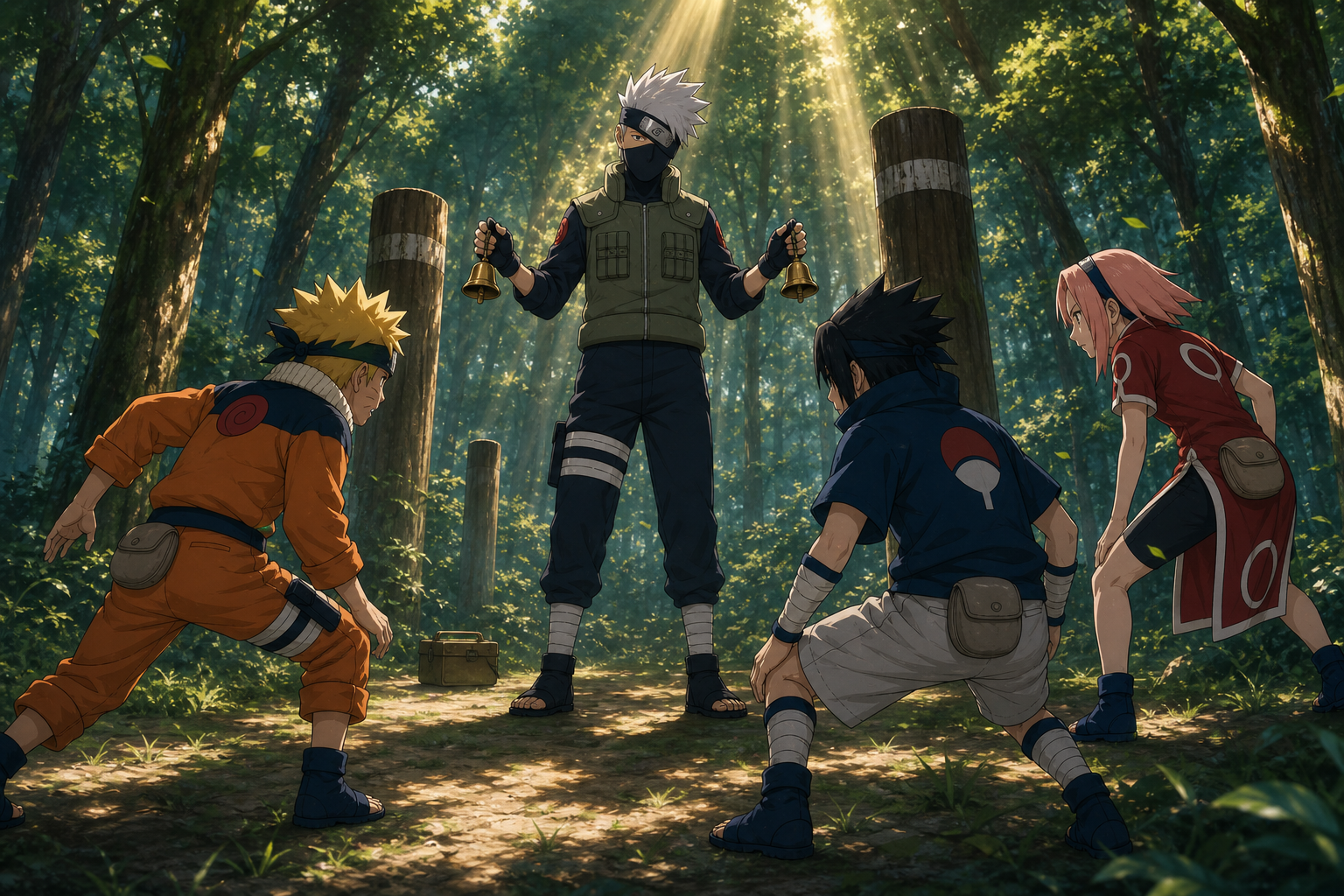
Episode 4 feels like the moment Naruto becomes the series many viewers remember. Academy comedy opens into a forest training ground. Kakashi stands beneath the trees with one eye visible, a little orange book nearby, and two bells hanging from his belt. Team 7 finally has an adult leader whose power is obvious precisely because he does not need to advertise it.
The episode is also deliciously frustrating. Kakashi arrives hours late. He gives almost nothing away during introductions. He announces a test whose rules appear unfair, then treats Naruto’s fury as more information. Every choice makes the children reveal themselves while Kakashi remains hidden behind mask, rank, and performance.
On a childhood watch, the question is who can grab a bell. On rewatch, the better question is why there are only two. The shortage is manufactured. Kakashi creates scarcity and watches whether the students accept its social meaning without examination.
Scene-by-Scene Recap
A teacher who refuses the expected entrance
Team 7 waits in the classroom while every other squad leaves with its instructor. Naruto’s irritation grows. He balances an eraser above the door as a prank. Sakura warns that a jonin would never fall for it. Sasuke silently shares the assumption. Kakashi enters, the eraser lands on his head, and the room freezes.
Whether Kakashi could have avoided it is almost beside the point. His first assessment is wonderfully dry: his impression of the group is that he hates them. The line establishes asymmetry. They have spent hours waiting to know him. He appears to know something about them after one childish trap.
Naruto’s prank is familiar attention-seeking, but it also tests authority. Will this adult rage, laugh, punish, or leave? Kakashi responds with ambiguity. Naruto cannot yet tell whether he has succeeded.
The rooftop interview
Kakashi takes the team to the roof and asks for introductions: likes, dislikes, dreams, hobbies. When asked to begin, he offers answers so vague that they reveal almost nothing. The adult controls the vulnerability level of the room while demanding openness from children.
Naruto declares his love of ramen, his dislike of waiting for noodles, and his dream of surpassing every Hokage so the village will acknowledge him. The speech is familiar bravado, yet Episode 1 has made its loneliness audible. Appetite, impatience, and political ambition all orbit the desire for ordinary belonging.
Sakura performs a different concealment. Her likes are communicated through embarrassed glances toward Sasuke; her dislikes center on Naruto. Her dream becomes a squeal rather than a statement. Kakashi quietly notes that girls her age seem more interested in romance than ninjutsu. The observation is reductive, but Sakura has offered him little else because she has learned to organize self-presentation around Sasuke’s gaze.
Sasuke names few pleasures. He identifies many dislikes and a goal he insists is not merely a dream: restore his clan and kill a certain man. The air changes. Naruto’s dream asks the village to embrace him. Sasuke’s goal is organized around the dead and an absent murderer. Team 7 now knows he carries something larger than school rivalry, though not its full shape.
Kakashi receives the answers without visible comfort. He tells them the first mission begins tomorrow. The interview has mapped the team’s fractures: Naruto needs recognition, Sakura seeks romantic validation, Sasuke seeks revenge, and none mentions cooperation.
The nine-out-of-twenty-seven threat
Kakashi explains that Academy graduation was only permission to attempt a second selection. Of the new graduates, only nine will become genin; the rest will return to school. The survival exercise has an enormous failure rate.
The announcement retroactively destabilizes every celebration. Naruto’s forehead protector felt like final acknowledgment. Now an unfamiliar adult claims it can be taken away. Institutions often create belonging through thresholds, and Kakashi reveals another gate behind the gate.
He tells them not to eat breakfast or they may vomit. Hunger will intensify irritability, urgency, and the meaning of lunch. Kakashi is not only testing technique. He is designing bodies and emotions into the experiment.
Two bells for three children
At the training ground, Kakashi displays two bells. Anyone who takes one before noon passes. The student without a bell is tied to a post, denied lunch, and sent back to the Academy. Three teammates receive two visible tokens of survival.
The arithmetic is the test’s first weapon. The students immediately assume they must defeat one another as well as Kakashi. Scarcity converts classmates into competitors. Kakashi reinforces the conclusion by telling them to come at him with intent to kill.
The bells do not merely measure skill. They ask whether Team 7 will accept a cruel rule as natural because an authority figure presented it with a clock.
Naruto attacks the premise head-on
Before Kakashi formally starts, Naruto lunges. Kakashi stops him instantly while remaining calm, yet acknowledges the seriousness of the intent. The reckless attack is tactically poor and psychologically important. Naruto refuses passivity when another institution threatens exclusion.
When the exercise begins, Sasuke and Sakura disappear into cover. Naruto remains in the open and announces a direct challenge. Kakashi produces his little orange book and appears to read while fighting. The gesture is humiliating. Naruto has made the test the center of his world; Kakashi allocates only partial attention.
Naruto fills the clearing with clones and launches a frontal combination. The attack shows genuine progress. Episode 1’s emergency technique has become an intentional combat tool. Kakashi handles it without strain, using substitution and positioning to redirect Naruto’s confidence.
One Thousand Years of Death
Kakashi appears behind Naruto and performs the infamous finger strike. The technique’s grand name and crude execution puncture the seriousness Naruto is trying to establish. Naruto is launched while Kakashi remains in control.
The gag is juvenile, but it demonstrates tactical attention. Naruto watches the visible threat and forgets his back. Kakashi weaponizes embarrassment because a flustered opponent stops observing. The lesson is not that dignity is irrelevant. Emotional reactivity can be manipulated.
The hidden students begin their own tests
While Naruto recovers, Sasuke studies Kakashi and prepares a controlled attack. Sakura waits in concealment, preoccupied with Sasuke’s safety. The team is physically distributed and psychologically isolated. Each believes the bell test is an individual examination that merely happens beside other people.
The episode ends before the full truth arrives. That structure matters. Viewers are invited to accept the apparent rules alongside the children, then carry suspicion into the next chapter.
Character Reaction
Kakashi
He teaches by manipulating conditions rather than explaining conclusions. His opacity is effective and ethically uneasy. The children cannot consent to a lesson whose stakes they believe are real.
Naruto
He responds to threatened exclusion with spectacle and direct force. His courage is real; his refusal to observe teammates makes it easy to neutralize.
Sasuke
He immediately understands concealment and assessment. Tactical maturity separates him from Naruto, while his solitary goal makes cooperation emotionally suspect.
Sakura
She follows the correct stealth instruction but remains organized around Sasuke. Classroom knowledge has not yet become an independent field identity.
What the Bell Test Is Really Measuring
Manufactured scarcity
There is no natural law requiring two bells. Kakashi creates the shortage, controls the deadline, withholds lunch, and threatens removal. The students’ competitive response reveals how quickly institutional design can make exclusion look like personal failure.
The test mirrors the shinobi world. Villages compete for missions, clans guard techniques, ranks concentrate authority, and children learn to understand limited opportunity as a reason to defeat peers. Kakashi uses that logic in miniature so Team 7 can expose and eventually reject it.
Rules versus purpose
A literal reading says obtain a bell. A functional reading asks what a three-person squad must do to survive missions. The students have been trained to follow stated objectives, yet the mature shinobi must infer purpose beneath incomplete orders.
This tension can be dangerous. Institutions sometimes praise rule-breaking after punishing those who cannot guess which rules are secretly negotiable. Kakashi’s test rewards moral and tactical interpretation, but depends on unequal information. Naruto repeatedly romanticizes mentors who create extreme experiences instead of explaining expectations.
Introductions as combat intelligence
The rooftop conversation is not filler. Kakashi asks each child to disclose motivating structures. Naruto risks everything for recognition. Sakura can be distracted through Sasuke. Sasuke’s revenge makes him focused and solitary. Kakashi knows the battlefield before they reach it.
The children learn almost nothing equivalent about him. He controls information just as he controls the bells. Team 7’s challenge is not merely to touch a faster body. The students must read a person who has made himself unreadable.
The Existential Reading
Are we the goals we announce?
Naruto says Hokage. Sakura implies Sasuke. Sasuke says revenge. The answers are authentic and incomplete. A declared goal organizes life, but can reduce the self to one future condition. What happens to Naruto if recognition does not heal him? Who is Sakura outside desired approval? Who remains when Sasuke’s revenge is completed?
Kakashi asks children to introduce themselves and receives destinations. They cannot describe a present self apart from appetite, aversion, and ambition. The series will spend hundreds of episodes filling in those answers.
Freedom under a false choice
The bells present a choice: compete for two passes or accept failure. Team 7’s future insight will be that the offered alternatives do not exhaust possibility. Existential freedom does not require unlimited options. Freedom begins by questioning who defined the options and what responsibility survives inside them.
Naruto currently rebels without interpretation. Sasuke interprets without solidarity. Sakura complies without self-definition. Teamwork will demand a fourth position: read the structure together and choose an action no isolated member could sustain.
The masked teacher
Kakashi’s covered face is a visual philosophy. He asks to be trusted while withholding identity. His visible eye observes; his covered eye contains history and power. The children encounter authority as partial revelation. They must decide whether trust can be built with someone who controls when he becomes knowable.
The Adult Behind the Test
Kakashi’s method is inseparable from his own history. He has learned that missions can punish rigid rule-following and that abandoning comrades creates wounds no completed objective can justify. Yet he does not disclose that history. He converts pain into a scenario and waits to see whether children independently reach the conclusion that cost him so much.
This makes him both compelling and difficult. He wants to prevent another generation from repeating his loss. He also reproduces fear, uncertainty, hunger, and threatened rejection to teach the lesson. Naruto often depicts traumatized mentors designing pedagogy from the shape of their trauma. Their wisdom is real, and so is the question of what students should have to endure in order to receive it.
Kakashi’s lateness belongs to this ambiguity. Later explanations give emotional context to his unreliable timekeeping. In Episode 4, the students only experience disrespect. Authority possesses reasons that subordinates cannot see, yet invisible reasons do not erase the effect of being kept waiting.
The Hidden Village as an Exam Machine
Episode 4 adds another layer to Konoha’s institutional architecture. The Academy tests technique. Graduation appears to certify readiness. Jonin instructors then run private survival exercises with enormous discretion. A child’s status can change according to criteria that were never stated during years of schooling.
Hidden criteria are excellent drama because they invite revelation. They are dangerous governance because students with fewer supportive adults are least equipped to infer them. Naruto nearly loses his new belonging because he reads the explicit task literally and reacts from the wound of exclusion. The test claims to measure teamwork while initially making communication look disadvantageous.
The episode is not necessarily condemning Konoha outright. The story shows a society that expects young people to adapt to uncertainty because missions will be uncertain. The existential question is whether unpredictability must be taught through deception, or whether a transparent institution could cultivate judgment without manufacturing terror.
Production and Adaptation Notes
The episode expands the manga’s introduction and early bell-test material into a tonal transition. Classroom stillness gives way to rooftop character framing, then open forest space. Increasing physical scale corresponds to increasing psychological stakes.
Kakashi’s performance depends on tempo. His lateness, pauses, book reading, and understated reactions establish dominance without constant animation spectacle. Naruto moves too much; Kakashi appears to move only when necessary. Their rhythm makes the power difference legible.
The bells provide clean sound design. A small metallic jingle becomes a promise of food, rank, humiliation, and survival. The object is visually trivial and emotionally enormous because Kakashi controls its meaning.
The rooftop introductions rely on composition rather than action. Each student sits near the others but speaks into a private future. Kakashi occupies the facing position as listener and judge. When the story reaches the forest, that emotional arrangement becomes spatial: three isolated students around one central evaluator.
Easter Eggs and Payoff Seeds
- Kakashi’s first impression is a test result disguised as a joke. He has already seen that the group lacks cohesion.
- Sasuke’s goal is not called a dream. He treats revenge as obligation rather than desire.
- The breakfast warning prepares the moral decision. Food will become the medium through which teammates choose one another over rules.
- Naruto’s prank and attack share a structure. Both challenge authority directly and reveal him before authority reveals itself.
- The bells create a three-versus-two problem. The solution depends on refusing the arithmetic’s implied social order.
- Kakashi’s book is psychological warfare. Divided attention tells Naruto that effort alone cannot compel an opponent’s respect.
- The three wooden posts preview punishment and belonging. The site is prepared before the students know which body will be tied down.
RaeRae Reaction
This episode still has one of the cleanest mentor entrances in anime. Kakashi does not walk in surrounded by a giant power display. An eraser lands on his head. He says he hates them. By the time the bells appear, the entire emotional environment belongs to him.
What fascinates me now is how institutional the test feels. These children just passed. Instead of letting them inhabit achievement, the system announces another hidden filter with a spectacular failure rate. Kakashi eventually uses the cruelty to teach solidarity, but the fear is real while they are inside it.
Naruto’s open attack used to look simply stupid. The charge is also consistent resistance. Every gate in his life has moved after he reached it. He will not let another adult quietly decide he does not belong. The tragedy is that he has not yet learned resistance can be collective.
And that is where the episode leaves us: not with an answer, but with three incomplete survival strategies. Naruto refuses the rules loudly. Sasuke studies how to win within them. Sakura hides and waits for the person she values to act. Kakashi’s real work is to make those strategies collide until the children discover a team.
Mission scorecard
Emotional impact: 8.5/10
Character depth: 9.2/10
Action: 8.4/10
Worldbuilding: 9/10
Existential aftertaste: 9.4/10
Overall: 9/10
Where to Watch Officially
Availability varies by region. Check VIZ’s official Naruto viewing options or the official Naruto page on Crunchyroll.
Kakashi manufactures scarcity because the village already taught competition
Three students receive two bells, and Kakashi never promises that passing will be fair. The setup turns graduation pride into immediate insecurity. Naruto rushes the instructor alone, Sasuke hunts for an individual victory, and Sakura filters the field through Sasuke. They respond exactly as an academy built on ranking has trained them to respond.
The trick is not that teamwork earns a sentimental bonus. Kakashi wants evidence that they can reject the premise when the premise makes a teammate disposable. A shinobi who follows every instruction without examining its human cost is useful to a bad commander. Team 7 has to become capable of disobedience with judgment.
The introductions expose three incompatible definitions of a future
Naruto declares Hokage because recognition still looks like the cure for loneliness. Sakura defines desire through Sasuke and rejection through Naruto. Sasuke names restoration and killing, giving the room a glimpse of grief so concentrated that ordinary adolescence cannot compete with it. Kakashi hears all three answers and understands that this team is not merely inexperienced. It is emotionally combustible.
His own introduction is evasive because Kakashi knows how much a stated history can cost. He asks children for dreams while withholding the dead teammates and failed promises shaping his test. That imbalance is part of his authority and part of his damage.
Naruto’s trap failure is still information
Naruto announces himself, charges, gets embarrassed, and keeps moving. The performance looks foolish beside Sasuke’s patience, but it also forces Kakashi to reveal speed, substitution, and the size of the gap between student confidence and jōnin reality. Failure becomes useful once somebody learns from it.
Episode 4 does not let enthusiasm substitute for skill. It also refuses the idea that quiet competence automatically equals readiness. Sasuke can reach a bell and still fail the actual test. Sakura can identify danger and still disappear into projection. Naruto can lose every exchange and still carry the instinct that will eventually make the team impossible to abandon.
RaeRae’s final take
“Pass or Fail: Survival Test” is the episode where Team 7’s branding meets the bill. Matching headbands do not make a team. Shared danger does not automatically make a family. Kakashi creates a cruel little system and waits to see whether the children will protect the rule or protect one another. They are not there yet, but now we know what passing will require.