
You Failed! Kakashi’s Final Decision
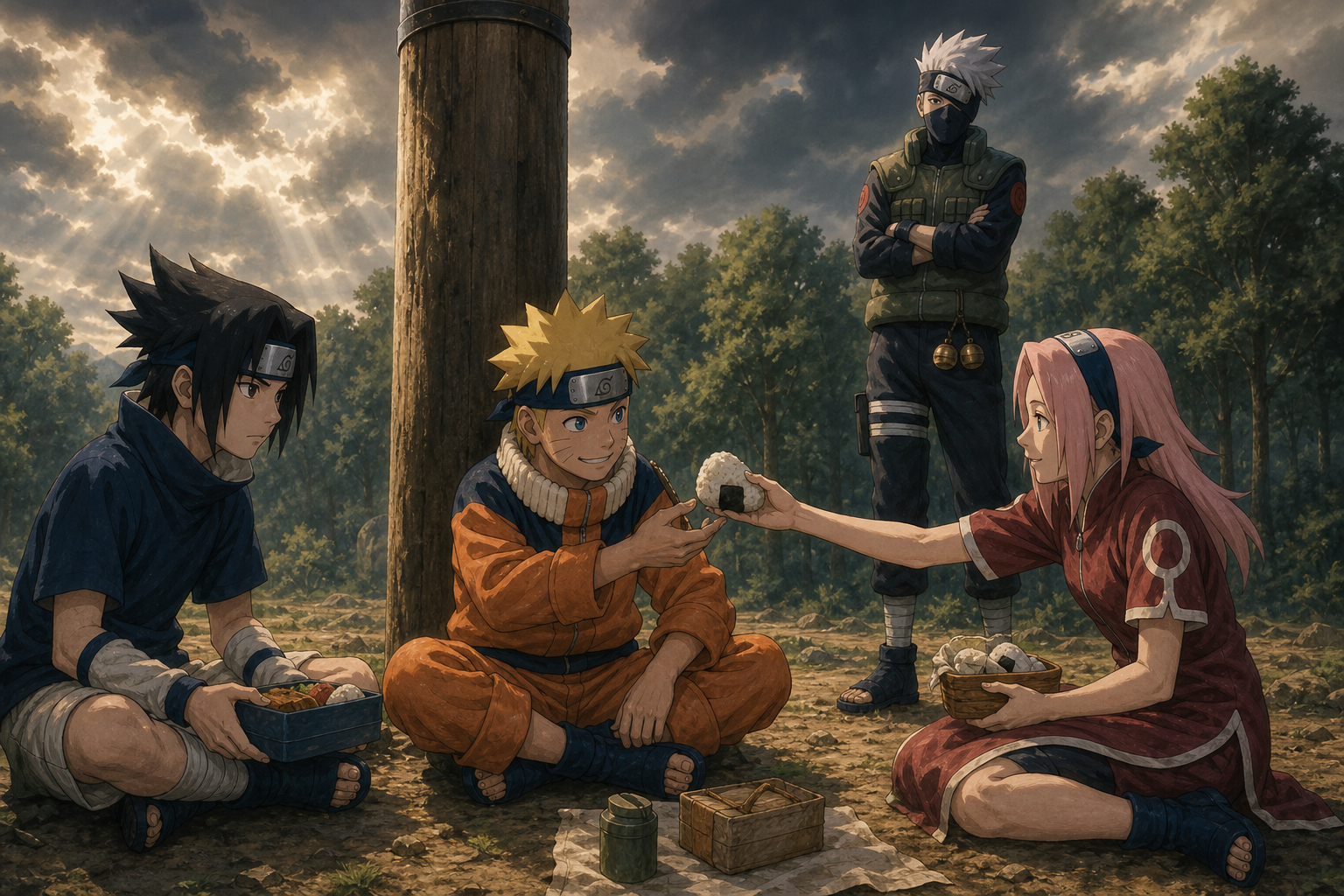
Three exhausted children face one final order: protect their own chance to pass, or feed the teammate Kakashi has tied to a post. Team 7 begins the moment they choose one another over the test.
Episode 5 is where Naruto stops being a story about three talented children placed beside one another and becomes a story about a team.
The Morning After the Bells
The episode opens inside the humiliation Kakashi engineered. Naruto hangs against the wooden post, furious and hungry. Sasuke and Sakura sit nearby with boxed lunches. None of them has a bell. None of them has defeated their teacher. By the stated terms of the exercise, the children have failed.
That failure feels especially cruel because each student spent the previous episode revealing exactly how they cope with insecurity. Naruto attacked loudly and repeatedly, demanding to be acknowledged through motion. Sasuke withdrew into solitary calculation, trusting competence more than companionship. Sakura organized her attention around Sasuke and treated Naruto as an obstacle. Kakashi did not merely beat three genin. He allowed their habits to beat them.
Now he gives them another rule. Sasuke and Sakura may eat. Naruto may not, because he tried to steal lunch earlier. If either teammate feeds him, all three will fail. Kakashi leaves them under the threat of surveillance, promising that he will know if they disobey.
The order sounds like discipline. The command is actually the cleanest moral trap in the test. The children are being asked whether obedience matters more than the human being sitting within arm’s reach.
Sasuke Makes the First Move
Sasuke is the first to extend his lunch toward Naruto. He does not suddenly become affectionate. He frames the decision tactically: if Naruto remains hungry, he will be useless when the exercise resumes. The explanation protects Sasuke from the emotional exposure of saying something simpler. You are on my team. I will not let you starve.
That restraint makes the gesture more meaningful, not less. Sasuke has spent the morning behaving as though strength is solitary. He hunted Kakashi alone, refused to answer Naruto’s attempts at coordination, and trusted his own skill enough to reach a bell. Yet the boy who came closest to individual success is the first person to reject the rule that rewards individual preservation.
This is an early glimpse of Sasuke before rivalry, grief, and ambition harden every choice around him. His instinct for comradeship exists. The instinct is simply buried beneath a survival system built from loss. Sharing food does not erase his distance, but it proves the distance is not emptiness.
Sakura hesitates because Kakashi’s prohibition still has power over her. She fears the instructor, fears failure, and fears making the wrong choice in front of Sasuke. Once Sasuke commits, she joins him and helps feed Naruto. Her decision is less independent, but it is still a decision. She crosses the boundary from watching the team to participating in its care.
Naruto, naturally, ruins any possibility of solemnity by demanding more food and talking with his mouth full. The comedy matters. Teamwork does not arrive as a majestic vow beneath swelling music. The team begins awkwardly, with rice, irritation, and three children who still do not know how to speak honestly to one another.
Kakashi Returns Like Judgment Day
The sky darkens. Wind tears across the training ground. Kakashi appears with the force of an offended deity and asks whether they broke his rule. The staging deliberately turns a small act of lunch sharing into an apocalyptic crime. For a few seconds, the children believe they have destroyed their futures by feeding a hungry teammate.
Kakashi’s anger is performance, but the fear it produces is real. He needs them to stand by the choice after authority returns. Moral action is easy to romanticize when the authority figure is absent. The deeper test is whether they will defend one another when consequences acquire a face.
Sasuke argues that Naruto is part of the squad. Sakura reinforces the claim. Naruto, still tied up and vulnerable, belongs to the “we” they present to their teacher. They do not blame him, retreat, or pretend the food fell into his mouth by accident. For the first time, all three answer Kakashi as a unit.
Then the storm vanishes. Kakashi tells them they pass.
The emotional release works because the victory has almost nothing to do with power. Naruto has a forbidden technique. Sasuke has elite instincts. Sakura has classroom intelligence and unusually fine chakra potential waiting to be developed. None of those qualities earns the answer. They pass because, for one brief decision, each child treats another person as more important than private advancement.
“Those Who Abandon Their Friends”
Kakashi explains that shinobi who violate rules are considered scum, but those who abandon their comrades are worse. Translations vary in wording, yet the moral hierarchy remains unmistakable. Rules matter. Missions matter. Discipline matters. None of them can justify converting a teammate into disposable material.
This line becomes one of Naruto’s defining ethical statements, and Episode 5 earns it by placing the principle in a mundane situation. The test is not whether Sasuke will leap in front of a legendary attack or whether Sakura will risk her life during a war. The smaller question is whether they will share lunch when a teacher says not to.
That scale is important. Most betrayals do not begin with operatic evil. They begin when a system rewards us for looking away from someone else’s need. Kakashi’s lesson trains resistance at the smallest level, before the stakes grow large enough to make courage glamorous.
There is also tension inside the lesson. The shinobi world absolutely does treat people as tools. Children receive military ranks. Villages protect secrets through violence. Missions place strategic outcomes above individual safety. Kakashi is teaching an ethic the institution repeatedly fails to honor.
That contradiction is not a flaw in the episode. The conflict becomes the point from which much of Naruto grows. The village produces rules for survival, then depends on individuals to remember why survival is worth protecting. Team 7 will repeatedly encounter orders that are legal, efficient, and morally insufficient.
Why Kakashi Designed an Unfair Test
Kakashi admits that every previous three-person group failed his exercise because candidates followed the obvious competition. Two bells for three students create artificial scarcity. The setup tells each child that another child’s exclusion is necessary for personal success.
The test is manipulative. Kakashi lies about its objective, withholds essential information, uses hunger, and threatens academic consequences. That discomfort deserves to remain visible. Naruto does not ask us to believe every harsh teacher is secretly wise. Mizuki’s false kindness in Episode 1 already established that adults can weaponize trust. Kakashi must be judged by what his deception teaches and what responsibility he accepts afterward.
His method succeeds because he does not demand blind obedience. He creates a rule that must be broken for the students to demonstrate judgment. The hidden curriculum is discernment. A shinobi cannot outsource conscience to procedure, especially when incomplete information and competing duties define every mission.
Kakashi is also testing for the wound that shaped him. The audience does not yet know the whole history, but his fixation on comrades is personal. This is not a slogan borrowed from a handbook. Kakashi has rebuilt a life marked by loss and regret around this principle. He refuses to command another team that can execute techniques but cannot recognize one another as human.
The Hidden Village as an Existential Problem
A hidden village promises belonging while training its members to conceal themselves. That paradox is already present in the name. To become a shinobi is to enter a social identity built around masks, secrets, codes, and performance. Episode 5 asks how a person can remain ethically real inside such a system.
Naruto’s answer begins with recognition. A person becomes more than a tool when someone refuses to abandon them. Iruka did this for Naruto in Episode 1. Konohamaru experienced it when Naruto addressed him as a rival rather than a title in Episode 2. Team 7 now repeats the pattern collectively. Sasuke and Sakura recognize Naruto as a teammate precisely when the official test appears to authorize his exclusion.
Existentially, the lunch decision is an act of self-definition. Kakashi gives the children a role: obedient candidates competing for advancement. They choose another identity: comrades responsible for one another. The meaning of “Team 7” does not descend from the roster sheet. Their actions create the team.
That is why the pass feels earned even though nobody takes a bell. The children fail the measurable task and fulfill the human one. Naruto will return to this distinction across exams, missions, wars, and political institutions. Achievement can certify skill. Only choice reveals allegiance.
Character Pulse Check
Naruto
He begins tied up because appetite and impulsiveness overruled patience. Yet his vulnerability creates the final opportunity for connection. Naruto does not win this episode by overwhelming someone. He becomes the person around whom two isolated classmates make their first shared moral choice.
Sasuke
He initiates the decisive act and reveals that his cool self-sufficiency has limits. Tactical language hides an ethical instinct: a teammate’s survival matters. The moment complicates any reading of Sasuke as naturally cold.
Sakura
She still takes her cue from Sasuke, but she participates in a collective risk that offers her no guaranteed reward. Her growth must eventually become more autonomous, yet this is the first crack in the spectator role she brought to the team.
Kakashi
He transforms from impossible opponent into teacher. His real expertise is not merely copying techniques. Kakashi identifies the stories students tell themselves about strength and constructs an experience that makes those stories fail.
Easter Eggs, Echoes, and Small Details
The memorial stone is already in the frame
The training ground and Kakashi’s language point toward a history the series will unfold slowly. His lateness, his attention to fallen comrades, and his refusal to accept abandonment belong to the same emotional architecture. The first-time viewer receives a rule. The returning viewer hears grief speaking through pedagogy.
Food is belonging
Naruto repeatedly uses meals as social language. Solitary hunger marks exclusion. Shared food creates temporary family. Ramen with Iruka, lunch with Team 7, and many later tables all translate acceptance into something bodily. You do not merely say a person belongs. You make room and feed them.
The bells were never the prize
Physical possession of the bells would have confirmed the false premise. Once the team understands the exercise, the bells become almost irrelevant. Naruto’s earliest tests repeatedly hide the real measure beneath an official one: clone versus courage, title versus identity, bell versus solidarity.
Three against one becomes three as one
Episode 4 staged the children as separate attackers against Kakashi. Episode 5 changes the grammar. Their first successful move is not a coordinated jutsu. The shared answer becomes their first success. Speech becomes team formation before combat does.
What the Episode Is Really Saying
Masashi Kishimoto introduces a military school, ranks, secret techniques, and village law, then makes the first graduation into a refusal to obey a cruel instruction. That choice announces the series’ moral ambition. Naruto is fascinated by institutions, but it does not confuse institutional approval with goodness.
The episode argues that community is not proven by matching symbols on a forehead protector. Belonging becomes real when the choice costs something. Sasuke and Sakura risk their advancement. Naruto must accept help while powerless. Kakashi risks teaching students to question him. Each participant gives up a little control so that a team can exist.
The story also rejects the fantasy that strength eliminates dependence. Sasuke is the most technically capable student in the group, yet Kakashi tells him he cannot complete missions alone. Naruto possesses absurd reserves of power, yet hunger and restraint leave him helpless. Sakura can recite correct answers, yet no exam key can make the moral choice for her.
Interdependence is not presented as weakness repaired by talent. Dependence on others allows talent to become meaningful. A technique used only for private survival may preserve a body. A technique used for comrades can preserve a world.
Reaction: The Quiet Birth of Team 7
I love that Team 7 is born through a lunch box rather than a battle. The series will eventually become enormous. Mountains will break. Mythology will enter the bloodstream of the plot. Nations will move. Yet the ethical center is already here beneath a tree: one hungry child, two portions of food, and a rule that deserves to be broken.
The scene also lands harder after years away from Naruto. As a younger viewer, the reveal feels clever. Kakashi tricked them, and they passed. Returning to it later, the loneliness inside every participant becomes louder. Naruto is accustomed to not being chosen. Sasuke is accustomed to surviving without asking. Sakura does not yet know who she is when Sasuke is not watching. Kakashi has already learned what abandonment costs. Lunch becomes the first fragile bridge among four people who are terrible at admitting they need anyone.
No friendship speech resolves their problems. Naruto remains annoying. Sasuke remains guarded. Sakura remains fixated. Kakashi remains evasive. The episode does something more believable: it gives them one shared act they can build upon.
Team 7 does not pass because the children have become harmonious. The team passes because, in the decisive moment, three imperfect children choose a relationship they have not yet learned how to name.
Episode Verdict
Emotional core: Belonging becomes real when Sasuke and Sakura feed the teammate the rules have excluded.
Best character beat: Sasuke offering the first bite while disguising care as strategy.
Big idea: Rules can organize responsibility, but they cannot replace conscience.
Rewatch value: Extremely high. Kakashi’s later history turns every line about comrades into an echo.
CVM Sekai rating: 9.5/10. A foundational episode whose smallest action contains the moral blueprint of the entire series.
Continue the Naruto Journey
The lunch rule is where the test becomes moral
Kakashi orders Sasuke and Sakura not to feed Naruto. The instruction is clear, the punishment is explicit, and the power difference is enormous. If they obey, they protect their individual chances while accepting that one teammate can be left hungry and tied to a post. If they disobey, they risk the careers they just earned.
Sasuke shares first because he understands that a weakened Naruto will hurt the team’s next attempt. The reasoning is practical, but practical care still counts. Sakura follows. Neither child delivers a grand declaration about found family. They simply refuse to let the structure turn Naruto into the disposable third person.
Kakashi rewards the exact disobedience he demanded
The trick can feel manipulative because it is. Kakashi creates a false rule and threatens consequences to see whether the students will recognize a higher obligation. His lesson is that shinobi who break regulations are scum, but those who abandon comrades are worse. The wording carries Obito’s legacy even though Team 7 does not yet know the dead boy behind it.
The test works because the children choose solidarity under pressure. It also reveals a recurring institutional problem: good mentors often have to teach students when official orders deserve resistance. Konoha depends on obedience, then praises heroes for knowing when obedience would become cruelty. That contradiction never stops mattering.
Naruto contributes even while tied up
Naruto spends much of the episode physically constrained and hungry, which makes it easy to treat him as the passive beneficiary of Sasuke and Sakura’s choice. He is also the reason the team’s moral structure becomes visible. Excluding him forces the other two to decide whether membership depends on performance or relationship.
His earlier failures matter too. Naruto keeps attacking, keeps declaring himself, and keeps refusing the idea that losing a bell means he has no place. The method is chaotic, but the refusal gives Team 7 a problem it cannot solve by quietly accepting his removal.
Sakura makes a choice outside Sasuke’s approval
Sakura still watches Sasuke closely, but feeding Naruto is not merely another attempt to agree with her crush. Kakashi’s order targets Naruto directly. Sakura crosses the line anyway. It is a small act, and the series will give her many frustrating regressions, yet this moment belongs in her record as the first time Team 7’s collective need defeats the role she assigned herself.
Passing does not mean the wounds are healed
Kakashi announces that Team 7 passes, but Sasuke still carries revenge, Sakura still builds too much of herself around Sasuke, and Naruto still mistakes recognition for proof that abandonment no longer hurts. The test establishes a working principle. Living by it will require repeated choices under far worse conditions.
That is why the scene remains emotionally durable. Family does not arrive as instant harmony. It begins when people stop letting a rule decide that one of them is expendable.
RaeRae’s final take
Episode 5 gives Naruto one of its cleanest statements and then spends the franchise testing whether villages believe it. Comrades matter more than rules when rules demand abandonment. Team 7 passes because Sasuke and Sakura feed the loud, difficult teammate who failed to earn a bell. Kakashi smiles because, for one meal, they choose people over the system he built around them.
Official Viewing
Streaming availability varies by region. Use an official licensed service carrying the original Naruto series, including Crunchyroll or Netflix where available.
Editorial note: This React covers the original Japanese series and original Japanese performances. English dub casting is outside CVM Sekai’s Naruto coverage.