
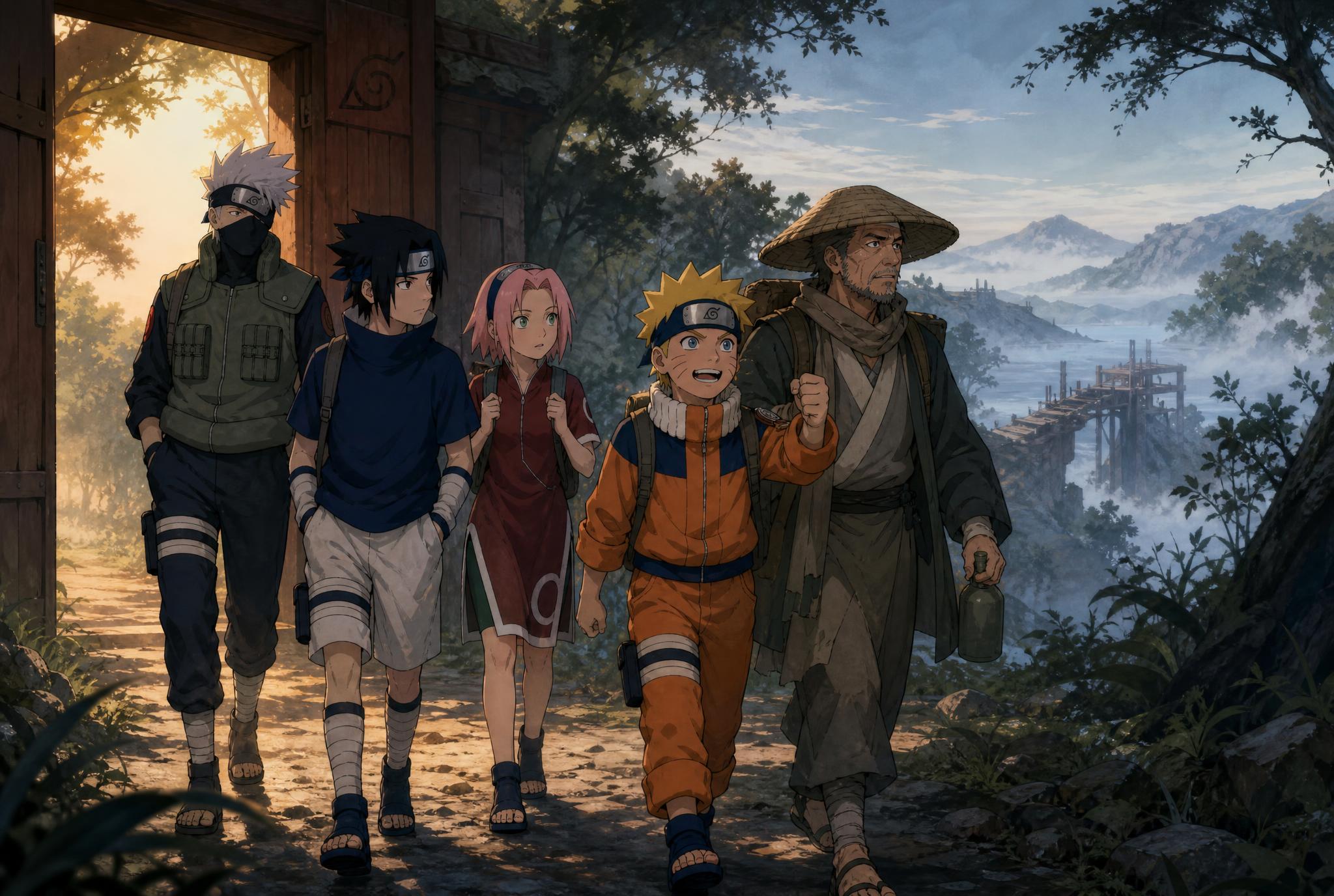
A Dangerous Mission! Journey to the Land of Waves!
Naruto demands a real mission, walks beyond Konoha’s gate, and discovers that wanting danger from a safe room is not the same thing as meeting violence on an open road.
Episode 6 opens the gate between childhood rehearsal and a world where mistakes bleed.
The Cat, the Chores, and Naruto’s Insulted Ambition
Team 7 has officially passed Kakashi’s test, but official shinobi life does not begin with glory. The first assignment begins with a runaway cat. The genin chase Tora through the village, endure scratches, and return the furious animal to the daimyo’s wife. The comedy is broad, yet the mission tells us exactly how Konoha introduces children to public responsibility.
D-rank work includes chores, retrieval, assistance, and other tasks unlikely to involve combat. Naruto experiences the assignments as humiliation. He did not struggle for a forehead protector so he could weed gardens, collect trash, babysit, or chase an animal that hates being held. His imagined self is already an important ninja. The work keeps returning him to the social position he most resents: a child whom adults do not take seriously.
His frustration is funny because it is excessive, but it is not empty. Naruto’s hunger for recognition makes scale emotionally important. A small mission appears to promise small recognition. If he succeeds at work anyone can do, he fears the village will continue treating him as someone anyone can ignore.
Kakashi understands the instructional logic. A team that has shared one lunch has not mastered coordination. Low-risk missions allow them to practice communication, client service, patience, and task completion without placing lives on every mistake. The ordinary work is not beneath shinobi discipline. Repetition turns discipline into habit.
The tension between Naruto and the system is therefore more interesting than “lazy child hates chores.” Naruto wants the institution to confirm the heroic identity he has announced. The institution answers that responsibility begins long before heroism becomes visible.
Hiruzen Explains the Mission Machine
In the Hokage’s office, Hiruzen describes the village mission structure. Requests are evaluated, ranked, assigned, and matched to shinobi ability. Higher ranks carry greater danger and political consequence. Genin receive D-rank assignments because they are still learning how to function in the field.
The explanation is worldbuilding, but it also exposes the economic machinery beneath the romantic image of the ninja. Konoha is not only a community or military settlement. The village also operates as a service institution. Clients bring needs and money. The village distributes labor. Rank determines who is permitted to encounter which forms of risk.
Naruto interrupts the lecture and rejects another D-rank task. Hiruzen begins to scold him, but Naruto’s protest forces a choice: reinforce the developmental ladder or grant the child enough responsibility to test his claim. Hiruzen assigns Team 7 a C-rank escort.
The decision is both generous and dangerous. Naruto receives the recognition he demanded, yet recognition arrives as exposure. The series refuses to let ambition remain imaginary. If Naruto wants to be seen as capable, he must enter situations where capability has consequences.
Enter Tazuna, the Client Who Does Not Believe in Them
Tazuna arrives carrying a bottle and the weariness of someone whose problems are larger than the room. He looks at the genin and openly doubts that they can protect him. His sharpest attention lands on Naruto, whom he treats as a tiny, unreliable child.
Naruto’s reaction is immediate. He rages, threatens, performs, and then tries to reassure himself that shinobi are not supposed to attack their clients. Kakashi restrains the moment with exhausted authority. The scene is comic, but it establishes the emotional arrangement of the escort. Tazuna has not purchased an abstract service. He has placed his body near children whose competence he cannot verify.
His contempt is unfair, yet his fear has a material cause that he is not ready to confess. The mission request has been classified below its true danger. Tazuna needs protection he cannot afford and has manipulated the village to obtain it. Like Mizuki, he withholds information that shapes another person’s consent. Unlike Mizuki, his deception emerges from desperation rather than predation. Naruto will repeatedly ask us to distinguish those motives without pretending desperate lies cause no harm.
Beyond the Gate
Naruto’s excitement at leaving Konoha is almost painfully young. The village that excluded him has also contained his entire known world. Passing through the gate gives physical form to his lifelong declaration that he will become someone larger than the role assigned to him.
The road changes the visual language of the series. Familiar rooftops and Academy spaces fall away. Forest, water, and distance enter the frame. Tazuna walks toward a country the children know only as a mission destination. Kakashi shifts from teacher inside a controlled exercise to commander responsible for a client and three lives.
There is an innocence to the departure that the episode immediately begins to poison. Naruto imagines adventure. Kakashi notices details. A puddle sits on a dry road where no puddle should exist. The children keep walking because they do not yet know that professional perception often means recognizing the wrong thing before it moves.
The Demon Brothers Attack
Chains explode from the puddle. Two masked shinobi rise from concealment, trap Kakashi, and appear to tear him apart. The violence is startling because Episode 4 taught us to read Kakashi as untouchable. The strongest adult in the group seems to die before the genin can understand that combat has begun.
Sasuke moves. He anchors the attackers’ chain, disrupts their coordination, and attacks with an efficiency that validates every earlier hint about his talent. His body understands danger faster than the group’s fear can organize itself.
Sakura positions herself in front of Tazuna. She does not defeat the attackers, but she remembers the mission. Protecting the client is the assignment’s central obligation, and in the instant when spectacle threatens to swallow attention, she holds the correct line.
Naruto freezes.
The pause is one of the most important early choices the anime makes. Naruto has spent five episodes declaring courage, demanding recognition, attacking stronger opponents, and refusing to stay quiet. Yet genuine lethal intent reaches him differently. His imagined bravery was loud because the danger was still, at some level, staged or familiar. The Demon Brothers bring death without classroom framing.
Fear does not make Naruto a fraud. Fear shows that his courage remains unfinished.
Kakashi Was Watching
Kakashi reappears. The body destroyed by the chain was a substitution. He restrains the attackers and reveals that he allowed the confrontation to proceed long enough to identify their target and evaluate his students’ reactions.
As in the bell test, the method is ethically uncomfortable. Kakashi possesses information and ability the genin lack. He lets them experience the apparent death of their teacher and the immediacy of assassination. His choice produces useful evidence, but it also produces trauma.
The episode does not ask us to ignore that cost. Kakashi’s world has normalized severe experiential teaching because shinobi missions will not pause for emotional readiness. He is trying to prepare children for a system that already intends to use them.
What he learns is precise. Sasuke can think under attack. Sakura can maintain mission priority. Naruto’s will is larger than his current nervous system. Team 7 passed the moral test of lunch, but solidarity does not automatically grant field composure.
The Wound in Naruto’s Hand
One attacker’s claw has injured Naruto, and the weapon may be poisoned. The wound becomes unbearable not only because it hurts, but because it records his hesitation. Sasuke’s competence is standing beside him. Tazuna’s doubt is behind him. Naruto sees his own hand as evidence that the identity he proclaimed has failed its first external test.
He drives a kunai into the wound and vows that he will never freeze or retreat again. The gesture is reckless, painful, theatrical, and emotionally honest. Naruto cannot undo the moment, so he tries to cut a new promise into his body.
Kakashi immediately tells him to stop the bleeding before he dies. That response matters. The series admires Naruto’s resolve while refusing to make self-harm magically practical. Courage is not proved by destroying the body that fear passed through.
The scene also contains an early mystery. Naruto’s wound begins healing with unnatural speed. The Nine-Tails is not merely a secret identity imposed by frightened adults. Its power lives inside his physiology, protecting the child even as the village fears what that protection represents.
Courage Is What Happens After Fear
Naruto often appears to define courage as never backing down. Episode 6 offers a more useful definition. Courage begins after the body has already revealed its fear.
He freezes. Nothing can revise that fact. Sasuke acted when Naruto could not. The client saw it. Kakashi saw it. Naruto saw himself. His next choice is not to invent an excuse. He publicly confronts the failure and commits to another response.
The vow is immature because he imagines future courage as absolute. No more fear. No more hesitation. Human beings do not become brave through permanent immunity. Yet the absolutism is how Naruto builds a bridge from shame to motion. He will later learn that courage can tremble, calculate, ask for help, and survive.
The episode’s emotional intelligence lies in allowing embarrassment to coexist with growth. Naruto is not rewarded for freezing. He is not condemned as permanently weak. The failure becomes information.
The Hidden Village and the Price of Classification
Konoha manages danger through ranks. The system assumes clients tell the truth and administrators can translate truth into appropriate assignments. Tazuna’s deception breaks that chain. A C-rank escort can become an encounter with enemy shinobi because poverty has distorted the information entering the institution.
This is where the Land of Waves arc begins to widen Naruto’s political imagination. Security is available at a price. A poor community threatened by concentrated private power cannot purchase the protection its danger requires. Tazuna lies because the official structure has no compassionate category between “affordable” and “accurately ranked.”
The children bear the risk created by that gap. Bureaucratic classification appears neutral, but unequal resources shape who can use it honestly. The hidden village protects through procedure, yet procedure alone cannot decide what justice demands once truth and affordability diverge.
Character Pulse Check
Naruto
He receives the real mission he demanded, then discovers that courage is not a personality trait he can announce in advance. His freeze and vow create a more credible hero than effortless confidence could.
Sasuke
His first live-combat response is controlled, inventive, and fast. The skill intensifies Naruto’s shame, but it also confirms that Sasuke’s distance has been built around relentless readiness.
Sakura
She protects Tazuna instead of chasing the flashiest target. The action is easy to overlook, yet it shows situational discipline and reinforces that mission success is not identical to winning the fight.
Kakashi
He notices the impossible puddle, tests the ambush, and reads every student. His competence is reassuring; his willingness to let the lesson become terrifying exposes the severity of shinobi education.
Tazuna
He begins as an insulting client and becomes the hidden center of the threat. His fear, pride, and concealed desperation will force Team 7 to decide whether a dishonest client still deserves protection.
Hiruzen
He grants Naruto greater responsibility, demonstrating both faith and institutional risk. The mission system he explains works only when information and resources are honest.
Easter Eggs and Rewatch Echoes
The impossible puddle
Kakashi’s attention to the road is an early lesson in shinobi literacy. Landscape is evidence. Weather, placement, and ordinary objects can reveal hostile intention. First-time viewers see a puddle. Returning viewers see the exact moment the adult knows the mission report is false.
Tora’s scratches versus the poisoned claw
The episode moves from comic injury during a safe mission to a wound carrying possible poison. Both arrive through “claws,” but the meaning changes completely. The structure lets Naruto’s complaint about harmless work collide with the physical cost of the danger he requested.
The gate as a threshold
Leaving Konoha is not just travel. The gate becomes a genre threshold. Academy comedy gives way to political violence. Naruto’s personal dream enters a world where villages, wealth, labor, and organized crime determine whose dreams can survive.
Sasuke’s body before his words
Sasuke rarely explains care or fear, but his movements reveal both. He acts to interrupt the chain and protect the group. Episode 5 showed his comradeship through food; Episode 6 translates it into combat reflex.
Reaction: The First Time the Fantasy Bleeds
This episode stays with me because it refuses to protect Naruto from looking small. He demanded danger. Danger arrived. Sasuke looked brilliant, Sakura remembered the client, and Naruto could not move.
A cheaper story might have hidden the freeze or immediately compensated with a spectacular victory. Naruto lets the shame breathe. The boy who survives by declaring himself impossible to ignore must now experience being present and unable to act.
That is the beginning of depth. Courage without fear is branding. Courage after fear is a relationship with the self. Naruto looks at the hand that failed to move, wounds it, and makes a promise. The promise is messy, but it belongs to him.
The episode also begins revealing what a “real mission” actually means. A real mission is not adventure arranged for Naruto’s development. Tazuna has a home, a secret, and a community under pressure. The attackers have an employer. Konoha has a pricing system. Team 7 has entered a conflict that existed before they arrived and will not become morally simple because they are protagonists.
Naruto leaves the village wanting proof that he is a shinobi. The road answers with a harder question: what will he do after discovering he is still afraid?
Episode Verdict
Emotional core: Naruto’s shame after freezing in his first lethal encounter.
Best character beat: Sakura guarding Tazuna while Sasuke intercepts the chain, two different forms of mission awareness.
Big idea: Responsibility begins when imagined danger becomes someone else’s real life.
Rewatch value: High. Kakashi’s puddle observation, Tazuna’s evasions, and Naruto’s healing all foreshadow the arc ahead.
CVM Sekai rating: 9/10. The episode turns a simple departure into the first fracture in Naruto’s heroic fantasy.
Continue the Naruto Journey
The first real mission begins with a pricing problem
Naruto begs for work that feels worthy of a shinobi and receives an escort assignment presented as ordinary protection. The comedy around D-rank chores makes the promotion feel like a reward for persistence. Tazuna’s reaction immediately complicates that fantasy. He sees children, doubts their ability, and still needs the cheaper mission category badly enough to keep moving.
The Land of Waves is poor because Gatō controls shipping and isolates the country economically. That poverty enters the mission before Team 7 reaches the border. Tazuna cannot afford the threat level he actually faces, so he purchases the protection he can afford and hides the rest. His lie is dangerous. The system that prices safety beyond his country’s reach is dangerous too.
The Demon Brothers turn paperwork into blood
The puddle on a dry road gives Kakashi the warning. He allows the attack to unfold so he can identify the target and see how his students respond. The Demon Brothers appear to kill him, then move toward Naruto and Tazuna. Sasuke acts. Sakura protects the client. Naruto freezes.
That freeze is not evidence that Naruto lacks courage. It is the body discovering that classroom danger and lethal intent are different realities. The chain cuts skin. Poison enters his hand. An enemy wants him dead. His imagination of shinobi glory finally meets the physical fact that missions can end a child.
Naruto’s self-inflicted wound is brave and alarming
Naruto drives a kunai into his poisoned hand and swears he will never freeze again. The scene works because shame, fear, determination, and performance arrive together. He wants Team 7 to know he can continue. He wants Sasuke to stop looking like the only student ready for danger. He wants his own body to obey the identity he declared.
Kakashi stopping him from bleeding out keeps the moment from becoming pure triumph. Courage without medical judgment can become another form of self-harm. Naruto is willing to hurt himself to prove usefulness because usefulness feels safer than being removed. That pattern deserves attention every time the franchise celebrates his endurance.
Tazuna’s confession changes the consent question
Once Kakashi identifies the attackers as shinobi and the mission as misclassified, Tazuna explains Gatō, the bridge, and the country’s desperation. Team 7 finally receives the truth required to understand the risk. By ordinary procedure, they should return and request a properly ranked assignment.
The children choose to continue, but their choice sits inside hierarchy, pride, compassion, and Tazuna’s public shaming of Naruto. Consent under those conditions is not clean. Kakashi remains the adult commander. Tazuna remains the client who withheld critical intelligence. The genin’s willingness matters; it does not transfer all responsibility onto them.
Sakura’s formation work deserves credit
During the attack, Sakura moves to Tazuna and maintains the escort objective. The direction gives Sasuke the flashier counterattack and Naruto the emotional wound, but Sakura performs the mission assignment. Protecting the client while teammates engage is not passive simply because the animation gives it fewer sparks.
This will become a recurring frustration in how early Naruto distributes spectacle. The girl often performs necessary defensive labor while the boys receive the celebrated action and crisis. A complete React keeps both in the record.
The road out of Konoha is also a road into politics
Team 7 leaves a village where ranks, clients, and procedures can look stable. The Land of Waves reveals what those systems mean to people without money or military power. A bridge can threaten a corporation. An escort contract can become resistance. A child’s first mission can place him inside an economic conflict adults failed to solve.
Naruto wanted a bigger adventure. He gets a lesson in how quickly ordinary work becomes political when somebody controls food, transport, and fear.
RaeRae’s final take
Episode 6 is where Naruto stops playing shinobi and starts paying for the role. The Demon Brothers prove the danger is real. Tazuna proves the mission file is incomplete. Sakura and Sasuke prove Team 7 can function under attack. Naruto proves he will force himself forward, even when the method scares me.
The episode does not ask whether Tazuna lied. He did. It asks what people do when the honest price of survival is one they were never given the power to pay.
Official Viewing
Streaming availability varies by region. Watch through an official licensed service carrying the original Naruto series, including Crunchyroll or Netflix where available.
Editorial note: CVM Sekai’s Naruto coverage centers the original Japanese series and original Japanese performances. English dub casting is outside this project’s scope.