
Gōzu and Meizu
The Demon Brothers last only minutes against Team 7, but those minutes tear open the series. A puddle becomes a lie, Kakashi appears to die, Naruto freezes, Sasuke moves, and the “mission” is revealed as somebody else’s assassination contract.
They are not filler thugs. They are Team 7’s first field exam.
Gōzu and Meizu lose their only major fight, and that loss is exactly why people flatten them. Bad read. The Demon Brothers are the first enemies who force Team 7 to discover that a real mission does not wait for everyone to feel ready. Their puddle tests observation. Their chain tests formation. Their fake killing of Kakashi tests emotional control. Their poisoned claws turn Naruto’s brave little speech into a wound he must physically answer. They do not need a long arc because their narrative job is surgical: expose every gap between classroom competence and survival.
The brothers also announce the Land of Waves arc’s ugliest truth. Violence has a supply chain. Gatō buys Zabuza, Zabuza deploys Gōzu and Meizu, and the men at the bottom carry poison while the man at the top carries money. The chain between their gauntlets becomes a tiny model of the entire contract. Each brother depends on the other, both depend on Zabuza, and Zabuza depends on a client already planning betrayal. Everybody is linked. Nobody is safe. Capitalism has entered the forest wearing claws, babes.
Quick facts and databook record
The first databook gives each brother a long work record despite their brief page time. Each completed 278 missions: 68 D-rank, 167 C-rank, and 43 B-rank, with no recorded A-rank or S-rank missions. Those numbers matter because the road ambush is not two random men trying something cute. These are adult chūnin with hundreds of assignments behind them. Their failure measures Kakashi’s control and Sasuke’s readiness more than their supposed incompetence.
Some English references drop the long vowel and print Gozu. CVM Sekai uses Gōzu to distinguish this Kirigakure assassin from the unrelated anime-original Gozu who later serves Guren. That accent mark is doing useful labor. Naruto has enough repeated mythological names without us throwing both men into the same filing cabinet.
Ox-Head, Horse-Face and the guardians at the road
The collective image reaches into East Asian Buddhist and popular underworld traditions. Gozu and Mezu, often translated as Ox-Head and Horse-Face, guard the realm of the dead and escort souls toward judgment. Naruto does not paste literal animal heads onto these brothers. The reference works through function and mood. Two paired guardians appear at a boundary, restrain bodies with a shared instrument, and make passage dangerous. Team 7 believes the village gate marked the beginning of danger. The Demon Brothers reveal that the real threshold was a puddle nobody respected.
The individual kanji used for Naruto’s characters complicate a one-line mythology explanation. Gōzu is written 業頭, with 業 carrying ideas that can include work, deed, or karma depending on context, while Meizu is written 冥頭, with 冥 suggesting darkness or the underworld. Databook character notes contrast Gōzu’s calmer reason with Meizu’s emotion-driven violence. The name pair therefore gives the twins a shared death-guardian frame while leaving room for different temperaments inside the unit.
That underworld echo becomes funnier and meaner once Kakashi uses substitution. The guardians perform a death that never happened. They believe their chain has torn him apart, the children believe their teacher has fallen, and Kakashi is already watching the next move. Death arrives as theater before death arrives as fact. The series teaches the audience the same rule Kakashi teaches his students: visible evidence matters, but shinobi manufacture visible evidence for a living.
The design makes partnership visible before either brother speaks
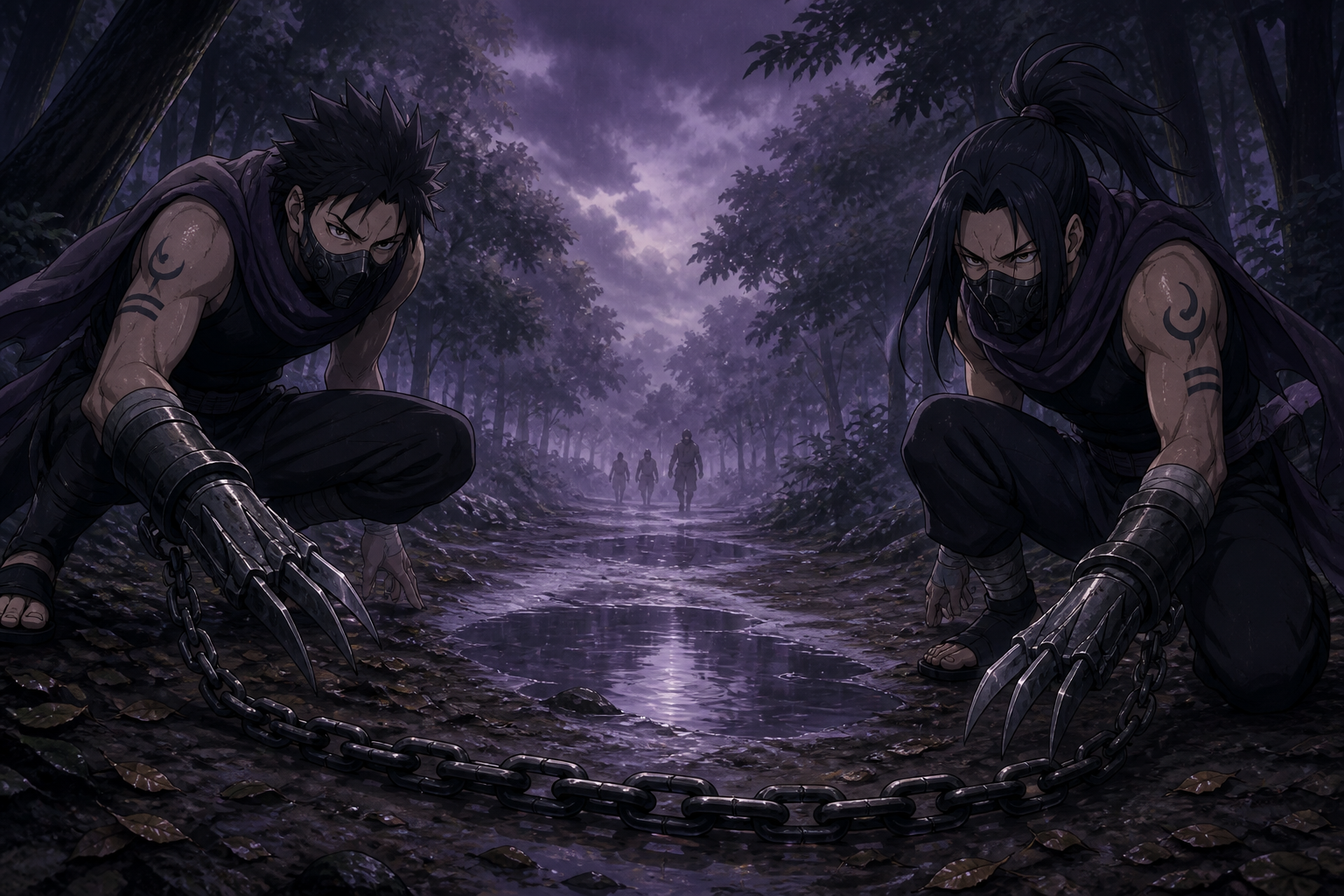
Gōzu and Meizu wear dark camouflage clothing, ragged capes, open shinobi sandals, waist bandaging, and rebreathers over the lower face. Their scratched Kirigakure forehead protectors identify defection rather than ordinary foreign service. Each brother carries one oversized clawed battle gauntlet. A retractable bladed chain joins those gauntlets, turning two bodies into one moving trap. Poison on the claws supplies the ugly insurance policy when the chain fails.
The pair are nearly mirrored, but not identical. Gōzu has wild shoulder-length dark hair and wears his claw gauntlet on the right arm. Meizu’s dark hair is arranged differently, and his corresponding gauntlet sits on the left. Their forehead protectors and silhouettes contain small differences, including the horn treatment noted in reference art. Those details keep the brothers readable in motion while preserving their paired-monster grammar. You should be able to see one and immediately expect the other.
The rebreathers do more than make them look menacing. Hidden Mist visual language repeatedly joins obscured faces, water, assassination, and depersonalized labor. The mask turns speech into threat and the worker into function. Their claws are industrial in scale, the chain looks like equipment as much as weaponry, and their entire design says outsourced killing before the plot explains the contract. Fashion can do exposition when the costume department comes ready to work.
Former Kiri chūnin who followed Zabuza into exile
Gōzu and Meizu trained in Kirigakure, graduated from the Academy at twelve, reached chūnin at eighteen, and accumulated hundreds of missions. Reference material identifies them as twin brothers and former Kiri shinobi who left with Zabuza after his failed attempt against the Mizukage. They later work as mercenary assassins under him. The manga does not pause the road attack for a flashback, so readers must keep a clean boundary between databook-supported background and dramatized on-page action.
The connection to Zabuza explains their competence, their equipment, and their willingness to take assassination work against a civilian bridge builder. Zabuza is not hiring novices. He is deploying people shaped by the same Bloody Mist system that trained children to treat lethal force as professional proof. The Demon Brothers are not as powerful as their commander, but they understand concealment, target order, coordinated attack, poison, and mission focus. Tazuna remains the objective even when Team 7 gets in the way.
Their loyalty also has an employment ceiling. Zabuza sends them first because a cheaper subordinate can test the road before the elite killer exposes himself. That is sound tactical delegation and an ugly labor arrangement at the same time. The mission gives the brothers danger without giving them narrative protection. When they fail, Zabuza simply becomes the next layer of violence. Nobody stops to mourn the contractors.
A puddle on a dry road is the whole exam question
The brothers conceal themselves with Water Release in a small roadside puddle after rainfall has already ended and the surrounding road has begun to dry. Kakashi notices the contradiction. The genin do not. That environmental mismatch matters more than a flashy hand sign because field intelligence starts with asking whether the world in front of you makes sense. Kakashi keeps walking to learn what his students will do once the trap commits.
From a teacher’s desk, that choice is ruthless. From a jōnin commander’s position, the choice is also controlled. Kakashi has identified the threat, prepared a substitution, and placed himself between the attackers and the client. He does not abandon Team 7 to chance. He creates a live test after determining that he can interrupt the result. The children experience terror because the lesson needs stakes, but Kakashi retains more control than the staging first reveals.
The puddle is excellent foreshadowing for the whole Land of Waves mission. Tazuna’s request looks like routine protection, yet an assassination contract hides beneath the paperwork. Gatō’s company looks legitimate, yet criminal coercion hides beneath commerce. Haku looks gentle, yet lethal training hides beneath courtesy. A tiny patch of water teaches the arc’s governing rule: surfaces are evidence, never guarantees.
Every beat of the ambush and what each beat exposes
The chain snaps around Kakashi first. Gōzu and Meizu pull in opposite directions, their linked blades appearing to tear the jōnin apart. With the apparent strongest protector removed, they move toward Naruto. He freezes. Sasuke does not. Sasuke throws a shuriken and kunai to pin and disrupt the chain, then uses the brothers’ connected movement against them. The response is fast, mechanical, and based on the exact weapon structure placed in front of him.
Once separated, the brothers release from the joined chain and split their attack. One presses Sasuke while the other drives toward Tazuna. Sakura positions herself in front of the client even though she cannot dominate the attackers. Naruto tries to enter the exchange but receives a poisoned claw wound. Kakashi then reveals the substitution, restrains both assassins, and confirms that the apparent death was a test rather than a failure.
The target order tells us who understands the mission. The Demon Brothers prioritize Kakashi, then Tazuna, while attacking genin who block access. Sasuke identifies the weapon system. Sakura remembers protection formation. Naruto focuses on the humiliation of freezing and getting hurt. Everyone processes the same seconds through a different role. That is why this short fight carries so much character information without anybody stopping to explain their personality chart.
After capture, Kakashi questions the circumstances and confronts Tazuna about the false mission rank. The bridge builder admits that Gatō wants him dead and that the impoverished Land of Waves could not afford the proper fee. The Demon Brothers therefore tear open not only Team 7’s weakness but Konoha’s contracting problem. A C-rank escort has become an A-rank threat because poverty forced the client to lie.
Gōzu is the calmer half of a violent machine
Databook characterization presents Gōzu as rational, calm, and level-headed. That description does not make him kinder. Calmness makes him operational. He works the right-arm gauntlet, follows target order, and coordinates without wasting movement. His danger comes from discipline rather than frenzy. Viewers who equate loudness with threat miss how often professional violence depends on somebody who can stay emotionally flat while carrying out a terrible instruction.
Gōzu’s 73.3 kg weight distinguishes him slightly from Meizu’s 73.6 kg even though both are 178 cm and twenty-five. The near symmetry supports the twin presentation, while the tiny difference reminds us that the story has not created interchangeable clones. His side of the pair is the regulating force. When the shared chain breaks, both men can release and continue individually, but the design suggests that Gōzu helps keep the original formation precise.
His Japanese name and underworld association sometimes tempt fans to fold him into the later anime-original Gozu from Team Guren. No, ma’am. Different man, different village history, different body, different techniques, and different storyline. This Gōzu belongs to the Demon Brothers, formerly Kirigakure, and debuts in the opening Land of Waves material. Proper names need context or fandom databases become a family reunion nobody consented to attend.
Meizu supplies impatience and emotional heat
Meizu’s databook personality is described as impatient and violent. The contrast with Gōzu does not break their coordination. The brothers have trained together long enough to turn different temperaments into one assault pattern. Meizu can deliver the aggressive forward pressure while Gōzu regulates the shared mechanism. Their bond works because sameness is not the requirement. Timing is.
Meizu weighs 73.6 kg, stands 178 cm, shares the June 6 birthday and blood type B, and carries the left-side claw gauntlet. His name uses 冥, a character associated with darkness and the underworld, which strengthens the death-guardian atmosphere around the pair. He is also the younger twin in reference descriptions, though Naruto’s main narrative never turns the age order into a separate subplot.
Calling Meizu the emotional brother should not become amateur diagnosis. The available record is compact. We see a mercenary carrying out an assassination, adapting after a weapon failure, and continuing toward the target. We do not receive childhood scenes, interior monologue, redemption material, or later-life clarification. A complete profile must say what the text supports and stop before confidence becomes fanfiction wearing glasses.
Water concealment, chain geometry, poison and real limits
Their signature ninjutsu is Water Release: Hiding in Water Technique, used to merge with or conceal themselves inside water. On the road, the technique transforms a suspicious puddle into an ambush chamber. Their stealth is good enough to position near the Konoha route without the genin detecting them. Kakashi catches the environmental inconsistency, which establishes a limit: concealment can hide a body without correcting the evidence around the hiding place.
The retractable chain allows binding, constriction, directional control, and a slicing pull when both brothers move apart. Their gauntlets include release mechanisms so either man can detach once an opponent neutralizes the shared line. Poisoned claws provide close-range lethality after separation. This toolkit is not built for an honorable duel. The whole system assumes surprise, numerical coordination, a protected target, and a short kill window.
The brothers are experienced chūnin, not elite jōnin. Sasuke disrupts their primary weapon after watching one exchange. Kakashi’s substitution deceives them, and his speed lets him restrain both once he ends the test. They show no large-scale water technique, healing, sensory specialty, summoning, bloodline limit, or defense against a superior close-range controller. Their greatest strength is coordination. Their greatest weakness is that breaking the chain also breaks the geometry around which the ambush was designed.
Power scaling that calls them useless because Kakashi wins misses the matchup. A trap optimized to delete an unaware escort loses value against a veteran who already spotted the trap. Against ordinary civilians or a less observant squad, poison and chain blades could end the mission immediately. Threat is contextual. Naruto teaches that lesson before fandom learns to spell tier list.
Naruto’s poisoned hand is a promise with a body attached
Naruto freezes when Kakashi appears to die. The reaction is human, especially for a twelve-year-old facing professional killers for the first time. Naruto hates that humanity because Sasuke moved while he did not. The poisoned scratch becomes physical proof of the gap between the hero he announces and the child whose nervous system just encountered murder.
After Kakashi explains the poison risk, Naruto drives a kunai into his own hand and vows never to freeze again. The gesture is brave, theatrical, frightening, and completely Naruto. He converts shame into spectacle because spectacle helps him seize control of a feeling he cannot quietly process. Kakashi stops him from causing further damage and notes the wound’s unusual healing, an early breadcrumb toward the power sealed inside him.
The scene should not be reduced to hustle culture with blood. Naruto’s growth does not come from punishing himself hard enough. The useful part of the vow is accountability: he names the failure and chooses action. The dangerous part is self-harm as proof of worth. The series will keep returning to that mixture, because Naruto often treats his body as the receipt for sincerity. Admirable determination and terrible boundaries can share the same hand.
Sasuke moves, Sakura holds position, and Kakashi watches everything
Sasuke’s counter demonstrates why Academy reputation followed him. He does not merely throw weapons quickly. He reads the chain as a connected system, pins the line, closes distance, and interrupts the brothers’ formation before panic owns the scene. His taunt toward Naruto sharpens their rivalry, but the underlying contrast is field readiness. Sasuke has already organized fear into movement.
Sakura receives less glamorous framing, yet her choice matters. She guards Tazuna. Against stronger adults, protection stance can look passive beside Sasuke’s choreography, but the client is the mission. Her body placement shows that classroom rules survived the shock. Naruto’s freeze, Sasuke’s counter, and Sakura’s formation give Kakashi three different diagnostic results from one attack.
Kakashi’s substitution completes the lesson. He lets the children believe he has died long enough to expose instinct, then ends the threat before the attackers reach a fatal result. The method is emotionally harsh, and the shinobi system rewards exactly that harshness because future enemies will not provide rehearsal space. Team 7 passes imperfectly. More importantly, Kakashi learns what each student will need before Zabuza himself appears.
Underworld guards, vertical loyalty and rented violence
The Ox-Head and Horse-Face echo gives Japanese audiences a paired-underworld association that many English viewers meet only through a wiki footnote. Naruto repurposes that cultural memory for two threshold antagonists. They guard no moral court, yet they stand at the passage between childhood exercise and adult consequence. Their defeat opens the road, and the road leads directly into a country where law has been privatized by money.
A Confucian lens helps clarify the hierarchy without excusing the crime. Brothers owe coordination to each other, subordinates owe service to a commander, and a commander carries obligations downward as well as authority upward. Gōzu and Meizu perform their side of the bond with impressive unity. Zabuza treats them as deployable assets. Gatō later plans to betray Zabuza. The hierarchy keeps demanding loyalty from below while care disappears from above. That is not stable order. That is exploitation wearing the posture of order.
A Buddhist reading can focus on attachment to violent identity and the karmic chain made literal by equipment. The brothers’ synchronized weapon gives them strength, but the same connection makes their movement readable and lets Sasuke interrupt both at once. Naruto does not preach a sermon over them. The symbolism remains visual: an instrument designed to bind another person also binds the users to one attack logic.
The mission economy finishes the argument. Tazuna cannot afford the rank that matches the threat. Konoha dispatches children according to false paperwork. Gatō’s money reaches the road through layers of subcontracted force. The poorest person lies to buy protection, while the richest person hires killers to preserve scarcity. Gōzu and Meizu are where that economic system finally touches skin.
Takeshi Kusao and Toshiaki Kuwahara make the pair feel practiced
Takeshi Kusao performs Gōzu in Japanese, while Toshiaki Kuwahara performs Meizu. Their work is compact because the brothers are action-first antagonists. The performances avoid turning the pair into chattering comedy. Breath through the lower-face masks, clipped threats, and coordinated timing support the sense that both men have executed this pattern before.
Kusao’s steadier attack energy suits Gōzu’s databook description as calm and rational. Kuwahara gives Meizu a sharper aggressive edge without destroying the shared rhythm. The difference is small enough that the brothers remain a unit and clear enough that the unit has internal texture. That balance matters. If both voices became identical, the twins would flatten into props. If the contrast became too broad, the ambush would stop feeling rehearsed.
CVM Sekai records the original Japanese performance because anime acting begins with the Japanese production. No English-dub material belongs in this profile. A future performer profile should link on first mention only when that profile is actually live. Honest future-link status beats a broken promise dressed as navigation.
Manga, anime, novel and game appearances
Gōzu and Meizu debut in manga Chapter 9 and anime Episode 6. The core encounter remains consistent: puddle concealment, apparent destruction of Kakashi, Sasuke’s chain counter, Naruto’s poisoned wound, Sakura’s client defense, Kakashi’s reveal, and the exposure of Tazuna’s false mission rank. Animation extends timing and sound so the chain, rain, masks, and panic can breathe more visibly than a short manga sequence.
The prose adaptation Naruto: Innocent Heart, Demonic Blood includes the encounter and implies that the brothers may escape back toward Zabuza after Team 7 moves on. That implication should not be promoted into a sweeping later biography. Main manga and anime canon leave them alive after restraint without supplying a confirmed adult future, death, redemption, family expansion, or Boruto-era return.
Naruto: Konoha Ninpōchō supplies their early game record. Meizu later appears as a playable character in Naruto Shippūden: Ultimate Ninja Blazing, while franchise games and databases may group both brothers in cards, enemy units, or adaptation material. Game mechanics can enlarge movesets for play. Such expansions do not automatically rewrite manga abilities.
Neither brother has a confirmed film, theatrical OVA, later manga arc, or Boruto storyline of narrative consequence in the reference record used here. Completeness means checking those shelves and recording the boundary. Completeness does not mean inventing an appearance because a profile feels lonely without one.
Three ways people underestimate the Demon Brothers
“They are weak because Sasuke handles them.”
Sasuke disrupts the chain, and Kakashi captures them. That proves Team 7 contains unusual talent and an elite commander. The databook still gives each brother chūnin rank, hundreds of completed missions, Water Release, poison, and a practiced assassination system. Losing to Kakashi Hatake is not a résumé-ending scandal. Most people lose to Kakashi Hatake. Some lose while he reads porn, which is frankly worse.
“They are only there to make Naruto look bad.”
Naruto’s freeze matters, but the encounter measures the entire squad. Sasuke reads the weapon, Sakura protects the client, Kakashi tests the formation, and Tazuna’s lie collapses. The brothers also establish Zabuza’s reach and Gatō’s contract chain. One child’s embarrassment is only the loudest immediate consequence.
“Their mythological names mean they are supernatural demons.”
The underworld reference shapes naming and atmosphere. Gōzu and Meizu remain human shinobi. They have chakra, Water Release, tools, training, poison, and physical limits. Symbolism adds meaning without replacing species. A metaphor is not a medical chart.
My read: the Demon Brothers are excellent early antagonists because Naruto uses them efficiently without treating them as disposable nonsense. Their attack changes the mission rank, exposes the team’s instincts, wounds the protagonist, foreshadows hidden surfaces, introduces outsourced violence, and prepares the audience for Zabuza. Two men, one puddle, one chain, and suddenly the whole series has consequences.
Viewing and reference shelf
Read Naruto manga Chapter 9 and continue into Chapter 10 for the ambush and its immediate consequences. Watch original Naruto Episode 6 for the animated staging, Japanese voice performances, sound design, and the transition into the mission-rank revelation. The official first character databook supplies the paired profile data, mission totals, rank history, physical statistics, personality contrast, and equipment context.
Reference cross-checks used for this retrofit include Narutopedia’s separate Gōzu and Meizu files, with the manga, anime, novel, game, and databook citations followed back to their listed records where available. Cultural interpretation of the Gozu and Mezu underworld figures is presented as context, not as a claim that Kishimoto wrote a literal Buddhist allegory into every claw swing.
Verified facts, adaptation differences, and CVM Sekai interpretation are separated throughout this profile. No English-dub credits are included. No unsupported death, later career, redemption, or Boruto appearance is claimed.