
Episode 7 is not the story of Naruto defeating an elite assassin. The episode follows a team choosing to enter someone else’s crisis after discovering the mission was never what they consented to.
The Lie After the Ambush
The Demon Brothers are restrained, Naruto’s wounded hand is healing, and Kakashi finally names the contradiction. Ordinary bandits might fit a C-rank escort. Enemy shinobi do not. The attackers targeted Tazuna specifically, which means the bridge builder concealed information when he commissioned the mission.
Kakashi explains that the assignment should be reclassified at a level far beyond new genin. The responsible response is to return to Konoha and report the deception. Team 7 has already faced poisoned weapons because an adult decided they could not be trusted with the truth.
Tazuna does not deny it. He admits that the Land of Waves is being strangled by Gato, a wealthy shipping magnate who controls transportation, commerce, and hired violence. Tazuna’s bridge would reconnect the isolated country to outside trade and break Gato’s monopoly. That is why the bridge must not be completed and why Tazuna has become a target.
The bridge builder could not afford the fee for an accurately ranked mission. He lied because the official price of protection exceeded what his country could pay.
Gato and Violence as an Economic System
Gato expands Naruto’s idea of a villain. He is not introduced as a stronger ninja seeking combat. He is a businessman who turns geography into dependence. The Land of Waves relies on water routes. Control the routes, and he can control food, labor, travel, and hope without personally throwing a kunai.
His violence is outsourced. Missing-nin and hired killers become operating expenses. The shinobi system that trains extraordinary combatants also creates a market in which private wealth can purchase their force.
This matters because the bridge is more than infrastructure. The construction gives collective agency a physical form. A completed route would allow ordinary people to move goods and themselves beyond Gato’s permission. Tazuna is dangerous because he is building an alternative.
The conflict therefore begins before Zabuza appears. Gato’s weapon is scarcity, and Tazuna’s answer is connection.
Tazuna’s Desperate Performance
Tazuna pressures the team by describing what will happen if they abandon him. He imagines his own death, his daughter’s grief, his grandson’s suffering, and a country left without its bridge. The speech is manipulative. He converts guilt into substitute payment.
Yet the manipulation is not identical to Mizuki’s. Mizuki exploited Naruto’s loneliness for private gain and intended to kill him. Tazuna exploits the team’s conscience because a community is trapped beneath economic coercion. Motive does not erase the stolen consent, but it changes the moral problem.
Naruto insists they continue. His determination is partly pride. Returning immediately after freezing would feel like confirmation that he is still the small child Tazuna mocked. But the choice is also an early expression of the ethic he is developing: once another person’s suffering becomes visible, procedural distance becomes difficult to maintain.
Kakashi accepts the continuation. The decision places adult responsibility back on him. He knows the risk is greater than reported and chooses to carry the team forward rather than pretending the children are now safe because they volunteered.
Crossing Into the Land of Waves
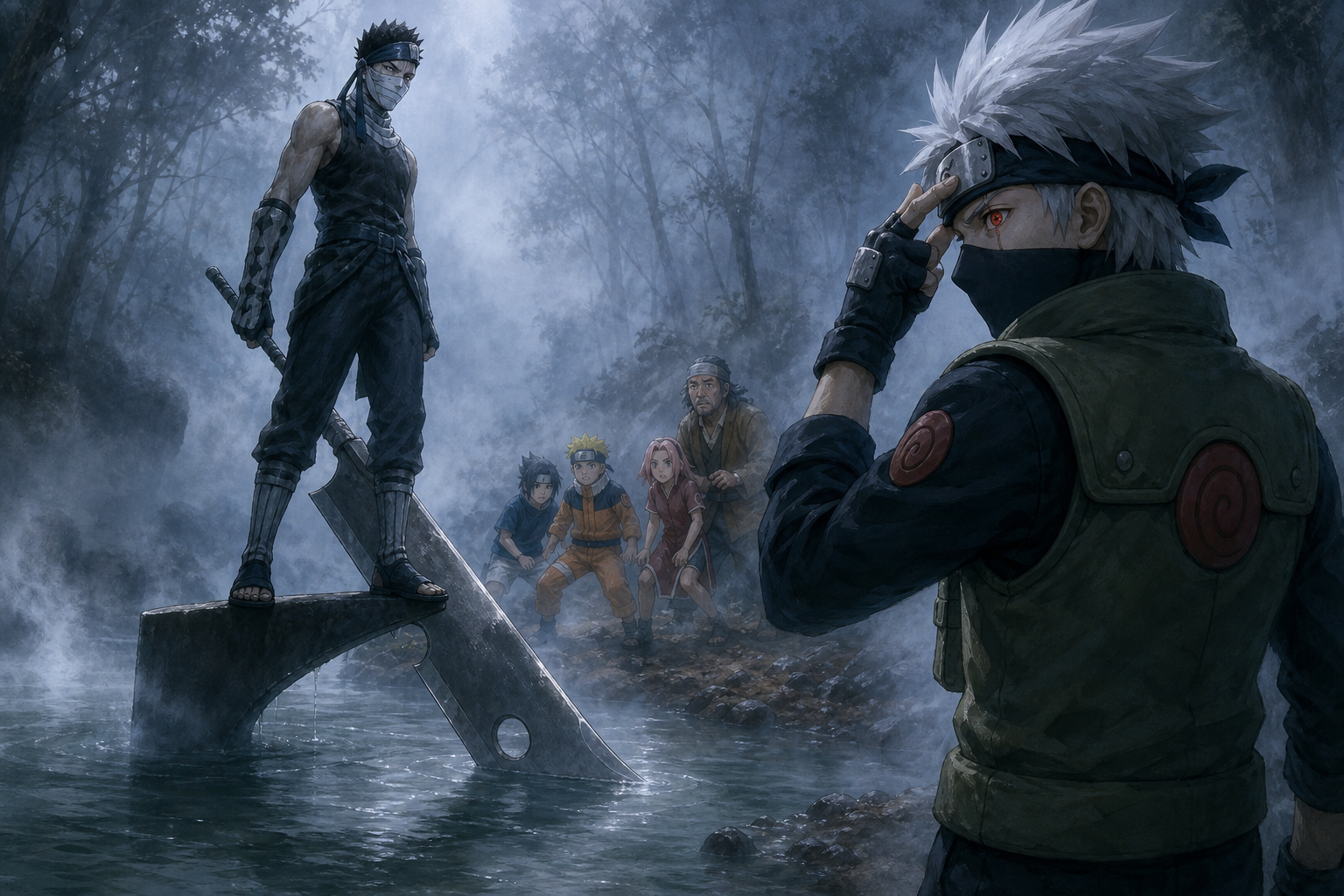
The group transfers to a small boat and moves through heavy mist. The boatman keeps the engine quiet and asks the passengers not to speak. Gato’s surveillance has made ordinary travel furtive. Even arrival must be hidden.
Konoha’s gate in Episode 6 represented Naruto’s excitement at entering the wider world. The misty crossing revises that fantasy. Borders are not empty thresholds. They are shaped by who controls movement and who must disappear to survive it.
As the bridge emerges from the fog, its scale becomes visible. Tazuna is not constructing a private monument. The unfinished structure reaches toward an economic future that Gato cannot own. Its incomplete span embodies both hope and exposure.
A Sword Arrives Before the Man
The Executioner’s Blade cuts through the air before Zabuza properly enters the scene. Kakashi drives everyone down, and the weapon buries itself in a tree with enough force to become a platform. Zabuza lands on it as if violence has built him a throne.
The introduction tells us almost everything through shape. The sword is too broad to feel elegant. The blade looks industrial, a device for separating bodies rather than winning refined duels. Zabuza’s bandaged lower face withholds an ordinary human expression. He arrives less like a traveler than the idea of execution given muscle.
Kakashi recognizes Zabuza Momochi, a missing-nin from Kirigakure and one of the Seven Ninja Swordsmen of the Mist. The vocabulary expands the map again. Villages do not only produce loyal operatives. They produce deserters, fugitives, specialists, and reputations that cross borders ahead of bodies.
Tazuna’s supposedly modest escort has now attracted an internationally known killer. The false ranking becomes absurd in a single silhouette.
Protect the Client, Do Not Chase the Legend
Kakashi tells Naruto, Sasuke, and Sakura to surround Tazuna and remain outside the duel. This is not the bell test. There is no hidden reward for ignoring the order and attacking the instructor. The genin’s task is to preserve the client while the jonin addresses the threat.
The formation turns Tazuna from an irritating adult into the vulnerable center of the mission. Naruto wants to prove himself after freezing, but real teamwork denies him the dramatic redemption he imagines. Sometimes the correct action is to stand still while someone else carries the visible fight.
Sakura maintains the client line. Sasuke reads Zabuza’s pressure and the unfamiliar power in Kakashi. Naruto strains against the humiliation of being protected. Their different reactions show that Team 7 has become a unit without becoming emotionally uniform.
The Eye Beneath Kakashi’s Forehead Protector
Kakashi lifts the forehead protector covering his left eye. Beneath it is a red Sharingan marked with tomoe. Zabuza recognizes him as Kakashi the Copy Ninja, the man said to have reproduced a thousand techniques.
The reveal transforms the teacher the audience thought it knew. Kakashi’s lateness, visible laziness, and small orange book coexist with an international combat identity. His students have been measuring themselves against a man whose history is recorded in other countries’ fear.
For Sasuke, the eye produces a sharper shock. The Sharingan belongs to the Uchiha bloodline. Kakashi is not an Uchiha, yet he carries the clan’s defining power. The episode does not rush to explain how. The story lets the contradiction enter Sasuke’s face and remain there.
An eye normally receives the world. Kakashi’s Sharingan also receives other people’s movements and returns them. Observation becomes active, almost invasive. To be seen completely by Kakashi is to risk losing exclusive ownership of what the body knows.
Killing Intent and the Body’s Honest Answer
Zabuza releases murderous intent so concentrated that the genin imagine death before the blade moves. Sasuke, who met the Demon Brothers with precision, feels the urge to end his own life rather than remain beneath the pressure.
The response is not cowardice. Naruto’s nervous system recognizes a predator beyond its experience. Skill does not make the body abstract. Zabuza’s reputation, chakra, stillness, and attention create a psychological attack before the physical one begins.
Kakashi interrupts Sasuke’s spiral. He promises to protect the team even if he dies. He does not mock the fear or pretend Zabuza is harmless. He gives the fear a boundary: Sasuke is not alone inside it.
This is the adult function the shinobi world too often withholds from children. Kakashi cannot remove danger, but he can prevent the children from translating terror into abandonment.
Mist as a Weapon
Zabuza covers the field in dense mist and disappears. His voice names vulnerable organs while Team 7 waits for an attack it cannot locate. The assassin does not need to strike immediately if anticipation can fracture the defenders first.
The Hidden Mist technique transforms environment into method. Water hangs in the air, sight shortens, direction becomes uncertain, and Zabuza turns absence into presence. Every patch of fog might contain him.
Kakashi’s Sharingan promises superior sight, but mist challenges the assumption that seeing is sufficient. Kakashi must read sound, chakra, displacement, and intention. Their conflict is already a contest over who controls the meaning of incomplete information.
Copying as Psychological Warfare
Once the direct exchange begins, Kakashi mirrors Zabuza’s movements and hand signs. He does not merely reproduce technique after seeing it completed. He appears to move with Zabuza, then ahead of him, speaking thoughts the assassin has not voiced.
The Sharingan’s effect becomes psychological. Zabuza cannot tell whether Kakashi is reading his body, predicting his intention, or planting the intention he then predicts. The enemy who weaponized uncertainty finds uncertainty returned to him.
Copying here is not passive theft. Kakashi must perceive, understand, physically reproduce, and time the imitation so precisely that the original performer loses confidence in the boundary between self and reflection.
The apparent upper hand at the episode’s end is therefore fragile and fascinating. Kakashi seems to have entered Zabuza’s rhythm. Yet mastery built on perception can still fail if the perceived situation has been arranged as a trap.
What the Sharingan Means to Sasuke
Sasuke watches a non-Uchiha wield the bloodline power associated with his murdered clan. The sight carries admiration, suspicion, grief, and future possibility at once.
The Sharingan is not merely a technique he hopes to acquire. Kakashi’s eye proves that Sasuke’s family history can exist outside him. Kakashi’s eye complicates the loneliness on which Sasuke has built his identity as sole survivor.
The episode wisely leaves him without an explanatory conversation. Trauma often encounters meaning before language. Sasuke first has to see the impossible thing.
Character Pulse Check
Naruto
He insists on continuing the mission and struggles to obey a defensive role once Zabuza arrives. His courage is real, but it remains entangled with the need to erase his earlier shame.
Sasuke
Zabuza’s killing intent reaches him despite his composure. Kakashi’s Sharingan then confronts him with his clan’s inheritance in another man’s body.
Sakura
She stays beside Tazuna and maintains the mission’s center while legendary shinobi dominate the spectacle. Protection, not attention, defines her correct task.
Kakashi
He accepts responsibility for continuing, reveals his feared combat identity, and turns observation into psychological pressure. The eccentric teacher and Copy Ninja are finally visible at once.
Zabuza
Sword, mist, killing intent, and reputation make him the first enemy who seems to embody an entire shinobi culture’s violence.
Tazuna
His lie steals informed consent, but the bridge reveals a country whose poverty has made honest access to protection impossible.
Easter Eggs and Rewatch Echoes
The bridge before its name
The unfinished structure enters as infrastructure and hope before it becomes a memorial. Returning viewers know that its eventual name will preserve the effect Team 7 has on a country Naruto has only just entered.
The copied thousand
Zabuza’s description instantly gives Kakashi a legend larger than the techniques shown. Later context turns the number into shorthand for a life spent collecting forms while carrying one irreplaceable gift.
The Uchiha eye outside an Uchiha face
Sasuke’s recognition is a mystery seed with emotional weight. The Sharingan is bloodline inheritance, historical trauma, and a link to a person Kakashi has not yet named.
Gato never needs to appear
His control is already present in the quiet boat, false mission rank, hired killers, and unfinished bridge. Power is most complete when the powerful person can remain absent.
The Hidden Village as a Marketplace
Episode 7 exposes a contradiction beneath the mission system. Konoha classifies danger with professional care, but protection is sold. A poor country can require A-rank safety and possess only C-rank money.
Tazuna’s lie is wrong because it transfers risk to uninformed children and their teacher. Returning him home may also be wrong if procedural purity leaves an entire country trapped beneath Gato. The episode refuses to make either principle disappear.
This is where Naruto’s moral world becomes political. Compassion must confront systems, not only cruel individuals. A bridge can threaten an empire more effectively than a heroic speech because it changes what ordinary people can do without permission.
Reaction: The World Gets Larger and Less Innocent
I remember Zabuza’s entrance because the sword is impossible to forget. Rewatching the episode, Tazuna’s confession is what makes the blade matter. Zabuza is terrifying, but he is also contracted labor inside Gato’s economic violence.
The episode keeps widening responsibility. Tazuna is responsible for the lie. Kakashi is responsible for the decision to continue. Gato is responsible for the coercive conditions that made the lie thinkable. Team 7 is responsible for what it chooses after learning the truth.
Naruto wanted a real mission because he imagined a larger stage for his courage. He receives something harder: a conflict where the client has deceived him, the villain has not appeared, the assassin is working for money, and the correct choice cannot be produced by rank alone.
The Land of Waves does not ask Team 7 whether Tazuna followed the rules. The mission asks what rules are worth when poverty decides who can afford the truth.
Episode Verdict
Emotional core: Team 7 chooses to continue after learning that Tazuna denied them informed consent.
Best character beat: Kakashi reassuring Sasuke without belittling the killing intent crushing him.
Big idea: Protection becomes morally unstable when safety is priced beyond a community’s reach.
Rewatch value: Exceptional. Gato’s invisible control, Kakashi’s eye, and Sasuke’s reaction all open major future themes.
CVM Sekai rating: 9.4/10. A superb expansion from personal ambition into economic and institutional conflict.
Continue the Naruto Journey
Zabuza arrives as a professional, not a monster story
The Demon Brothers attack like an ambush. Zabuza arrives like a reputation. Kakashi knows the blade, the village, and the kind of work attached to the name. The episode lets that recognition change the air before the fight begins. Team 7 is no longer dealing with criminals who happen to use chakra. They are facing an elite missing-nin hired to stop a bridge that threatens somebody’s profit.
Zabuza’s violence is real, but the political chain matters. Gatō purchases the assassination. The Land of Waves cannot purchase equal protection. Kiri produced the training Zabuza now sells outside its authority. One fighter carries several institutions into the clearing even while claiming loyalty to none.
Kakashi’s Sharingan makes borrowed power visible
When Kakashi reveals the Sharingan, Sasuke’s reaction gives the spectacle a family wound. The eye belongs to the Uchiha bloodline, yet a non-Uchiha jōnin carries it. At this point, the story withholds how and why. The mystery works because the technique is not simply another weapon. It raises questions about inheritance, ownership, loss, and the body holding somebody else’s legacy.
Kakashi uses the eye with expertise, but expertise does not make the cost disappear. Covering it, uncovering it, and managing chakra remind us that power has conditions. The cool reveal is also a medical and historical fact written into his face.
The Water Prison turns Team 7 into the fight
Zabuza traps Kakashi and leaves a water clone to finish the others. The jōnin can advise, but the students have to act. Retreat would protect them while abandoning Kakashi and Tazuna. Charging separately would repeat the bell-test failure. Naruto and Sasuke need a plan that uses what each can do.
This is the first field proof that the lunch lesson survived outside the training ground. Their cooperation is still competitive and barely communicated, but both boys accept dependence. Sasuke becomes the visible threat. Naruto turns transformation into strategy. The team begins to look like more than a roster.
Tazuna’s cause does not erase his deception
The bridge can free a country from economic capture. That makes the mission worthy. It does not make every decision used to obtain protection fair. Tazuna placed children and their teacher into danger without honest disclosure. Kakashi chose to continue after the truth emerged. Those facts should remain attached even while we root for the bridge.
Naruto is good at making compassion feel like the only brave answer. The episode is better when we also remember that desperate people can harm others while resisting a greater harm. Moral seriousness means keeping both truths visible.
RaeRae’s final take
Episode 7 raises the franchise’s level without abandoning its argument. The fight is sharper, the enemy is famous, and the Sharingan finally appears. Underneath the spectacle, Naruto is still asking who gets treated as a tool. Gatō buys one shinobi to destroy a country’s hope. Konoha rents another team to protect it. Team 7 survives by choosing each other inside those contracts.
Zabuza looks like the adult professional in control. The next move belongs to two genin who refuse to let his categories decide the outcome.
Official Viewing and Episode Guide
Streaming availability varies by region. Watch through an official licensed service carrying the original Naruto series, including Crunchyroll or Netflix where available. Episode continuity was checked against the official Naruto Episode 7 guide.
Editorial note: CVM Sekai’s Naruto coverage centers the original Japanese series and original Japanese performances. English dub casting is outside this project’s scope.