
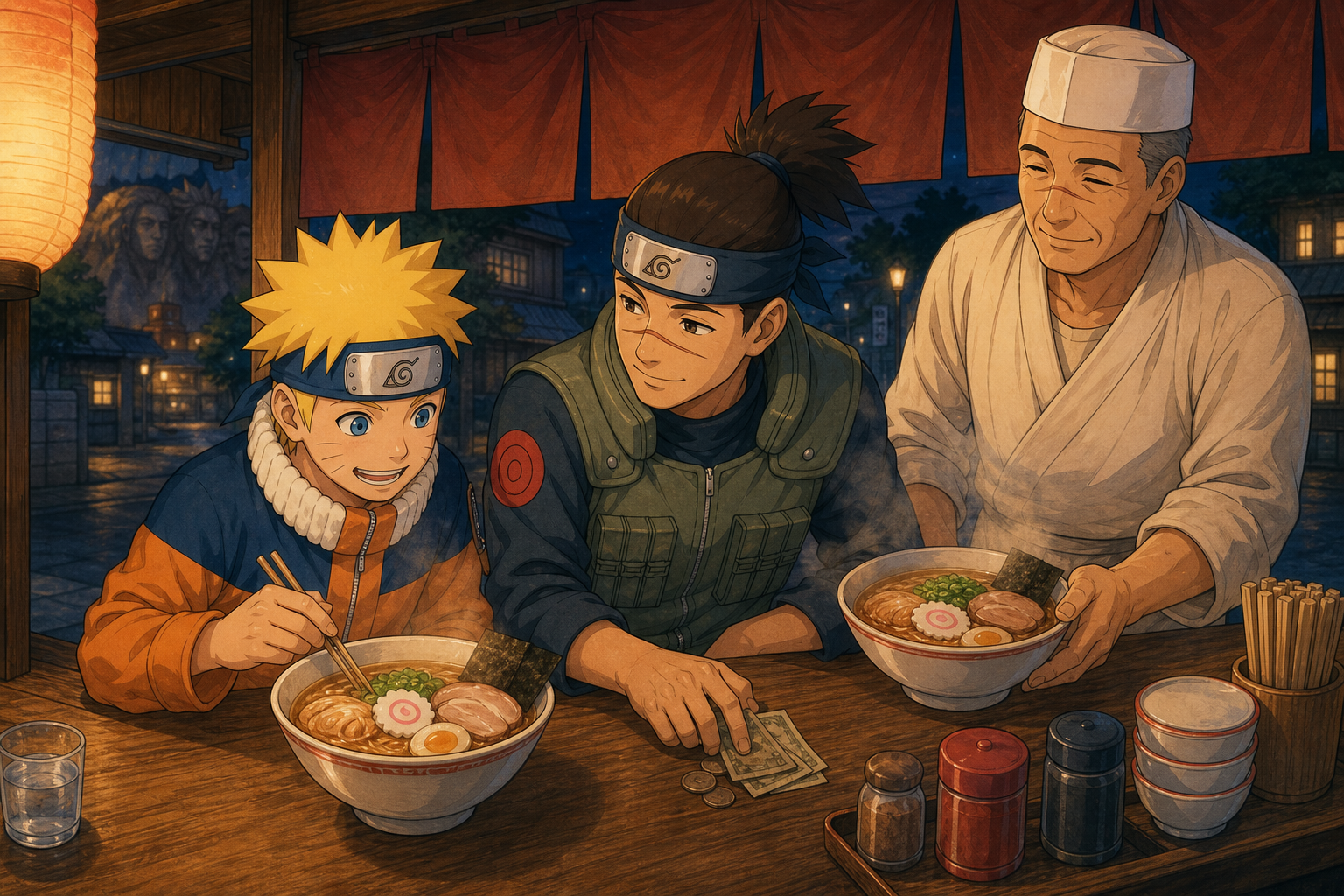
The Naruto Food File
Ramen gives an orphan a regular seat. Barbecue gives a team somewhere to become friends after the mission. Bento makes care portable. Soldier pills turn eating into military logistics. In Naruto, meals reveal who is welcomed, who is working, who is grieving,and who has forgotten that bodies cannot live on willpower alone.
The one-sentence truth
Food in Naruto measures belonging: ordinary meals make people human to one another, while pills, rations, hunger, and mission schedules expose the cost of treating shinobi bodies as weapons.
Canon food
Dishes, preferences, and meals explicitly shown or stated in manga, anime, or official character material.
Cultural context
Japanese food history and dining practice that help explain a scene without claiming the series invented them.
Character reading
Interpretation of how a meal develops relationship, class, grief, or identity. Analysis stays labeled as analysis.
Not an official cookbook
Naruto rarely provides exact recipes. This guide explains foods and scenes; it does not fabricate canon broth ratios.
Food scenes operate on two clocks. The mission clock asks how fast a body can refuel and return to work. The relationship clock asks who prepared the meal, who shares it, who pays, who is missing, and whether the eater is allowed to rest long enough to taste anything.
The series needs both. Soldier pills make ninja logistics plausible. Ichiraku makes Naruto’s childhood emotionally legible. One keeps the weapon functioning. The other tells the child he has a seat.
Ichiraku ramen: the first table that keeps a place for Naruto
Naruto Uzumaki loves Ichiraku ramen. Official character information identifies Ichiraku’s ramen and oshiruko among his favorite foods. Iruka Umino also favors Ichiraku, making the shop part of their shared language.
Ramen is affordable, warming, fast, and socially accessible. A counter seat does not require a family dining room. For an orphan returning to an empty apartment, the shop offers routine contact without demanding a confession of loneliness.
Teuchi and Ayame serve Naruto before the village celebrates him. Their hospitality matters because it is ordinary. They do not need him to defeat Pain before deciding he deserves dinner.
That ordinariness is political. Konoha’s formal institutions classify Naruto as jinchūriki, orphan, troublemaker, student, and military asset. A neighborhood business knows him as a regular. The shop’s recognition is smaller than the Hokage Monument and healthier than most of the village.
Fans sometimes romanticize Ichiraku into Naruto’s replacement family. The text supports warmth and continuity, not a complete private childhood we never see. We do not need to inflate the relationship. Remembering a child’s order and welcoming him back is already a big damn deal when his community crosses the street to avoid him.
Canon anchor: official Naruto character material lists Ichiraku ramen among Naruto’s favorite foods and Ichiraku ramen as Iruka’s favorite.
Iruka’s bowl is care without interrogation
Iruka takes Naruto to ramen after emotionally significant moments. The meal creates a space where teacher and student can sit beside one another rather than face each other across an institutional desk.
Buying food is materially small compared with saving a life, yet it answers a recurring need: Naruto wants an adult who notices whether he has eaten, listens to his boasting and returns the next day.
The bowl cannot repair orphanhood. Its power lies in repetition. Family is built not only through dramatic sacrifice but through becoming expected at a familiar counter.
What is in a bowl of ramen?
Ramen pairs wheat noodles with broth and toppings. Styles vary enormously. The series presents Ichiraku as a recognizable neighborhood ramen shop rather than documenting one fixed real-world regional recipe.
Noodles
Alkaline wheat noodles provide chew and carry broth. Thickness and curl vary by shop and style.
Broth
Possible bases include pork, chicken, seafood or vegetables. “Shōyu,” “miso” and “shio” often describe seasoning profile more than a complete stock recipe.
Chāshū and egg
Braised pork and seasoned egg add richness and protein. Presentation changes across adaptations and promotional versions.
Narutomaki
The white-and-pink spiral fish cake is called narutomaki. The visual rhyme with Naruto’s name and spiral motifs makes it irresistible iconography, but the character is not simply named after a ramen topping in isolation.
Naruto’s name, narutomaki and spirals
Jiraiya names the hero of his first novel Naruto after seeing narutomaki in ramen. Minato and Kushina later choose the fictional character’s name for their son. The chain links food, authorship, godparenthood and identity.
“Naruto” also refers to whirlpools associated with the Naruto Strait, while narutomaki displays a spiral. The Uzumaki name means “spiral” or “whirlpool.” The series layers these associations rather than giving the name one single joke-origin.
A ramen topping becomes part of a symbolic network: whirlpool, seal, clan, narrative hero and child named after a story about perseverance.
Barbecue and Team Asuma
Chōji Akimichi, Shikamaru Nara, Ino Yamanaka, and Asuma Sarutobi are repeatedly associated with barbecue meals. Yakiniku lets diners cook pieces together over a shared grill, making conversation, timing, appetite, and bill-paying part of the table.
For Chōji, eating is tied to clan methods that convert calories into chakra and body expansion. Jokes about appetite conceal the strategic reality that food is stored energy and inherited knowledge.
For Team 10, the restaurant becomes an off-duty room. Their bond exists not only in formation tactics but in arguments over portions, checks, and who notices whom. The meal gives a military team a civilian rhythm.
After Asuma’s death, familiar food carries absence because the seating arrangement remembers. Grief does not only live at graves. It appears when the person who usually reaches for the bill is gone and everyone knows exactly where his hand should be.
Chōji later promises to stop relying on Asuma to pay, a small sign of adulthood that lands because the recurring joke had built economic intimacy first. Food comedy becomes succession. The student grows by recognizing what the teacher quietly provided.
Food, bodies and the Akimichi clan
Akimichi techniques use calories as a combat resource. The clan’s Three Colored Pills rapidly convert fat into immense chakra at escalating physical cost. Spinach, curry and chili pills represent increasing power and danger; the final pill can be fatal without intervention.
The system refuses the assumption that a large body is undisciplined. Chōji’s body is trained capacity. Its fat supports techniques other shinobi cannot perform.
At the same time, repeated insults about weight wound him because the village reads appearance through ordinary stigma rather than clan function. Food can be strength within one knowledge system and shame within another social gaze.
Soldier pills: a meal redesigned by the military
Hyōrōgan, commonly translated as military ration pills or soldier pills, restore stamina and help shinobi continue operating under difficult conditions. Exact effects vary with depiction, source, and formula.
The pills compress nourishment into portable mission technology. They reduce weight, spoilage, preparation time, and the need for a fire or visible camp. A reconnaissance unit can stay mobile while carrying more operational days in less space.
Efficiency has a cost. A pill treats the body as a machine that must remain deployable rather than a person who deserves rest, pleasure, digestion, and a shared table. The difference between ramen and a ration pill is not only flavor; it is whether eating is relationship or maintenance.
That does not make the pill evil. Field medicine and emergency nutrition save lives. The ethical problem begins when emergency support becomes the excuse for permanent overwork. A shinobi who can swallow one more pill may still need sleep, treatment, and a leader willing to stop.
The military imagination loves anything that converts care into a compact object. Pop it, move on, no kitchen, no cook, no vulnerability. Naruto keeps reintroducing the people hidden by that fantasy: healers, shopkeepers, teammates, farmers, and bodies that eventually refuse the schedule.
Hero Water and the fantasy of borrowed capacity
In the Land of Tea-era anime material and especially the Hidden Waterfall setting, special water or performance-enhancing substances temporarily increase chakra at bodily cost. Such devices belong beside soldier pills conceptually even when they are not ordinary food.
They dramatize the shortcut question: can a body borrow tomorrow’s strength to survive today? Ninja institutions routinely reward the answer when mission success matters more than recovery.
This guide separates manga-canon systems from anime-original food adventures. Filler can still reveal what the adaptation finds narratively useful, but it should not be presented as identical source continuity.
Bento, onigiri and portable care
Bento organizes a complete meal for travel, school, or work. Onigiri, rice balls often filled or seasoned, make staple food portable. Both suit a mission culture in which people leave early and eat away from kitchens.
A prepared lunch communicates care without speech. Someone planned portions, wrapped food, and imagined the eater’s future hunger. That future orientation matters in a story where adults often train children for danger without planning adequately for their safety.
The bell test twists this logic. Kakashi forbids Sasuke and Sakura from feeding Naruto. They share food anyway. Their first successful teamwork is a violation that treats nourishment as more fundamental than the instructor’s rule.
Kakashi engineered the prohibition to test whether they would recognize the hidden ethical requirement. That does not make the hunger fake. Naruto’s body is still the medium of the lesson. The scene works because Sasuke and Sakura stop treating his deprivation as deserved punishment and act together.
Food-sharing also invokes Japanese group etiquette and school-lunch familiarity without needing a lecture. Dividing a meal says the group will absorb scarcity together. Team 7 becomes a team when lunch stops being individual property.
This moment belongs in both a food file and the Survival Test arc guide: lunch is the mechanism through which three competitors begin becoming comrades.
Dango, sweets and character texture
Dango are skewered rice-flour dumplings served in many sweet or savory styles. Anko Mitarashi’s name itself echoes sweet-food vocabulary: anko is red bean paste, and mitarashi dango are glazed dumplings associated with a particular preparation tradition.
Character data frequently assigns favorite and disliked foods. These details are not power-system lore; they make elite combatants legible as people with appetite, comfort and aversion.
Naruto’s fondness for oshiruko,sweet red bean soup,softens the assumption that he only wants salty ramen. Kakashi’s preferences, Hinata’s cinnamon rolls in later materials, and Sakura’s tastes help fandom imagine ordinary days the main plot rarely pauses to show.
Curry of Life and anime-original excess
The Curry of Life appears in an anime-original storyline and is presented as extremely spicy, restorative food tied to the Curry of Life shop. Rock Lee and others encounter it during the Kurosuki Family material.
It is comedic and emotionally useful, but continuity labeling matters. A detailed fandom should say “anime-original” instead of quietly blending every adaptation invention into manga canon.
Food filler episodes often work because cooking lowers the stakes enough for personalities to collide. They are not worthless; they answer different questions than the central plot.
Restaurants as civilian infrastructure
Konoha’s restaurants prove the hidden village is not only barracks and training grounds. Cooks, servers, farmers, fishers, delivery workers, brewers, cleaners, and suppliers sustain the military population.
Shinobi earn mission pay and spend it in a civilian economy. Teams celebrate promotions, birthdays, reunions, and grief in businesses that never receive combat ranks. The mission system and restaurant system are materially linked even if one gets monument faces and the other gets dishes.
Restaurants also create semi-public intimacy. Home can be private and unequal; headquarters can be formal. A counter or grill lets teachers and students meet without pretending hierarchy disappeared. Iruka can buy Naruto dinner. Asuma can feed Team 10. Kakashi can be late and still find everybody annoyed together.
The village calls shinobi protectors, but restaurants show what protection is for: not an abstract map symbol, but repeated ordinary life. If peace does not create more places where people can eat without fear, then peace is just a quieter mission briefing.
Hunger, poverty and the villages outside abundance
The Land of Waves places Team 7 inside a community strangled by Gatō. Inari’s household offers shelter and meals despite insecurity. Hospitality becomes resistance to the isolation Gatō’s economy produces.
Tsunami feeds foreign shinobi who arrived under a contract her father falsified. That domestic labor supports the mission while rarely entering its official accounting. The bridge fight looks heroic because someone else kept the fighters housed and fed before sunrise.
Amegakure’s war orphans learn that food, shelter, and safety are political resources. Nagato, Konan, and Yahiko’s hunger is not personal failure; it is the civilian consequence of larger nations using a small country as battlefield.
Jiraiya feeding and teaching the orphans interrupts that abandonment, but temporary care cannot rebuild the state around them. Once he leaves, the structural vulnerability remains. Compassion is real and incomplete.
Konoha’s abundant shops look natural when the story stays inside them. Travel reveals that bowls, meat, sweets, and stocked markets depend on peace, roads, weather, labor, and military advantage. Food abundance is geopolitical privilege made edible.
This is why hunger should not become aesthetic trauma. Empty bowls are not set decoration proving the arc is serious. They are receipts for who controlled land, trade, and safety before the hero arrived.
Favorite foods are not personality tests
Official profiles use food preferences as quick texture. They should not be inflated into destiny. Naruto’s ramen love reflects comfort and habit; it does not explain his entire psychology.
Preferences can nevertheless open good questions. Who introduced the food? Is it affordable? Is it eaten alone or with others? Does a character cook, buy, receive or refuse it?
Fandom becomes richer when trivia leads back to lived context instead of becoming a list copied without meaning.
Common food-file confusions
Is Ichiraku a real historical Naruto restaurant?
Ichiraku is fictional within the series. Licensed attractions and collaborations have created real-world Ichiraku-themed dining experiences.
Is every ramen spiral narutomaki?
No. Narutomaki is a particular steamed fish cake with a characteristic spiral cross-section.
Are soldier pills complete meals?
They are mission aids and compressed military nutrition in the fiction, not evidence that ordinary food and recovery are unnecessary.
Is Curry of Life manga canon?
No. It belongs to anime-original material. It can be discussed as part of the Naruto anime ecosystem with that label intact.
What food is really telling us
Naruto begins with a child who wants the village to say his name. Food reveals a quieter version of that desire: he wants someone to expect his arrival, remember his order, and notice his empty seat.
Military systems measure bodies by chakra, endurance, and mission usefulness. Meals restore another scale of value. A person can deserve care before proving strength.
Confucian reciprocity lives naturally at the table. Elders feed children; students grow and later feed others; teams share obligation. The ethic fails when authority wants service without sustenance. You cannot call people family and then forget whether they ate.
A Buddhist lens reminds us that appetite is neither sin nor complete identity. Chōji’s hunger is mocked when observers reduce him to it. Naruto’s ramen love becomes caricature when fandom forgets the relationships around the bowl. Desire becomes meaningful through context, not shame.
The existential question is simple: are you being fueled for what others need from you, or fed because your continued presence matters? Naruto’s most beloved bowl answers both, but the second answer is why fans remember it.
Ichiraku does not solve the ninja world. It gives one child an ordinary place inside it. Sometimes that is where a revolution in belonging starts, with somebody setting down a bowl before asking what you can do for them.
Food measures belonging faster than a speech
Naruto begins as a child with money for ramen and almost no dependable family table. Ichiraku matters because Teuchi and Ayame feed him without turning the meal into a test of whether he deserves ordinary kindness. The bowl does not solve institutional neglect. It gives Naruto one place where hunger is answered instead of judged.
That is why shared meals keep carrying emotional weight. Barbecue gives Team 10 a social rhythm outside missions. Bento boxes reveal who prepared for whom. Dango, tea, festival food, hospital fruit, and post-mission meals mark pauses where shinobi can become people again. Characters who struggle to speak directly can still sit down, offer food, and make care visible.
Rations expose the military body
Soldier pills and field provisions turn eating into performance management. Calories, chakra, endurance, medicine, and emergency recovery become part of mission planning. Chōji’s clan pills push that logic to its cruel limit by converting the body into power through escalating danger. The technique is heroic in context and horrifying as a system.
The contrast with ramen is deliberate even when the story does not announce it. One meal restores a person because somebody wants them alive and comforted. Another treats the body as a resource that may be spent to finish the assignment. Both feed the shinobi. Only one asks what the person needs after the battle.
RaeRae’s bottom line
Do not treat Naruto food as decorative trivia. Meals identify home, scarcity, friendship, class, discipline, hospitality, and the difference between sustaining a life and fueling a weapon. Watch who cooks, who pays, who shares, who eats alone, and who finally gets invited back.
Source shelf and adaptation boundary
Favorite-food details use official Naruto character material. The bell-test meal, Team 10 barbecue, Land of Waves hospitality, Akimichi pills, and war-orphan hunger use the core manga/anime record. Cultural context explains ramen, yakiniku, bento, onigiri, dango, oshiruko, and narutomaki without claiming one universal recipe. Interpretation and judgment are original to CVM Sekai.
Anime-original foods such as Curry of Life remain labeled anime-original. Attraction menus, collaborations, games, and branded cookbooks can be delightful without becoming story canon. Where the franchise does not give a recipe or exact nutritional rule, this file does not invent one.