
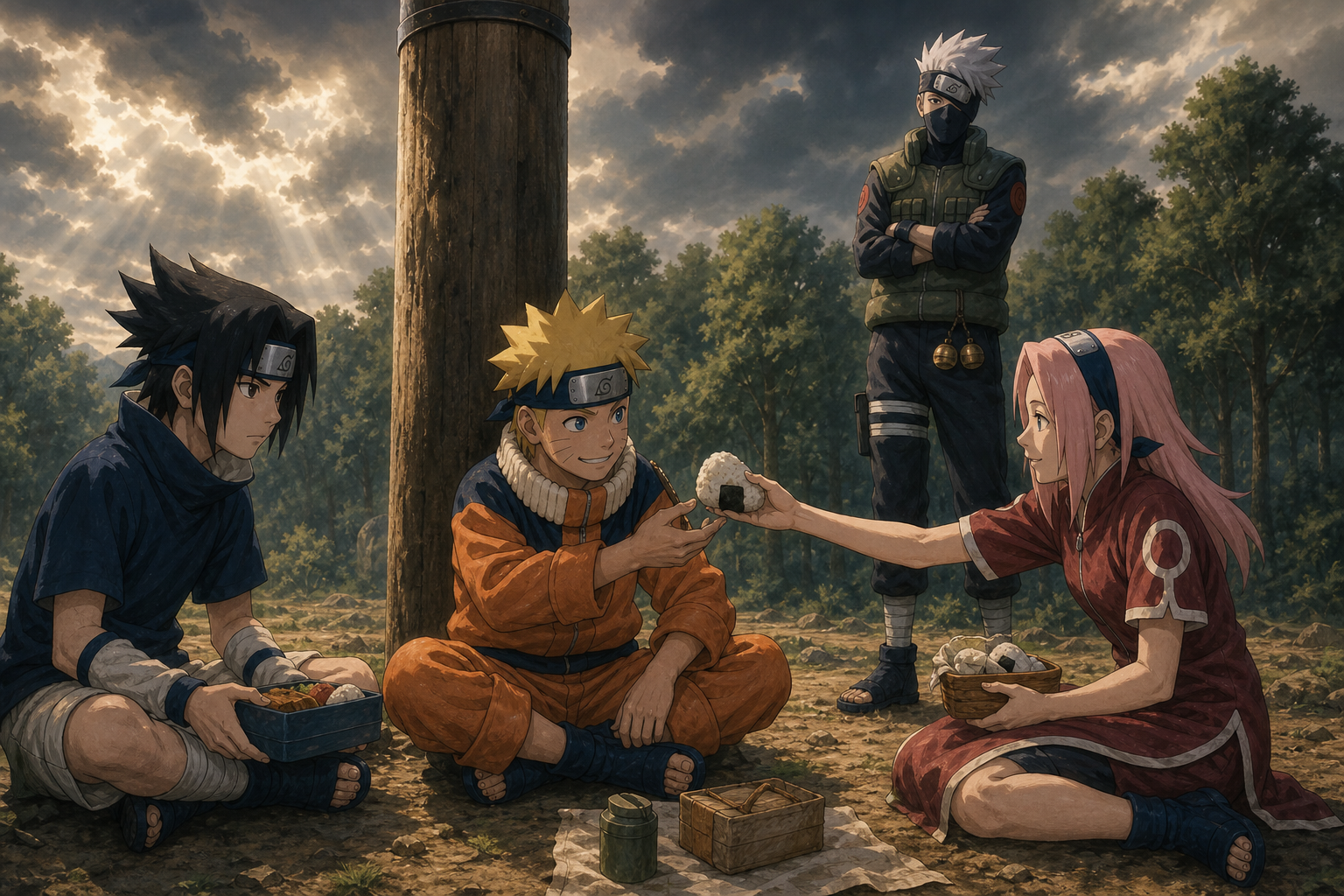
Survival Test: how four lonely people accidentally become Team 7
Before the bridge, the exams, and the wars, Naruto begins with a smaller revolution: three children choose to share lunch even when the adult holding their future tells them not to.
A village can know your name and still refuse to know you
Naruto’s opening arc is not really about graduating from school. It is about whether institutions that classify children can recognize them as human beings, and whether wounded children can recognize one another before the system converts loneliness into competition.
Naruto Uzumaki paints the Hokage Monument because negative attention is still evidence that he exists. The prank is childish, but its logic is devastatingly adult. Konoha looks through him until he becomes inconvenient. His Hokage dream is noble and wounded at once: he wants to protect the village, and he wants a title powerful enough to compel recognition ordinary personhood did not earn him.
The series refuses to make the village’s rejection abstract. Adults glare. Parents pull children away. The law forbidding discussion of Kurama protects classified history but leaves Naruto surrounded by conclusions nobody will explain. Silence does not prevent stigma. It gives stigma the authority of a secret everyone else seems to understand.
The first major act of heroism belongs to Iruka Umino. He does not defeat Naruto’s isolation with a secret technique or policy speech. He names Naruto as citizen, student, and individual while standing between him and Mizuki. Iruka knows Kurama took his parents. His recognition carries moral weight because he refuses to let inherited grief decide what adult he will be to a child.
Mizuki sees the same loneliness and chooses exploitation. That contrast is the arc’s ethical engine. Recognition is not automatically kindness. An abuser can read a wound accurately and use the information as a handle. Iruka recognizes Naruto in order to protect his agency; Mizuki recognizes him in order to redirect it.
Episodes 2 and 3 widen the diagnosis. Konohamaru is hidden by prestige instead of stigma. Sasuke is admired so aggressively that nobody asks what the silence contains. Sakura performs a socially polished self while an inner voice keeps the less acceptable parts alive. Kakashi arrives late with his face covered and grief encoded into a test. Team 7 does not begin with four personalities. It begins with four defense systems and a lunch nobody is supposed to share.
Five episodes, five lessons about belonging
Episode 1: recognition creates the hero
Mizuki weaponizes Naruto’s hunger to belong, sending him after the Scroll of Sealing and revealing the truth of the Nine-Tails. The revelation does not simply explain why the village hates Naruto. It gives Naruto the interpretation he has feared all along: perhaps the disgust on every adult face is proof that he is the monster.
Iruka interrupts that conclusion. He distinguishes the child from what was placed inside him, and Naruto answers by mastering the Multiple Shadow Clone Technique. The sequence establishes the series’ central relationship between recognition and power. Naruto’s strength becomes available after one trusted person sees him clearly.
Episode 2: loneliness can reproduce hierarchy
Konohamaru Sarutobi is Naruto’s comic mirror. Naruto is ignored because his identity carries stigma; Konohamaru is ignored because his identity is swallowed by prestige. One is “the fox.” The other is “the Third Hokage’s grandson.” Both want to be addressed as themselves.
Naruto’s first attempt at mentorship is gloriously unqualified, but ethically important. He refuses to flatter Konohamaru’s title and refuses to hand him a shortcut. Respect cannot be stolen through transformation or inherited through blood. It has to be built through the difficult work of becoming someone.
Episode 3: Team 7 begins as three private fantasies
Sasuke Uchiha wants power for a revenge he will not explain. Sakura Haruno wants Sasuke’s approval and treats Naruto as an obstacle. Naruto wants Sakura and resents Sasuke as the person already receiving the admiration he craves.
The accidental kiss is broad comedy, but it also punctures the polished social script. The children enter Team 7 knowing one another mostly as projections. Sasuke is the cool rival, Sakura the prize, Naruto the nuisance. Their arc begins when reality repeatedly embarrasses those categories.
Episode 4: Kakashi tests the rule beneath the rule
Kakashi Hatake presents two bells to three students and tells them to compete. The arithmetic is psychological warfare. Each child is invited to believe that another child’s failure is the price of personal survival.
Naruto attacks without a plan, Sasuke tries to win alone, and Sakura is trapped inside an illusion shaped around Sasuke. Kakashi defeats them because he understands their isolation more completely than they understand his strength. The test is not measuring whether they can take bells from a jōnin. It is measuring whether they can perceive the institution’s stated incentive as a trap.
Episode 5: disobedience becomes an ethical skill
Kakashi ties Naruto to a post and orders Sasuke and Sakura not to feed him. The instruction is clear. The moral situation is clearer. Sasuke shares food because a hungry teammate will weaken the unit; Sakura joins him. Their reasons do not need to be pure. Solidarity often begins as practical recognition before it develops the language of affection.
Kakashi’s judgment,that those who abandon comrades are worse than those who break rules,contains the series’ most important institutional contradiction. Shinobi are trained to obey, yet the best shinobi must recognize when obedience destroys the purpose the rule claims to serve. Team 7 forms not when they receive matching paperwork, but when they accept responsibility for a person they did not choose.
The people inside the formation
Naruto Uzumaki
The neglected child who mistakes visibility for belonging. Iruka’s protection and Team 7’s food begin teaching him that recognition can arrive through relationship rather than applause.
Sasuke Uchiha
The celebrated prodigy whose isolation is mistaken for self-sufficiency. Sharing food is his first quiet rebellion against the idea that survival must be solitary.
Sakura Haruno
Academically accomplished but emotionally organized around approval. The test begins separating her actual judgment from the persona she performs for Sasuke.
Kakashi Hatake
A teacher using apparent cruelty to detect the isolation that once destroyed people he loved. The memorial posts make the test personal long before the students know why.
Iruka Umino
The first adult to separate Naruto from the demon sealed inside him. His headband is not merely a graduation gift; it is material proof that Naruto has been witnessed.
Mizuki
The adult who sees Naruto’s loneliness clearly and chooses exploitation. He is Iruka’s moral opposite: recognition without care becomes manipulation.
Hiruzen Sarutobi
The Hokage who protects Naruto in broad institutional terms but cannot give him ordinary intimacy. His affection exists beside the village’s ongoing failure.
Konohamaru Sarutobi and Ebisu
A child suffocated by inherited status and the tutor tasked with reproducing that status. Naruto offers Konohamaru equality disguised as chaos.
What the formation of Team 7 is really saying
The headband is recognition and conscription
When Iruka gives Naruto his protector, the object answers a desperate need. Naruto is officially included. The same object marks him as deployable. Community can save a person and recruit that person into danger at once. Naruto’s lifelong problem is learning to love his village without becoming unable to judge it.
The contradiction is not a cynical gotcha. Iruka’s gift is loving. Naruto’s pride is real. So is the fact that graduation moves a twelve-year-old from classroom rejection into military labor. Naruto becomes somebody in the village’s eyes just as the village gains the right to assign his body.
The bell test is an anti-meritocracy trap
Two bells create artificial scarcity. Kakashi watches to see whether talented children accept the premise that another child must lose for them to succeed. Sasuke appears best positioned to win individually, but individual victory is defined as collective failure.
The test exposes a truth hidden inside competitive institutions: sometimes rules reward the behavior the institution publicly condemns. Teamwork appears in the curriculum while the immediate incentive says hoard, deceive, and let one teammate return to school. Passing requires reading the purpose beneath the procedure.
Every child performs an answer to loneliness
Naruto becomes loud. Sasuke becomes unreachable. Sakura becomes socially vigilant, constructing inner and outer selves around evaluation. Kakashi becomes late, evasive, and unreadable. Their personalities are not reducible to trauma, but their friction makes more sense as four survival strategies colliding.
Naruto attacks to force the room to acknowledge him. Sasuke withdraws before attachment can create another loss. Sakura studies social hierarchy because acceptance feels safer when managed. Kakashi creates distance because closeness has repeatedly become grief. Team formation does not erase those strategies. It creates a place where they can stop being the only available answer.
The forbidden lunch turns care into tactics
Sasuke initially feeds Naruto because a hungry teammate will weaken the unit. That practical reasoning is enough. Ethical life does not always begin with perfect feeling. Sometimes it begins when someone notices another body’s need and refuses to call suffering deserved.
Sakura follows. The act revises her earlier treatment of Naruto without pretending she suddenly understands him completely. Food crosses the gap before affection does. The body receives care while the relationship is still learning its name.
Kakashi teaches through a wound he has not explained
The lesson comes from Obito’s condemnation of abandoning comrades and Sakumo’s destruction after choosing teammates over mission success. Kakashi turns private grief into pedagogy. That gives the test emotional authority and makes its cruelty worth examining.
He frightens, starves, humiliates, and deceives children to see whether they will reject the stated rule. The result saves them from becoming the kind of team that failed his past. It also shows a wounded teacher reproducing pressure because pressure is the language he knows. Good purpose does not make every teaching method above criticism.
Easter eggs and long echoes
The Fourth Hokage’s face watches Naruto deface the monument before viewers know their relationship. The Scroll of Sealing introduces Shadow Clones, whose shared memories later transform training and identity. Kakashi’s memorial posts connect his teamwork obsession to Obito and Rin before the students know why.
The bells return after the time skip, measuring growth by repetition. Team 7’s awkward photograph becomes an artifact because the family exists before its members know what to call it. The arc plants objects that will spend years collecting consequence.
How the anime makes a tiny test feel foundational
The original anime places these five episodes under director Hayato Date’s series leadership, with series coordination credited to Katsuyuki Sumisawa and character design to Tetsuya Nishio and Hirofumi Suzuki. Toshio Masuda’s music gives the opening material room to shift between prank comedy, unease, action, and the first emotional declarations without pretending the story has only one tone.
The production design understands that spaces teach. The Hokage Monument makes Naruto’s need public. The forest around the Scroll of Sealing isolates teacher and student from village spectators. The classroom assigns teams through desks and lists. The memorial-post field looks open while Kakashi controls every condition. Institutions become architecture before characters explain them.
The bell test animation favors readable tactics over scale. Clones, wires, traps, substitution, taijutsu, and misdirection reveal thinking. Kakashi’s book gag works because his body remains composed while the children spend everything. The visual joke is also a power diagnosis: he can divide attention; they cannot yet combine theirs.
The verified original Japanese cast places Junko Takeuchi as Naruto, Noriaki Sugiyama as Sasuke, Chie Nakamura as Sakura, and Kazuhiko Inoue as Kakashi, with Toshihiko Seki as Iruka and Shinichirō Miki as Mizuki. Those credits matter because this arc establishes vocal identities the franchise carries for decades. A cast list is a receipt; performance claims still need heard scenes, so this file does not invent breath or pitch analysis from memory.
The adaptation’s best structural choice is patience. It spends nearly a full episode letting the impossible test expose the team, then another letting food resolve what combat could not. A modern binge summary might compress the bells into “Kakashi teaches teamwork.” The anime makes viewers sit inside each child’s wrong answer long enough for the shared lunch to feel earned.
The consequences do not end when Kakashi says they pass
Naruto learns that recognition can come from specific people rather than a whole crowd. That lesson makes later relationships possible. He does not stop wanting Hokage acknowledgment, but Iruka gives him a model of belonging that is not applause.
Sasuke’s decision to share food becomes the first receipt against the idea that he was always emotionally unreachable. Later rupture hurts because Team 7 was real before revenge pulled him away. The series can argue for return because the bond has behavior behind it.
Sakura begins moving from social performance toward judgment. She still has miles to go, especially in how she treats Naruto and imagines Sasuke, but the lunch proves she can act against the hierarchy she has been following.
Kakashi accepts another team. His earlier groups failed because he rejected candidates who obeyed the test’s surface. Passing these three means exposing himself to attachment again. The jōnin who appears detached has just chosen future grief as the price of mentorship.
Institutionally, the result is more ambiguous. Konoha has created a team capable of mutual care, then immediately sends it into a mission economy where bad intelligence will test that care against lethal force. The bell lesson is not sentimental preparation. It is survival equipment for Land of Waves.
The arc also defines Naruto’s moral method. Rules, labels, and inherited hatred will keep presenting themselves as reality. Naruto’s answer begins here: look for the person the category is starving, then feed them before debating whether the form was properly filed.
Survival Test episode guide
Episode 1 · Enter: Naruto Uzumaki!
The forbidden scroll, the truth of the Nine-Tails, Iruka’s recognition, and Naruto’s first overwhelming victory.
Read Episode 1 →Episode 2 · My Name Is Konohamaru!
Two boys trapped inside public labels discover that respect cannot be inherited or transformed into existence.
Read Episode 2 →Episode 3 · Sasuke and Sakura
Team 7 arrives as rivalry, projection, romantic performance, and one accidental kiss.
Read Episode 3 →Episodes 4-5 · The bell test
Kakashi’s impossible challenge reveals that teamwork requires the courage to read beneath an order.
Start Episode 4 →Browse the complete Naruto episode directory · Watch Naruto officially on Crunchyroll
The bell test is not a teamwork poster
People flatten this arc into “work together and you win,” which is true in the same way that saying ramen contains noodles is true. Kakashi builds a test where obedience to the stated rules produces the wrong moral answer. Only two students can earn bells. Anyone without one loses lunch. Helping Naruto is forbidden. The children have been trained to chase individual recognition, so the setup weaponizes exactly what the Academy rewarded.
Sasuke initially treats the test like a private ranking exercise. Sakura lets her fixation on Sasuke shrink her field of vision. Naruto attacks the problem loudly and alone because attention has always been his substitute for security. Kakashi does not manufacture those weaknesses. He exposes them, then waits to see whether the team can choose each other over the institution’s immediate command.
The lunch scene matters because sharing food is not a cute epilogue. Sasuke and Sakura knowingly risk failure to meet Naruto’s basic need. That choice is the first evidence that Team 7 can become more than three children assigned to the same supervisor. Kakashi passes them only after they disobey him for the right reason.
Kakashi’s lesson carries his own dead team inside it
Kakashi quotes the principle that abandoning comrades is worse than breaking rules because Obito forced that truth into his life. The test therefore contains grief he does not explain to his students. He is asking Team 7 to avoid the failure that destroyed Team Minato, even while his aloof performance makes care look like indifference.
That contradiction is why the arc works. Kakashi is a perceptive teacher and a damaged adult. He understands the lesson but has not mastered openness. Team 7 passes the stated test in five episodes. Becoming a family takes the rest of the story, several betrayals, one war, and more emotional paperwork than Konoha ever wants to file.
Sakura’s first choice deserves to stay in the record
Sakura often gets reduced to the crush that limits her during these opening episodes, but the pass is also her first deliberate move beyond it. Feeding Naruto does not impress Sasuke, win a bell, or make her look capable. It simply recognizes that a teammate is hungry and that Kakashi’s order is wrong. The gesture is small because moral beginnings usually are.
Naruto also changes the team before he has the skill to lead it. His refusal to disappear makes Sasuke and Sakura account for him. The boy who was treated as a nuisance becomes the person whose exclusion reveals the test’s cruelty. Team 7 begins when all three children stop accepting that one of them must be disposable.
Source shelf and adaptation boundary
Arc boundaries and event checks use the official Naruto 20th Anniversary retrospective, the official pages for Episode 4 and Episode 5, and the official Volume 1 synopsis. Series staff and original Japanese cast credits use the official Naruto anime page. Analysis and editorial judgment are original to CVM Sekai.
The anime and manga pace these events differently, and localization changes some wording. This file keeps the shared story spine visible, labels anime episode structure, and does not fake scene-specific voice criticism without the heard Japanese performance.
They passed the test. Now the world tests them.
Land of Waves takes Team 7’s new promise outside the village and asks whether teamwork can survive fear, exploitation, and real death.
Continue to Land of Waves → · Return to the Naruto arc directory →