
Mizuki
The smiling teacher who turns a lonely child’s need for recognition into a weapon, and the first villain to demonstrate that knowledge without care is another form of violence.
Bottom line: Mizuki weaponizes the trust attached to a teacher
Mizuki weaponizes Naruto’s need for recognition to steal the Scroll of Seals. His Episode 1 betrayal turns teacher authority into a weapon against a lonely child.
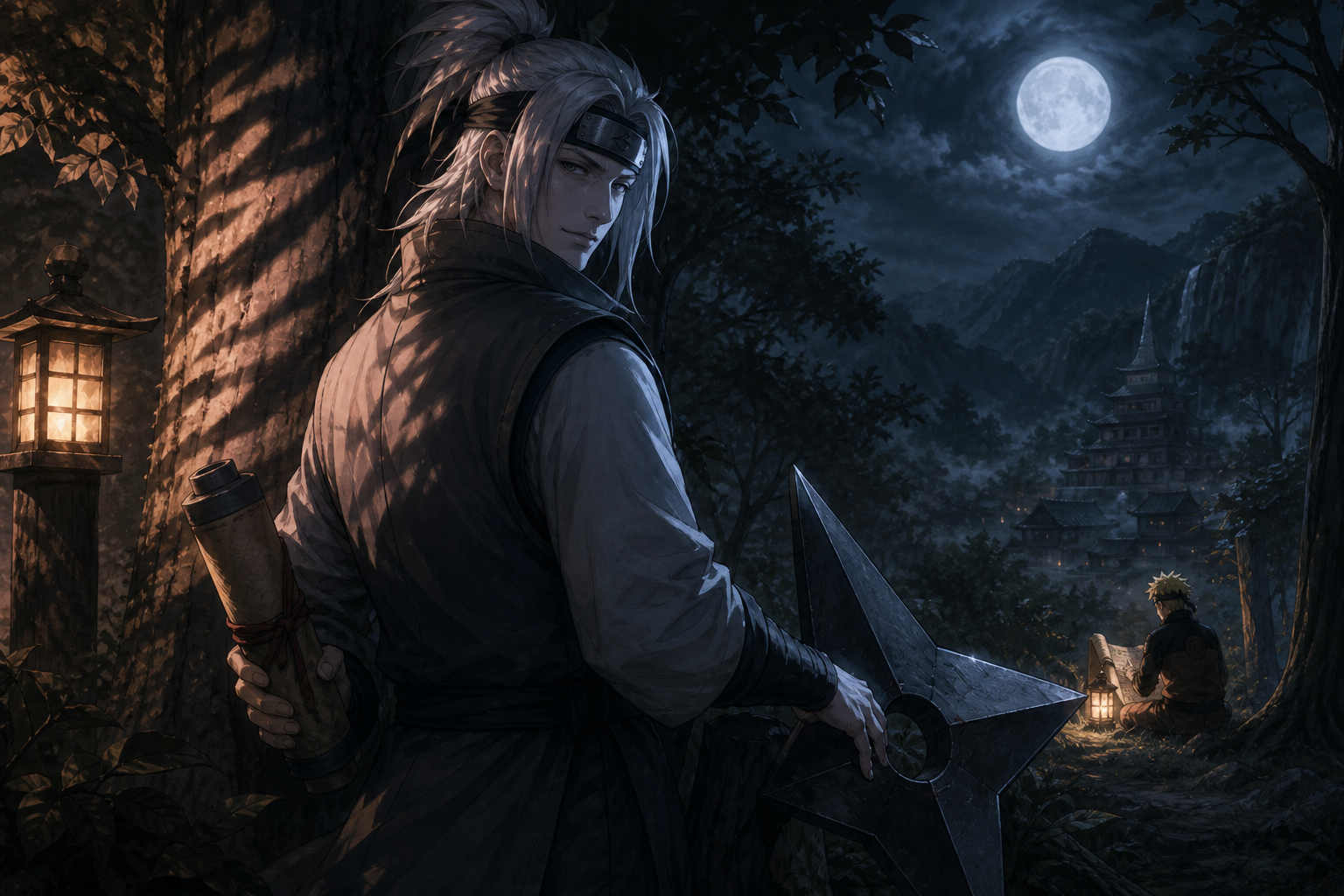
The silver-haired instructor with the enormous shuriken is easy to remember as the first man Naruto overwhelms. That summary captures the action and misses the design. Mizuki is the first person in Naruto to understand the hero’s emotional wound well enough to exploit it.
He does not approach Naruto as an obvious enemy. He approaches as a teacher offering special knowledge. Naruto has just failed graduation again. Iruka has maintained a standard that feels, to the hurt child, like rejection. Mizuki reframes the failure as unfairness and offers a secret route around it. His manipulation works because it imitates kindness, personal attention, and institutional honesty.
The theft of the Scroll of Seals is therefore not merely a security breach. It is abuse of educational authority. Mizuki knows Naruto trusts teachers to explain the rules of belonging. He invents a rule, sends the child into danger, then intends to kill him after recovering the prize. The villainy is intimate before it becomes physical.
Profile
| Name | Mizuki; commonly identified as Mizuki Tōji in supplementary usage |
|---|---|
| Japanese | ミズキ |
| Home | Konohagakure |
| Affiliation | Ninja Academy instructor; later imprisoned Konoha shinobi |
| Rank | Chunin |
| Primary role | Episode 1 antagonist, traitor, false mentor, Iruka’s foil |
| Original Japanese voice | Shinichiro Miki |
| First anime appearance | Original Naruto Episode 1 |
| Character tags | antagonist, teacher, traitor, Konoha, forbidden scroll, manipulation |
Spoiler map: This profile covers Episode 1 completely and discusses Mizuki’s later anime-original return, including his alliance, transformation, and defeat.
Complete Life File
Academy standing and concealed resentment
Mizuki serves as a Konoha Academy instructor alongside Iruka. The position grants access to children, institutional routines, and knowledge about Naruto’s vulnerable social status. Outwardly, he can perform patience and collegiality. Inwardly, he wants power and resents the limits of his place.
Unlike many later antagonists, Mizuki does not present an elaborate political philosophy. His grievance is personal and opportunistic. This relative smallness is thematically useful. The first threat to Naruto is not a god, revolutionary, or foreign army. It is a familiar adult who believes another person’s loneliness is raw material for his advancement.
The graduation failure
When Naruto fails the Clone Technique portion of the graduation exam, Mizuki argues for leniency while Iruka refuses. The exchange initially makes Mizuki look gentler. In retrospect, his apparent advocacy is reconnaissance. He observes the exact moment Naruto feels excluded and understands that the boy will be receptive to anyone who claims to possess a hidden path into the group.
Iruka’s refusal and Mizuki’s permission establish competing models of care. Iruka disappoints Naruto while protecting the meaning of the credential and the boy’s future competence. Mizuki tells Naruto what he wants to hear because the lie makes him useful.
The Scroll of Seals plot
Mizuki tells Naruto that stealing the forbidden scroll and learning a technique from it will allow him to graduate. Naruto, hungry for recognition and accustomed to solving pain through disruptive spectacle, accepts the task. He takes the scroll from the Hokage residence and studies it in the forest.
Mizuki’s plan depends on several layers of knowledge Naruto lacks: the scroll’s strategic value, the severity of the crime, the village’s secret about the Nine-Tails, and Mizuki’s intention to eliminate witnesses. The imbalance is what makes the manipulation so predatory. Naruto appears to choose, but the adult has engineered the available meaning of every choice.
The revelation and attack
When Iruka finds Naruto, Mizuki attacks with a giant shuriken and reveals that the Nine-Tailed Fox is sealed inside the boy. He presents the truth in its most psychologically destructive form. Rather than say Naruto contains the fox, he claims Naruto is the fox and that the village’s adults hate him accordingly.
The statement combines classified fact, social observation, and a false conclusion. Naruto has indeed been ostracized. The fox is indeed sealed within him. But identity does not follow containment. Mizuki takes two truths and arranges them into a lie designed to make Naruto abandon trust.
Iruka shields Naruto and openly rejects Mizuki’s definition. Hidden nearby, Naruto hears the two teachers make competing claims about who he is. Mizuki offers an identity assigned by fear. Iruka names effort, loneliness, mischief, pain, and personhood. Naruto chooses which interpretation he will act from.
Defeat by the technique of failed belonging
Naruto uses the Multiple Shadow Clone Technique learned from the scroll and produces an overwhelming crowd of physical duplicates. The technique is poetically exact. He failed the ordinary clone test, and Mizuki used that failure to manipulate him. Naruto transforms the category of failure into the instrument of resistance.
Mizuki’s defeat is not only a reversal of combat expectations. The lonely child whom Mizuki isolated becomes many. The teacher who treated him as a disposable tool is surrounded by the visible proof of Naruto’s capacity. Iruka then grants the forehead protector, ending Mizuki’s false graduation lesson with a real one.
Imprisonment and the later anime return
The anime later revisits Mizuki in an original storyline. Imprisonment does not produce insight. He remains attached to resentment and to the fantasy that power will vindicate him. He manipulates the Legendary Stupid Brothers, Fujin and Raijin, uses old connections, and pursues a formula associated with Orochimaru.
Mizuki’s transformation amplifies his body into a tiger-like form, externalizing the predatory self he once concealed behind a teacher’s smile. The power is unstable and costly. Rather than reveal hidden greatness, it exposes how little he has learned. He again seeks a shortcut, again treats other people as instruments, and again mistakes borrowed transformation for earned identity.
Iruka confronts him once more, making their contrast explicit. Mizuki views Iruka’s attachment to Naruto as weakness and imagines that strength should settle the question of worth. His eventual collapse demonstrates the emptiness of power pursued as compensation for grievance. The later arc is not required to understand Episode 1, but it extends the same psychology rather than replacing it.
Relationship and Foil Atlas
Naruto Uzumaki
Mizuki sees Naruto’s loneliness accurately and responds without empathy. That combination makes him dangerous. He is the first adult to offer Naruto forbidden truth, but he delivers truth as a weapon rather than a foundation for agency.
Iruka Umino
Iruka is Mizuki’s central moral opposite. Both are teachers, chunin, and holders of sensitive knowledge. Iruka accepts responsibility for the vulnerable student. Mizuki converts vulnerability into leverage.
Orochimaru
In the anime-original material, Orochimaru represents the power Mizuki envies and imitates. Mizuki adopts the logic of self-alteration without possessing Orochimaru’s scale, discipline, or long strategy. He becomes a minor echo of a much larger violation.
Fujin and Raijin
Mizuki uses the brothers’ appetite and limited judgment to facilitate escape and violence. The pattern repeats Episode 1: identify another person’s need, pretend to meet it, then deploy the person as a tool.
Konoha
Mizuki has institutional access but no durable identification with the community’s responsibilities. He wants what the village can give him while resenting the limits that membership imposes.
Ability and Method File
| Method | Function | Meaning |
|---|---|---|
| Manipulation | Identifies emotional need, offers special access, withholds consequences, and isolates the target. | His most effective ability is social rather than supernatural. |
| Academy fundamentals | Uses standard chunin skills, weapons, movement, and teaching knowledge. | Competence makes betrayal possible; he is trusted because he belongs inside the system. |
| Large shuriken | Attacks at range with lethal force. | The oversized weapon strips away the gentle-teacher performance and reveals direct predation. |
| Forbidden enhancement | In the later anime storyline, uses a formula to gain a tiger-like body and increased physical strength. | Turns the shortcut mentality of Episode 1 into bodily form. |
| Deception and impersonation | Uses false narratives and situational performance to redirect allies and enemies. | He wins access by controlling interpretation before combat begins. |
Limits
Mizuki overestimates his intelligence because his earliest deception succeeds. He understands immediate insecurity but not the resilience produced by real relationships. He assumes Naruto will break when told the truth and fails to anticipate that Iruka’s testimony can reorganize its meaning. Later, he again confuses temporary advantage with durable strength.
The Anatomy of False Mentorship
Special attention
A neglected child can experience individualized attention as proof of love. Mizuki makes Naruto feel selected. The secrecy of the task becomes evidence, in Naruto’s mind, that Mizuki trusts him with something others would not. In reality, secrecy isolates Naruto from corrective information.
A shortcut disguised as fairness
Mizuki does not tell Naruto to abandon the dream. He claims to provide a fairer route toward it. Effective manipulation often attaches itself to a legitimate grievance. Naruto has been excluded and denied essential knowledge. Mizuki exploits those truths to sell a course of action that serves Mizuki alone.
Withheld risk
Naruto cannot meaningfully consent to the theft because Mizuki lies about the rules and consequences. The boy believes he is completing an alternate exam. Mizuki knows he is inducing a serious crime. The gap between those understandings is the ethical center of the betrayal.
Identity as a final blow
Once the theft is complete, Mizuki reveals the Nine-Tails secret in a way intended to erase Naruto’s trust in everyone. He tries to leave the child with no community to return to and no self-description beyond monster. This is psychological disposal before attempted physical murder.
Existential File: Knowledge Without Responsibility
Does truth liberate by itself?
Naruto has a right to know what is sealed inside him. Mizuki proves that disclosure alone is not justice. Truth delivered without context, care, or regard for timing can become domination. The ethical problem is not that Mizuki tells Naruto. It is that he tells him in order to control what the information will mean.
The label and the person
Mizuki collapses Naruto into the Nine-Tails because categorical identity makes violence easier. If Naruto is a fox rather than a child, using and killing him can be narrated as defense. Iruka restores moral difficulty by describing Naruto concretely. Personhood returns through detail.
Institutional betrayal
Mizuki is dangerous because he is already inside the Academy. The series begins by warning that uniforms and titles do not guarantee ethical authority. A hidden village protects secrets, but secrecy also creates power for insiders who decide when and how those secrets appear.
Resentment and the fantasy of deserved power
Mizuki imagines that greater strength will reveal his true worth. This reverses Naruto’s healthier development. Naruto also wants power and recognition, but relationships gradually make power responsible to others. Mizuki treats others as the fuel of recognition, so every new advantage deepens isolation.
Design, Voice, and Adaptation
Mizuki’s pale hair, composed expression, and conventional shinobi clothing initially let him occupy the visual category of trustworthy instructor. The enormous shuriken changes the silhouette from approachable to predatory. His later tiger-like transformation abandons ambiguity and gives appetite a body.
Shinichiro Miki’s Japanese performance gives Mizuki the smoothness required for the deception and the contempt required for the reveal. The English performance similarly must make the early encouragement plausible without making the later cruelty feel unrelated. The voice is the bridge between false care and open hatred.
In the original manga’s opening, Mizuki’s function is concentrated. The anime extends his presence through a later original storyline. That addition offers more biography and action, but the pilot remains the character’s definitive material because his most important conflict is not his power level. It is the choice between two teachers’ interpretations of a child.
Easter Eggs and Close-Reading Notes
- Mizuki appears more sympathetic than Iruka during the graduation discussion. The pilot teaches viewers to distinguish comfort from care.
- He uses a secret that should belong to Naruto as if it belongs to the institution and its insiders.
- The Multiple Shadow Clone Technique answers every component of his scheme: failed graduation, enforced isolation, forbidden knowledge, and presumed weakness.
- His later animal transformation makes visible the predatory logic that Episode 1 hides beneath professional authority.
- Iruka and Mizuki know many of the same facts. Their moral difference lies in the purpose for which knowledge is used.
Episode and Arc Compass
Essential appearance: Original Naruto Episode 1, “Enter: Naruto Uzumaki!”
Extended anime material: The later Mizuki Tracking Mission, including his prison escape, use of Fujin and Raijin, pursuit of Orochimaru’s enhancement, renewed conflict with Iruka, and final defeat.
Best reading order: Episode 1 first. Treat the later storyline as an anime expansion of the resentment and shortcut psychology already complete in the pilot.
Scene-by-Scene Psychological Reading
The exam room
The graduation scene places Mizuki beside Iruka before viewers know which adult deserves trust. Naruto produces a weak clone. Iruka applies the stated rule. Mizuki suggests passing him because of effort and clone quantity. The proposal sounds humane, particularly because Naruto’s classmates have succeeded and the child is visibly devastated.
What makes the scene sophisticated is that Mizuki’s gentleness is detached from responsibility. He does not intend to support Naruto after lowering the standard. He wants Naruto dissatisfied with Iruka and grateful to him. Iruka accepts the immediate cost of being disliked because false certification could place Naruto and teammates in lethal danger. A viewer who initially prefers Mizuki experiences a small version of Naruto’s mistake.
The private invitation
Mizuki waits until Naruto is emotionally raw. He does not need a sophisticated genjutsu because timing supplies the distortion. An excluded child offered a hidden second chance will interpret secrecy as intimacy. Mizuki makes himself the sole gatekeeper of a path that supposedly proves Naruto worthy.
This is a recognizable pattern of grooming without importing a different crime into the text. The adult separates the child from normal oversight, defines a private rule system, rewards secrecy, and makes compliance feel like evidence of special potential. Naruto acts energetically because the task appears to restore agency. The agency is counterfeit because the available facts have been curated by the manipulator.
The forest lesson
Naruto works sincerely. He does not steal the scroll for wealth or revenge. He studies because he believes mastery will earn belonging. That sincerity sharpens Mizuki’s betrayal. The same drive that will later save villages can be redirected toward catastrophe when a trusted adult corrupts the meaning of the assignment.
The forest also isolates Naruto physically at the moment he is most socially isolated. He has knowledge but no context, a powerful artifact but no legitimate teacher, and a new technique but no understanding of why everyone is pursuing him. The situation models a recurring Naruto principle: information and power without relationship are unstable.
The weapon from above
Mizuki’s giant shuriken descends toward Naruto from behind. Iruka intercepts it with his body. The staging translates both teaching philosophies into motion. Mizuki places lethal consequence onto a child who cannot see it coming. Iruka receives the consequence himself so the child has time to understand and act.
The forbidden explanation
Mizuki’s speech is designed less to inform than to close every escape. He explains the village decree, invokes the adults’ hatred, and identifies Naruto with the fox. If accepted, the story makes Iruka’s pursuit proof of hostility and Mizuki’s manipulation the only honest relationship Naruto has. The best lie is not the one with no facts. It is the one that arranges facts so only the liar appears trustworthy.
The reaction Mizuki cannot imagine
Mizuki expects Naruto either to collapse or to attack the village. He does not anticipate that Naruto might hear Iruka, integrate painful truth, and choose protection. This failure of imagination is moral as well as tactical. Because Mizuki relates to other people as fixed appetites, he cannot understand transformation through relationship.
Mizuki Among Naruto’s Antagonists
Compared with Zabuza
Zabuza calls shinobi tools but reveals grief that contradicts his creed. Mizuki treats Naruto as a tool without comparable devotion beneath the performance. Zabuza’s buried bond permits a final recognition; Mizuki’s pilot role ends in exposure and defeat.
Compared with Orochimaru
Both exploit vulnerable young shinobi with promises of exceptional access and power. Orochimaru operates at grander scale and offers a developed philosophy of knowledge, immortality, and experimentation. Mizuki is the local, immediately legible version of the same temptation.
Compared with Gaara
Gaara’s violence emerges from systematic childhood betrayal and can be reached through recognition. Mizuki is an adult choosing to repeat betrayal downward. Understanding his resentment does not assign a child the duty to redeem him.
Compared with Pain
Nagato builds an argument about political cycles of violence. Mizuki offers no comparable structural critique. The difference prevents every antagonist from becoming philosophically interchangeable. Some harm arises from ideology; some arises from opportunity and entitlement.
Compared with Obito
Obito uses imposed identities and secret history on a global scale. Mizuki performs the pilot-sized version: control a person’s actions by controlling the story of who they are.
Compared with Sasuke
Sasuke seeks power in response to profound loss and manipulated history, but he remains capable of examining the systems that formed him. Mizuki seeks power to validate grievance and consistently avoids self-examination.
What the Later Anime Arc Adds
The Mizuki Tracking Mission is often treated as disposable filler because it is not part of the manga’s central chronology and arrives during the anime’s long post-Sasuke-departure expansion. For character study, it offers a useful experiment: what happens if Episode 1’s loser receives more time, more power, and another opportunity to interpret his failure?
The answer is repetition. Mizuki does not conclude that he betrayed a student or underestimated the bond between Naruto and Iruka. He concludes that he lacked sufficient strength. This diagnosis produces the same error at higher volume. He seeks Orochimaru’s research, recruits through manipulation, and treats bodily transformation as proof that the earlier hierarchy was unjust.
Fujin and Raijin expose his method because their needs are simple and visible. Food becomes the leverage by which Mizuki directs them. He remains a teacher in the darkest sense: he studies what motivates someone, then constructs a lesson whose only beneficiary is himself.
His tiger-like enhancement also contrasts with Naruto’s relationship to Kurama. Naruto begins with an animalized power imposed on his body and gradually turns coercion into dialogue. Mizuki voluntarily animalizes himself to escape dialogue, limitation, and responsibility. One character humanizes power through relationship. The other dehumanizes himself in pursuit of power.
The arc’s limitation is that it can make an already effective small antagonist louder without making him fundamentally more complex. The pilot gives Mizuki thematic precision. The return gives completion and contrast. Readers and viewers can value the added material while keeping the distinction between manga-canonical foundation and anime-original extension clear.
Ethics Desk: What Adults Owe a Child Who Wants In
Naruto’s vulnerability is not merely loneliness. It is conditional belonging. He believes he must perform, pass, prank, or become Hokage before the village will admit he counts. An ethical teacher should challenge the false condition while still helping the child develop competence. Iruka imperfectly does this. Mizuki intensifies the condition by presenting criminal usefulness as the path to recognition.
The contrast clarifies why praise can be abusive. Praise is not automatically care when it is strategically distributed to obtain compliance. Mizuki flatters Naruto’s potential, offers apparent flexibility, and supplies a heroic interpretation of the theft. Every positive signal leads the child farther from safety.
Adults also control context. Naruto cannot evaluate the scroll mission because the institution has denied him the central fact of his life. Mizuki takes advantage of a secrecy policy he did not create. This distributes responsibility. Mizuki is culpable for the immediate manipulation, while Konoha’s information structure creates the vulnerability he exploits.
The answer is not indiscriminate disclosure. Children need truth in forms they can understand, accompanied by people responsible for the consequences. Mizuki represents disclosure severed from relationship. The village decree represents secrecy severed from adequate care. Iruka’s testimony begins a third model: truthful recognition joined to presence.
Fandom Misreadings and Better Questions
“Mizuki is too weak to matter”
Combat scale is not narrative scale. Mizuki activates Naruto’s origin knowledge, triggers the first meaningful bond, and creates the circumstances of the signature technique. His physical weakness helps establish that the series’ earliest decisive danger is relational.
“He told Naruto the truth”
He disclosed facts and imposed a false identity. Ethical truth includes distinctions the speaker knows are relevant. Saying Naruto contains the Nine-Tails while insisting he is the Nine-Tails is not courageous honesty. It is weaponized interpretation.
“Iruka should have passed Naruto”
Mizuki’s apparent leniency is part of the trap. The stronger question is whether the Academy provided Naruto the teaching and support required to meet a standardized test despite his unusual chakra conditions. Compassion can critique the system without pretending an unearned field credential is safe.
“The later arc redeems him by adding backstory”
Additional context is not redemption. Redemption requires accountability, changed action, or repaired relation. The later story explains and enlarges Mizuki’s resentment but chiefly demonstrates his refusal to learn.
“Naruto changes every villain, so why not Mizuki?”
Naruto’s empathy is not a mechanical spell and should not be a moral obligation imposed on victims. Some characters become reachable when contradiction opens inside their worldview. Mizuki’s pilot function is to be stopped so Naruto can act from Iruka’s recognition.
The record has limits: no secret clan, grand ideology, or heroic rank upgrade
Mizuki enters the story as a Konoha chūnin and Academy instructor. That rank establishes competence, access, and institutional trust. The manga does not need to reveal a hidden bloodline or elite promotion to explain why his betrayal works. A middling insider can cause enormous damage when the system gives him proximity to a lonely child and sensitive information.
His core manga record begins in chapter 1, while the anime places the same betrayal in episode 1. He knows about Naruto’s jinchuriki status, understands the Scroll of Seals, and can move through Academy authority without looking suspicious. Those facts are enough. Later anime-original material expands resentment, imprisonment, allies, and transformation. Those additions belong in the profile with a bright adaptation label, not smuggled into the manga biography as if Kishimoto supplied every beat.
The name Mizuki is the stable canonical identifier. Supplementary and fan usage sometimes attaches additional naming, but the profile should not manufacture a clan history from a name field. Naruto reference culture already has enough cousins created by autocomplete.
His design supports the role. Light hair, composed features, ordinary Konoha clothing, and the teacher position create a safe surface. The giant shuriken breaks that surface. Mizuki looks like an educator until the weapon behind the smile becomes literal.
The jinchuriki secret is social ammunition before it is exposition
Mizuki tells Naruto that the Nine-Tailed Fox is sealed inside him because the information can collapse the child’s sense of self. The reveal answers years of rejection at the worst possible moment and through the least trustworthy adult. Naruto learns why villagers recoil from him while a weapon is already coming toward his body.
The scene exposes the cost of Konoha’s secrecy. Adults obey the rule against telling Naruto directly, yet their behavior leaks the verdict every day. The child receives punishment without context. That arrangement allows Mizuki to frame disclosure as forbidden honesty and himself as the one adult willing to explain the world.
Information does not become ethical merely because the sentence is factually true. Timing, purpose, support, and power matter. Mizuki gives Naruto a true fact in order to destroy him. Iruka gives Naruto an interpretation that restores agency: the fox is inside him, but Naruto is Naruto.
This distinction becomes a franchise rule. Orochimaru, Danzō, Obito, and other manipulators often use partial truth as leverage. Naruto learns to survive those truths because Episode 1 separates revelation from care. A fact can open a cage or become another bar depending on who controls the moment.
The Scroll of Seals exposes a security failure, not child genius alone
Naruto steals one of Konoha’s most dangerous archives after an instructor directs him toward it. His accomplishment shows stealth, nerve, and desperation, but the event also asks why a repeat prankster can reach the scroll after one private conversation with a teacher.
Mizuki understands procedures well enough to exploit them. That makes the theft an insider attack. Konoha’s protection fails at the human layer: trusted staff, uneven supervision, a secret that creates leverage, and a child whose longing for graduation is obvious to every adult in the building.
The Multiple Shadow Clone Technique then flips the plan. Mizuki expects Naruto to remain disposable muscle. Naruto learns a forbidden technique that fits his abnormal chakra reserves and uses it to defend the teacher who defended him. The scene does not reward Mizuki for providing a useful shortcut. Naruto survives despite the manipulation, not because abuse secretly improves children.
Institutions love to praise resilience because resilience is cheaper than fixing access controls and child welfare. Episode 1 gives Konoha a future Hokage and a security incident in the same forest. Only one of those outcomes receives a monument.
The giant shuriken turns false mentorship into a visible object
Mizuki’s oversized shuriken is memorable because the weapon performs the betrayal at the correct scale. He has already used Naruto’s trust, ambition, and ignorance. The blade makes the emotional violence physical.
Iruka intercepts the attack with his body. The staging creates a clean ethical contrast between two teachers. Mizuki places the student between himself and punishment. Iruka places himself between the student and the weapon.
Mizuki’s battle plan also reveals his limits. He depends on surprise, classified knowledge, and Naruto’s isolation. Once Naruto receives credible recognition and turns his clones outward, Mizuki loses control of the entire scene. His authority was never deep enough to survive the child understanding the trick.
That failure is more important than a power-scaling debate about whether Mizuki could defeat some later genin. His real technique is coercive framing. He controls the rule, the secret, and the promised reward until Iruka supplies a competing account of reality. Naruto’s clones are the action payoff. Recognition is the counter-technique.
Confucian teacher duty and the betrayal of entrusted authority
A Confucian reading treats teaching as a moral relationship, not a job title attached to lesson delivery. The teacher owes instruction, correction, example, and care because the student is structurally dependent. Mizuki uses the same hierarchy to demand obedience while abandoning every duty that makes hierarchy legitimate.
His offense is therefore larger than theft. He corrupts the relationship that lets a child trust knowledge handed down by an adult. Naruto cannot evaluate the forbidden-scroll story as an equal colleague. He believes a teacher who claims to know how graduation works.
Iruka restores the relationship by accepting its cost. He corrects Naruto, protects him, tells the truth about his effort, and gives the forehead protector only after Naruto demonstrates the technique. Care does not remove standards. Care makes standards answerable to the student’s humanity.
A Buddhist lens places Mizuki inside craving without useful self-examination. He wants power, recognition, and escape from ordinary status, then converts frustration into entitlement. Naruto wants recognition too. The difference is what each person does with longing. Naruto’s need can become connection once somebody sees him. Mizuki’s need becomes permission to use whoever stands lower in the hierarchy.
Original Japanese performance and adaptation boundaries
Shinichirō Miki is Mizuki’s original Japanese performer. The credit matters because Mizuki must occupy two functions in the opening episode: approachable instructor and exposed traitor. CVM Sekai can name the performance contexts without inventing claims about pitch, breath, or timing that have not been checked against an accessible Japanese-language scene.
The anime-original return expands Mizuki far beyond the concise manga function. Prison resentment, outside alliances, transformation, and another confrontation with Iruka turn the character into a longer study of envy and refusal to change. That material can be analyzed on its own terms while remaining anime continuity.
The expansion also changes proportion. Manga Mizuki is frightening because the ordinary institution already contains him. Later transformed Mizuki becomes more physically obvious, which can make the original smiling-teacher version feel even sharper by comparison.
Games and supplemental appearances often preserve the giant shuriken, treachery, and Episode 1 confrontation because those are his defining visual and narrative cues. A complete profile records representative appearances without pretending every playable move or recycled cutscene adds new canon biography.
Source Desk
Factual episode chronology is anchored to official franchise episode material. The analysis of teaching, disclosure, identity, and manipulation is original CVM Sekai editorial work.
- Naruto Official: Original Naruto anime
- Naruto Official: later Mizuki storyline episode material
- Naruto Official: About the series
- VIZ Media: Naruto
Continuity note: the later Mizuki return is anime-original material. This profile labels it separately rather than blending it invisibly into the manga spine.