
Asuma Sarutobi
Team 10’s teacher understood that the next generation was the point. His ordinary mentorship makes his death hurt, and his students’ choices prove whether the lesson survived him.
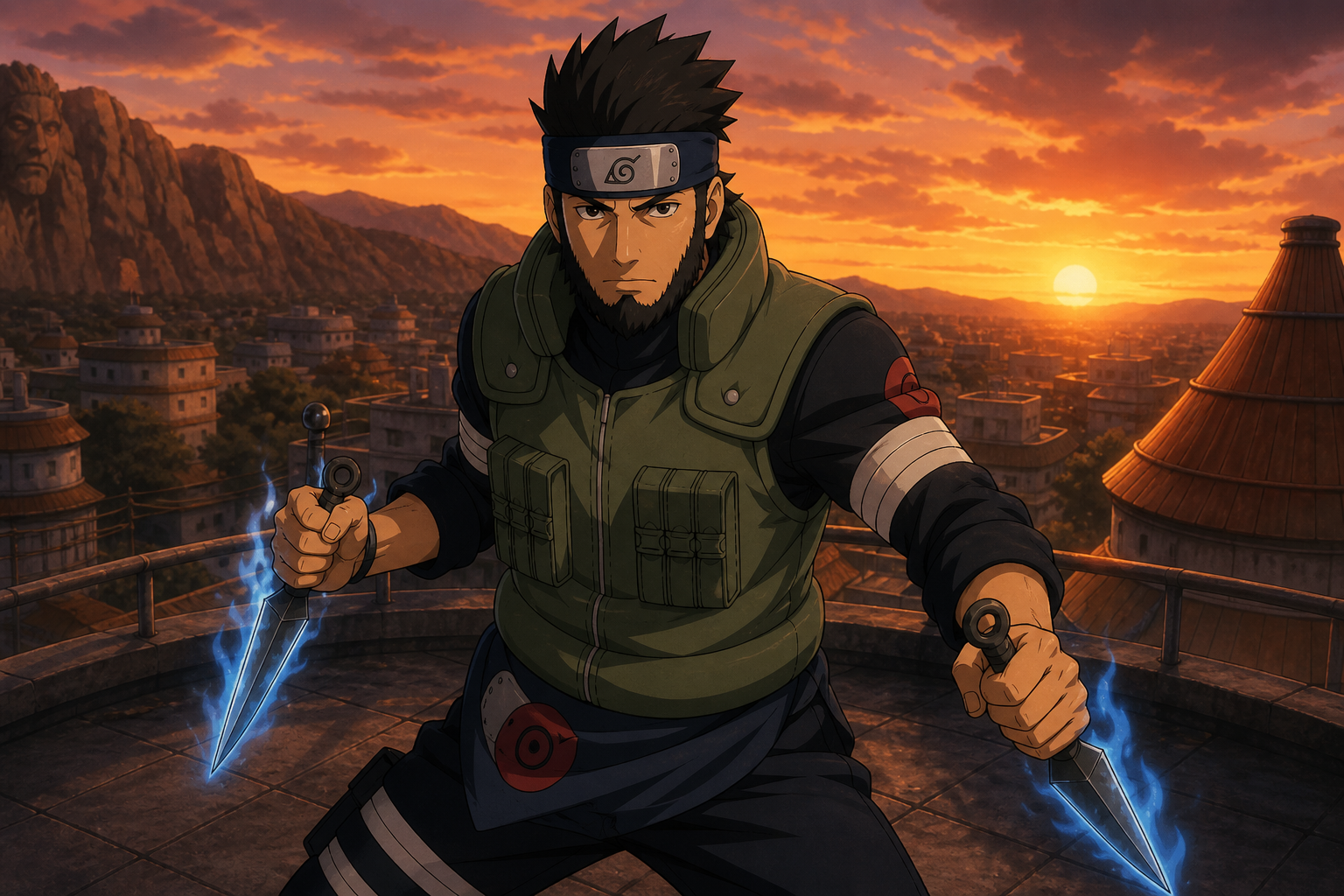
Asuma Sarutobi does not become meaningful because Naruto kills him and hands Shikamaru a revenge arc. The order matters. Asuma matters first because he notices children. He studies how they think, what embarrasses them, which pressure makes them shut down, and which small opening might get them moving again. Then the story kills him and makes Team 10 prove whether all that ordinary teaching labor took root.
That distinction saves Asuma from the Dead Mentor Hall of Fame, where fandom sometimes installs a man after one sad soundtrack and three quotable lines. Asuma earns his grief before the rain starts. He buys meals, plays shōgi, watches more than he lectures, protects without smothering, and speaks to Ino, Chōji, and Shikamaru as three different people. He also smokes constantly, waits too long to reconcile with his father, and walks into Hidan’s ritual with incomplete information. A grown man can be loving, skilled, stubborn, politically complicated, and catastrophically mortal at the same time. Naruto is better whenever the adults are allowed to be people instead of inspirational vitamins.
The databook record is elite, balanced, and not a fantasy-league score
The second databook gives Asuma 111 D-rank missions, 193 C-rank, 207 B-rank, 167 A-rank, and 18 S-rank assignments. That is a huge professional record. The shape matters more than the total. He has years of low-risk service, hundreds of middle-rank missions, and enough A- and S-rank work to establish serious field experience. His career did not begin when Akatsuki walked onto the page.
His period-specific guidebook ratings are ninjutsu 4.5, taijutsu 4.5, genjutsu 3.5, intelligence 4.5, strength 4, speed 4.5, stamina 3.5, and hand seals 3.5. The profile is broad, fast, tactical, and strongest at ninjutsu plus close combat. Stamina is comparatively lower, and no rating gives him regeneration, immortality, or advance knowledge of a cult ritual built around stolen blood.
Databook numbers are useful evidence. They are not a cosmic spreadsheet where 4.5 beats 4.0 every Tuesday. They describe how official guide material framed a character at a particular publication point. Powerscaling fandom sometimes treats them like audited tax returns from God. Calm down. The manga still decides how information, terrain, teamwork, matchup, and consequence operate.
What Asuma looks like, and why the design works
Adult Asuma is tall and broad, with short black spiked hair, brown eyes, and a full beard that separates him immediately from the younger clean-faced Konoha cast. He wears the standard forehead protector and shinobi uniform, but his rolled sleeves, bandaged forearms, black bangles, darker flak jacket, and Fire-marked waist sash keep the silhouette personal. Twin trench knives complete the design.
The knives are more than accessories. Their compact size places Asuma inside grabbing distance, where every mistake becomes bodily. When he channels wind chakra through the metal, the edge extends beyond what an opponent can see. His design therefore carries his fighting thesis: relaxed surface, dangerous proximity, more reach than the eye predicts.
Youth material removes much of the beard and presents a leaner student or young shinobi in period clothing. Anime episodes that expand the Guardian Ninja years add a fur-collared outer layer and other mission-era details. Edo Tensei later gives him the cracked, altered skin and darkened eye treatment shared by the reanimated dead. That last design is not an upgraded Asuma skin. Kabuto has converted a dead teacher into enemy inventory.
Hiruzen’s son had to leave before he understood what his father meant
Asuma is the son of Hiruzen Sarutobi and Biwako Sarutobi. Konohamaru is his nephew, but the core story does not name the sibling who connects them. That blank needs to remain blank. A family tree does not become more complete because a fan wiki gets creative with somebody’s unnamed parent.
Being the Third Hokage’s son gives Asuma status, expectation, and a very public father. The manga establishes conflict between them and Asuma’s departure from Konoha. He serves the Land of Fire’s daimyō as one of the Twelve Guardian Ninja before returning to village duty. The anime builds a much larger political story around that period, including Sora and a violent split within the Guardian group. That arc can deepen an anime viewer’s understanding of Asuma, but those events are anime-original expansion, not secret manga chapters hiding behind the couch.
The father-son problem is not simply that young Asuma is rebellious and old Hiruzen is wise. Hiruzen represents a village office that consumes private life. Asuma grows up under a man called Hokage by everyone and father by very few. Leaving can be read as selfish, but staying obedient would not automatically produce maturity. He needs distance from inherited authority before he can decide which parts of service he actually believes.
By the time Asuma understands Hiruzen’s idea of the king, Hiruzen is dead. That lateness is the bruise. Reconciliation does not arrive as a clean conversation where both men apologize and hug under a tree. Asuma inherits an answer after the relationship can no longer be repaired in person. Naruto repeatedly asks children to finish emotional work their parents left half done. Asuma is one of the adults who realizes that pattern and tries to hand his students something better before his own time runs out.
The Twelve Guardian Ninja belong to state power, not superhero branding
The Twelve Guardian Ninja protect the Fire Daimyō. Their Fire-marked sashes signal service to the political ruler of the Land of Fire rather than direct village command. That placement matters because Naruto’s world does not consist only of hidden villages and Kage. Civil authority, wealthy patrons, temples, military contractors, missing-nin, and bounty stations all sit around the shinobi economy.
Asuma’s former membership tells us that his departure from Konoha was not retirement from dangerous work. He changed institutions. He protected another center of power, built a bond with Chiriku, and acquired a black-market bounty worth 35 million ryō. A bounty is not a salary or a medal. A criminal market has priced his corpse because of the work, enemies, and visibility attached to his career.
The anime-original Guardian Shinobi Twelve arc makes the politics much louder. Competing guardians argue over whether the Hokage system should survive, Sora carries the fallout, and Asuma’s past becomes an active conflict. That expansion gives the adaptation room to explore divided loyalty between village and daimyō. The manga uses a leaner record: former elite service, Chiriku, a sash, and the consequences waiting in the bounty station. Both versions care about protection. Only the anime supplies that specific coup machinery.
Chiriku proves that public service can still end on a bounty counter
Chiriku is not valuable because his death warns Asuma that Akatsuki is strong. He is a former comrade, a monk, and another Guardian veteran whose body has a market price. Hidan and Kakuzu kill him at the Fire Temple, and Kakuzu takes the corpse to a bounty station for payment. The sequence drags noble language into cash accounting. Service to the daimyō does not prevent a dead protector from becoming merchandise.
Asuma’s larger bounty carries a nasty irony. Recognition of skill becomes increased value to the people hunting him. The same résumé that creates prestige inside one institution creates a higher payout in another. Kakuzu understands labor through return on investment. Hidan understands murder through worship. Asuma and Chiriku become profitable at the point where their own ability to consent, work, or protect disappears.
That is why the Akatsuki Suppression arc should not be flattened into revenge hype. The villains are not wandering toward Konoha because destiny scheduled a cool fight. They move through temples, borders, bodies, and cash networks. Violence has logistics. Naruto keeps showing that every grand ideology eventually hires somebody, invoices somebody, or leaves somebody else to carry the body home.
Team 10 is three students, not Shikamaru plus witnesses
Asuma leads Shikamaru Nara, Ino Yamanaka, and Chōji Akimichi. Their inherited Ino-Shika-Chō formation gives the team a proven clan structure, but inherited teamwork is not automatic intimacy. Asuma still has to learn the children inside the formation.
Shikamaru needs an adult who recognizes intelligence without rewarding avoidance forever. Asuma uses shōgi because direct lectures make Shikamaru mentally leave the building. The game creates a space where strategy becomes visible and conversation can happen sideways. Asuma does not cure laziness. He gives Shikamaru reasons to invest effort in people.
Chōji needs trust that does not begin with ridicule. Food jokes surround him constantly, and Asuma sometimes participates in weight language that has aged poorly. Still, Asuma understands that Chōji’s kindness is not weakness. His final message identifies that caring nature as the basis of strength. The teacher sees a quality the shinobi world regularly treats as liability and refuses that verdict.
Ino needs recognition beyond confidence, beauty, and rivalry with Sakura. Asuma names her reliability and asks her to watch over the boys because he knows she already performs emotional and practical coordination. The gendered wording deserves side-eye, especially when a dying teacher still brings romance competition into her assignment. Yet the deeper recognition is real: Ino is responsible, alert, and capable of holding a team together.
The war proves the full triangle. Ino acts decisively when Chōji freezes. Shikamaru supplies structure. Chōji eventually brings the force required to stop their teacher’s reanimated body. None can complete that encounter alone. Asuma’s success is not producing three miniature Asumas. He helps three very different people become mutually usable.
Barbecue is not filler when food is how a team stays a team
Team 10’s meals are funny because Chōji can destroy a budget with frightening efficiency. The joke also reveals material care. Somebody schedules time, pays the bill, and makes room for children to exist together outside a mission report. Asuma’s teaching does not only happen on a training field.
Food can become coercive when adults use access as control, and Chōji deserves more than constant appetite jokes. Asuma’s better moments use meals as welcome rather than punishment. He knows that shared food lets the group practice belonging before a battlefield demands trust. This is care labor wearing a barbecue apron.
Confucian readings often emphasize relational duty, but duty is not an abstract speech. People maintain relationships through repeated acts. Showing up, sharing a table, remembering preferences, noticing silence, and paying attention during a game all count. Naruto loves monumental sacrifice. Asuma’s profile reminds us that a community also survives through receipts nobody frames.
The king is the next generation, but children are not village property
Asuma asks Shikamaru who the king represents in the shōgi board of Konoha. Shikamaru initially thinks in terms of the Hokage or political leader. Asuma’s answer is the children, the next generation whose future gives present service meaning.
The lesson works because Shikamaru eventually understands protection as more than obeying whoever sits at the top. Leadership must serve people who cannot yet command the institution. Kurenai’s pregnancy makes the principle intimate for Asuma, and Mirai later gives that future a face, voice, and life beyond metaphor.
Still, the Will of Fire can become manipulative when leaders use children to justify every sacrifice demanded by the village. Protecting the next generation is beautiful. Treating that generation as future military inventory is not. Asuma’s teaching lands best when king means people with lives worth protecting, not replacement pieces waiting to enter the same war machine.
Kurenai is not a pregnancy announcement attached to his character sheet
Asuma and Kurenai share an adult relationship that the series reveals with understatement. They spend time together, dodge questions, and build a private future while both remain working shinobi. By Part II, Kurenai is pregnant with their daughter, Mirai. Asuma dies before Mirai is born.
Fandom often uses Kurenai as evidence that Asuma had a soft side. Babes, she is a person, not a certificate of male emotional growth. Her experience includes love, pregnancy, bereavement, work, and single parenthood after political violence removes her partner. Any profile that treats her only as the woman carrying his legacy repeats the exact erasure a good relationship analysis should challenge.
Mirai also becomes more than Asuma’s posthumous symbol. Later stories give her training, duties, doubts, humor, and relationships of her own. She inherits family history, not a requirement to impersonate a father she never met. The future can honor the dead without becoming their mausoleum.
Naruto gets one short wind lesson that does real technical work
When Naruto begins training his wind nature, Asuma provides a practical comparison. He channels wind chakra through a blade and demonstrates how that nature can sharpen and extend an edge. Naruto receives a concrete sensory target rather than another inspirational speech about believing harder.
Asuma bargains for a Team 10 meal in exchange, and Naruto agrees before remembering Chōji’s appetite. The joke works because the technical lesson already landed. Humor adds relationship texture instead of replacing information.
This small exchange also shows a healthy teaching ecosystem. Kakashi does not need to possess every answer. Yamato supports the dangerous chakra process, Kakashi structures the clone method, and Asuma contributes specialized wind experience. Good instruction is allowed to come from several adults. The village becomes stronger when expertise circulates instead of becoming one mentor’s private kingdom.
How the chakra trench knives actually work
Asuma fights at close range with paired trench knives built to conduct chakra. Wind nature gives the metal an extended cutting edge that reaches farther and cuts more sharply than the visible blade alone suggests. Flying Swallow is the named expression of that weapon-plus-chakra method.
The invisible extension rewards misjudgment. An opponent who believes the steel missed can still be cut by the chakra edge. The technique complements Asuma’s speed and taijutsu rather than replacing either. He has to enter the danger zone, control both weapons, read distance, and keep pressure on a target.
The knives also become inheritance objects after his death. Shikamaru uses Asuma’s weapons during the retaliation against Hidan. That transfer is practical and symbolic. A student’s strategy carries the teacher’s blades, but Shikamaru does not fight like Asuma. He anchors shadow techniques through them and makes inherited equipment serve his own system.
Fire, ash, wind, and a complete ability shelf
Asuma’s elemental profile centers on Wind Release affinity and Fire Release. Fire Release: Ash Pile Burning produces a cloud of ash that can be ignited, turning breath and suspended material into an area threat. Wind chakra turns his close-range knives into edges with deceptive reach. Together, these skills let him control both intimate distance and a wider pocket around the fight.
His taijutsu is strong enough to dispatch multiple Sound shinobi during the Konoha Crush. The scene establishes elite jōnin competence, not universal invincibility. He also brings tactical intelligence, quick pattern recognition, and team coordination. Shōgi is not proof that every battle becomes a perfect chess win. The habit reveals how he studies positions, sacrifices, protection, and future moves.
Anime-original material adds techniques and Guardian-era combat not present in the manga. Those sequences belong in the adaptation shelf with labels. Game animations may give him still more elemental spectacle. A licensed game can be fun without rewriting Kishimoto’s combat record.
His limits are wonderfully human. Asuma has no immortality, no regeneration, no bloodline defense, and no safe long-range answer that lets him solve every fight from across a valley. His best weapons require proximity. He can analyze a new technique quickly, but Hidan’s ritual punishes the information gap before Team 10 fully understands the rules.
Hidan turns a tiny wound into a remote execution system
Hidan’s curse requires an opponent’s blood and the ritual circle associated with his Jashin practice. Once the link is active, injury inflicted on Hidan transfers to the victim. His immortality lets him survive damage that would end another fighter, so ordinary assumptions about mutual bodily risk collapse.
Asuma, Shikamaru, Izumo, and Kotetsu enter the encounter with fragments of information. Shikamaru studies the sequence and helps force Hidan outside the circle, interrupting the linked effect. Asuma decapitates him. Against a normal opponent, excellent work. Hidan keeps talking because normal anatomy has left the chat.
Kakuzu then restores Hidan’s head to the body and reopens the threat. Hidan returns to the ritual and destroys Asuma’s heart through the linked injury. Reinforcements arrive, but the Akatsuki pair withdraw for another organizational priority rather than because Asuma has been saved. Ino’s medical skill cannot reverse catastrophic ritual damage.
Calling Asuma weak because he dies here deletes the entire reason the fight works. An experienced close-range specialist encounters an immortal opponent whose technique weaponizes a stolen trace of blood, while a second Akatsuki member can repair decapitation and interfere. Skill helps the team understand the mechanism. Understanding arrives after the body has already paid.
His final words know all three students
In manga chapter 328, Asuma addresses Ino, Chōji, and Shikamaru individually. The scene is not a generic speech about friendship. He tells Ino that she is dependable and responsible, asks her to look after the boys, and urges her not to lose to Sakura. The comparison reflects the period’s gender writing and deserves critique, but the acknowledgment of Ino’s reliability remains important.
He tells Chōji to have confidence in his kind heart and become stronger. The diet joke arrives too, because Naruto cannot resist putting body commentary inside tenderness. The better line is the one that recognizes compassion as strength rather than an obstacle to shinobi identity.
Asuma tells Shikamaru that he has the mind and qualities to become an excellent ninja, then gives him the answer to the king question. Shikamaru receives the most structurally important secret, but the scene belongs to Team 10. All three children listen. All three carry a different instruction forward.
Asuma smokes one final cigarette before dying. Shikamaru takes the remaining cigarette and says the smoke stings his eyes. The object lets a teenager disguise grief for about half a second. The manga does not need him to deliver a polished monologue about tears. Everybody knows what the smoke is covering.
Smoking is character behavior, not an endorsement campaign
Asuma’s cigarette creates a recognizable rhythm: conversation, pause, thought, exhale. The lighter later becomes a memory object for Shikamaru. Visual storytelling can use tobacco without requiring readers to pretend tobacco is harmless.
Smoking damages health. The habit also carries adult-coded coolness in manga and anime production traditions. Both truths belong on the page. Asuma does not become deeper because he smokes, and removing every cigarette from discussion would erase a repeated prop that the story uses around tension, mourning, and inheritance.
The correct reading is not cigarettes are wisdom. The correct reading is that people load ordinary objects with memory. Shikamaru uses Asuma’s lighter during the Hidan retaliation because grief has attached a person to the thing. The emotional meaning comes from the relationship, not the tobacco company.
Shikamaru’s revenge is brilliant, satisfying, and not morally spotless
After the funeral, Shikamaru builds a plan to confront Hidan and Kakuzu. Ino and Chōji join him, and Kakashi supplies the adult oversight that grief has made painfully necessary. Shikamaru isolates Hidan, uses blood and ritual knowledge against him, traps him in Nara clan land, detonates the prepared site, and buries the immortal body in pieces.
The sequence is one of Naruto’s cleanest tactical payoffs. Shikamaru turns observations from Asuma’s fatal encounter into control. The forest belongs to his clan. Asuma’s lighter ignites the explosive tags. Strategy, place, memory, and anger align.
Satisfaction does not erase the ethical tension. Shikamaru does not capture Hidan for a court. He condemns him to isolation and eventual bodily failure. Hidan murdered Asuma through a ritual and intends to keep killing. The retaliation answers an active threat, but revenge remains revenge even when the target is horrible and the plan is fabulous.
Asuma’s legacy therefore produces protection and vengeance at once. Love can motivate precise care. Love can also sharpen punishment. Naruto wisely refuses to make every inherited will morally tidy.
Edo Tensei turns a dead teacher into enemy labor
During the Fourth Shinobi World War, Kabuto uses Edo Tensei to reanimate Asuma. His mind recognizes his students, but his body is compelled to fight the Allied Shinobi Forces. This is not reunion magic. A military operator has taken a corpse, restored combat capacity, and removed consent.
Team 10 must stop him. Chōji hesitates because striking a beloved teacher feels like betrayal. Ino and Shikamaru compensate, pressure him toward action, and hold the formation together. Ino even uses Mind Body Switch when necessary to bridge the team’s immediate failure. Eventually Chōji accepts the responsibility, transforms his resolve into force, and helps drive the encounter toward sealing.
Asuma praises the completed Ino-Shika-Chō formation before he is sealed. The emotional payoff is cruel and exact. He gets evidence that his students grew, but only because war makes them demonstrate that growth against his stolen body.
Buddhist language about impermanence can illuminate the scene if we do not turn pain into greeting-card wisdom. The dead cannot be possessed without consequence. Edo Tensei is attachment made technologically violent: refusal to let bodies remain dead, service extended beyond consent, and grief weaponized against survivors.
The original Japanese performance
Jūrōta Kosugi performs adult Asuma in the original Japanese anime. His credit is verified. A separate original Japanese performer for child Asuma is not listed here because I could not verify that credit to the same standard.
The key performance contexts include relaxed Team 10 conversation, the wind lesson, conflict surrounding the Guardian expansion, the Hidan battle, Asuma’s final words and the war reunion. They cross the original series, Shippūden and anime-original direction.
I am not inventing claims about pitch, breath, timing or vocal texture without the heard Japanese scenes. A cast list proves who performed the role. Memory dressed as close listening is not criticism.
Anime, film, OVA, novel, and game record
The original anime adapts Asuma’s early Team 10 presence and expands his youth through flashbacks. Naruto Shippūden adapts the manga’s Guardian references, wind lesson, Akatsuki Suppression material, death, aftermath, and Edo Tensei return. The anime-original Guardian Shinobi Twelve arc supplies Sora, the internal guardian conflict, and a much larger political history. Viewers may value that story without calling the additions manga canon.
Naruto Shippūden the Movie: The Will of Fire uses Asuma as a memory or conscience within Shikamaru’s decision-making. The Lost Tower includes a younger cameo. Hidden Leaf Village Grand Sports Festival! places him in licensed comedy-event material. These appearances belong to the franchise record, but none silently rewrites the core manga chronology.
Konoha Shinden: Steam Ninja Scrolls engages Asuma’s legacy through Mirai and the Sarutobi family context. Asuma remains dead; the later story follows what his family carries forward.
Games make Asuma playable or usable across titles including Ultimate Ninja 2, Ultimate Ninja 3, Clash of Ninja Revolution 2, Ultimate Ninja Storm Generations, Ultimate Ninja Storm Revolution, Ninja Voltage, and Ultimate Ninja Storm Connections. Game move sets package his knives, wind, fire, and team identity for play. They do not add canonical elements to his manga résumé.
Seven fandom misreadings that need to retire
Asuma is a weak jōnin because Hidan killed him
No. Asuma has a massive mission record, elite guidebook ratings, Guardian service, close-combat skill, and strong field judgment. Hidan uses an unknown blood ritual backed by immortality while Kakuzu repairs the counterattack. Death is an outcome, not a full résumé.
He exists only to develop Shikamaru
The manga gives Shikamaru the largest aftermath, but Asuma teaches Ino and Chōji too. The war return makes that three-person legacy unavoidable. Ignoring two students because the camera prefers one repeats the imbalance rather than analyzing the imbalance.
He is just Hiruzen's nepotism baby
Family status matters. So do 696 recorded missions, jōnin rank, Guardian service, and demonstrated skill. Critiquing inherited access is useful. Pretending no labor follows that access is lazy.
Kurenai is only his girlfriend or baby mama
Kurenai is a jōnin, teacher, partner, grieving survivor, and parent who continues after his death. Her life is not supporting documentation for Asuma’s tenderness.
Smoking makes him cool and deep
The character is deep because of relationships, conflict, teaching, and consequence. Cigarettes are a recurring behavior and visual prop with real health baggage. Merchandising the habit into personality is unserious.
The Sora arc is Asuma's canon backstory
The manga confirms Guardian service and related consequences. The Sora/coup story is anime-original expansion. Enjoying adaptation material does not require falsifying its source layer.
His death proves the next generation must replace the old one
The next generation continues because death leaves unfinished work. Replacement language can hide the cost paid by Kurenai, Mirai, Team 10, and the village. Children are not spare parts for fallen adults.
Confucian duty, Buddhist impermanence, and the politics of succession
Asuma’s story is built around relational duty: son to father, teacher to student, partner to partner, shinobi to community. He fails some obligations, revises others, and eventually understands that authority exists to serve people beyond the officeholder. The king lesson converts hierarchy into responsibility downward.
Confucian analysis becomes useful when duty remains reciprocal. Hiruzen cannot demand filial obedience while public office consumes the relationship. A teacher cannot ask loyalty without investing care. Students honor Asuma not through empty reverence but by becoming capable of protecting one another.
Buddhist impermanence sits beside that continuity. Asuma dies before reconciliation, parenthood, and teaching feel complete. No cosmic fairness repairs the timing. Attachment causes pain because people matter, not because caring was a mistake. Team 10 must learn to carry love without freezing life at the grave.
Institutionally, the profile is harsher. The village trains children for violence, sends adults into bounty networks, and later faces an enemy who conscripts its dead. The Will of Fire can inspire care, but institutions love turning care into free fuel. Asuma’s best legacy resists that theft. He teaches people, not slogans.
Final verdict
Asuma Sarutobi is an elite jōnin, a politically complicated son, a patient teacher, a flawed smoker, a loving partner, and a man who understands his father’s lesson after conversation is no longer possible. His power matters. His death matters. Neither matters as much as the work between them.
Team 10 does not honor Asuma by becoming copies of him. Ino coordinates, Chōji chooses courage without surrendering kindness, and Shikamaru turns intelligence toward responsibility. Their formation becomes complete because their teacher learned that the next generation was never a monument to him. They were the point.
Sources and canon boundary
Manga chronology controls this profile. Anime staging, databook material, novels, films, games, and later franchise appearances are labeled instead of being blended into one false continuity.
Primary franchise references: Naruto Official and VIZ Media Naruto. CVM Sekai’s conclusions about Team 10, chakra blades, Hidan, Kurenai, Shikamaru, the king lesson, death, and war-era return are editorial analysis, not invented creator quotations.