
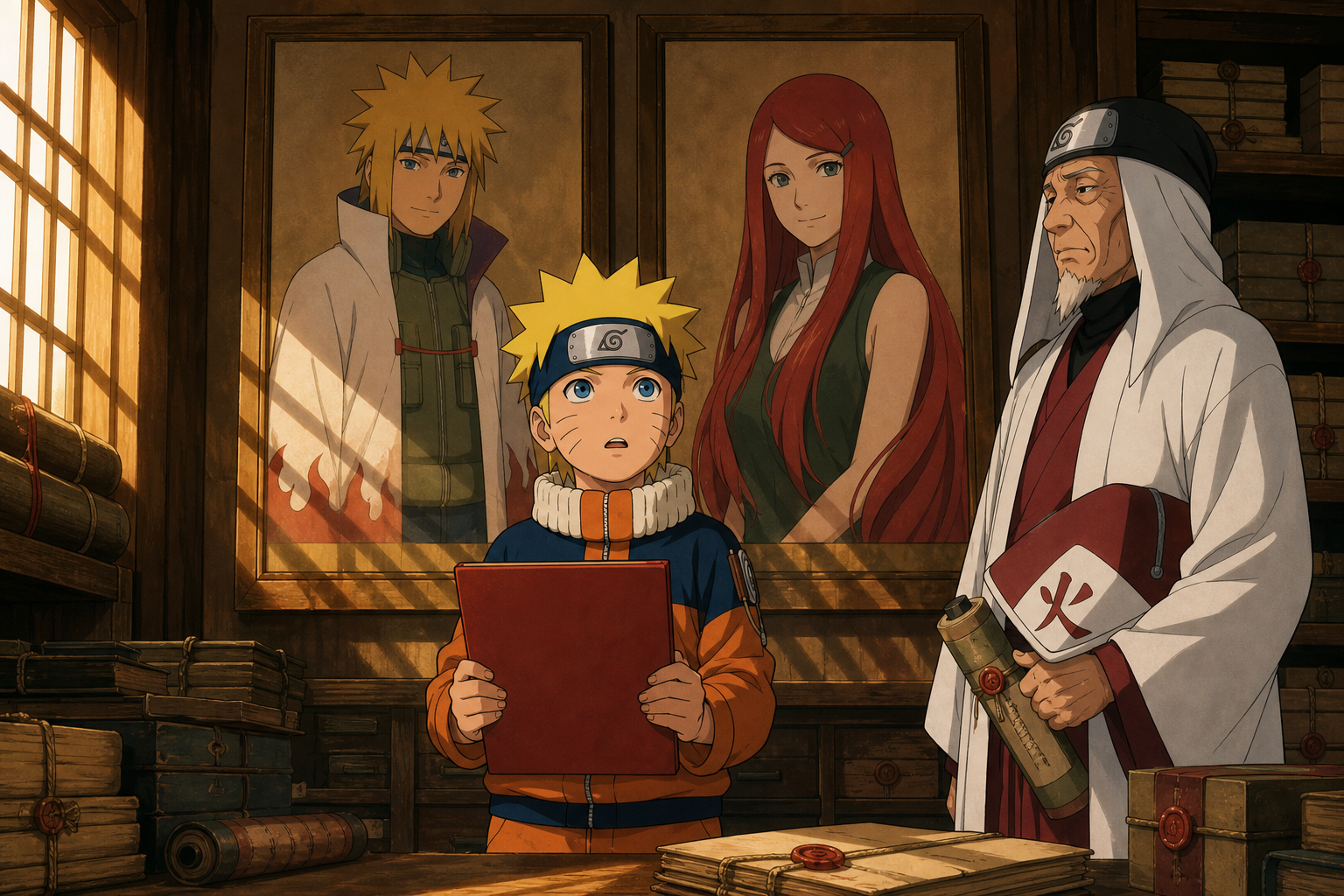
Who Knew Naruto Was Minato’s Son?
Several powerful adults knew the truth about Naruto’s parents. The harder question concerns why nobody found a safe way to tell the child who he was.
The mystery looks obvious from the audience’s side of the screen. Naruto Uzumaki has bright blond hair, blue eyes, the same birthday as the Nine-Tails attack, and a face that resembles the Fourth Hokage. The village also treats him as a classified security concern. Viewers can place those clues beside one another and wonder how every person in Konoha missed the answer.
The village did not miss the answer. Senior leaders knew. Several shinobi had personal or operational reasons to know. Other people may have suspected the connection without receiving confirmation. Ordinary villagers knew about the Nine-Tails but had no confirmed access to Naruto’s parentage. The real problem was not a village-wide conspiracy in which every shopkeeper recognized Minato’s cheekbones. The problem was that enough adults with power knew the full story, yet Naruto still grew up without a private explanation of his own family.
The real question is not whether the resemblance was obvious
Fans often begin with Naruto’s appearance because the resemblance becomes striking once Minato enters the story. That observation makes sense for viewers who already know the answer. A blond child born on the night of the attack looks suspicious beside a blond Hokage who died during the same disaster. The clue becomes even stronger when the child carries the Nine-Tails.
Resemblance alone would not prove parentage inside a large village. Children can resemble unrelated adults, and most civilians would not have access to Kushina’s protected pregnancy or the details of the sealing. Naruto also used Kushina’s surname rather than Minato’s. The public record therefore pointed away from the most dangerous connection.
The useful question concerns access. Who knew that Kushina was pregnant? Who guarded the birth? Who responded to the attack? Who knew that Minato and Kushina died that night? Who knew that the newborn jinchuriki was their son? Once the investigation focuses on access rather than hair color, the list becomes smaller and more responsible.
What people in Konoha could actually see
Naruto’s appearance
Naruto shares Minato’s blond hair and blue eyes. The resemblance supports suspicion but cannot confirm a family relationship without additional knowledge. An experienced shinobi who knew Minato and Kushina personally would have more reason to notice than an ordinary villager who saw the Fourth Hokage mainly through public images.
The timing of Naruto’s birth
Naruto was born on the night of the Nine-Tails attack. Minato and Kushina died during the same event, and Naruto became Kurama’s host. Anyone with direct knowledge of the birth or sealing operation would understand the connection. People farther from the operation might know only that an infant became the new jinchuriki.
The Uzumaki surname
The surname linked Naruto to Kushina’s clan, but the name did not automatically reveal that Kushina was his mother. Her status as the previous jinchuriki was protected information. Most villagers also had little reason to understand the remaining Uzumaki family network after the destruction of Uzushiogakure scattered the clan.
Hiruzen’s attention
Hiruzen monitored Naruto, managed information about the Nine-Tails, and held authority over the village after Minato’s death. That attention signaled Naruto’s strategic importance, but strategic importance did not tell ordinary people the names of his parents.
The certainty list
The series never provides a complete document listing every person who received the parentage file. A responsible answer therefore needs separate categories for confirmed knowledge, knowledge supported by role and access, and speculation.
Hiruzen Sarutobi
Hiruzen resumed office after Minato’s death, knew Naruto had become the Nine-Tails jinchuriki, and controlled the village response. Hiruzen’s knowledge of Minato, Kushina, the attack, and the newborn host makes the parentage certain.
Jiraiya
Jiraiya trained Minato, knew the family, inspired Naruto’s name through his novel, understood sealing, and later carried the key connected to Naruto’s seal. The exact legal meaning of the culturally specific naming relationship should not be overstated, but Jiraiya’s knowledge of the family is not in doubt.
Kakashi Hatake
Kakashi was Minato’s student, knew Kushina, and later understood Naruto’s parentage. Canon does not provide a dated scene showing when Kakashi first received confirmation, so claims about his knowledge during every year of Naruto’s childhood should remain cautious.
Obito Uchiha
Obito attacked Kushina during childbirth, extracted Kurama, and fought Minato. An enemy therefore knew the circumstances of Naruto’s birth more clearly than Naruto did.
Homura, Koharu, Danzō, and senior operations personnel
Senior leaders involved in jinchuriki policy and village security had overwhelming reason to know the parentage or receive enough operational information to reconstruct the answer. Individual staff members may have known only one part because classified operations often divide information across teams.
Ordinary villagers
Adults in Konoha knew that Naruto was connected to the Nine-Tails. Their treatment of him makes that knowledge clear. Canon does not establish that the entire village also knew that Minato and Kushina were his parents.
Hiruzen knew, and knowledge created a duty
Hiruzen had the strongest combination of knowledge and authority. Hiding Naruto’s public connection to Minato had a reasonable security purpose because Minato had made dangerous enemies during war. Broadcasting the existence of an unprotected son could have made Naruto a hostage, assassination target, or tool for political revenge.
That reasoning supports confidentiality. The same reasoning does not require total ignorance inside Naruto’s home. Hiruzen could have protected the public secret while arranging a guardian, preserving family records, and giving Naruto a private explanation as he became old enough to understand. Security and identity did not need to become opposing choices.
Hiruzen’s failure therefore developed over time. An emergency decision made on the night of the attack may have been necessary. Years passed after the emergency. Naruto remained isolated, confused about the hostility around him, and unaware of the parents who died protecting him. Hiruzen had repeated opportunities to reconsider the arrangement.
The criticism does not require describing Hiruzen as cruel. The larger Konoha rant explains why affection and institutional failure can exist in the same adult. Hiruzen cared about Naruto, but private concern never developed into enough daily support.
Jiraiya knew the family, but the word “godfather” needs care
Jiraiya was not a random traveler who later discovered Naruto. Minato was his student. Kushina knew him. Naruto received the name of the hero from Jiraiya’s novel. Jiraiya also understood the sealing system and later carried access to the key connected with Naruto’s Eight Trigrams Seal.
English discussion often calls Jiraiya Naruto’s godfather. The Japanese naming custom behind that relationship does not automatically create the same legal custody duties associated with a Western godparent. Treating the word as a legal document creates a stronger claim than canon supports.
The cultural distinction does not erase moral proximity. Jiraiya knew the parents, knew the child’s identity, and had specialized knowledge relevant to Naruto’s safety. His long absence deserves criticism even if the series never assigns him formal custody. Espionage work, travel, grief, and Jiraiya’s general difficulty with attachment explain parts of his life. Those factors do not fully explain why Naruto grew up without even knowing the origin of his name.
Kakashi knew eventually, but the exact date remains uncertain
Kakashi trained under Minato and knew Kushina. By adulthood, Kakashi understood Naruto’s parentage. The series never pauses to show a formal briefing or identify the year when Kakashi received confirmation.
Kakashi could have suspected the truth early. The blond newborn, Kushina’s pregnancy, Minato’s death, and the new jinchuriki all pointed toward the same answer for someone who knew the family. Suspicion and confirmed knowledge remain different, especially inside a village built around classified information.
Kakashi was also a traumatized young shinobi who entered ANBU while carrying severe survivor guilt. That history helps explain why he was not prepared to become a guardian. The explanation should not become another claim that Naruto received enough care. Kakashi’s pain and Naruto’s abandonment can both matter without forcing either person into the role of villain.
Iruka knew the fox secret, not necessarily the family secret
Iruka knew that Naruto contained the Nine-Tails. His own parents died during the attack, and Mizuki weaponized the secret in Episode 1. Early canon does not provide strong evidence that Iruka knew Minato and Kushina were Naruto’s parents.
The distinction makes Iruka’s choice more meaningful. Iruka did not need prestigious parentage to decide that Naruto deserved protection. He responded to the neglected student in front of him rather than to the hidden son of a famous Hokage.
Iruka also lacked the authority and information held by senior leadership. Criticism should focus on the adults who controlled the family record, not on a young teacher who eventually became one of Naruto’s first dependable relationships.
Why Naruto carried the Uzumaki surname
Naruto received Kushina’s surname rather than the Namikaze name. The usual in-world explanation concerns protection. Minato’s reputation during the Third Shinobi World War gave foreign enemies a reason to target his surviving family. A child publicly named Naruto Namikaze would have advertised the connection.
Uzumaki was not an insignificant name. The clan had a powerful history, and other nations had feared Uzushiogakure. By Naruto’s childhood, however, the scattered clan had little visible political presence inside Konoha. The surname revealed less immediate information than Namikaze.
The choice preserved Kushina’s lineage while separating Naruto from the story attached to the name. Naruto carried an important clan identity without receiving the history, family relationships, or cultural knowledge that should have accompanied the surname.
Naruto saw Minato’s face without knowing how to read the clue
The Fourth Hokage’s face appears on the monument above Konoha, so Naruto saw Minato’s image throughout childhood. Viewers may wonder why the resemblance never led Naruto to the answer.
A carved public monument is not a family photograph. The stone face is stylized, blond hair is not visible in stone, and Naruto had no adult suggesting that the Fourth Hokage belonged inside his personal history. Children do not normally investigate a family connection that every trusted adult treats as unavailable.
Naruto also had no reason to assume that an orphan with his social position could be the son of the village’s celebrated hero. Konoha taught him to understand himself as a burden. The village never gave him the information needed to imagine a different story.
A classified file and a private family story are not the same thing
Konoha treated Naruto’s origins as military intelligence. The file involved enemy threats, jinchuriki succession, sealing techniques, Kushina’s protected status, and the Fourth Hokage’s legacy. The village had legitimate reasons to control public access.
Naruto needed many of the same facts for a different reason. He needed to know who loved him, why his parents died, why he carried the Uzumaki name, whose features he inherited, and why Kurama lived inside his body. A private family story could have answered those questions without publishing military details.
Institutions often confuse controlling information with caring for the person described in the file. Konoha protected the record more carefully than the child because the record fit inside established security procedures. Naruto’s emotional needs required judgment, time, and a responsible adult willing to remain involved.
Nobody needed to announce “Naruto Namikaze” from the Hokage Monument. One trusted adult needed to tell Naruto that his parents loved him and died protecting him.
Why the story delayed the answer
The delayed reveal works well as storytelling. Naruto meets Minato within the seal during a crisis, and Kushina later gives him the birth story through intimate testimony. Those scenes allow Naruto to encounter his parents as people rather than as facts in a public biography.
Strong narrative timing does not prove that Konoha’s adults made a good childcare decision. Readers can appreciate the emotional reveal while criticizing the in-world secrecy that left a child without his family history. The two judgments address different questions.
The part people keep turning into a village-wide conspiracy
Fandom conversations often jump from “several powerful adults knew” to “every adult in Konoha must have known and pretended otherwise.” The text does not support that leap. It also does not need the leap. A secret can remain restricted while still producing a profound institutional failure. The Hokage, advisers, intelligence personnel, and people closest to Minato occupied a different evidentiary position from a shopkeeper who saw a loud blond child and remembered the Nine-Tails attack.
That distinction matters because blame should follow knowledge and authority. Random villagers participated in stigma once they learned Naruto carried the fox, and their treatment of him was cruel. That does not prove they knew his parents. Hiruzen’s responsibility is heavier because he knew the boy’s identity, controlled the official story, had executive power, and watched the social consequences unfold. Jiraiya’s responsibility comes from personal connection and prolonged absence. Kakashi’s responsibility depends on when he learned the full truth and what authority he possessed at that point. Put people in the right column before putting them on trial.
Knowing a classified fact is not the same as showing up for a child
Naruto’s childhood exposes the ugliest weakness in Konoha’s secrecy policy: the adults treated information control as if it completed the assignment. It did not. Keeping Minato’s enemies from locating his son explains why the village might hide the Namikaze name. It does not explain the absence of a consistent guardian, a truthful private explanation, photographs, family stories, or a trusted adult prepared to answer the questions Naruto was old enough to ask.
A village can protect a secret without erasing a family. Naruto could have learned privately that his parents died protecting him, even if their names remained classified until he reached a safer age. He could have been told that the fox inside him was not his fault. He could have received monitored care from adults who knew why hostile attention followed him. None of those measures required a monument, a parade, or a public announcement saying, “Hello, foreign assassins, the Fourth Hokage’s son lives here.” That excuse has been doing cardio for years, and it is still not strong enough.
The result is a child who invents explanations for his own rejection because the government refuses to give him the true one. Naruto decides attention is attention, so disruption becomes a survival tool. He dreams of the Hokage title before he understands that his father held it. He studies the stone face of a parent he cannot recognize. The dramatic irony works beautifully as storytelling. Inside the world, it remains an indictment.
Why the resemblance argument proves less than fans think
Yes, Naruto resembles Minato. Blond hair, blue eyes, facial structure, timing, and Hiruzen’s attention create a convincing pattern once the answer is known. Retrospective certainty is sneaky, though. Konoha contains thousands of people, wartime displacement, orphaned children, mixed clan traits, and citizens who may never have stood close enough to Minato to catalogue his face. A reader receives framed panels and narrative emphasis. A civilian receives a passing child in a crowded street.
The surname complicates the clue further. Naruto is publicly Uzumaki, not Namikaze. Most villagers have no reason to know Kushina’s full private history, and the Uzumaki clan’s scattered survival means the name does not function like a neat household address. The clue is obvious to Jiraiya. It may be meaningful to senior shinobi. It is not automatically a confession delivered to every civilian with groceries in hand.
What certainty actually changes
The strongest version of this file is not a gossip chart. It is a duty chart. Hiruzen’s confirmed knowledge establishes state responsibility. Jiraiya’s knowledge establishes a painful gap between affection for Minato and care for Minato’s child. Obito’s knowledge shows how Naruto’s identity becomes strategically useful to an enemy. Kakashi’s uncertain timeline warns us not to promote inference into fact simply because the emotional symmetry feels right.
That is the standard across this archive: say what the story confirms, label what it strongly implies, and leave uncertainty visible where the record stays silent. Naruto deserved the truth. Readers deserve it too.
Final verdict
Hiruzen and Jiraiya knew Naruto’s parentage. Senior leaders and operational personnel knew the full truth or held pieces of the classified history. Kakashi knew by adulthood, although canon leaves the exact timing unclear. Obito knew because he attacked during Naruto’s birth. Iruka knew the Nine-Tails secret but is not shown knowing the parents during Naruto’s early childhood. Ordinary villagers knew enough to stigmatize Naruto without necessarily knowing that Minato and Kushina were his parents.
The scandal does not require every villager to recognize the blond hair or sign a formal silence agreement. Enough powerful adults knew the full story to give Naruto protection, stable care, and age-appropriate truth. Those adults chose a policy that protected the secret while leaving the child to interpret the consequences alone.
Minato’s enemies justified public secrecy. Naruto’s safety required discretion. Neither concern required twelve years of personal silence.
Sources and connected reading
- VIZ: Naruto Chapter 1
- Naruto Official: original anime series
- Naruto Episode 1 recap and reaction
- Jinchuriki and Tailed Beasts guide
- Seals and Fuinjutsu guide