
Soyeon
Leader, main rapper, producer, and the creative engine behind the songs that made i-dle impossible to confuse with anybody else.
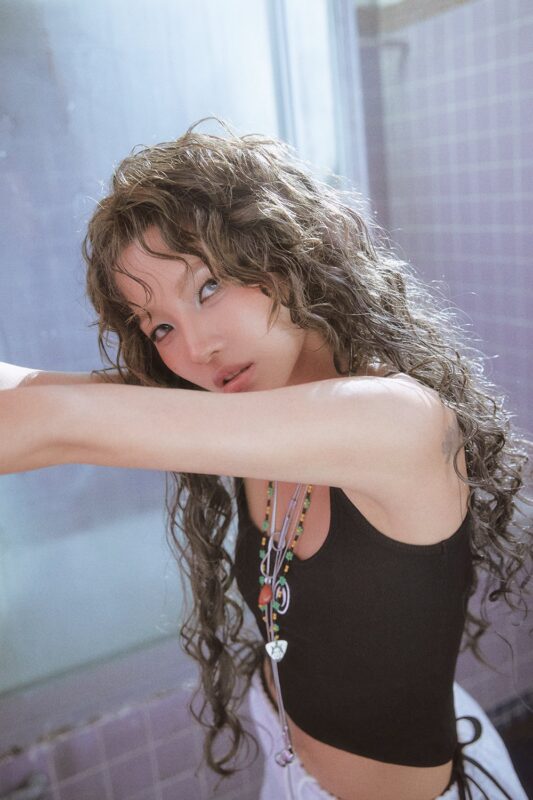
Early life and pre-debut
Jeon So-yeon was born in Seoul and trained under Cube Entertainment before most listeners knew her as the person arguing with an entire industry through a three-minute pop song. Her early path was not a clean, glittery staircase. She competed publicly, got judged publicly, lost publicly, and kept building anyway.
That matters because Soyeon’s later confidence did not come from being protected from failure. It came from surviving formats that turned young trainees into weekly rankings. By the time i-dle debuted, she already understood cameras, editing, rap competition, audience voting, and how quickly a woman with a clear opinion gets called “too much.”
Competition and solo beginnings
Soyeon represented Cube Entertainment on the first season. She reached the finale but did not enter I.O.I. The show gave her visibility, but it did not give her the career people now remember her for.
She moved from idol-trainee framing into a rap competition and made her writing, timing, and stage nerve much harder to dismiss.
Her solo releases arrived before i-dle, establishing the bright, strange, slightly sharp-edged personality that would later become familiar across the group’s catalog.
i-dle: building the group’s grammar
Soyeon debuted as i-dle’s leader and main rapper with “LATATA” in 2018. More importantly, she entered as a credited writer and creative center. The members were not presented as interchangeable voices waiting for somebody else’s concept. Songs such as “HANN,” “LION,” and “Oh my god” made each tone part of the arrangement.
“LATATA,” “HANN,” “Senorita,” “LION,” and “Oh my god” established the group’s taste for theatrical structure, distinct vocal characters, and concepts that arrive with an actual point of view.
After Soojin’s departure, the five-member group returned with “TOMBOY.” “Nxde,” “Queencard,” “Super Lady,” and “Fate” turned a difficult reset into the group’s largest commercial era.
The members renewed, removed the parenthetical “G,” and moved into a chapter where solo identities and group authorship overlap more openly. We made also tests what authorship means when outside producers enter a catalog so closely associated with Soyeon.
Voice, performance, and creative identity
Soyeon writes characters, not only hooks. “TOMBOY,” “Nxde,” “Queencard,” and “Super Lady” use camp, satire, discomfort, and pop structure to turn a comeback into an argument people cannot stop having. Sometimes the idea is elegant. Sometimes it arrives in six-inch platforms carrying a baseball bat. Either way, it has a thesis.
Her rap delivery is nasal, clipped, and deliberately recognizable. She changes rhythm aggressively, uses pronunciation as texture, and often treats the bridge, intro, or final chorus as part of the story rather than empty connective tissue.
Era and credit map
LATATA / HANN
The raw debut identity: heat, repetition, and voices kept deliberately separate.
YouTube tracking history

LION / Oh my god
The moment the group’s theatrical ambition stopped looking accidental.
HWAA
Winter, fire, restraint, and the last major chapter before the lineup fracture.
TOMBOY / Nxde
Five-member reinvention, public argument, satire, and the start of the group’s biggest run.
Queencard / Super Lady
Camp, mass appeal, ridiculous confidence, and scale large enough to become its own joke.
We made
A self-producing group asking what still counts as “we made” when the process changes.
Fandom notes and trivia
- The fandom is Neverland.
- Soyeon’s solo work and group work should be followed together; one explains choices made in the other.
- Start with “LATATA,” “LION,” “TOMBOY,” “Nxde,” and “Gimme Dat Love” to hear the change rather than treating every era as an isolated costume.
- Her producing is most interesting when you listen for which member receives which texture, not only for Soyeon’s own lines.