
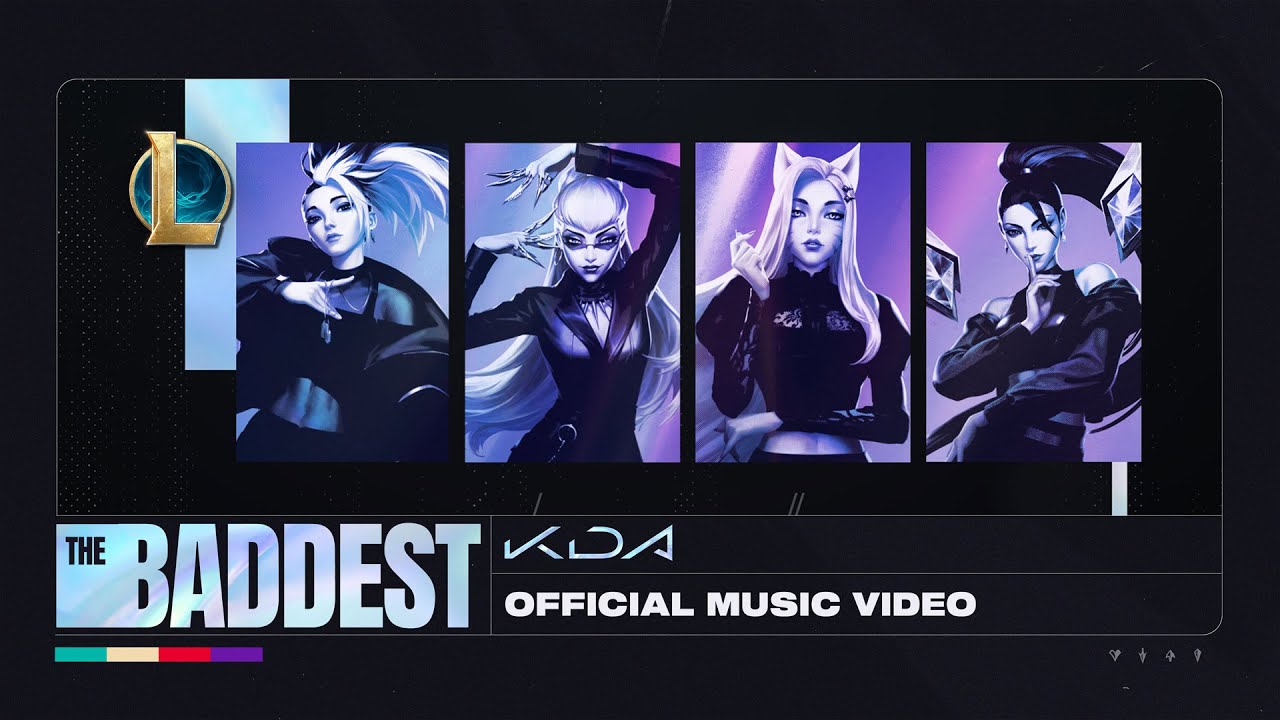
THE BADDEST: K/DA Proved a Lyric Video Can Still Walk Into the Room Like a Threat
No full animated plot, no choreography spectacle and no problem. K/DA turn typography, portrait motion and four voices into a lyric video with enough posture to clear its own hallway.
Release file
Released: August 27, 2020
Runtime: 2:56
Artist / channel: K/DA / League of Legends
Exact-file focus: The exact official THE BADDEST lyric video featuring Soyeon, Miyeon, Bea Miller and Wolftyla, not an audio repost, fan lyric upload, stage, short, remix or another K/DA release.
Verdict first: the exact upload matters. This React follows the performance and visual choices in this video, not a neighboring stage, fan lyric upload or different song with the same English title.
First reaction: what the hook is actually doing
“THE BADDEST” is a pre-release flex built from controlled space. The beat leaves room for Akali’s rap to cut and Ahri’s melodic authority to reset the surface. Bea Miller and Wolftyla add new colors without asking the virtual group to abandon its identity between major MVs.
Catchiness is the entrance, not the verdict. The useful question is how percussion, bass, vocal register and phrasing make the central idea feel repeatable—and whether the repetition reveals more feeling or merely occupies time.
Production under the topline
The arrangement creates a floor before the performers decorate it. Follow the kick and low end, then notice which sounds vanish before a line begins. Empty space can give a low voice more authority than another layer of volume, while a bright response can reset the ear without flattening the groove.
i-dle-related solo work is strongest when the production recognizes the featured voice instead of renting a generic trend. Yuqi’s grain and delayed pocket, Minnie’s atmosphere and Soyeon’s percussive diction require different rooms. The mix here succeeds where it lets identity change structure.
The video argument
The official lyric video uses typography, graphic motion and character imagery instead of full animation. That limitation becomes style: words hit like interface commands, and visual rhythm forces the viewer to notice how multilingual phrasing occupies the beat.
The canonical still above comes from this exact upload. It remains the featured image, hero, Music Reviews card and social preview, so a reader does not click one visual promise and arrive inside another video’s page.
Performance details worth the replay
SOYEON and MIYEON are the participating i-dle members. Accurate profiles matter especially in virtual-pop coverage, where character names, voice performers and fictional group branding can make real labor disappear behind the skin. Watch the type as choreography. Size, entry direction and disappearance mimic attack, sustain and breath. The screen performs the words, but the voice determines which graphic choices feel earned.
Watch preparation rather than only impact: the breath before a phrase, the body loading weight before a directional change and the eye line that tells the editor where the next cut can land. Those decisions are the bridge between choreography and camera.
What works, and what I would change
A lyric video cannot provide the full bodily performance K/DA invites, and several graphic loops repeat before the song’s confidence has changed. It remains an exact official visual with its own editorial job, not a substitute for an imaginary MV.
That tradeoff matters. A harder bridge, longer ending or stranger cut might create complexity, but it can also break the release’s chosen scale. Criticism should identify the price of the existing choice without pretending every song wants to become a different genre.
Participation, not inheritance
The i-dle hub remains connected because the career grew from and continues beside the group. The profile trail follows actual participation, however. A Yuqi and Lexie Liu performance does not automatically belong to all five members; a Yuqi and Minnie duet belongs to both women; a solo choreography file links the solo artist and group history without fabricating group presence.
Bottom line
THE BADDEST: K/DA Proved a Lyric Video Can Still Walk Into the Room Like a Threat understands the mechanism beneath its hook and gives the camera enough performance evidence to make that mechanism visible. The release has limits, but none of them erase the reason to replay it.
Replay section
- First replay: watch only the performer outside the obvious focal point or the body between named moves.
- Second replay: isolate drums and bass; mark every place the groove removes sound instead of adding it.
- Third replay: follow vocal color and breath, not volume or line count.
- Fourth replay: test the criticism—imagine the proposed change, then decide what pleasure it would cost.
Canonical profile trail
- i-dle group profile
- SOYEON / Akali performer profile
- MIYEON / Ahri performer profile
- Exact official videoDaily+12.5KTotal views79.8M
Sources and receipts
A lyric video would normally be the lesser visual in a release cycle, but “THE BADDEST” turns limitation into posture. Graphic type, character art and hard transitions behave like attacks, making every line arrive with an assigned visual weight. The absence of full animation creates space for the track’s cadence to dominate. Viewers are not waiting for plot; they are being taught exactly where the record places its shoulders and elbows.
Soyeon’s performance is the hinge because her consonants make the illustrated Akali feel mobile even when the frame is not. Miyeon supplies a different authority: sustained tone and melodic control widen the threat instead of duplicating it. Bea Miller and Wolftyla add textures that prevent K/DA from hardening into one repeated definition of confidence. The group sounds assembled, but the assembly is the artistic point.
On replay, follow how typography answers rhythm. Words stretch, fracture and occupy the screen according to delivery, turning reading into a physical task. That synchronization is why the video does not feel like marketing collateral. It is a performance built from design timing, and it proves that visual ambition is not measured only by rendering budget or the number of moving bodies.
The hook uses repetition as intimidation because certainty is part of the character performance. A less controlled delivery would make the boasts sound defensive. Instead, every return lands as settled fact, while small timbral changes prevent the refrain from becoming a pasted loop. The singers understand that dominance in pop is often less about maximum volume than about behaving as if the listener arrived late to a conclusion everyone else already accepted.
This release also demonstrates useful economy in franchise storytelling. A viewer does not need League of Legends knowledge to understand the emotional hierarchy, yet character-specific colors and gestures reward the audience that does. On replay, notice how little explanatory text the video requires beyond lyrics themselves. Identity is communicated through design behavior. That makes “THE BADDEST” accessible pop first and expandable lore second, the order virtual music projects too often reverse.
The release therefore works as more than connective material between large videos. It isolates the group’s sonic identity and asks whether confidence survives without cinematic bodies. It does. Bass, cadence, multilingual phrasing and sharply differentiated voices provide enough character information to animate still images in the listener’s mind. The modest format becomes a diagnostic tool, proving K/DA’s appeal lives in the record and performers rather than only in Riot’s rendering pipeline.
That sonic independence matters for preservation as well as promotion. Spectacular game cinematics can age with software aesthetics, but a strong cadence and hook continue functioning after viewers stop being impressed by technical novelty. “THE BADDEST” was built as a smaller visual event, yet it remains replayable because the graphic aggression follows musical decisions. Its confidence is not stored in pixel count. It lives in the way four voices negotiate a beat and make a static character portrait feel temporarily unable to contain them.
RaeRae verdict
THE BADDEST should be the boring bridge between bigger K/DA videos. Instead, it walks in with typography, portraits and enough vocal attitude to make the missing animation irrelevant. I replay the contrast between Soyeon’s cut and Miyeon’s polish, then the guest colors that keep the record from folding inward. A lyric video does not need to apologize for being one. It needs timing, and this one has teeth.
What changed every time I replayed it
The second replay listens without reading and checks whether the vocal hierarchy remains clear. The third watches typography as choreography: scale changes, directional hits and pauses that give the words physical timing. The fourth follows character portraits and asks how little motion each image needs before attitude becomes performance. The fifth isolates Soyeon’s rhythmic attack against Miyeon’s melodic control, then tracks how Bea Miller and Wolftyla keep the file from becoming an i-dle duet wearing Riot branding. By the sixth, the lyric video feels complete because it understands that stillness can threaten when every interruption lands on purpose.
Lyrics and meaning
THE BADDEST sells self-definition at maximum volume. The boast works because each voice claims authority differently; confidence is not one approved delivery pasted across four performers. The lyric video makes language the spectacle, which exposes both the pleasure and the limit of the song. Repetition can build a persona, but being the baddest is meaningful only while the voices remain distinguishable from the corporate superlative surrounding them.