
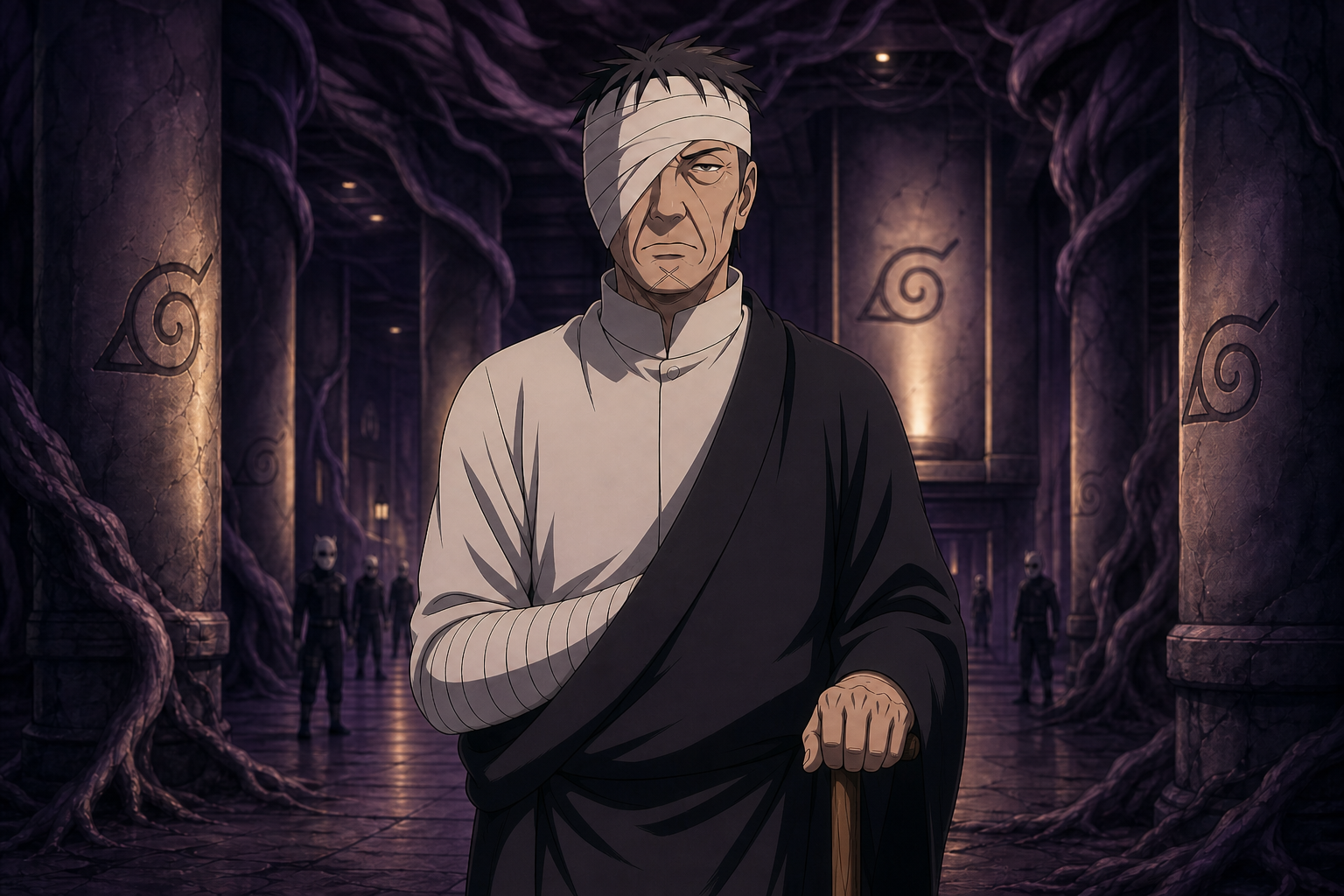
Danzō Shimura
Bottom line
Danzō Shimura is not Konoha’s necessary darkness. He is what happens when a frightened, ambitious man receives enough secrecy to rename every private weapon public safety. Danzō says the village is a tree. Hiruzen stands in the sun as its visible leaves. Danzō works below as the root nobody thanks. Cute metaphor. Terrible government. Real roots feed a tree. Danzō’s Root removes children’s names, seals their tongues, destroys their attachments and turns their bodies into tools that cannot refuse him. He steals Shisui Uchiha’s eye while claiming to prevent civil war. He helps force Itachi into an atrocity. He turns Nono and Kabuto‘s loyalty against them. He sends Sai into Team Kakashi with a hidden assassination order. During Pain’s attack, he protects his chance at office while Konoha burns. Then he finally reaches the Hokage seat and uses stolen genjutsu to manipulate a neutral summit.
The man has ten extra chances to survive and still cannot imagine one honest way to lead. Danzō does love Konoha in the possessive sense. He loves the village as an object that proves his judgment. People matter when they can be arranged beneath that judgment. That is not sacrifice. That is appetite wearing bandages.
Fast facts and record boundaries
Danzō Shimura is written 志村ダンゾウ in Japanese. He first enters the manga in chapter 281 and the anime in Naruto Shippūden episode 32. Official character data lists January 6 as his birthday. He is 72 during Part II, stands about 170 centimeters tall, weighs 52.7 kilograms and has blood type AB. His ninja registration number is 000272. He is a Konoha elder, the founder and leader of Root, and a longtime political rival of Hiruzen Sarutobi. After Pain’s assault leaves Tsunade comatose, the Land of Fire’s daimyō approves Danzō as the Sixth Hokage candidate. Candidate matters.
Danzō represents Konoha at the Five Kage Summit and exercises the office’s authority. He does not complete the ordinary inauguration process or receive the settled historical position later held by Kakashi. Calling him “the Sixth Hokage” without the candidate boundary turns a disputed transition into a clean reign. The accessible official data used here does not publish a complete mission total or promotion ages for him. Those rows stay empty. The manga controls the main chronology. The anime adds large portions of Root history and Danzō’s operations. Those additions belong in an adaptation shelf with labels. They do not receive a fake manga passport because the scenes are useful.
The name, the bandages and the body he built from other people
Shimura is a real Japanese surname with multiple possible written-name associations. Danzō’s given name uses katakana in the franchise. Fan etymology often tries to turn every syllable into a confession. The character supplies enough evidence through conduct. Old Danzō has short dark hair, a hard lined face and an X-shaped scar on his chin. Bandages cover his right eye and right arm. He walks with a cane and wears pale, high-collared clothing beneath a dark robe. The silhouette performs frailty. Under the bandages sits a stolen military archive.
His right eye is Shisui Uchiha’s Sharingan. His modified arm carries multiple Sharingan and Hashirama Senju’s cells. The body that appears wounded and disciplined is also a collection of tissues taken from other people. Danzō treats transplantation as policy. Uchiha eyes become expendable minutes. Hashirama’s cells become fuel. Shinobi bodies become a resource stockpile for the person claiming to protect them. The bandage does not hide weakness. That hides procurement.
Tobirama’s team and one fatal hesitation
Danzō serves under Tobirama Senju beside Hiruzen, Homura Mitokado, Koharu Utatane, Kagami Uchiha and Torifu Akimichi. During the First Shinobi World War, the Kinkaku Force traps the unit. Someone must remain behind as a decoy. Danzō wants to volunteer. Fear stops the words. Hiruzen speaks first. Tobirama chooses himself for the sacrifice and appoints Hiruzen the next Hokage. Official Naruto history returns to the scene during Danzō’s death because the moment explains him better than a villain speech could. Danzō does not merely lose an office. He receives a judgment about character. Hiruzen acts before ambition can calculate the reward. Danzō wants to be the brave man and discovers that wanting arrives after the necessary second. He spends the rest of his life trying to prove hesitation was not identity. The tragedy is that he chooses systems where nobody under him is allowed to hesitate. Root children receive the punishment Danzō cannot give his younger self.
Hiruzen gets the hat and Danzō builds a basement
Hiruzen becomes Third Hokage. Danzō becomes the rival who believes the visible leader is too soft. Their disagreement is real. Hiruzen values patience, bonds and public legitimacy. Danzō values preemption, secrecy and control. Fandom often describes the arrangement as light and shadow, as though both halves carry equal civic value. They do not. A public leader can be questioned, mourned, replaced and judged against law. A covert official whose operations cannot be named can define success after every body is buried. Danzō frames that lack of accountability as sacrifice. He claims no applause. Conveniently, he also accepts no ordinary review. Hiruzen’s failure is not creating Danzō’s beliefs. Hiruzen’s failure is letting an old teammate keep institutional capacity after repeated proof that secrecy has become private sovereignty. Danzō’s failure is everything he does with it.
Root removes the part of a child that can say no
Root begins as an ANBU training subdivision and becomes Danzō’s covert apparatus. Its name is ideological. Leaves receive sunlight and public recognition. Roots work unseen so the tree survives. Members surrender ordinary identity, emotional expression and attachment. Danzō imposes a curse seal on their tongues so they cannot reveal information about him and the organization. That detail demolishes the noble-shadow fantasy. If the work were only difficult and secret, members would need discretion. Danzō requires bodily paralysis against testimony. Root does not train operatives to master emotion. That treats bonds as contamination because a bond can create loyalty outside Danzō’s command. A name connects a person to memory. A friend creates an obligation the order did not authorize. Grief proves the dead operative mattered beyond function. So the system cuts those things away. Root is militarized education with the education removed. Children learn obedience, concealment, killing and the replacement of conscience with mission language. The village receives useful weapons. The child disappears before death.
Nono and Kabuto show how Danzō manufactures betrayal
Kabuto Yakushi enters Konoha’s intelligence machinery through Nono Yakushi, the woman he knows as Mother. Nono has served Root. She tries to leave covert work and care for children at the orphanage. Danzō uses pressure against that refuge to pull her back into espionage. Kabuto also enters service to protect the home. The operation does not merely risk them. That turns recognition against them. Danzō’s organization feeds Nono altered images of Kabuto over time so she will no longer recognize the boy when their paths cross. Kabuto kills her without understanding the target is Mother. She dies unable to confirm his identity. That fracture helps make Kabuto available to Orochimaru. Danzō would call the pair compromised assets whose knowledge required disposal. The reader should call them two loyal people deliberately maneuvered into destroying each other. This is what Root does to relationship. That does not merely forbid attachment. That weaponizes attachment after the attached people have served their purpose.
Kabuto’s later crimes belong to Kabuto. His identity collapse still has institutional authors. Orochimaru is the laboratory behind the patriot. Danzō publicly presents himself as the man willing to do what softer leaders will not. Privately, his body depends on work associated with Orochimaru. Hashirama cells and implanted Sharingan do not arrive through healthy village medicine. They emerge from the same research culture that treats human bodies as platforms. Danzō and Orochimaru share a belief beneath their different goals. People are material when knowledge or power needs a container. Orochimaru says the pursuit itself matters. Danzō says the village matters. The person under the scalpel receives the same absence of consent. The exact history of every procedure is not fully staged in the main manga. The profile therefore keeps the chronology bounded. The body modification is confirmed. The broader research network is confirmed. Anime expansions can add encounters and operations when labeled. What cannot be claimed is innocence through outsourcing.
A man does not become morally clean because somebody else handled the lab. Amegakure: the shadow exported. Danzō joins Hanzō in the operation that traps Yahiko, Nagato and Konan. The young Akatsuki seeks peace in a country crushed between larger powers. Hanzō fears its influence. Danzō sees regional instability and a rising organization through Konoha’s security lens. Konan is taken hostage. Yahiko drives himself onto Nagato’s weapon rather than force his friend to choose.
Nagato’s grief explodes. The movement changes. The manga establishes Danzō’s participation in Hanzō’s trap. The anime adds operational detail, including manipulation around the negotiations. Those added steps remain anime material. The consequence crosses both versions. Danzō’s attempt to control a foreign peace movement helps create the Pain who later destroys Konoha. This is not cosmic irony. This is policy returning home. Security thinking that cannot imagine independent peace will manufacture the enemy it expects.
Shisui’s eye: Danzō steals consent while claiming to prevent coercion
Shisui Uchiha and Itachi work to prevent the clan’s coup. Shisui possesses Kotoamatsukami, a genjutsu capable of altering a target’s will without the target realizing manipulation occurred. He plans to use the ability in the crisis. Danzō does not trust the plan or the young man holding the power. He takes Shisui’s right eye. Official Naruto history states the theft plainly. Shisui entrusts his remaining eye to Itachi and dies soon after. Danzō’s logic eats itself. He fears an Uchiha using covert mind control, so he steals the eye and later uses covert mind control at an international summit. The issue is never manipulation in principle. The issue is who gets to manipulate. Shisui is willing to sacrifice personal freedom and clan autonomy to prevent war. That plan deserves its own moral scrutiny. Danzō makes scrutiny impossible by converting the young man’s body into state inventory.
Itachi and the Uchiha massacre chain
The Uchiha coup places Konoha leadership, the clan and Itachi inside a crisis built over years. Hiruzen seeks negotiation. Danzō believes waiting risks civil war and foreign invasion. Itachi becomes the operative carrying information between institutions that each claim him. Danzō presents the choice in its cruelest form: participate in the clan’s destruction and preserve Sasuke, or let conflict consume everybody, including the younger brother. Itachi carries out the massacre with Obito’s participation. Fugaku, Mikoto and the clan die. Sasuke survives. Official Naruto material describes the annihilation as a top-secret mission given through Konoha leadership while later manga scenes expose Danzō’s coercive role and Hiruzen’s regret. The exact assignment chain must be described with those distinctions intact. Danzō does not swing every blade. He constructs the choice. That distinction does not reduce responsibility. That identifies the method.
He uses a child’s love for his brother as the lever that makes atrocity possible. Then Konoha receives peace without publicly admitting the price. Root calls this protection from the shadow. Sasuke calls the dead by name. Hiruzen’s half-measure keeps Root alive. After the massacre, Hiruzen strips Danzō of position and moves against Root’s formal standing. Danzō remains in Konoha with followers, influence and operational reach. The punishment is enough to prove disagreement and too weak to prevent return. Hiruzen’s instinct toward continuity appears again. Removing an old colleague completely might fracture leadership, expose secrets or create new instability. The compromise preserves the instability in place.
Danzō learns that even massacre-level consequence will not permanently separate him from power. This is why institutional accountability cannot depend on whether the top leader is personally disappointed. A disappointed Hokage still leaves the basement furnished. Sai is the child Root fails to finish. Sai enters Team Kakashi as a Root operative. His name is an assignment. His social responses are trained performances. Danzō gives him a secret mission connected to Sasuke that differs from the team’s stated work.
Sai initially reads bonds as irrational vulnerabilities. Then he watches Naruto and Sakura refuse to abandon Sasuke. He remembers his own bond with the boy he knew as brother. He chooses relationship over the script that says feeling is a defect. That choice is not instant healing. Sai has to learn names, expressions, trust and apology with all the grace of a handbook falling down stairs. The awkwardness matters. Root claims emotion makes operatives weak. Sai becomes more morally capable when attachment returns. Bonds let him compare an order to a person and decide the person matters. He is living evidence against Danzō’s curriculum.
Pain attacks and Danzō protects the office he wants
Pain invades Konoha looking for Naruto. Danzō kills the messenger frog intended to summon Naruto back from Mount Myōboku. He keeps Root out of the village’s defense. The stated logic is strategic. Naruto is the Nine-Tails jinchūriki and must not fall into Akatsuki hands. The political outcome is also obvious. Tsunade’s defense can fail. Danzō can inherit the emergency. Konoha is destroyed. People die while the secret force built to protect the village remains beneath it. This is the moment the root metaphor rots completely. A root that withholds water until the visible tree dies is not sacrificing for the whole. That is waiting to own the trunk. Naruto returns anyway, defeats Pain and helps Nagato choose restoration. The boy Hiruzen’s softer philosophy helped nurture achieves security through a relationship Danzō’s worldview cannot predict.
Sixth Hokage candidate: the title arrives before legitimacy. Tsunade falls into a coma after protecting Konoha’s population through Katsuyu. Danzō argues for a harder direction and receives the daimyō’s approval as Sixth Hokage candidate. He acts with the authority to represent Konoha and marks Sasuke for elimination. The appointment is not fake. Neither is it complete. That middle state fits Danzō perfectly. He finally possesses the authority he has wanted since Tobirama chose Hiruzen, but public confirmation and symbolic settlement remain unfinished. The office arrives through another leader’s bodily collapse. He does not use the opportunity to make Root answerable, disclose old crimes or rebuild trust. He carries the basement to the summit.
The Five Kage Summit exposes covert government in public
Danzō attends the Five Kage Summit while the shinobi world faces Akatsuki and the tailed-beast crisis. The summit needs coordination. Danzō wants Konoha to control the alliance. He uses Shisui’s eye to influence Mifune, the neutral samurai leader guiding the discussion. Ao detects Shisui’s chakra and exposes the manipulation. Official anniversary material confirms the sequence. Danzō’s first international act as Hokage representative reproduces the same principle as Root: agreement is acceptable when the other person cannot know their will was altered. This is not diplomacy. That is a tongue seal applied from across the room. The summit loses trust at the exact moment trust is required for collective defense. Danzō flees when Sasuke’s attack and the exposure make his position unsafe. Necessary darkness has entered daylight and discovered witnesses.
Sasuke versus Danzō turns the clan into evidence
Sasuke confronts Danzō after learning the truth behind Itachi’s life. Danzō removes the seal and bandages from his right arm. Multiple Sharingan stare from flesh altered with Hashirama’s cells. The image is body horror because the politics are body horror. The Uchiha were killed as a security threat. Their eyes then became equipment for the official who argued they had to die. Sasuke’s rage is not a neutral moral authority. He is deep inside revenge, manipulated by Obito and willing to endanger people around him. That does not make Danzō’s arm less obscene. Their fight becomes a contest between inherited grief and hoarded survival. Sasuke studies the timing of Izanagi. Danzō spends Sharingan to rewrite fatal outcomes. Each closed eye records another death avoided by the man wearing a dead clan. Karin becomes another body between Danzō and consequence. During the final exchange, Danzō takes Karin hostage.
Sasuke pierces through her to strike him. Both men treat her body as available inside their objective. Danzō uses her as cover. Sasuke decides revenge matters more than her safety. The scene does not need a debate about which man’s disregard is technically worse before Karin is allowed to count. Danzō’s lifelong claim is that hard choices protect the village. Faced with death, he reaches for a young woman’s body. The private instinct matches the public policy. Somebody else becomes the shield.
Izanagi offers ten chances and no self-knowledge
Izanagi lets Danzō make injury and death function as illusion for a limited period while his own attacks remain real. Each implanted Sharingan extends the technique and closes after use. Hashirama cells help sustain the system. The cost remains high, the duration remains trackable and the body remains unstable. Sasuke and Obito study the clock. Danzō wastes uses because he behaves as though stored resurrection has made ordinary caution beneath him. That is the character in miniature.
Danzō acquires extra chances without acquiring reflection. He can rewrite what happens to his body. He cannot rewrite why the fight exists. When Hashirama’s cells begin to overwhelm the arm, he severs it. The body modification meant to secure control becomes another thing he cannot control. Borrowed power has never agreed to become him.
Wind, seals, Baku and the complete ability shelf
Danzō is a skilled veteran before the stolen eyes enter the discussion. Wind Release is his clearest natural combat identity. He fires cutting vacuum projectiles, shapes wind around weapons and uses pressure with tactical precision. He summons Baku, a giant tapir-like creature associated with consuming nightmares. Baku creates powerful suction that can restrict movement and intensify Danzō’s wind attacks. The combination is clever rather than infinite. Strong fire can exploit the airflow. Position, preparation and the summon itself matter.
Danzō uses sealing techniques to restrict information and movement. Root’s tongue seals paralyze members who attempt to disclose forbidden facts. In combat, binding marks can restrain a target. His right eye gives access to Shisui’s genjutsu. Kotoamatsukami’s subtle manipulation is powerful, but the eye has cooldown and access constraints. Danzō cannot casually solve every encounter by saying the technique’s name. The Sharingan arm and Hashirama cells enable repeated Izanagi far beyond an ordinary single-eye use. They also consume chakra, require an arm seal and risk biological loss of control. His Wood Release is limited. One unstable growth does not make him Hashirama with worse manners.
Reverse Four Symbols Sealing activates at death and pulls a large surrounding area into the seal within his corpse. Danzō tries to take Sasuke and Obito with him. They escape. The final technique is a lethal capture attempt, not proof that every earlier action becomes noble because he dies saying Konoha’s name. Relationship and accountability atlas. Hiruzen Sarutobi. Hiruzen is teammate, rival, chosen successor and the standard Danzō cannot stop measuring himself against. Danzō calls Hiruzen soft while depending on Hiruzen’s reluctance to remove him. Tobirama Senju. Tobirama is teacher and the authority who recognizes Hiruzen’s immediate self-sacrifice. Danzō imitates Tobirama’s security language without reproducing the moment where Tobirama spends his own life instead of a subordinate’s.
Shisui Uchiha. Shisui is a young operative trying to prevent war. Danzō steals his eye and helps eliminate the peaceful option he claims is too risky. Itachi Uchiha. Itachi is a child genius Danzō turns into a state weapon. His love for Sasuke becomes the mechanism of coercion. Sasuke Uchiha. Sasuke is survivor and consequence. His revenge is destructive, but Danzō cannot dismiss the evidence embedded in his own arm. Sai. Sai is supposed to be Root’s successful child. His recovery of bond and judgment exposes the doctrine as damage, not discipline.
Nono and Kabuto Yakushi. Nono and Kabuto show Danzō’s intelligence system destroying loyal operatives through identity manipulation. Their later paths do not erase who built the trap. Orochimaru. Orochimaru supplies or enables research Danzō uses while both men treat bodies as containers. Their stated goals differ. Consent disappears in both systems. Hanzō, Yahiko, Nagato and Konan. Danzō’s foreign intervention helps turn a peace movement into the Pain crisis that later destroys Konoha. Tsunade. Tsunade protects the village until coma removes her from office. Danzō uses the emergency to pursue succession and represents the opposite theory of care.
Mifune and Ao. Mifune is the summit leader Danzō manipulates. Ao is the witness whose sensory history with Shisui exposes the theft in public. Fū and Torune. Fū Yamanaka and Torune Aburame accompany Danzō as Root bodyguards. They possess clan techniques, histories and lives beyond service. Later use of their bodies by Obito and Kabuto extends the series’ argument about operatives treated as material. Karin. Karin becomes a hostage because Danzō’s survival instinct makes another young body disposable. Sasuke’s answer compounds the violation. Hiroshi Thatō and the Japanese performance boundary. Hiroshi Thatō is the original Japanese performer for adult Danzō in the television anime record used here.
The credit is verified. This profile does not invent vocal texture, timing or breath analysis without a controlled Japanese-audio rewatch. Danzō creates a demanding performance problem. He speaks the language of restraint while pursuing enormous personal control. The actor must carry age, authority, grievance and calculation without turning every line into obvious villain hissing. Episode Reacts can examine how the performance accomplishes that work when exact scenes are available. No English-dub section appears here.
Manga, anime, novels and games. The manga provides Danzō’s central political role, Shisui eye, massacre chain, Pain-era maneuvering, summit exposure, Sasuke battle and death. The anime expands his younger years, Root operations, relationships with ANBU-era characters and portions of Amegakure history. Those expansions can illuminate adaptation choices. They remain anime continuity unless the manga or licensed novels independently establish the event. Itachi-focused novels and their adaptations add detail around the Uchiha crisis. The exact medium and scene must be named rather than blended into one universal timeline. Games make Danzō’s wind, Baku, Sharingan and sealing abilities playable. A move designed for balance or spectacle is not automatic manga evidence.
This boundary matters especially for a character built from secrets. “That could have happened offscreen” is not a source. Root symbolism: the underground is a political choice. Roots ordinarily feed life from below. Danzō uses the image to justify invisibility. That reversal is the point. Healthy roots exchange nutrients with the tree. Root agents cannot speak about the organization. Healthy roots branch. Root demands loyalty converge on one man. Healthy roots stabilize growth. Danzō repeatedly destabilizes the village and its neighbors to preserve his preferred control.
The bandages extend the symbolism. He presents secrecy as a wound carried for others. Underneath is stolen power. The cane presents age and limitation. The hidden arm stores repeated escape from death. The body is propaganda before Danzō says a word. Confucian office and the minister who wants the ruler’s name. This is a RaeRae interpretive lens, not an author-declared doctrine.
Confucian political ethics care about roles and the conduct attached to them. A minister owes honest service. A ruler owes moral governance. A teacher owes development rather than possession. Danzō breaks role while insisting he alone understands duty. He acts as an unaccountable ruler while Hiruzen holds the office. He undermines collective policy while claiming service. He conditions children as extensions of his will while calling them shinobi. When he finally receives the candidate title, he manipulates Mifune instead of earning consent.
The problem is not ambition by itself. The problem is pursuing the ruler’s authority while refusing the ruler’s accountability. Danzō wants the name Hokage because Tobirama once gave it to Hiruzen. He never understands why Tobirama made the choice. Buddhist attachment and ten stolen deaths. Danzō describes himself as willing to die for Konoha.
His body tells another story. He stores Sharingan so death can be rewritten again and again. He takes Hashirama’s cells to extend control. He steals Shisui’s eye, a technique built around rewriting another person’s will. Attachment to life is not shameful. Danzō’s shame comes from making other bodies pay for his refusal to face limitation. Izanagi gives him impermanence as a resource. Death occurs, then gets denied. The eye closes. Another eye opens. No lesson enters. His final moments return to the Kinkaku Force memory. Hiruzen appears in his mind. Danzō finally attempts a death that spends his own body for the village. The gesture comes after a lifetime of spending everybody else first.
Fandom court
“Danzō was a necessary evil”. Necessary for what specific outcome? His intervention helps create Pain, his Uchiha policy creates Sasuke’s revenge, his treatment of Kabuto helps deliver a genius to Orochimaru and his summit manipulation damages alliance trust. Calling every secret act necessary after the act backfires is branding, not analysis. “He did everything for Konoha”. He often believes that. He also withholds Root during Konoha’s destruction and manipulates an international summit to strengthen his leadership. Motive and ambition occupy the same body. “Hiruzen’s softness forced Danzō to exist”. Hiruzen’s poor oversight enables Danzō. That does not author Danzō’s choices.
“He prevented the Uchiha civil war”. The massacre prevents the planned coup by destroying the clan. The result does not prove every alternative was exhausted, especially after Danzō removes Shisui’s proposed intervention and undermines negotiation. “Root made strong shinobi”. Sai is skilled. So are many abused children. Competence does not retroactively make abuse the correct teacher. “His final sacrifice redeemed him”. Death can reveal sincerity. That cannot restore Shisui’s eye, Nono’s recognition, Itachi’s childhood or the Uchiha dead. “He was weak without stolen eyes”. Danzō is an experienced wind and sealing user with a dangerous summon. The stolen body expands that skill. Accurate criticism does not require pretending he has none.
Consequence ledger. Danzō’s life touches nearly every major institutional wound in Naruto. The Tobirama succession gives him grievance. Root turns grievance into a system. Nono and Kabuto show the system eating its own people. Amegakure helps create Pain. Shisui’s eye theft closes a path away from massacre. Itachi carries the atrocity. Sasuke carries the revenge. Sai carries the conditioning and then breaks it. The Pain assault gives Danzō his opening. The summit exposes the method. His death removes a man but leaves the world his choices helped shape. This is why he matters. Danzō is not a side villain with a gross arm.
He is the franchise’s clearest warning that institutions do not remain morally clean by assigning cruelty to a hidden department. Design chronology: grievance ages into uniform. Young Danzō appears in the standard armor of Tobirama’s wartime unit. His body is open to the same battlefield as everybody else’s. The face is younger, the posture less settled and the rivalry with Hiruzen has not yet become an underground institution. The Kinkaku Force flashback matters visually because nothing marks him as destiny’s villain. He is a frightened young soldier inside an impossible decision. Fear does not make him monstrous. What he does with the memory does. Later Danzō turns restraint into uniform. High collars, dark robes, cane and bandages make him look controlled while concealing the most uncontrolled parts of his body. The right eye is stolen. The right arm needs seals and wrappings because the implanted system consumes chakra and risks biological rebellion.
His final battle removes the costume layer by layer. The arm seal comes off. Sharingan open. Izanagi closes them. Hashirama’s cells escape his command. The body Danzō presented as disciplined becomes a record of appetite and instability. That reveal should never be reduced to “cool villain transformation.” The shock belongs to Sasuke and the dead Uchiha. Their clan is literally looking back from the official who helped authorize its destruction. The anime adds younger and ANBU-era visual material around Root. Those designs can support adaptation analysis when the episode is named. They do not become manga biography through familiarity.
The economics of a secret army. Root requires more than ideology. Children must be identified, recruited or pressured into service. Trainers need space, food, equipment, intelligence access and medical support. Missions require information channels. Body modification requires laboratories and specialists. Silence requires enforcement. That means Danzō is not one rogue elder operating from a dramatic cave. He controls a budget, labor system and supply chain inside Konoha. The manga does not publish Root’s accounting ledger. The infrastructure remains visible through personnel and reach. Danzō can assign Sai to Team Kakashi, deploy clan specialists such as Fū and Torune, pressure Nono through the orphanage and maintain followers after formal dissolution. Hidden power still consumes public resources and private lives. This matters for the franchise’s worldbuilding. Shinobi villages make money through missions while spending children and trained adults on security. Root removes even the ordinary client-facing explanation. Operatives become off-book labor whose success belongs to the village and whose failure can be denied. Danzō’s model therefore privatizes accountability while socializing consequence. He chooses. Root acts. Konoha receives retaliation.
That pattern is more frightening than one forbidden jutsu because no chakra exhaustion automatically ends it. Why the necessary-evil story keeps working. Danzō looks serious. He speaks calmly. He does not laugh while describing sacrifice. Fiction has trained audiences to confuse those signals with strategic depth. The industry also likes a shadow administrator because the figure protects beloved heroes from institutional blame. Hiruzen can remain the grandfather. Tsunade can remain the healer. Itachi can remain the tragic brother. Konoha can remain home. Danzō absorbs the ugliness. That narrative function is useful and dangerous.
He does carry direct responsibility. The answer is not to spread his choices so widely that nobody chose anything. The answer is to keep the system visible around him. Hiruzen retains him. Elders tolerate covert structures. Orochimaru provides science. Clan and orphan bodies become resources. The daimyō can approve a candidate without knowing the basement beneath the résumé. Danzō is guilty inside that network, not instead of it.
Satire helps because his rhetoric is always one step away from parody. Every failure proves he needed more secrecy. Every enemy proves preemption was wise. Every victim proves the threat was serious. Every demand for evidence risks the village. That argument cannot lose because it defines losing as permission to expand. Naruto defeats the logic through visible relationship. Sai speaks. Ao identifies the eye. Sasuke counts the Izanagi intervals. Secrets stop functioning as authority once other people can name the mechanism.
Final verdict
Danzō spends his life trying to become the man who volunteered before Hiruzen. He never does. The younger Danzō freezes for one human second. The older Danzō builds an organization designed to erase that second from everybody beneath him. Root children cannot hesitate. Nono cannot retire. Kabuto cannot keep a stable identity. Shisui cannot retain his eye. Itachi cannot receive a choice that leaves both clan and brother alive. Mifune cannot even know his judgment has been touched.
Danzō calls those removals protection. The tree receives no nourishment from them. The tree receives Pain, massacre, revenge and distrust. At death, Danzō remembers Hiruzen and wonders how far behind he remained. The answer is not a power level or a title. Hiruzen volunteered his own body. Danzō spent a lifetime volunteering other people’s.
Sources and canon boundary
Manga chronology controls this profile. Anime staging, databook material, novels, films, games, and later franchise appearances are labeled instead of being blended into one false continuity.
Primary franchise references: Naruto Official and VIZ Media Naruto. CVM Sekai’s conclusions about Root, Hiruzen, Shisui’s eye, Itachi, the Uchiha massacre, Sai, Izanagi, the summit, stolen bodies, state secrecy, and accountability are editorial analysis, not invented creator quotations.