
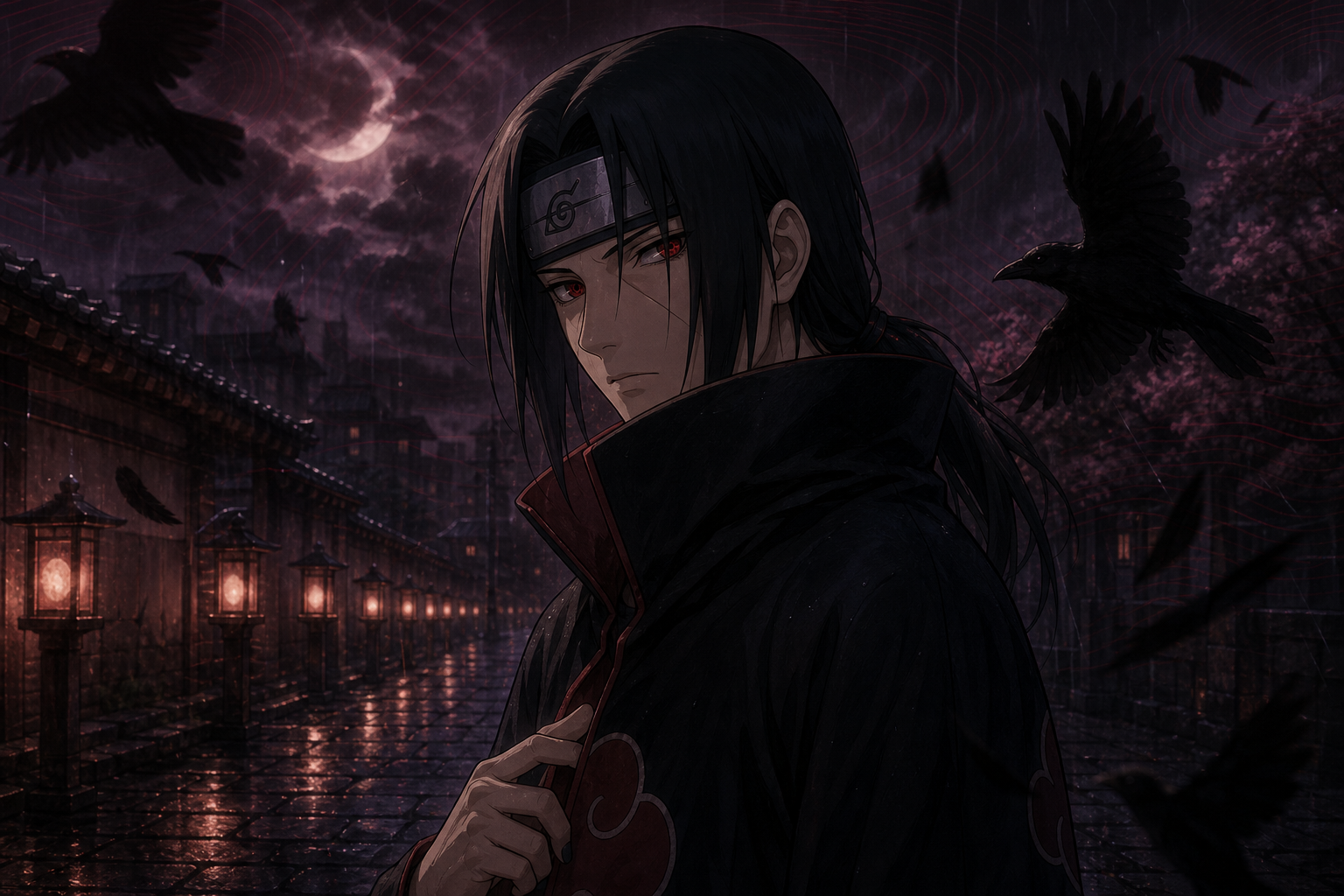
Itachi Uchiha
Bottom line
Itachi Uchiha loves Sasuke and still abuses him. That sentence is the door. If a profile cannot walk through it, the rest becomes either saint worship or villain wallpaper. Itachi is a child prodigy turned into an adult solution for a clan and government that fail him. He witnesses war at four, graduates at seven, awakens the Sharingan at eight and becomes chūnin at ten. Before most children are trusted to choose dinner, Konoha and the Uchiha are using him as a double agent inside a coup crisis. Danzō narrows the future to massacre or civil war. Itachi chooses massacre and protects Sasuke.
Then he tries to manufacture Sasuke’s entire life. He uses Tsukuyomi to force a child to relive their parents’ deaths. He tells Sasuke to hate him, pursue power and eventually commit fratricide. He joins Akatsuki, protects Konoha through secrecy, returns after Hiruzen‘s death and breaks Sasuke again because the hatred plan is not progressing on schedule. The love is real. The damage is real.
Itachi’s greatest growth arrives after death. Reanimated, freed from Kabuto‘s control by Shisui’s eye, he stops trying to program Sasuke. He admits that trusting Sasuke earlier might have changed the Uchiha crisis. He shows the truth and says he will love his brother no matter what Sasuke chooses. That final sentence matters because Itachi finally removes the hidden command. Love stops being a plan.
Fast facts and the complete controlled record
Itachi Uchiha is written うちはイタチ in Japanese. His given name means weasel, an animal with complicated folklore associations, but the series does not turn him into a walking etymology puzzle. He debuts in manga chapter 139 and anime episode 80. His birthday is June 9, and his blood type is AB. He is 17 to 18 during Part I and 21 at death in Part II. Official character data lists him at 175.2 centimeters and 57.1 kilograms in Part I, then 178 centimeters and 58 kilograms in Part II. Official Naruto history gives an extraordinary early timeline. Itachi witnesses Third Shinobi World War deaths at age four. He graduates from the Academy at seven, awakens his Sharingan at eight and becomes chūnin at ten.
He later serves in ANBU and rises to captain-level responsibility while still very young. Exact age and title conventions around the captain appointment differ across manga-adjacent data, novels and adaptation material. The final post must state the source rather than sanding every version into one clean résumé. His affiliations include Konoha, the Uchiha clan, ANBU and Akatsuki. Publicly, he becomes an S-rank missing-nin responsible for the clan massacre. Secretly, he preserves ties to Konoha’s security and tries to keep Sasuke alive. The manga controls the main chronology. Itachi Shinden novels and anime adaptations expand childhood, missions, clan politics and the massacre. Those details remain labeled by medium.
Design: a twenty-one-year-old the anime keeps aging on sight
Adult Itachi has long black hair tied low, face-framing strands, dark eyes and pronounced tear-trough lines. He wears the black Akatsuki cloak with red clouds, a scratched Konoha forehead protector and dark nail polish associated with the organization. He is twenty-one when he dies. Fan art and animation frequently make him look thirty-five because the deep lines, low voice and permanent exhaustion do heavy visual labor. The result can hide how young the character remains. At the massacre, he is younger still. The adaptation often preserves the adult face while shrinking the body or changing costuming. That choice makes a child operative read like a fully mature mastermind.
Age is part of accountability, not a pass. Itachi makes catastrophic choices. He also makes them inside institutions that hand military, intelligence and clan responsibility to a teenager, then call his composure evidence that the assignment was reasonable. His scratched forehead protector communicates public betrayal. The Akatsuki cloak communicates enemy status. The face remains controlled enough that viewers must wait for later truth. The ring, crows and red-black eye imagery became marketing shorthand because Itachi is visually perfect for tragic mystery. The profile has to restore the person under the merchandise.
War enters his body at four
Official birthday history says Itachi encounters the Third Shinobi World War at age four and sees many deaths. The experience creates a hatred of conflict and a desire for peace. That origin is often used to call him a pacifist. The word needs friction. Itachi hates war so intensely that he later accepts mass killing to prevent a larger conflict. Peace becomes an outcome separated from method. The child learns that bodies disappear when adults fail to control politics. The teenager decides he can control politics by deciding which bodies disappear. This is not hypocrisy in the cheap sense. That is trauma becoming strategy. War teaches Itachi to think beyond immediate clan interest. That also teaches him to treat catastrophic predictions as morally decisive. If civil war might bring foreign invasion, then stopping the coup appears to outweigh every individual claim. The boy sees the whole board because the people around him keep placing him above it. Nobody asks what standing there does to him.
Academy prodigy means gifted-child labor
Itachi’s early accomplishments are astonishing. Academy graduation at seven. Sharingan at eight. Chūnin at ten. Rapid movement into elite intelligence work. Fans use those milestones to prove genius. They do. They also prove Konoha is willing to convert childhood ability into state capacity as fast as possible. A gifted child in a civilian school may receive harder books. A gifted child in a shinobi village receives classified missions, command expectations and access to lethal institutions. Itachi’s calm makes the exploitation easy to overlook. He does not rebel loudly. Adults praise his Hokage-like thinking and maturity. Maturity can describe judgment. That can also become the excuse adults use to hand a child what adults do not want to carry.
Itachi performs competence so consistently that every institution asks for more. Clan. Academy. ANBU. Hokage leadership. Danzō. Akatsuki. The reward for being reliable is becoming load-bearing. Career, temperament and the difference between calm and health. Itachi’s professional record moves through Academy, genin work, chūnin promotion, ANBU service, clan surveillance and Akatsuki membership at a speed that should make the adults look worse, not the child look magically finished. Licensed and supplementary records describe high intelligence, observation, discipline and an ability to learn techniques rapidly. His mission totals and promotion details need to follow the exact databook edition used in publication. The visible career already establishes the point without a decorative number dump.
Itachi is polite, restrained and difficult to read. He avoids unnecessary noise and often ends fights before opponents understand the exchange. That calm is not emotional health. He suppresses fear, grief, anger, illness and attachment until secrecy becomes personality. People praise composure because they benefit from never having to manage what he carries. Around Sasuke, small gestures reveal warmth. Around Shisui, the record permits intellectual and emotional trust. Around Kisame, restraint becomes professional companionship. Around enemies, the same quiet makes violence feel inevitable.
His official food trivia includes kelp rice balls and cabbage among favorites. The ordinary detail matters because Itachi’s image is so heavily mythologized that fandom sometimes forgets he ate, coughed, took medicine and occupied a young human body. The prodigy label should describe capacity. That should never erase need. Fugaku and Mikoto give him family and expectation. Fugaku Uchiha is Itachi and Sasuke’s father, head of the family and a major clan leader. Mikoto is their mother.
Fugaku recognizes Itachi’s talent and places clan expectation on him. The pride is genuine. The political use is also genuine. Itachi enters ANBU partly as a bridge and intelligence channel for the Uchiha. Official Naruto history states Fugaku orders him into the unit so he can spy for the clan. Konoha leadership also uses him to spy on the Uchiha. The boy becomes a hallway with locked rooms on both sides. Mikoto receives less political space in the main manga, but her presence matters. She is mother to both sons and a massacre victim whose final scene refuses to reduce the family to enemy combatants. Fugaku’s role in the coup does not erase fatherhood. Fatherhood does not erase his role in making Itachi an instrument of clan strategy. The family loves. The family recruits. Both truths reach the final room.
Sasuke before hatred becomes the curriculum
Young Sasuke adores Itachi. He wants time, training and acknowledgment. Itachi taps his forehead and postpones him, often with affection rather than rejection. The gesture becomes their private language. Itachi trains, works and carries responsibilities Sasuke cannot see. Sasuke experiences the absence as distance and tries harder to earn attention. Their bond is ordinary enough to make the later plan unbearable. Itachi does not spare a stranger during the massacre. He spares the child who loves him most. Then he decides love alone will not keep Sasuke alive. Hatred will. This is the original sin of their adult relationship. Itachi trusts Sasuke’s capacity but not Sasuke’s agency. He writes a path: survive, hate me, gain power, kill me, become a hero to the clan and village. Sasuke becomes a person inside somebody else’s redemption script.
Shisui is friend, brother and political teacher
Official Naruto history describes Shisui as Itachi’s best friend and older-brother figure. They train, talk and develop a shared concern with protecting Konoha while honoring the Uchiha. Shisui teaches that true shinobi do not seek glory and protect from the shadows. Itachi makes the lesson his entire life. Shisui’s plan to use Kotoamatsukami against the coup leadership reveals their shared willingness to use hidden control for peace. Danzō steals Shisui’s right eye. Shisui gives the left to Itachi and asks him to protect village and clan. Then Shisui dies. Itachi awakens the Mangekyō Sharingan through that loss. The friend gives him an eye, an ideal, a secret and a request no child should carry alone. Itachi later hides the eye inside a crow and places the crow in Naruto. The inheritance keeps converting trust into contingency. Shisui trusts Itachi. Itachi trusts a command embedded in Naruto more than he trusts future Sasuke. The lesson changes as it travels.
ANBU and the double-spy trap
Itachi’s ANBU role places him close to the Hokage while the Uchiha police and clan leadership plan a coup. Official history states the clan wants him to report on Konoha. Konoha leadership wants him to report on the clan. Every conversation becomes evidence. Double agents survive by controlling information. Itachi already responds to fear through secrecy, so the role rewards his most dangerous instinct. The institutions call him loyal when the information favors them and suspect him when it does not. He has no stable audience for the complete truth. Hiruzen favors negotiation. Danzō favors preemptive destruction. Fugaku and the clan prepare revolt. Shisui seeks a genjutsu intervention. Itachi stands between them with the emotional expression of someone waiting for the adults to remember they are adults.
They do not. The Uchiha coup is not sudden clan madness. The Uchiha crisis grows through history. The clan’s police role separates it from other civic power. Suspicion follows the Nine-Tails attack. Leadership pushes the clan farther toward the village edge. Surveillance and distrust deepen. Fugaku and clan leaders plan a coup. The coup risks civil war and outside attack. That threat is real. The grievance is real too. Calling the Uchiha irrational erases the political conditions. Calling the coup harmless erases the likely violence. Itachi sees both. His tragedy is not that one side is obviously right and he chooses the other. His tragedy is that adults collapse every political option until a teenager believes the only remaining task is deciding which catastrophe kills fewer people.
Danzō presents an impossible choice and calls it policy
Danzō takes Shisui’s eye and removes the proposed genjutsu intervention. He then corners Itachi with a choice centered on Sasuke. If the coup proceeds, the clan and village may destroy each other, and Sasuke may die. If Itachi helps eliminate the clan, Sasuke can be spared. This is coercion. The coercion does not turn Itachi’s body into Danzō’s puppet. Itachi chooses within the narrowed field. That distinction is essential. Danzō creates and weaponizes the conditions. Itachi participates in the massacre. Obito assists. Konoha receives the result. Hiruzen regrets failing to create another outcome. Nobody becomes clean because responsibility is shared. Itachi’s peace fixation makes Danzō’s argument effective. Sasuke’s life makes it irresistible. Danzō understands the boy well enough to make love the handle.
Obito helps carry out the massacre
Itachi makes contact with the masked Uchiha he understands through the Madara identity and brings him into the operation. Obito participates in the clan’s destruction. Exact divisions of victims and locations receive additional treatment in novels and adaptations. The main record confirms collaboration without providing a simple ledger that assigns every death. That boundary matters. “Itachi killed his entire clan alone” erases Obito. “Obito did the bad part, so Itachi is clean” erases Itachi. The operation is collective and secret. That is how state violence often protects itself from clear authorship. The victims remain individuals even when the story cannot name each one.
Fugaku and Mikoto refuse to turn the final room into a battle. Itachi reaches his parents. Fugaku and Mikoto understand what he has chosen. They do not fight him in the remembered final scene. Fugaku acknowledges the path and asks Itachi to care for Sasuke. Mikoto remains with her husband and son in the final moment. Their response is not permission from the entire clan. That is a family decision inside the last seconds available. Fugaku’s acceptance complicates him. The coup leader remains father. Itachi’s tears complicate the killer. The blade remains real. This is not a tender absolution scene. That is a family refusing to make the child perform one more fight after every political role has already consumed him. Sasuke loses all three of them while believing only one chose the night.
Tsukuyomi writes trauma into Sasuke
Itachi spares Sasuke and then uses Tsukuyomi to make him relive the massacre. He tells Sasuke to hate him, live, gain power and seek revenge. The plan is supposed to direct Sasuke away from Konoha’s responsibility and toward Itachi alone. That also destroys Sasuke’s emotional safety. The child experiences family death repeatedly through his brother’s eyes. He receives no truthful adult, no shared mourning and no consent to the future assigned to him. Itachi treats hatred as armor. Hatred becomes isolation, obsession and vulnerability to Orochimaru. The plan produces strength. That does not make the method correct.
Abuse can produce survival skills. Survival does not retroactively turn abuse into training. Exile, Hiruzen and the warning to Danzō. Itachi leaves Konoha as the public murderer of the Uchiha clan. He warns Danzō against harming Sasuke and relies on Hiruzen to protect the boy. The threat demonstrates that Itachi retains leverage and strategic judgment after the massacre. The arrangement also leaves Sasuke in the same village that hid the truth. Hiruzen’s protection matters. Danzō does not openly eliminate Sasuke while Hiruzen lives. Hiruzen cannot provide the truth, family or emotional care Sasuke needs. Again, policy protection and lived protection are not identical. Itachi becomes a missing-nin and joins Akatsuki. Public hatred settles around him exactly as planned. The village receives a villain. Sasuke receives a target. The institutions receive silence.
Akatsuki turns self-exile into work
Itachi joins an organization collecting tailed beasts and destabilizing the shinobi world. His hidden intentions include watching the group and protecting Konoha’s interests. That does not make every Akatsuki mission fake. He participates in the organization. Anime and novel material expands an earlier partnership with Jūzō Biwa. The main series strongly associates him with Kisame Hoshigaki.
Kisame and Itachi develop professional trust. Kisame respects strength and recognizes that Itachi carries depths he does not explain. Itachi treats Kisame with a restraint uncommon inside Akatsuki. Their relationship is not wholesome friendship pasted over criminal work. That is companionship between two men who have made identity out of hidden violence. Itachi’s presence may restrain some outcomes. He still belongs to a group hunting jinchūriki. Infiltration does not make participation consequence-free.
Kisame recognizes the person under the cover without receiving the truth. Kisame Hoshigaki becomes Itachi’s best-known Akatsuki partner. Both men come from systems where loyalty and betrayal have become difficult to separate. Kisame kills comrades to protect intelligence, then learns the authority giving orders is compromised. Itachi destroys his clan under a village security logic and lives publicly as traitor. They do not confess those histories to each other in full. They still develop working respect.
Kisame follows Itachi’s tactical judgment, notices his physical condition and treats his strength seriously. Itachi restrains some of Kisame’s appetite for violence and speaks without the contempt common inside Akatsuki. The relationship humanizes both without cleaning their work. Itachi does not tell Kisame he remains tied to Konoha. Kisame does not become a secret hero because he respects his partner. Their bond grows inside an organization kidnapping and killing jinchūriki. That tension is useful. People can care for one another while participating in harmful systems. Personal decency does not automatically transform institutional purpose.
Kisame later remembers Itachi’s words about understanding oneself at death. The line survives because Itachi gives him recognition without full disclosure. Even here, Itachi offers truth in pieces. Surveillance cuts both ways. Itachi’s Akatsuki role is commonly described as infiltration for Konoha. The manga supports continued protective intent, awareness of the masked man and efforts to keep danger away from Sasuke and the village. The exact flow of intelligence back to Konoha is not presented as a tidy sequence of reports.
That distinction matters. An infiltrator who never safely reports still watches, deters and positions himself. Itachi’s presence can make Obito and Danzō consider consequences. His survival after Hiruzen’s death lets him return and signal that the old secrets remain guarded. The cover also requires credible participation. He pursues Naruto with Kisame, helps Akatsuki operations and uses damaging techniques on Konoha shinobi. A profile should not call every harmful act fake because later truth makes the audience uncomfortable.
Surveillance is not moral immunity. Itachi watches Akatsuki while Akatsuki watches him. Obito knows more of the massacre than most members. Kisame observes illness. Zetsu monitors the final battle. The man who lives by controlling information is never the only observer. That is why the plan cannot stay private forever. Orochimaru learns the body is not available. Orochimaru desires the Sharingan and attempts to take Itachi’s body. Itachi defeats him through genjutsu. The encounter establishes ocular skill, composure and a boundary Orochimaru cannot cross. That also affects Orochimaru’s later pursuit of Sasuke. Itachi protects his own body from becoming a container. Sasuke later becomes the next desired container.
The brothers’ stories keep circling bodily ownership. Danzō collects eyes. Orochimaru collects vessels. Itachi tries to control Sasuke’s mind while protecting his body. Naruto does not let those forms of possession become identical. The pattern remains visible. Return to Konoha after Hiruzen’s death. Itachi and Kisame enter Konoha after Hiruzen dies. They confront Asuma, Kurenai and Kakashi. Itachi uses Tsukuyomi on Kakashi, subjecting him to prolonged torture inside compressed time. Kakashi survives with severe mental and physical consequence. Jiraiya later blocks the attempt to reach Naruto. Sasuke arrives and confronts Itachi.
Itachi humiliates him, breaks his wrist, dismisses his progress and uses Tsukuyomi again. This is where the protective-mastermind defense collapses if left unexamined. Itachi may want to warn Konoha’s elders that he remains alive after Hiruzen’s death. He may need Akatsuki to believe the mission is genuine. He also chooses to retraumatize Sasuke because Sasuke’s hatred is not strong enough for Itachi’s planned ending. The strategy works in one sense. Sasuke seeks more power. He leaves Konoha for Orochimaru. Itachi’s attempt to protect him helps push him toward a body thief. Gaara ‘s rescue and the thirty-percent proxy. During the Kazekage rescue operation, Akatsuki uses proxy bodies carrying portions of members’ chakra to delay pursuers. Itachi’s proxy fights Team Kakashi.
The encounter demonstrates genjutsu, clone tactics, fire and strategic delay under reduced power conditions. Naruto’s growth and Chiyo’s guidance around genjutsu matter to the outcome. The proxy is not full living Itachi. Fandom power scaling routinely drops that sentence when convenient. The fight belongs in his record because the organization deploys his chakra and methods. That cannot become clean evidence for the limits of his complete body.
Illness, medicine and a death plan
Itachi is seriously ill by the final battle. He uses medicine to prolong life long enough to fight Sasuke. The manga does not supply a medical diagnosis. No tuberculosis cosplay. No mystery chakra cancer written in by confidence. The honest record says severe illness, medication, declining body and intent to reach the planned death. Mangekyō use also damages vision and consumes chakra. Amaterasu, Tsukuyomi and Susanoo carry physical cost. Itachi enters the final confrontation intending Sasuke to defeat him. That intention does not mean every attack is harmless theater. He pushes Sasuke through lethal conditions, removes Orochimaru and maintains the villain story until death. The plan requires Sasuke to believe the danger. Itachi once again chooses controlled trauma over disclosed truth.
The final brother battle begins with an argument over reality
Official anniversary history lays out the confrontation in stages. Itachi summons Sasuke to the Uchiha hideout through genjutsu. The opening fatal strike is illusion. An apparent eye removal is Tsukuyomi. Sasuke breaks free. The brothers move from perception to fire. Great Fireball techniques test chakra and control. Itachi uses Amaterasu. Sasuke shapes the battlefield and atmosphere toward Kirin. Lightning crashes down with natural force beyond ordinary generated chakra. Itachi survives through Susanoo. The sequence is not a simple list of bigger moves. Each stage reveals what the brothers learned in separation. Sasuke has built counters. Itachi has built contingencies.
Neither has built an honest conversation. Susanoo removes Orochimaru from Sasuke. As Sasuke’s chakra falls, Orochimaru emerges through the cursed power he left inside the younger Uchiha. Itachi’s Susanoo wields the Totsuka Blade and seals Orochimaru. The action frees Sasuke from Orochimaru’s embedded threat. This is protection through battle rather than explanation. Itachi can remove the literal serpent from his brother’s body. He cannot remove the years of fear and hatred he placed there. The Yata Mirror and Totsuka Blade give Susanoo enormous defense and sealing power. Fandom calls the combination invincible. The story gives costs. Itachi is ill, nearly blind, draining chakra and moving toward death. A powerful spiritual defense is not a permanent condition outside the user’s body.
Death, the forehead touch and a plan completed badly. Itachi approaches Sasuke after Orochimaru is sealed. Sasuke expects his eyes to be taken. Itachi touches his forehead as he did in childhood and apologizes before dying. The gesture returns private affection inside the villain performance. Sasuke has achieved revenge and loses the object organizing his life in the same moment. Itachi dies believing the plan has protected Sasuke from Orochimaru, concentrated clan blame in himself and given his brother a path back toward Konoha. He is wrong about the last part. Obito tells Sasuke the hidden history.
The truth converts revenge rather than ending it. Obito’s revelation destroys the hero ending Itachi designed. Sasuke wakes after the fight and learns that Itachi acted under Konoha’s secret crisis. Obito controls the narration and has his own agenda. The later story confirms central truths while complicating details. Sasuke realizes the brother he hated loved him and that Konoha benefited from the massacre. Itachi wanted Sasuke to kill him, return as clan avenger and remain loyal to the village. Sasuke chooses revenge against Konoha. That outcome is not proof Sasuke is irrational. That is proof a person does not become predictable because somebody scripts their trauma carefully.
Itachi tries to control the information environment. Obito changes it after death. Secrecy gives the surviving narrator power. The crow plan proves Itachi still wants control after death. Itachi places Shisui’s eye inside a crow and puts the crow in Naruto. The intended command is designed to protect Konoha if Sasuke receives Itachi’s eyes and turns against the village. Naruto does not know he carries it. Sasuke cannot consent to the future command. Itachi’s posthumous contingency repeats his central flaw. He loves Sasuke, predicts danger and replaces trust with programming. The plan does not activate as expected. Reanimated Itachi encounters Naruto, and Kotoamatsukami frees Itachi from Kabuto’s Edo Tensei control. The technique becomes liberation through accident. The accidental good outcome does not make the original intention healthy.
Edo Tensei removes illness and forces reflection
Kabuto reanimates Itachi for the Fourth War. The Edo body is not living Itachi restored exactly. Illness is gone. Regeneration changes risk. Chakra and death conditions differ. Kabuto initially controls action. Kotoamatsukami breaks that control. Itachi helps Naruto and Killer Bee against reanimated Nagato. He uses Amaterasu, Susanoo, the Totsuka Blade and tactical analysis while Naruto confronts him about Sasuke. The conversation matters because Naruto is the person refusing Itachi’s approach. Naruto wants to carry Sasuke’s pain with him, not program it away. Itachi recognizes the danger of trying to handle everything alone. He tells Naruto not to become arrogant through solitary responsibility. The advice is autobiography.
Kabuto and Izanami turn identity into the final battlefield. Itachi joins Sasuke against Kabuto, who controls Edo Tensei and has rebuilt his body through other people’s abilities. Kabuto is a mirror for identity through acquisition. Root destroyed his stable sense of self. Orochimaru offered a model where collecting bodies and techniques fills the absence. Itachi uses Izanami. The technique traps Kabuto in a repeating sensory sequence until he stops running from his own reality and accepts himself.
Izanami is coercive too. Naruto does not suddenly become a consent seminar because the user has sad eyes. The narrative distinction is purpose and exit. Kabuto can leave the loop by changing his relation to self rather than obeying a permanent external command. Itachi uses the technique to stop Edo Tensei and enable Kabuto’s later change. The solution is still a forced cage. The cage contains a door Kabuto must recognize. The final confession gives Sasuke what the first plan denied. After stopping Edo Tensei, Itachi shares the truth directly with Sasuke. He does not ask Sasuke to forgive Konoha. He does not command a political outcome. He admits that perhaps trusting Sasuke and telling him earlier could have changed their parents and the clan. The statement is not historically certain. Young Sasuke may not have stopped a coup. The admission matters because Itachi finally recognizes the flaw in solitary control. He touches his forehead to Sasuke’s, shows memory and says he will love him always, whatever Sasuke chooses. Love without a required ending. That is the growth. That does not erase the massacre or Tsukuyomi. That gives Sasuke one relationship where truth arrives without a new hidden program attached.
Complete ability and limit shelf
Itachi masters the Sharingan’s perception and genjutsu functions at an exceptional level. Tsukuyomi creates intense mental experience under his control. The technique can compress prolonged torture into moments and carries severe psychological consequence. Strong ocular power, knowledge and individual resistance matter. That is not an automatic button outside context. Amaterasu produces black flames associated with his Mangekyō. Itachi can ignite targets in his visual focus, but eye strain, chakra, evasion and sealing or removal methods affect outcomes. Susanoo provides chakra armor and weapon manifestation. Itachi’s version carries the Totsuka Blade, which seals what it pierces, and the Yata Mirror, associated with adaptive defense. Illness, vision loss and chakra cost keep the form from becoming permanent invulnerability.
Izanami creates a loop through recorded sensory moments and ends when the target accepts reality rather than repeating the same escape. The technique sacrifices sight in the using eye under ordinary Uchiha conditions. Itachi uses Fire Release with elite control and demonstrates Water Release in battle. Supplementary data lists additional nature capacity that the main manga does not fully stage. Shuriken, kunai, wire and hand-seal speed are core skills. His clone tactics include shadow and explosive clone use. Crows function through genjutsu, substitution and summons depending on medium. His mind is a weapon. He studies opponents, hides objectives and builds multi-stage contingencies.
His limits are equally central: severe illness, medication, falling stamina, Mangekyō vision loss, chakra cost, secrecy, guilt and a habit of assuming he alone should decide the plan. Edo Itachi loses illness and ordinary mortality limits. Do not use Edo feats to erase living-body cost. Relationship and accountability atlas. Sasuke Uchiha. Sasuke is beloved brother, survivor, victim and the person Itachi tries hardest to control. Itachi saves his life, abuses his mind, removes Orochimaru, hides truth and finally returns choice. Shisui Uchiha. Shisui is best friend, older brother and ideological source. His eye and final request become tools Itachi carries beyond Shisui’s life.
Fugaku Uchiha. Fugaku is proud father, clan leader and one of the adults who makes Itachi a political instrument. His final acceptance does not erase the role conflict that preceded it. Mikoto Uchiha. Mikoto is mother and massacre victim. Her quieter narrative presence should not make her death less personal. Danzō Shimura. Danzō creates the coercive choice, steals Shisui’s eye and receives Itachi’s threat concerning Sasuke. He understands Itachi’s love well enough to weaponize it. Hiruzen Sarutobi. Hiruzen favors negotiation and promises to protect Sasuke. His failure to restrain Danzō and prevent massacre remains part of Itachi’s institutional trap.
Obito Uchiha. Obito is massacre collaborator, Akatsuki power and later narrator of Itachi’s truth to Sasuke. Itachi works with him while preparing defenses against him. Kisame Hoshigaki. Kisame is Akatsuki partner and one of the few adults who spends sustained time beside Itachi. Their professional respect exists inside criminal work. Naruto Uzumaki. Naruto is jinchūriki target, unknown carrier of Shisui’s crow and the person who challenges Itachi’s solitary protection model. Kakashi Hatake. Kakashi is former ANBU colleague in expanded continuity and a Tsukuyomi victim in the main story. Itachi uses him to establish danger and protect cover at real bodily cost.
Kabuto Yakushi. Kabuto reanimates and controls Itachi. Their final confrontation links two children consumed by secret institutions and two different responses to fractured identity. Orochimaru. Orochimaru attempts to possess Itachi, then moves toward Sasuke. Itachi defeats and later seals him from his brother’s body. Hideo Ishikawa and the original Japanese performance. Hideo Ishikawa performs adult Itachi in the original Japanese anime. Yuka Terasaki performs child Itachi in later material. The credits are factual. Scene-specific claims about pitch, breath, timing or illness require direct Japanese-audio observation.
The performance challenge is enormous. Itachi must initially read as controlled threat, later as exhausted young man, and finally as a brother speaking without the villain mask. The adaptation’s low, composed adult presentation contributes to audiences aging Itachi mentally beyond twenty-one. That is a broad production effect, not a criticism of any unobserved delivery. Episode Reacts can later study exact scenes with lawful playback and credits. Manga, novels, anime, films, OVAs and games. The manga supplies Itachi’s central story and retrospective revelations.
Itachi Shinden novels expand childhood, school, missions, Shisui, clan politics and massacre events. The anime adapts and changes portions of that material. A detail from the novel should not be called a manga panel. A scene from the anime should not be used to overrule the novel without saying why. Road to Ninja presents an alternate-world Akatsuki context. That version belongs to film continuity, not main Itachi biography. OVAs and games add cameos, missions, costumes and battle systems. Game techniques must not expand his manga arsenal by stealth. The medium shelf matters because Itachi’s popularity encouraged extensive retroactive content. More material can deepen him. That can also create false certainty when adaptations disagree.
Confucian duty collapses when every role demands betrayal. This is a RaeRae interpretation. Itachi is son, brother, clan member, village shinobi, subordinate and friend. Each role carries duty. Fugaku demands clan service. Konoha demands intelligence. Danzō demands atrocity. Sasuke needs a brother. Shisui asks protection of village and clan. The roles become impossible because the institutions refuse reciprocal responsibility. Itachi responds by ranking them privately. Sasuke survives. Village survives. Clan dies. Itachi’s own name becomes disposable. That looks like perfect filial sacrifice until Sasuke’s personhood returns to the analysis. A brother is not only somebody kept alive. A brother is somebody owed truth, care and the right to choose. Itachi fulfills bodily protection and fails relational duty. His final confession repairs the role by speaking as brother rather than strategist. Buddhist attachment, self-erasure and the inability to let Sasuke be uncertain. Itachi gives up reputation, home, health and life. The sacrifice appears detached.
He remains deeply attached to outcome. Sasuke must live. Sasuke must hate him. Sasuke must kill him. Sasuke must return to Konoha. Every step is controlled because uncertainty terrifies Itachi more than self-destruction. Self-erasure becomes another form of attachment. If Itachi disappears perfectly, the future might remain obedient to his design. That does not. Reanimation forces him to watch the plan’s consequences. His growth comes through release. He stops demanding Sasuke become the ending that justifies his life. “I will love you always” finally separates love from possession. The finger tap changes meaning across the brothers’ lives. The forehead tap begins as affectionate postponement. Itachi cannot give Sasuke time now, so he promises later.
During death, the gesture returns as apology and farewell. Later, the forehead-to-forehead contact during the Edo confession removes distance. The first tap says not yet. The final contact says no more hidden time. That visual repetition is why the gesture became iconic. That holds childhood warmth, absence, deception and final truth without needing a speech every time. The symbol works because Sasuke remembers the body before he understands the plan. The industry loves Itachi because tragedy sells in both directions. Itachi can be marketed as villain and hero without changing costume. Akatsuki cloak, red eyes, crows and quiet menace sell antagonist cool. Hidden sacrifice, illness and brotherly love sell tragic redemption. That flexibility makes him one of Naruto’s most durable icons.
That also encourages simplification. Villain-era marketing forgets the child operative. Hero-era marketing forgets Sasuke’s torture. Power-scaling marketing forgets illness and intent. Romance edits forget the massacre. Political edits call him the perfect shinobi because the state benefited from his silence. The full character resists every clean product category. Good.
Fandom court
“Itachi was a perfect brother”. He loves Sasuke and repeatedly traumatizes him to control his path. The final confession matters because earlier brotherhood failed. “Itachi had no choice”. Danzō creates a coercive, catastrophic field of options. Itachi still chooses and later admits another approach might have existed. “Itachi was simply evil”. That erases child coercion, peace motive, protection of Sasuke, opposition to some Akatsuki aims and posthumous growth. “He could defeat anybody if healthy”. Healthy Itachi is hypothetical. Known abilities and intelligence remain elite. Unknown stamina does not become infinity.
“He massacred the clan to save the world”. He acts to prevent civil war and likely foreign exploitation. The world does not receive a blank moral receipt for the victims. “Tsukuyomi made Sasuke stronger, so it worked”. Abuse can create adaptations. Sasuke’s strength does not make repeated psychological torture healthy mentorship. “He always planned everything”. Obito reveals the truth, Sasuke turns against Konoha and the crow activates on reanimated Itachi. Major outcomes escape the plan. “The final confession redeems everything”. The confession demonstrates growth and gives Sasuke truth without command. That does not resurrect the clan or remove trauma.
Consequence ledger. Itachi’s life shapes the Uchiha massacre, Sasuke’s entire first-series motive, Orochimaru’s interest in Sasuke, Akatsuki operations, Konoha’s secret history, Naruto’s crow, the Five Kage era, Edo Tensei’s defeat and Sasuke’s final political choices. His methods reproduce the central problem he wants to solve. He hates war caused by people refusing trust. He refuses to trust Sasuke with truth. He wants to protect Konoha from covert conflict. He lives through covert conflict. He wants Sasuke free from danger. He turns Sasuke’s mind into a route toward a planned death. The final lesson is not that Itachi was secretly right about everything. The final lesson is that even extraordinary love becomes destructive when one person claims authority over everybody else’s choices.
Final verdict
Itachi Uchiha is a child the shinobi system praises for thinking like a Hokage and then uses because actual leaders fail to lead. He chooses the massacre under coercion. He saves Sasuke’s body and attacks Sasuke’s mind. He accepts public hatred, joins Akatsuki and turns his death into the final lesson of a revenge curriculum. The plan is brilliant. The plan is cruel. The plan fails. Sasuke does not return to Konoha as Itachi’s grateful avenger. He learns the truth and aims his hatred at the village. Naruto carries a hidden eye meant to rewrite him. Obito controls the story Itachi tried to bury. Death gives Itachi one more chance. Reanimated, he stops trying to become the sole author of Sasuke’s life. He admits trust might have changed the past. He shows the truth and leaves love without a required political answer.
That is why the final confession works. Itachi does not become innocent. He becomes honest. For the first time, Sasuke receives his brother without a genjutsu telling him what to do next.
Sources and canon boundary
Manga chronology controls this profile. Anime staging, databook material, novels, films, games, and later franchise appearances are labeled instead of being blended into one false continuity.
Primary franchise references: Naruto Official and VIZ Media Naruto. CVM Sekai’s conclusions about war trauma, gifted-child labor, the Uchiha massacre, Sasuke, coercive love, Akatsuki, illness, Edo Tensei, confession, and accountability are editorial analysis, not invented creator quotations.