
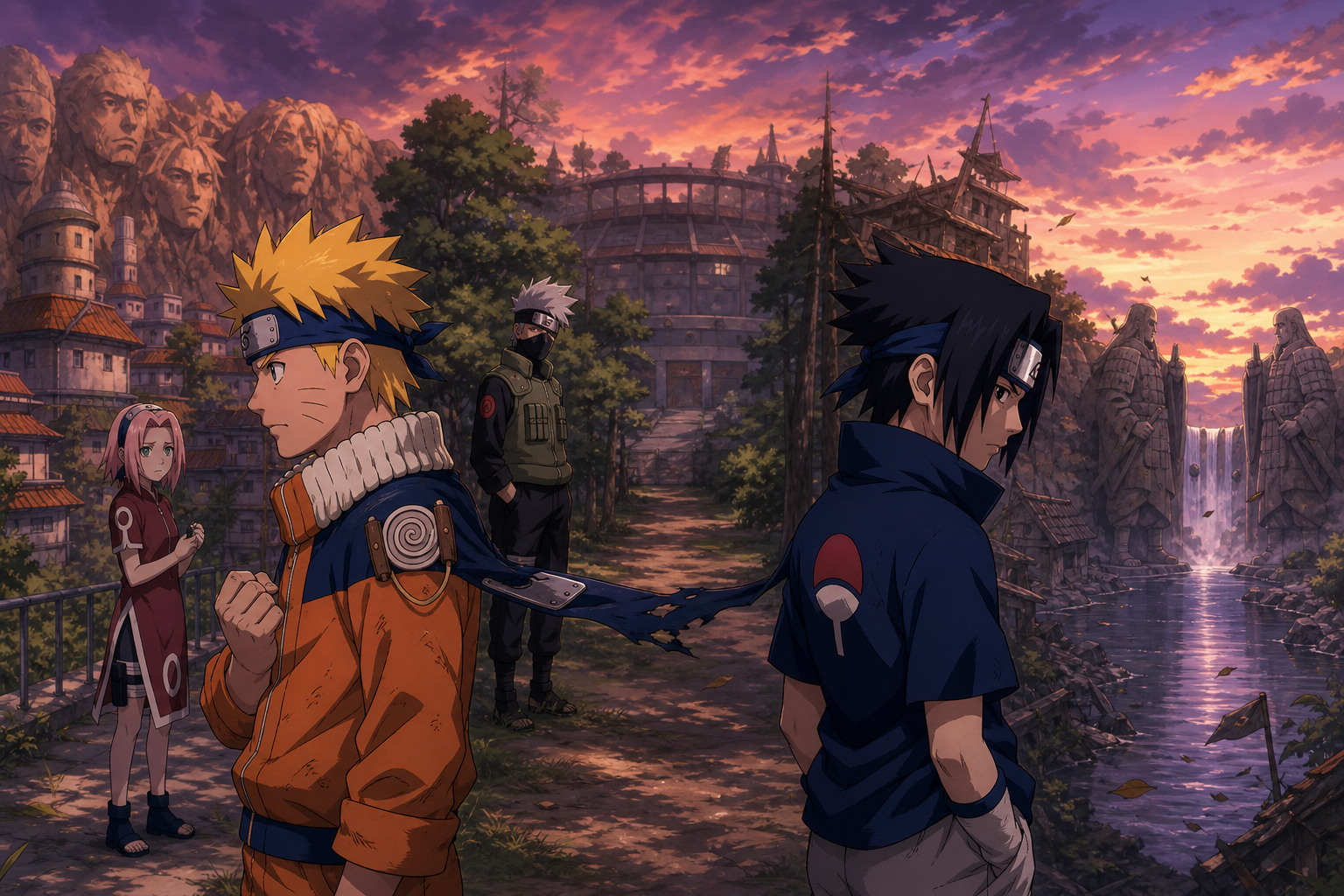
RaeRae Reviews · Animated Series
Naruto: The Original Series Review
The original Naruto is brilliant, funny, emotionally exact, politically messy, and at least seventy episodes longer than its own ending knows how to survive. Its best arcs understand lonely children better than most prestige dramas understand adults. Its weakest stretch treats momentum like a resource the anime can spend forever. Both facts belong in the same review, babes.
The bottom line
Bottom line first: Naruto earned the love before the franchise learned how to manage it
The original Naruto works because it starts with a child pulling a stupid prank and understands that the prank is a public argument. Naruto paints the Hokage Monument because being punished still requires the village to look at him. He talks too loudly because silence has never brought an adult to his door. He wants to become Hokage because a title feels easier to imagine than unconditional belonging. Episode 1 makes all of that legible before the story has explained chakra, clans, ranks, tailed beasts, or the political machinery that abandoned him.
That is the series at its best. A flashy ninja action can always be traced back to a human need. Sasuke's Sharingan is power, inheritance, trauma, and a family grave sitting behind his eyes. Sakura's chakra control is talent, discipline, class positioning, and proof that the supposedly ordinary child has skills the boys cannot fake through volume. Rock Lee's taijutsu is not merely a cool restriction. It is a body arguing with an institution that decided one missing ability should define his ceiling. Gaara's sand is protection that became imprisonment. Neji's Byakugan lets him see nearly everything except the ideology shaping what he believes is possible.
Then the anime reaches its long post-Sasuke anime-original road and starts separating action from consequence. Missions arrive, guest characters suffer, Naruto gives a speech, and the reset button waits near the ending credits. Some of those stories are charming. A few give neglected supporting characters room the manga never gave them. As a single 220-episode work, however, the back stretch is a structural wound. The central promise is Sasuke. The anime spends dozens of episodes unable to advance it.
So no, my verdict is not that Naruto is secretly bad because it has filler. That take is lazy in the opposite direction. Naruto is a landmark because its emotional grammar, visual identities, music, performances, rivalries, and institutional contradictions became part of global popular culture. It is also an adaptation whose broadcast needs sometimes fight its storytelling needs in public. Loving it means telling the truth about both.
The complete review
What exactly are we reviewing across 220 episodes?
Pierrot's official archive records 220 episodes broadcast on TV Tokyo from October 3, 2002 through February 8, 2007. Hayato Date directed the series. Katsuyuki Sumisawa and Junki Takegami handled series composition, with Tetsuya Nishio and Hirofumi Suzuki leading character design. Toshio Masuda and Musashi Project created the score that made flutes, drums, distorted guitar, silence, and breath feel like parts of the same ninja language.
The first 135 episodes carry the main manga-adaptation spine from Naruto's graduation through Sasuke's departure and Naruto's first Valley of the End defeat. Episode 220 reconnects the television series to that central road by sending Naruto away with Jiraiya. The long territory between those points is mostly anime-original. Exact watch labels vary when an episode mixes a manga frame, a transitional scene, or an anime-only expansion, which is why CVM Sekai's separate episode directory labels every row instead of pretending one magic number solves adaptation history.
That production reality matters to a review. Weekly television is not a tankōbon volume with infinite scheduling freedom. The anime was adapting a manga that still needed to stay ahead. Broadcasters, sponsors, home-video schedules, staff pipelines, and a global licensing machine all benefited from keeping Naruto on air. The solution protected the franchise calendar and weakened the original series' final act. That is not a moral failure by one animator hiding in a studio. It is an industry decision with artistic consequences.
The English-market season labels also change by platform and release. VIZ has marketed the complete classic series as 220 episodes, while different services divide those episodes into different season counts. I am reviewing the Japanese television work as one 220-episode series, not treating a storefront's folder structure as sacred narrative architecture.
The complete review
Episode 1 understands loneliness without begging us to admire its sadness
Naruto Uzumaki begins as the village problem because the village has arranged his life so that being a problem is one of his only reliable social roles. Adults glare without giving him the truth. Children inherit the distance without understanding the cause. The Hokage knows. Teachers know pieces. The institution calls secrecy protection while leaving a child alone with the social punishment created by that secret.
Iruka's choice works because he does not rescue Naruto through abstract kindness. He recognizes him in public and at personal cost. When Iruka protects Naruto from Mizuki and names him as a student rather than a monster, Naruto receives more than approval. He receives evidence that another person can know the dangerous truth and still choose him. The forehead protector becomes meaningful because a relationship gives the object weight.
This is also where Junko Takeuchi establishes the original Japanese performance as the series' emotional center. Naruto's volume is not one unchanging loud-boy setting. He can sound boastful, feral, delighted, humiliated, hungry, and suddenly very young. The performance allows the joke and the wound to occupy the same line without putting a tasteful little fence between them. Naruto does not stop being funny when he hurts. He often gets funnier because he is trying not to let anybody see the hurt first.
The premiere's craft is economical. The Monument gives the prank public scale. The Forbidden Scroll turns academic failure into dangerous opportunity. Shadow clones convert the lesson he could not perform into a mass of bodies that finally fill the empty space around him. That visual is not subtle, and it does not need to be. The lonely child wins by becoming a crowd.
The complete review
Team 7 is a family assignment before any of them knows how to be family
Sasuke Uchiha, Sakura Haruno, and Naruto are not assembled because destiny handed Kakashi three emotionally compatible children. They are a bureaucratic team assignment built from different strengths, status positions, and wounds. Kakashi Hatake then asks them to cooperate inside a test designed around withholding, competition, hunger, and the possibility of failure. The bell test is effective because the institution's stated rule and the teacher's actual lesson are not the same thing.
Naruto wants recognition. Sasuke wants vengeance and control. Sakura wants Sasuke's attention while trying to protect her own social footing. Kakashi wants them to understand that technical talent without mutual obligation produces bodies, not a team. The lunch scene is the first time they break a rule for one another. Their bond begins as disobedience guided by care.
The series repeatedly proves that Team 7's love is real and insufficient. Sasuke can protect Naruto with his body against Haku and still choose Orochimaru later. Sakura can know Sasuke is leaving and still lack the power, language, or relationship leverage to stop him. Naruto can love Sasuke fiercely and still make Sasuke's pain about a promise Naruto needs fulfilled. Kakashi can recognize the path and still arrive too late. Love is not a cheat code that cancels trauma, hierarchy, or agency.
That makes the team more compelling than the clean found-family slogan fandom sometimes pastes over it. Team 7 is a family in formation, but it is also four people trained by a military village to turn attachment into performance. They protect one another and use one another as mirrors. They share food and keep secrets. They are children, teacher, soldiers, and survivors at the same time. The show is strongest when it lets those roles conflict instead of handing us one soft answer.
The complete review
Land of Waves proves the series can hurt people without becoming empty grimness
The Land of Waves arc is where Naruto stops being a charming premise and becomes a real story. A poor client lies about mission danger because monopoly violence has made honest protection unaffordable. Team 7 leaves a wealthy military village and discovers a place where a businessman can control transportation, labor, information, and fear without performing one jutsu himself. Gatō pays for the swords. Other bodies absorb the consequences.
Zabuza and Haku make the arc dangerous because they cannot be reduced to villain and innocent. Zabuza recruits a homeless child after Haku survives family violence and persecution tied to his inherited power. Haku has agency, skill, tenderness, and devotion. He is also fifteen, economically dependent, emotionally attached, and shaped by an adult who teaches him to measure his worth as usefulness. Calling that chosen family without naming exploitation is sentimental laundering. Calling Haku a mindless tool erases the child who makes choices inside a structure he did not build.
Naruto's response to Haku changes the series. He recognizes another lonely child across an enemy line. That recognition does not magically solve the labor relationship or prevent death. It does crack Zabuza's performed indifference. When Naruto demands that Zabuza admit Haku mattered, the speech works because the evidence is already lying between them. Naruto is not converting a stranger through charisma. He is forcing a man to stop hiding behind the language of tools after the tool has died for him.
The bridge matters as infrastructure. Tazuna is not building a decorative monument to courage. He is creating a route that can weaken Gatō's control over trade and movement. Inari's change matters because grief becomes collective action rather than a private inspirational vitamin. The town does not win because Naruto yelled hope into the weather. People gather, labor becomes visible, and the monopoly loses its guarantee that fear will keep everybody separate.
This arc also establishes Kakashi as a professional mirror to Zabuza. Both are elite men formed by systems that reward emotional concealment. Both turn children into field assets. Kakashi's difference is not purity. It is the choice to keep revising what duty requires when human attachment contradicts the rule. Zabuza reaches that truth too late. The series refuses to make timing irrelevant.
The complete review
The Chūnin Exams are spectacular because the test is morally rotten
The Chūnin Exams are one of shōnen anime's great tournament structures because they keep refusing to stay a tournament. The written test is an intelligence operation disguised as academics. The Forest of Death is surveillance, scarcity, predation, and team stress dressed as promotion. The preliminaries turn injury into public sorting. The finals become diplomacy, spectacle, military advertising, and eventually an invasion.
The exam is fun. The exam is also a child-soldier recruitment fair. Both facts are visible. Village leaders gather talented minors, display their inherited techniques, invite political clients to judge institutional strength, and call the process advancement. The children internalize the stakes differently. Some want rank. Some want family recognition. Some need proof that their body is not a mistake. Some are carrying orders from adults who have already decided which young lives are useful.
Rock Lee versus Gaara remains devastating because effort is not rewarded with a tidy moral victory. Lee removes the weights, opens the gates, and reveals a body built through discipline. Gaara breaks that body anyway. Might Guy stops the killing and then has to face what his teaching demanded from a student who trusted him. The story celebrates Lee's commitment while showing the bill.
Hinata Hyūga versus Neji turns a clan's internal violence into public entertainment. Neji speaks fatalism because the branch-family seal has made hierarchy bodily. Hinata refuses to disappear, but courage does not erase the power gap. Naruto's anger is sincere and incomplete. He sees Neji humiliating Hinata before he understands that the Hyūga institution has been humiliating Neji for years.
Naruto versus Neji works as emotional payoff because Naruto refuses the conclusion that a person is only the role assigned at birth. It is less successful when fans use the fight to pretend Naruto has no inherited power, teachers, bloodline, or sealed resource. The point is not that Naruto is a self-made capitalist poster child. The point is that inheritance does not finish the meaning of a life. Naruto needs help, lineage, luck, labor, and relationships. So does everybody else in the arena.
The complete review
Konoha Crush lets the village mourn without putting the institution on trial
Orochimaru's invasion breaks the exam open and exposes Konoha's confidence as vulnerability. Hiruzen Sarutobi faces a former student whose violence grew inside relationships and decisions the Third Hokage helped shape. Their battle is not simply old master versus fallen prodigy. It is institutional consequence returning in a familiar face.
Hiruzen's death is staged as sacrifice, leadership, and inherited Will of Fire. Those meanings are real. So are the failures around them. He protected the village. He also presided over systems that isolated Naruto, contained Hyūga abuse, mishandled Orochimaru, and allowed Danzō's shadow structure room to operate. Respecting his final act does not require laundering his administration. Naruto is full of leaders whose love for the village coexists with harm they call necessary.
Gaara's defeat is more emotionally important than the invasion's tactical scoreboard. Naruto recognizes the path his own loneliness could have taken if Iruka, Team 7, and later bonds had not interrupted it. Gaara is not healed because one punch gives him a better attitude. He encounters someone with comparable isolation who chose connection, and that evidence makes another future imaginable. The consequence continues through his siblings and eventually his leadership. The best Naruto confrontations change the social map after the bodies stop moving.
The complete review
Tsunade is not a reward for Naruto believing loudly enough
The Search for Tsunade arc gives the series an adult woman whose grief, labor, vice, authority, and expertise cannot fit inside one inspirational box. Tsunade has lost Nawaki and Dan to the shinobi system's promises. Her hemophobia turns memory into bodily interruption. Her gambling and sake are not cute replacements for personality, but neither do they cancel her judgment.
Naruto affects Tsunade because he carries familiar language without being a copy of the dead. The necklace passes through hope, loss, wager, and responsibility. Tsunade's return is still her choice. She evaluates Orochimaru's offer, confronts what resurrection would cost, fights through trauma, protects Naruto, and accepts office. Reducing the arc to “Naruto inspired her” steals the adult decision-making from the woman the story is trying to restore.
The Sannin battle also widens the series' combat vocabulary. Bodies can be diagnosed, disrupted, poisoned, summoned, repaired, and exhausted. Medical skill is not support glitter around real fighting. It changes who can remain alive long enough for victory to mean anything. Tsunade's later medical reforms grow from the same argument: a team without care infrastructure is a body-count plan.
The complete review
Sasuke leaves because love cannot compete with a system offering immediate power
The Sasuke Recovery Mission is the original series' emotional climax. Sasuke has watched Naruto grow, felt his own power become uncertain, survived Itachi's return, and absorbed Orochimaru's promise that vengeance can be made efficient. Konoha offers bonds, but the village also contains the institutions, memories, comparisons, and limits that keep reopening his wound. Orochimaru offers control without honesty.
The Sound Four do not merely kidnap Sasuke. They recruit him by confirming a story he is ready to believe: attachment is weakness, waiting is failure, and power exists somewhere adults will stop asking him to heal before he receives it. The offer is predatory because it uses a teenager's grief as labor acquisition. Sasuke still chooses. Naming coercion does not erase agency, and naming agency does not clean the coercion.
The retrieval squad turns friendship into bodily debt. Chōji risks death to stop being the teammate everybody protects. Neji applies the same genius once used to enforce fatalism toward preserving another person's future. Kiba and Akamaru fight as an interdependent unit, not master and accessory. Shikamaru learns that leadership means sending people into danger with incomplete information and living with the outcomes. The mission promotes no one emotionally without hurting them first.
Naruto and Sasuke at the Valley of the End is not a clean hero-versus-villain fight. Naruto is trying to keep a promise, save a bond, and refuse abandonment. He is also trying to override Sasuke's declared choice through force. Sasuke wants freedom from a team he experiences as emotional restraint, yet he is walking directly into another adult's ownership plan. Both boys are right about pieces and catastrophic about the whole.
Sasuke wins. That matters. Naruto's devotion does not entitle him to success, and the story needs the failure to expose how far affection is from understanding. The scratched forehead protector becomes the receipt Sasuke denied Naruto verbally. Naruto could reach him. He could not keep him.
The complete review
Then the broadcast calendar eats the ending
After episode 135, the anime moves into a long sequence of mostly anime-original missions before episode 220 sends Naruto away with Jiraiya. There are useful episodes in this territory. Supporting characters receive combinations and conversations the main plot rarely permits. The wider village feels inhabited. Comedy gets room. Some missions examine labor, local politics, family structures, and minor shinobi whose lives do not intersect with prophecy.
The problem is accumulation without irreversible movement. Naruto cannot retrieve Sasuke because the sequel needs that conflict. Sakura cannot complete her transformation because Shippuden needs to reveal it after the time skip. Akatsuki cannot advance too far. The major institutions cannot change. Guest characters can suffer, learn, and leave, but the central cast has to remain near the doorway.
This creates emotional inflation. Naruto repeatedly encounters someone lonely, recognizes the wound, fights the threat, and offers connection. The pattern is fundamental to his character, but repetition without central consequence turns empathy into a formula. A speech that once cracked Zabuza's armor can begin to feel like the required final technique before credits.
The watch decision is therefore personal, not moral. Fans who want the tight central adaptation should use the episode directory's classifications. Fans who want every Team 8 mission, strange client, comedic detour, and village side road can watch the broadcast journey. Skipping anime-original episodes does not make somebody a fake fan. Watching them does not make somebody incapable of understanding pacing. We are allowed to know what kind of evening we are trying to have.
The complete review
Direction, animation, and the art of saving the budget for impact
Naruto does not look uniformly expensive because it was a long-running weekly television production. Model detail, background density, movement, and compositing fluctuate. Some episodes carry stillness longer than a modern seasonal anime audience expects. Repeated frames and reaction shots sometimes stretch time. None of that means the series lacks visual intelligence.
The strongest episodes change drawing and motion to serve impact. Weight removal makes Lee's speed legible before dialogue catches up. Gaara's sand moves like defense with its own instinct. The Valley of the End uses water, stone scale, damaged clothing, and increasingly animal movement to strip the boys down to need. Zabuza's final charge becomes powerful through direction and accumulated relationship evidence, not because every frame tries to look like a theatrical poster.
Tetsuya Nishio and Hirofumi Suzuki's character-design language is a major reason the huge cast remains readable. Silhouette does work. Headbands sit differently. Clothing reflects clan, rank, aspiration, and personality. Lee can be recognized by posture before his face is clear. Shino's concealment is a design argument. Naruto's orange announces the child who refuses camouflage in a profession built around it.
The adaptation also knows when comedy needs ugly timing. Naruto's face can collapse. Kakashi can look bored enough to become violence. Guy and Lee can overwhelm a scene through sincerity. The visual world allows absurdity and grief to coexist, which is one reason the serious material does not suffocate under its own importance.
The complete review
Toshio Masuda’s score gives the world memory
The original score makes Naruto sound culturally specific without pretending one instrument equals all of Japan. Shakuhachi color, shamisen textures, percussion, guitar, choral weight, and silence interact with the series' invented ninja world. The result can move from mischief to ritual to grief without sounding as though the music has changed franchises.
VIZ's official promotion for Naruto: The Symphonic Experience explicitly credits Toshio Masuda and describes the blend of pop and rock arrangements with traditional Japanese instruments such as shakuhachi and shamisen. That receipt matters because the score's hybrid language is part of the adaptation's identity, not fan nostalgia doing all the work afterward.
Themes accumulate memory. A cue attached to loneliness can return after a relationship changes and make the earlier isolation audible. Battle music creates forward drive, but the quieter material often carries more consequence. Naruto is a show where a swing, an empty room, or a hand resting on a head can become devastating because sound reminds us how long the child waited.
The openings and endings also make the broadcast object larger than plot. Hound Dog's “Rocks,” Akeboshi's “Wind,” Asian Kung-Fu Generation's “Haruka Kanata,” FLOW's “GO!!!,” and the later theme rotation preserve different emotional eras. TV Tokyo's own opening and ending history anchors the song changes to broadcast episode ranges. Fans did not merely watch 220 files. They repeatedly entered and left the world through music.
The complete review
The Japanese cast performs children without sanding off the ugly feelings
Junko Takeuchi carries Naruto's bravado, comedy, hunger, rage, and youth without making him sound emotionally tidy. Noriaki Sugiyama lets Sasuke's restraint read as active pressure rather than absence. Chie Nakamura gives Sakura's social brightness, irritation, insecurity, and later resolve distinct weight. Kazuhiko Inoue makes Kakashi's laziness, authority, and buried grief share one deceptively relaxed instrument.
The larger cast is one of the anime's great assets. Mayumi Asano keeps Haku gentle without erasing danger. Unshō Ishizuka gives Zabuza enough rough control for the final emotional break to matter. Akira Ishida makes Gaara's early stillness feel less like calm than pressure sealed behind a face. Masako Katsuki gives Tsunade adult force, damaged confidence, humor, and command.
Performance analysis still requires heard scenes. A cast list is not criticism by itself. What the original series makes clear across the actual episodes is that vocal contrast organizes relationships. Naruto presses outward. Sasuke compresses. Sakura tries to manage the room and sometimes exposes herself in the effort. Kakashi floats above the children's noise until a threat pulls the professional voice into place. Team 7 sounds like four survival strategies before it looks like a family.
The complete review
The women deserve better than the writing repeatedly gives them
Naruto's women are memorable because design, performance, specific abilities, and fragments of strong characterization keep pushing against a story that too often limits their narrative power. Sakura has exceptional chakra control, academic intelligence, emotional perception, and the courage to stand over two unconscious teammates in the Forest of Death. The series then spends long stretches making her feelings for Sasuke louder than her professional development.
Hinata receives a compelling conflict with clan hierarchy and self-erasure, but her interior life is often routed through Naruto. Ino's rivalry with Sakura begins with real friendship, social rescue, and adolescence, then the exam frame compresses it toward competition over a boy. Tenten is allowed to love weapons and preparation, which is apparently so dangerous that the anime keeps forgetting to give her major consequences. Temari arrives with strategy, authority, and wind power that can reshape a battlefield, then often gets used to confirm Shikamaru's growth.
Tsunade is the strongest counterexample in the original series because her grief, expertise, leadership, body, age presentation, vice, and choices remain connected. She is still subjected to jokes about breasts, age, and gambling. The writing does not erase her authority in order to make the jokes work, which is a bar more of the series should have cleared.
Saying the women are badly used is not the same as saying they are empty. Fandom sometimes completes the erasure by treating every missed opportunity as proof the character herself has no value. Babes, a writer failing to invest in a woman is not evidence that the woman deserved less investment. It is the receipt.
The complete review
Japanese cultural language, Buddhist attachment, and Confucian duty are in the machinery
Naruto's world is invented, but it does not arrive culturally blank. Senpai and kōhai relationships, teacher obligations, family-name weight, village loyalty, examination culture, group harmony, filial expectation, inherited household roles, and the tension between personal desire and collective duty shape how characters read one another.
Confucian relationship ethics are useful when they clarify reciprocal obligations rather than becoming a sticker placed on every hierarchy. A teacher owes care to a student. A leader owes responsibility to the governed. A child owes respect inside family and community, but authority that demands loyalty while refusing protection has already broken reciprocity. Naruto keeps finding institutions that love duty in one direction.
Buddhist ideas around attachment, suffering, impermanence, and cycles of harm also help explain the emotional architecture. Attachment is not simply bad. Naruto survives because he forms bonds. The problem comes when attachment hardens into possession, identity, revenge, or refusal to accept change. Sasuke's bond to the dead becomes a command that consumes the living. Orochimaru treats bodies as temporary containers because impermanence terrifies him. Naruto's best quality is not detachment. It is learning how to hold people without turning their continued presence into proof of his worth.
The series also borrows folklore, religion, theater, martial imagery, and historical language freely. Nine-tailed fox traditions, toads, snakes, slugs, hand seals, chakra, clan crests, masks, gates, and named techniques form a remix, not a documentary record of Japanese belief. Good cultural reading identifies the source pressure and the transformation. It does not announce that every orange object is secretly a Buddhist thesis.
The complete review
Konoha is home, government, employer, school, and military machine
Fans often flatten Konoha into either perfect found family or irredeemable villain state. The series gives us a more uncomfortable structure. Konoha feeds people, educates children, creates friendships, protects civilians, sells military labor, hides classified harm, preserves clan power, produces heroes, and sacrifices bodies. Home and institution occupy the same geography.
That is why Naruto's dream of becoming Hokage is emotionally moving and politically incomplete. He wants the office because recognition has been concentrated there. The Hokage face is literally carved above the village. Becoming the leader promises that no one can look away again. But an office cannot repair childhood merely by changing who sits inside it. Naruto will eventually need to ask what leadership owes children who are not future heroes.
The original series raises that question more clearly than it answers it. Hiruzen can love Naruto and fail him. Kakashi can protect Team 7 and still train children for lethal work. Tsunade can reform medical infrastructure while governing the same mission economy. Iruka can provide life-changing care without possessing the power to change every system around the child. Individual goodness and structural harm coexist. That is the actual tea.
The complete review
Fandom arguments that need to retire
First, “Naruto was always destined to win, so his underdog story is fake.” Naruto has inherited power and unusual resources. He is also socially isolated, academically struggling, poorly informed, and repeatedly dependent on teachers and friends. Privilege and deprivation can occupy one child. The interesting question is how the story balances them, not which half we delete.
Second, “Sasuke was just being dramatic.” His choices harm people. His family was also murdered by his brother inside a state-linked political catastrophe, and adults repeatedly weaponize the aftermath. Accountability does not require emotional illiteracy.
Third, “Sakura is useless.” The writing underinvests in her combat and interior arcs during Part I. She still protects the client, identifies danger, demonstrates elite control, saves teammates through alertness, resists sound ninja under impossible conditions, and begins choosing training. Critique the allocation. Stop turning the allocation into her moral defect.
Fourth, “Neji was proven completely wrong.” Naruto disproves fatalism as a complete account of human possibility. The Hyūga branch seal and inherited hierarchy remain real. Beating Neji does not abolish the institution that taught him despair.
Fifth, “The filler is all worthless.” The anime-original stretch damages momentum and contains disposable work. It also gives supporting cast members, minor villages, comedy, and production experiments space. Useful criticism can sort. It does not need one giant trash bag.
Sixth, “Talk no Jutsu means Naruto wins by giving speeches.” Naruto's words work when combat, recognition, shared experience, and another person's unresolved attachment have already created an opening. The weak uses are weak because later stories imitate the shape without earning the relationship evidence. The concept itself is Naruto's central power: he sees the person a system has reduced to a function.
The complete review
Industry consequence: Naruto became a global gateway because it was easy to enter and hard to emotionally leave
VIZ's official brand record identifies the original anime as 220 episodes and emphasizes its extraordinary global reach. TV Tokyo records the anime beginning in 2002, while Pierrot's archive identifies the full broadcast dates, staff, and episode total. The series arrived during a period when television blocks, DVDs, fan communities, early streaming, and international licensing overlapped. Different audiences discovered it through different infrastructures and still met at the same headbands.
The premise travels cleanly. A lonely child wants recognition. A rival carries grief. A team learns cooperation. The world then expands into clans, exams, villages, war memory, labor, and inherited ideology. Viewers can enter through comedy or action and discover the emotional system after attachment has already formed.
Merchandising understood the silhouettes. Games understood the move sets. Music releases understood the theme-song memory. Forums understood the matchup arguments. Fansubs and illegal distribution also filled regional gaps while rights holders developed wider licensed routes, which is part of the real history even when it is not an endorsement of unlicensed watching now. Naruto did not become global through one perfect corporate plan. It moved through an ecosystem of broadcast, licensing, scarcity, fandom labor, retail, and digital circulation.
That success changed what international audiences expected anime access to look like. It also created pressure to keep the machine moving. The endless broadcast stretch is not separate from popularity. It is one of popularity's costs.
The complete review
Final verdict
The original Naruto is essential because its best stories understand that power is never only power. A technique carries a family. A scar carries an institution. A mission rank carries an economy. A rivalry carries grief. A joke carries a child trying not to be left alone.
The series is uneven because weekly production and franchise momentum eventually pull against the emotional line it established. The anime-original back stretch can make the ending feel postponed rather than completed. Women receive less narrative investment than their designs, performers, and abilities deserve. Konoha's failures are often mourned without being fully judged.
Still, the core lands. Episode 1, Land of Waves, the Chūnin Exams, Konoha Crush, the Search for Tsunade, and the Sasuke Recovery Mission form a childhood story with teeth. Team 7 does not become a perfect family. It becomes a promise strong enough to survive failure and damaged enough to require another 500 episodes of consequences.
My rating is 8.5 out of 10 for the complete 220-episode television work. The central 135-episode spine scores higher. The total series earns the lower number honestly and the recommendation without apology.
Watch it. Use the directory when the long anime-original road stops serving your evening. Listen to the Japanese performances. Let the music do its work. And please do not walk away believing the lesson was simply that Naruto never gave up. The deeper lesson is that a child survived because a few people finally treated his need for connection as a human fact instead of a behavior problem.
Stay inside the village
Connected Naruto reading
Official records
Receipts
- Studio Pierrot, official Naruto series archive: https://pierrot.jp/archive/2000/tv00_13.html
- TV Tokyo, original Naruto broadcast site: https://www.tv-tokyo.co.jp/anime/naruto2002/
- TV Tokyo, opening and ending history: https://www.tv-tokyo.co.jp/anime/naruto/history/history01.html
- VIZ, official Naruto brand record: https://cpg.viz.com/brands/naruto
- VIZ, official 220-episode streaming announcement: https://www.viz.com/blog/posts/watch-viz-anime-for-free-24-7
- VIZ, Naruto Symphonic Experience and Toshio Masuda score context: https://www.viz.com/blog/posts/naruto-the-symphonic-experience-coming-in-2025