
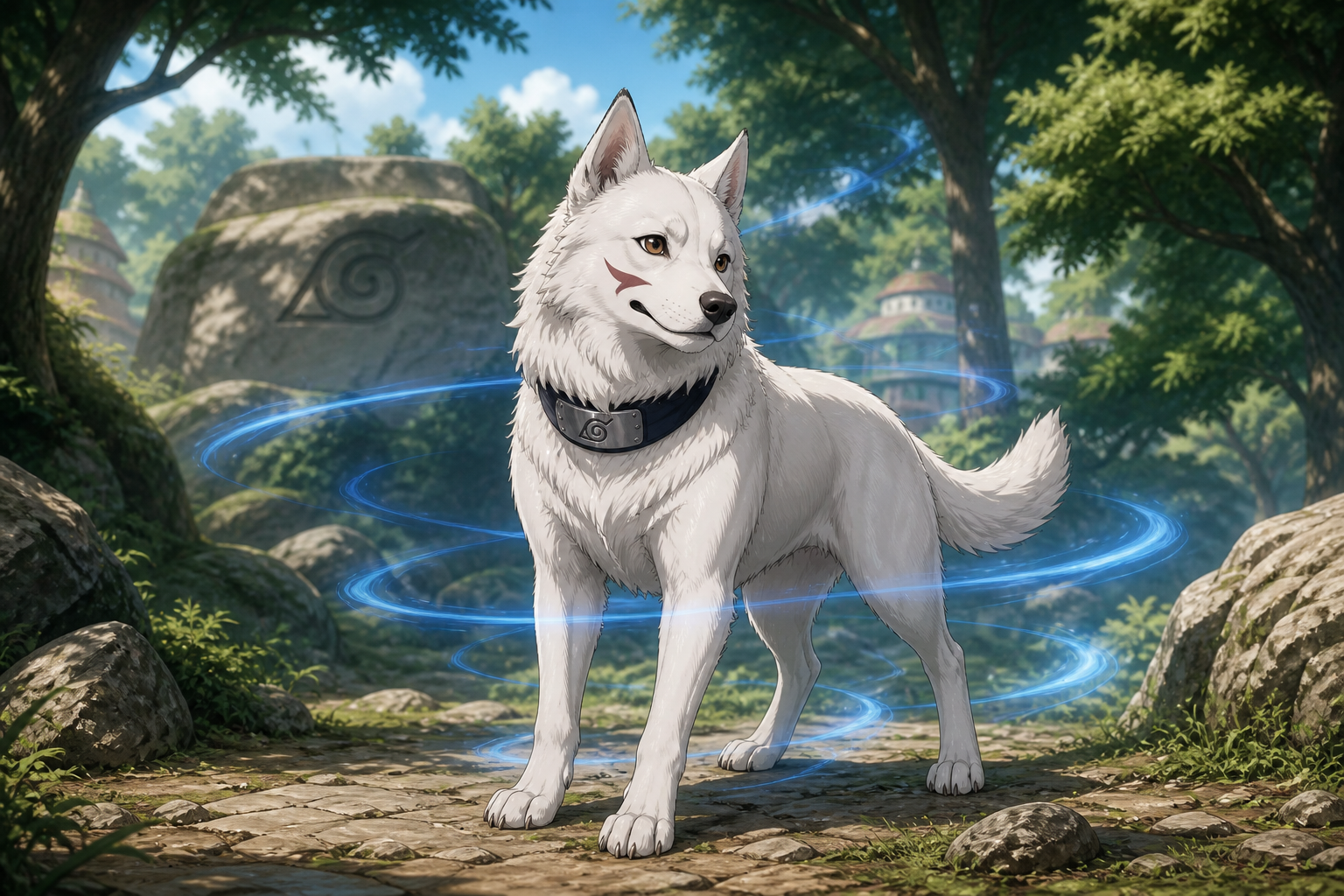
Naruto Character File
Akamaru
Kiba’s ninken partner is a tracker, fighter, teammate, and emotional anchor whose body records the entire Naruto timeline.
Akamaru is the white ninken partner of Kiba Inuzuka, a founding member of Team 8, and one of the clearest examples of partnership as a shinobi discipline in Naruto. He is not a pet carried into battle. He is Kiba’s teammate, tracker, lookout, emotional anchor, and equal participant in the Inuzuka clan’s combination techniques.
Akamaru Essential File
- Village: Konohagakure
- Affiliation: Inuzuka clan and Team 8
- Species: Ninken, a trained ninja dog
- Partner: Kiba Inuzuka
- Specialties: Scent tracking, coordinated taijutsu, Dynamic Marking, Fang Over Fang, and transformation combinations
- Era: Naruto, Naruto Shippuden, the Fourth Shinobi World War, and the Boruto era
- Original Japanese performance: Junko Takeuchi voices Akamaru in Part I.
More Than Kiba’s Dog
The simplest description of Akamaru is “Kiba’s dog,” but that phrase misses how Inuzuka partnerships work. Akamaru reads trails, identifies danger, communicates observations, and makes tactical decisions. Kiba trusts his senses enough to build an entire fighting style around them. Their bond is familial and professional at once.
Akamaru’s speech is usually expressed through barks, growls, posture, and Kiba’s interpretation. That does not make him passive. His reactions often warn Team 8 before its human members understand what is nearby. The story uses his body language as a form of dialogue.
Puppy Years and Team 8
When Team 8 forms under Kurenai Yūhi, Akamaru is small enough to ride inside Kiba’s jacket. The team’s specialties fit together: Hinata Hyūga provides Byakugan reconnaissance, Shino Aburame uses kikaichū for pursuit and control, and Kiba and Akamaru follow scent at speed.
Kurenai treats the ninken as part of the unit. Team 8’s success depends less on overwhelming force than on information, patience, and coordinated pursuit. Akamaru is central to that identity from the beginning.
The Chūnin Exams and Forest of Death
During the Chūnin Exams, Akamaru helps Kiba assess opponents and navigate the dangerous Forest of Death. His senses make him valuable in an environment designed around ambushes. He can identify blood, unfamiliar chakra-linked scents, and approaching threats before they become visible.
The exams also establish the risk of the partnership. Akamaru enters combat beside Kiba and can be hurt, frightened, or separated. Every combination gives the pair more power, but it also means each partner’s condition affects the other.
Kiba and Akamaru vs. Naruto
In the preliminary match against Naruto Uzumaki, Akamaru demonstrates that the pair’s teamwork is not a novelty. After receiving a soldier pill, he becomes more aggressive and gains the chakra needed for coordinated attacks. Kiba uses the Four Legs Technique, while Akamaru transforms into Kiba’s likeness so the two can attack as an indistinguishable pair.
Their signature Fang Over Fang turns both bodies into rotating drills. The technique is fast and difficult to track, but it also depends on scent and coordination. Naruto disrupts those advantages through deception and improvisation. The defeat teaches a recurring lesson: synchronized strength remains vulnerable when an opponent breaks the information system supporting it.
Sasuke Recovery Mission
Akamaru joins Kiba in the mission to retrieve Sasuke, where they confront Sakon and Ukon. The battle pushes their partnership beyond the techniques shown in the exams. Outmatched by the twins’ body-merging abilities, Kiba and Akamaru rely on speed, scent, transformation, and mutual sacrifice to survive.
Their Two-Headed Wolf transformation magnifies their physical power and produces the devastating Wolf Fang Over Fang. The form is difficult to control because its rotation blocks ordinary vision. Akamaru’s Dynamic Marking gives the transformed pair a scent target, turning a comic-looking technique into an essential targeting system.
When Kiba is invaded by Sakon, he wounds himself to force the enemy out. Akamaru, already injured, continues trying to protect him. The sequence strips away any idea that their bond is merely a set of moves. Each is willing to endure pain to keep the other alive.
Growth in Naruto Shippuden
By the beginning of Naruto Shippuden, Akamaru has grown into a large adult ninken, creating one of the series’ warmest reunion jokes when Naruto initially fails to recognize him. The change signals that time passed for the supporting cast as well as the central heroes.
His mature size increases his strength and carrying capacity, but his essential role remains the same. He accompanies Kiba on tracking assignments, supports Konoha operations, and preserves the pair’s close-range combination style.
Tracking Akatsuki and Defending Konoha
Team 8’s sensory talents make its members natural choices for pursuit missions. Akamaru helps follow difficult trails and distinguish targets across large areas. During the Akatsuki era and the crisis surrounding Pain’s attack, his value is often practical rather than spectacular: warning allies, locating people, and keeping Kiba mobile through chaos.
These assignments show why villages train ninken. Battles are won not only by the person who lands the final technique, but also by the scouts who find the enemy and keep a squad from walking into an ambush.
Fourth Shinobi World War
Akamaru serves with Kiba during the Fourth Shinobi World War. The battlefield magnifies the problem of identification because White Zetsu can imitate allied shinobi. Scent, memory, and established trust become important defenses against deception.
Kiba’s ambition to compete with Naruto becomes more exaggerated during the war, while Akamaru grounds him through familiar cooperation. Their advanced combinations reflect years of practice rather than a sudden individual power-up. Whatever form they take, the pair succeeds only when both commit to the same movement and target.
Movies, Specials and OVAs
Akamaru appears across supporting anime adventures, films, and comedy-oriented specials connected to the Naruto franchise. These appearances generally reinforce his established roles: Kiba’s inseparable partner, Team 8 tracker, and expressive source of reactions. They are best understood as supplemental adventures rather than replacements for the manga’s main chronology.
Because tie-in stories vary in continuity, individual feats should not automatically be ranked above his core-series limits. Their strongest contribution is showing the ordinary companionship between missions:the daily life that makes their battlefield trust believable.
Akamaru in the Boruto Era
In the Boruto era, Akamaru is elderly. His slower body contrasts with the energetic puppy introduced at the Chūnin Exams, but his bond with Kiba remains intact. The image of the two aging together completes a relationship measured across decades rather than a single war.
Kiba continues to care for ninken and stays connected to the Inuzuka tradition. Akamaru’s later life matters precisely because the series allows him to become old. He is not discarded when he stops being a convenient battle upgrade.
Abilities and Techniques
Extraordinary Scent
Akamaru can follow trails over long distances, identify familiar people, notice hidden enemies, and provide targeting information. Weather, masking agents, overwhelming odors, and transformed opponents can complicate this advantage.
Beast Human Transformation
Akamaru can transform into Kiba’s likeness, confusing opponents and enabling mirrored taijutsu. The technique works best because the partners understand each other’s timing.
Fang Over Fang
Kiba and Akamaru spin at high speed and strike from multiple directions. The attack sacrifices clear vision for momentum, making prior targeting and scent crucial.
Dynamic Marking
Akamaru marks an opponent with urine so the pair can track a target during rapid rotation or obstructed visibility. The presentation is comic, but the tactical purpose is exact.
Two-Headed Wolf
With Kiba, Akamaru forms a giant two-headed wolf capable of Wolf Fang Over Fang. Its power is enormous, though chakra cost, control, and lost visibility create meaningful limits.
Key Relationships
Kiba Inuzuka
Kiba and Akamaru grow, train, fight, recover, and age together. Kiba interprets Akamaru, but Akamaru also corrects and steadies Kiba through reactions that reveal fear, confidence, or doubt.
Kurenai Yūhi
Kurenai organizes Team 8 around complementary reconnaissance skills and recognizes Akamaru as part of its operational strength.
Hinata Hyūga
Hinata’s vision and Akamaru’s scent create layered tracking. Their gentle temperaments also contrast with Kiba’s loud confidence.
Shino Aburame
Shino and Akamaru contribute different forms of nonhuman intelligence to the team. Insects and ninken are partners in information gathering rather than decorative accessories.
Personality and Communication
Akamaru is loyal, courageous, observant, and more cautious than Kiba. He can be playful in safe moments and visibly alarmed by dangerous chakra. His emotional clarity makes him an effective counterpoint to shinobi who hide their fear behind bravado.
He also has agency. Loyalty does not mean an absence of judgment; it means repeatedly choosing to act with Kiba despite understanding the risk.
What Akamaru Represents
Akamaru represents trust practiced until it becomes instinct. Naruto’s world often treats strength as personal achievement, but the Inuzuka style makes individual incompleteness visible. Kiba cannot perform his defining techniques alone, and Akamaru’s power becomes meaningful through cooperation.
Their bond also broadens the series’ idea of family. Clan inheritance is not limited to blood between humans. Training, care, shared danger, and long companionship create a relationship every bit as serious as the bonds driving the central plot.
Common Misunderstandings
- “Akamaru is only a pet.” He is a trained ninken, squad member, sensory specialist, and combat partner.
- “Kiba performs every technique.” Many signature attacks require Akamaru’s chakra, transformation, scent, and timing.
- “Dynamic Marking is only a joke.” The joke masks a practical solution to targeting without sight.
- “He disappears after Naruto.” Akamaru continues through Shippuden, the war, supplemental anime material, and the Boruto era.
The bottom line
Akamaru is what happens when Naruto lets partnership become a combat system instead of a speech. Kiba does not command a disposable animal and collect the glory afterward. He shares space, risk, scent, timing, injury, embarrassment and age with another living being. That arrangement is not always perfectly equal because Kiba is the human shinobi with legal rank and public recognition. Still, the story repeatedly treats Akamaru as a thinking participant whose judgment changes what Team 8 can know and do.
That distinction matters. Plenty of anime animals exist to be cute, sell merchandise or rescue the hero when the plot needs a miracle. Akamaru is cute and absolutely merch-friendly, but the work remains visible. He tracks targets, warns Kiba, creates openings, marks enemies, copies Kiba’s body, enters rotations that could break his own bones and keeps serving after growing old. The little white puppy becomes a large battle partner, then an elderly companion. Naruto uses that body across time to show what long loyalty actually costs.
The verified record, and the blanks that stay blank
Akamaru belongs to Konohagakure’s Inuzuka clan and partners with Kiba from childhood. He joins Team 8 under Kurenai with Hinata and Shino. The manga and anime establish his scent work, battlefield communication, Dynamic Marking, Beast Human Transformation and combination attacks with Kiba. The record also establishes a major growth change between Part I and Part II, participation in the Fourth Shinobi World War and survival into the New Era.
The story does not give Akamaru a human rank, a separate mission ledger, a spoken autobiography or a tidy explanation for every ninken biological trait. Those absences are not invitations to invent a pedigree, secret bloodline, exact lifespan or human-style promotion history. A complete profile should distinguish what Akamaru does from what reference culture sometimes guesses around him. He is important enough without giving the dog a fake résumé.
Ninken are partners, not summon contracts with fur
Akamaru is a ninken, a ninja dog trained to work with shinobi. That is different from a summoned animal arriving through the Summoning Technique. Akamaru lives in Konoha, grows beside Kiba, trains within the Inuzuka household and remains present outside formal missions. His relationship is daily rather than transactional. He is not waiting in another realm for chakra and paperwork to call him into the episode.
The distinction changes the emotional math. A summon can be a respected ally, but Akamaru shares the unglamorous hours that happen before and after battle. He sleeps near Kiba, rides inside his jacket as a puppy, learns household routines and grows old in the same social world. The partnership is built through repetition. No single dramatic vow creates it. That is probably why the bond feels believable even when the technique names get delightfully feral.
The Inuzuka partnership is family, labor and military training at once
The Inuzuka clan organizes shinobi work around canine partners, heightened senses and coordinated attack. Akamaru therefore enters a family tradition that values him and uses him. Both truths matter. Kiba’s affection is genuine, and the village still benefits from a living creature trained for surveillance and violence. Naruto often makes family structures carry state labor. The Inuzuka version simply makes the arrangement easier to see because one worker has paws.
Tsume Inuzuka and Kuromaru show the adult form of the same partnership. Hana and her ninken show another professional branch through veterinary skill and animal care. Akamaru grows inside an ecosystem, not a one-boy miracle. Kiba’s bond is personal, but the clan supplies knowledge, expectations and a model for what their adulthood could become.
Communication works because Kiba listens before the audience understands
Akamaru does not need ordinary human dialogue to communicate. Posture, scent reactions, barks, whines, movement and long familiarity create a working language with Kiba. The story often lets Kiba interpret first, which can make Akamaru look dependent on him. The information usually originates with Akamaru. Kiba is translating a teammate’s observation for people who lack the same relationship.
That makes listening one of Kiba’s real skills. His swagger can be loud enough to frighten furniture, but he repeatedly trusts Akamaru’s warning even when his own pride wants a different answer. Their strongest moments are not the matching spins. They are the small exchanges where one notices danger and the other changes course. Collaboration begins before chakra starts glowing.
Team 8 turns four specialized senses into one field unit
Kurenai’s team is built for detection. Hinata sees through barriers and across distance with the Byakugan. Shino’s kikaichū search, trail and drain chakra. Kiba reads scent, while Akamaru adds another nose, a smaller mobile body and a partner trained to signal what he finds. Their abilities overlap without becoming identical. That overlap gives the team confirmation instead of a single point of failure.
Akamaru also changes the group socially. He gives Kiba someone to care for in public, which exposes the gentleness behind the competition. Hinata treats him as a teammate rather than a prop. Shino respects the operational role of another nonhuman partnership. Kurenai has to supervise a unit where intelligence may arrive through eyes, insects, odor or a dog’s sudden refusal to move. That is a better classroom for humility than another lecture about teamwork.
The Chūnin Exams test partnership under fear, injury and incomplete information
During the written and survival stages, Akamaru helps Team 8 gather intelligence and read danger. The Forest of Death rewards exactly the skills the team has trained: finding, avoiding, confirming and deciding whether a fight is worth the cost. Naruto fandom sometimes treats any avoided fight as cowardice because shōnen logic has broken our collective risk assessment. A tracking unit that survives by noticing trouble before trouble eats it is doing the assignment.
The preliminaries then force Kiba and Akamaru into public combat. Their match against Naruto reveals both the power and the weakness of a paired style. Two bodies create angles, substitutions and pressure that one opponent must process quickly. The same closeness creates shared vulnerabilities. Confusion, disrupted scent and bad assumptions can damage the whole system at once.
Kiba and Akamaru versus Naruto is funny because the mechanics are serious
Dynamic Marking is a joke built around urine. We can acknowledge that without pretending the technique has no purpose. Akamaru marks a target so Kiba can track through speed, dust and impaired vision. Scent becomes a targeting system. The comedy lowers the audience’s guard while the fight explains how Inuzuka combat solves practical battlefield problems.
Naruto disrupts that system with transformation, improvisation and the kind of bodily humor only a twelve-year-old under pressure could weaponize. Kiba loses because he underestimates Naruto and because confidence in a familiar system becomes predictability. Akamaru does not fail as a partner. The pair fail to update quickly enough when the opponent changes the information environment. That is a useful lesson for every strategist who thinks a strong method is the same thing as an unbeatable method.
The Sasuke Recovery Mission makes injury part of the partnership record
The battle against Sakon and Ukon pushes Kiba and Akamaru far beyond the Chūnin Exam’s controlled setting. Their opponents invade bodies, split identities and turn physical proximity into danger. That is almost custom-built horror for a pair whose strength depends on synchronized bodies. Kiba cannot solve the problem by sending Akamaru somewhere safe and fighting alone. Their style, their attachment and their vulnerability arrive together.
Akamaru is injured, Kiba is injured and the mission keeps moving without caring that they are children. The arc is often remembered as a showcase for the retrieval team’s new techniques, but the blood matters. Naruto’s village trains intimate bonds into military assets, then sends those bonds into missions where one partner may have to watch the other collapse. Loyalty looks heroic because the system asks something brutal from it.
Part II makes growth visible before Akamaru performs a single technique
When Naruto returns to Konoha, Akamaru is no longer a puppy tucked inside Kiba’s coat. He has grown large enough for Kiba to ride. The reveal is funny because Naruto fails to recognize him immediately, but the body carries real chronology. Time passed for everyone who stayed home. Training happened. Feeding happened. Bones lengthened. The village did not freeze while the protagonist traveled.
The size change also shifts the partnership’s visual balance. Part I often places Akamaru as a small figure beside a larger boy. Shippuden can frame them as two substantial bodies sharing speed and momentum. Kiba still speaks most of the human language, but Akamaru no longer reads as cargo for even a second. The design catches up with the teamwork.
Tracking Akatsuki means finding people who know they are hunted
Team 8’s later tracking work places Akamaru against targets who erase trails, use decoys and understand shinobi detection. Scent is powerful, not magical certainty. Weather, distance, contamination, terrain, transformation and deliberate countermeasures can complicate a trail. The team’s value comes from combining sources instead of worshiping one perfect nose.
This is where Akamaru’s discipline matters more than spectacle. Tracking scenes rarely receive the animation budget of a giant finishing move. They hold the plot together anyway. Someone has to find the cave, confirm the direction, distinguish a teammate from a disguise and tell the fighters where to run. Intelligence work becomes invisible when it succeeds, because the next battle steals the camera.
Pain’s assault tests the village network, not one flashy hero
During Pain’s invasion, Konoha’s specialists respond across a broken city. Akamaru and the Inuzuka network contribute through detection, movement and defense while civilians and shinobi are scattered. Naruto ultimately receives the central confrontation, but the village survives because hundreds of smaller decisions happen before, during and after his arrival.
Akamaru’s role fits the profile’s larger argument. He does not need to defeat a Path of Pain to matter. He needs to help people locate danger, move through chaos and remain connected. Fandom power scales often rank characters by who could win a clean arena duel. Villages are not clean arenas. Search, warning and evacuation save lives that a tournament bracket never counts.
The Fourth Shinobi World War turns private trust into shared infrastructure
The Allied Shinobi Forces combine villages that spent generations treating one another as threats. Tracking units now have to share information across uniforms, accents and command systems. Akamaru’s bond with Kiba remains personal, but their work feeds a multinational force. A scent report becomes useful only if the humans around them communicate it correctly and act before the trail changes.
War also intensifies the body cost. Long deployments, mass enemies and battlefield confusion punish techniques that depend on stamina and sensory clarity. Akamaru fights beside Kiba rather than becoming a symbol safely left at headquarters. Their partnership remains operational because both have trained for the ugly duration after the exciting first charge.
Boruto lets Akamaru age, which is kinder and sadder than pretending otherwise
By the New Era, Akamaru is old. The slower body is not a betrayal of his Part I image. The aging is the completion of it. The puppy, the giant partner and the elder dog are one life. Kiba’s continued care proves that the relationship was never limited to peak mission usefulness. When speed and combat value decline, family remains.
Anime often protects mascots from time because aging threatens the product silhouette. Boruto allows the change to show. That choice gives Akamaru a rare dignity. He does not vanish offscreen so a younger, cuter replacement can inherit the brand. He occupies the household as history with fur, appetite and joints that have earned a quieter pace.
Complete ability shelf: what Akamaru contributes
Scent tracking: Akamaru identifies people, follows trails and helps distinguish threats through odor. The ability can be affected by range, weather, contamination and deliberate deception. Communication: he relays observations to Kiba through sounds and behavior shaped by long training. Dynamic Marking: he marks a target by scent, supporting pursuit and attacks when vision is unreliable.
Beast Human Transformation: Akamaru can transform into a Kiba-like form for coordinated combat and confusion. Fang Over Fang: the pair rotate at high speed to strike from multiple directions. Two-Headed Wolf and later combination forms: Kiba and Akamaru merge or coordinate through transformation for greater scale and force. The power rises with synchronization, chakra and physical strain. Bigger teeth do not repeal stamina.
Limits: a second body creates strength and responsibility
Akamaru can be injured, exhausted, poisoned, separated or misled. His sense of smell is exceptional but not omniscient. Transformations require coordination. Rotation attacks can be redirected or outlasted. A failed combination exposes two partners instead of one. These limits keep the relationship meaningful. Trust matters because neither participant is an invulnerable tool.
Kiba also carries an ethical limit. He must decide when the mission risk is worth placing Akamaru in danger. Naruto rarely pauses for a formal animal-welfare hearing, but the question sits underneath every command. Love does not remove the power difference between a ranked human shinobi and a canine partner. Kiba earns the bond through listening, care and shared risk, not through ownership alone.
Relationship atlas: the people around the partnership
Kiba: partner, family, translator, training companion and the human whose identity is most entangled with Akamaru. Tsume and Kuromaru: the adult Inuzuka model, showing a partnership that survives leadership and family duty. Hana: veterinary care and clan expertise, important because battle animals need medicine after the applause stops.
Kurenai: team leader responsible for integrating a ninken pair into broader tactics. Hinata: teammate whose precise vision complements scent tracking. Shino: teammate whose kikaichū create another living intelligence network. Naruto: early opponent whose improvisation exposes Kiba’s assumptions, later ally in a war far larger than their preliminary match.
Japanese performance: Junko Takeuchi without a dub detour
Junko Takeuchi performs Akamaru in the original Japanese Part I anime, alongside her central work as Naruto. The credit is worth noting because a performer already carrying the protagonist also supplies animal vocalizations that must communicate alarm, confidence, pain and response without ordinary sentences. That is character work, not random barking pasted under a reaction shot.
This profile does not invent claims about exact pitch, breath or recording technique without a scene-by-scene audio receipt. The useful point is structural. Akamaru’s Japanese performance helps the audience read communication that Kiba understands more fully than we do. The gap lets the dog remain an animal while still functioning as a character.
Adaptation, movies, OVAs and game boundaries
The manga controls Akamaru’s main biography: Team 8, the Chūnin Exams, Naruto fight, Sasuke Recovery, Part II growth, later tracking, war service and survival into the next era. The anime expands daily companionship, comedy, missions and reaction time. Those additions can deepen familiarity without automatically becoming manga history.
Films, specials and OVAs often use Akamaru as part of Team 8 or the wider Konoha roster. A cameo confirms presence, not a new personal arc. Games translate scent, transformation and Fang Over Fang into playable systems, which can exaggerate range, durability or move combinations for balance. Game mechanics are useful adaptation evidence and terrible automatic canon.
Culture and symbolism: loyalty is practice, not obedience
A Confucian reading highlights reciprocal duty. Kiba owes care, attention and responsible leadership. Akamaru returns trust, labor and protection. The relationship becomes ethical when obligation moves in both directions. Blind obedience would be easier and much less interesting. Their bond works because Kiba changes behavior when Akamaru communicates.
A Buddhist reading notices attachment without demanding emotional coldness. Kiba loves Akamaru and still has to accept change, injury and aging. The New Era body makes impermanence visible. Love cannot freeze the puppy inside the jacket. Care means staying present as the form changes.
Creatively, Akamaru externalizes Kiba’s senses and his softer self. The dog can warn, hesitate, suffer and need comfort in ways Kiba’s competitive persona resists. Symbolism does not erase animal identity. Akamaru is not merely Kiba’s feelings wearing fur. He is another life whose presence makes those feelings harder for Kiba to hide.
Fandom arguments that deserve a firmer answer
“Akamaru is only a pet.” Pets can be family, but the phrase is incomplete here. He performs specialized mission labor and enters lethal techniques as a partner. “Kiba does everything.” Kiba provides human speech and rank visibility. Akamaru provides information, targeting, a second body and half the synchronization. Remove him and Kiba’s signature style collapses.
“The old Akamaru scenes are disrespectful.” Aging is not disrespect. Treating an elderly partner as disposable would be. The quieter New Era role shows continuity after combat. “Dynamic Marking makes him a gag character.” Naruto routinely hides practical tactics inside gross jokes. The target remains marked whether the audience giggles or not.
“He should have a separate human-style rank.” The absence exposes how village bureaucracy centers human shinobi. Giving Akamaru a fake rank would hide that issue rather than solve it. “Team 8 was useless.” That judgment confuses screen-dominant boss fights with village labor. Detection, tracking and warning are the reason many boss fights can happen at all.
The consequence ledger
Akamaru’s story has no single redemption speech because he is not built around a moral fall. His consequences are physical and relational. He carries wounds from missions, grows into greater combat demands, serves through war and ages after the world stops rewarding him for speed. Kiba carries those consequences too. Their shared history becomes the proof of partnership.
The village receives years of labor from both. The clan receives continuity. Team 8 receives an extra sensory specialist and emotional center. Akamaru receives family, training and care, but also exposure to violence he did not design. A complete profile can celebrate the bond while still asking what a shinobi state owes the nonhuman lives inside its victories.
Essential Akamaru Viewing Guide
For the clearest character arc, watch Team 8’s Chūnin Exam material, Kiba’s preliminary fight with Naruto, the Sakon and Ukon battle in the Sasuke Recovery Mission, Naruto’s Shippuden reunion with the now-grown Akamaru, Team 8’s tracking missions, the Fourth Shinobi World War, and his elderly appearances in the Boruto era.
Why Akamaru Still Matters
Akamaru matters because he turns loyalty into action. He finds the trail, enters the rotation, takes the wound, and stays beside Kiba afterward. His complete story moves from a puppy hidden inside a jacket to an old companion still sharing Kiba’s life. Few Naruto relationships communicate the passage of time so simply or so well.
Naruto and its characters belong to their respective rights holders. This independent profile uses original commentary and CVM Sekai fan art.
Sources and canon boundary
Manga chronology controls this profile. Anime staging, databook material, novels, films, games, and New Era appearances are labeled instead of being blended into one false continuity.
Primary franchise references: Naruto Official and VIZ Media Naruto. CVM Sekai’s conclusions about Kiba partnership, Team 8, scent tracking, Fang Over Fang, war service, aging, ninken ethics, and legacy are editorial analysis, not invented creator quotations.