
Naruto Character File
Tsume Inuzuka
Veteran Inuzuka tracker, Kuromaru’s lifelong partner, and proof that clan partnership gets tougher, stranger, and more meaningful with age.
Tsume Inuzuka Essential File
Tsume is a veteran Konoha kunoichi, an Inuzuka mother, and Kuromaru’s lifelong combat partner. The series gives her limited page time, which means a responsible profile must do two things at once. We should gather every meaningful fact the story does provide, and we should refuse to turn silence into fake canon. Tsume deserves depth. She does not need fan fiction wearing a databook wig.
The Woman Behind the Clan Stereotype
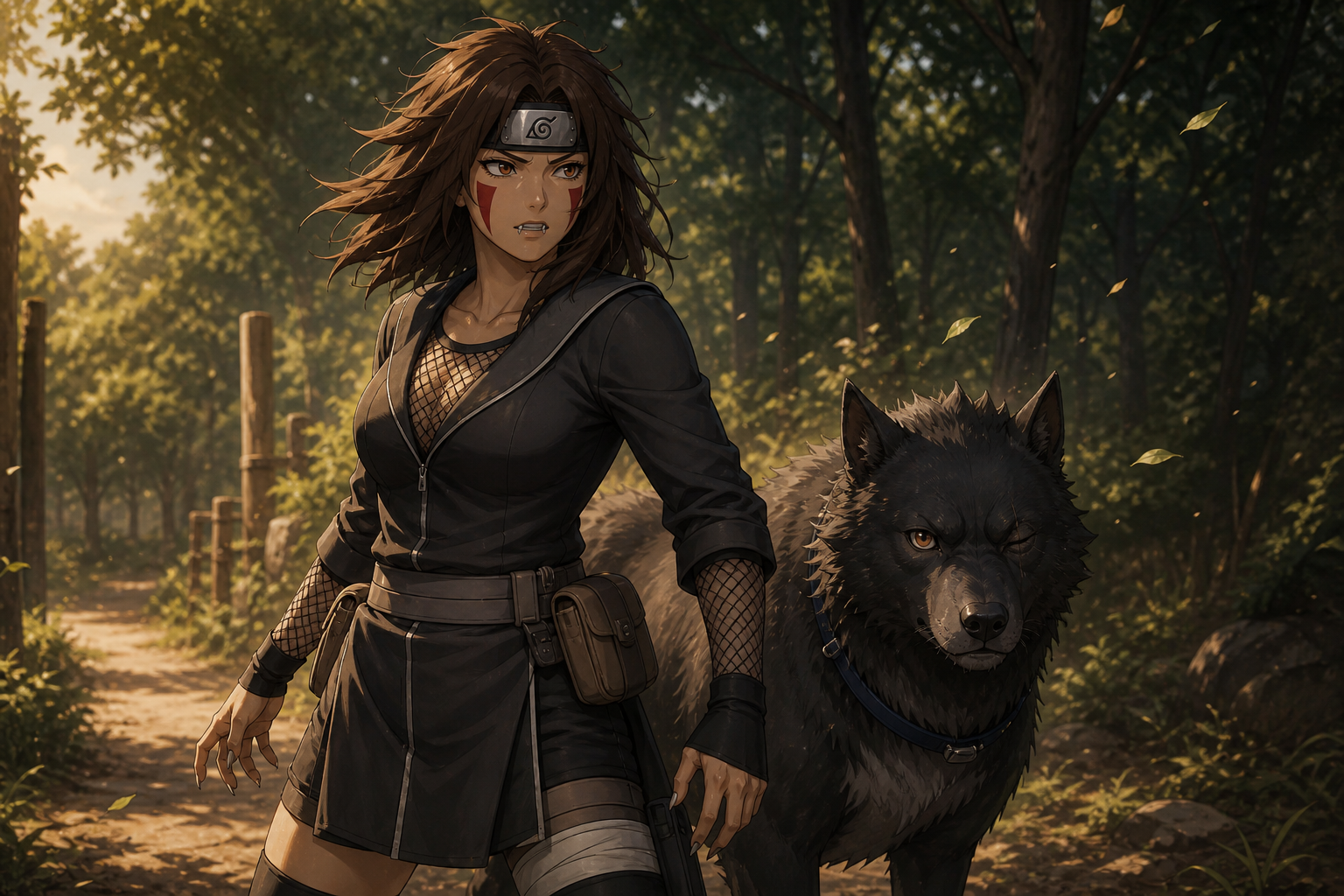
Tsume arrives with wild hair, sharp teeth, red cheek markings, and the kind of posture that says she has already decided whether you are useful. Kishimoto makes the Inuzuka identity readable in seconds. Kiba’s face, temper, competitive streak, and physical confidence stop looking like random personality traits once his mother walks onto the page.
That resemblance does not make Tsume a female copy of her son. Kiba spends much of Part I announcing confidence before experience has earned it. Tsume reads as someone whose confidence survived experience. Kuromaru’s scarred eye and adult voice reinforce the difference. This pair has history in its body.
Tsume is often described through motherhood because Kiba is the recurring cast member. That framing shrinks her. She has a rank, a partner, a combat discipline, village duties, and a record of responding when Konoha is attacked. Motherhood belongs in her file. Motherhood is not the whole file.
Kuromaru Is a Partner, Not Equipment
Kuromaru is a large black ninken with one damaged or closed eye. He can speak, assess a battlefield, communicate warnings, and coordinate decisions with Tsume. Calling him a pet misses the entire structure of Inuzuka combat. A pet receives commands. A partner contributes judgment.
The most useful comparison is Akamaru. Part I Akamaru is young, physically small, and still growing into Kiba’s tactical equal. Kuromaru shows the far end of that road. His body carries age and injury. His voice carries adult awareness. Tsume does not simply own a stronger dog. She has spent years learning another being’s pace, signals, fears, strengths, and limits.
That work matters because synchronized techniques are not magic friendship buttons. Tsume and Kuromaru must share timing while moving too quickly for ordinary visual correction. They trust each other with momentum, exposed angles, scent information, and the consequences of a missed turn. Loyalty sounds sweet. Coordination is the labor that makes loyalty useful.
What the Story Confirms About Her Family
Tsume is the mother of Kiba and Hana Inuzuka. Hana becomes a veterinary ninja who treats ninken. Kiba becomes a tracker whose public identity is inseparable from Akamaru. The siblings choose different expressions of the same household ethic. One specializes in care and medical support. The other specializes in pursuit and field combat.
Kiba jokes that his father ran away because Tsume frightened him. Fans repeat that joke as a complete marriage biography. The manga does not give us one. We know Tsume has an intimidating reputation. We do not know enough to diagnose the marriage, name the father, or decide whether the line is literal, exaggerated, or both. A funny sentence is not a custody file.
The larger point is visible without invention. Tsume appears to be the forceful center of the household the audience meets. Both children grow into service roles. Both understand that canine partnership demands responsibility. Whatever warmth exists in this family rarely arrives wrapped in soft language. Inuzuka affection looks more like training, teasing, showing up, and refusing to let a partner face danger alone.
Tsume and Kiba
Kiba inherits Tsume’s face markings, blunt speech, competitiveness, and appetite for direct action. Their similarities make their friction believable. People who share a temperament do not automatically communicate well. Sometimes they know exactly which nerve to step on.
Anime-expanded family scenes often use Tsume to pressure Kiba about training, responsibility, or his personal life. Those scenes should remain labeled as anime material, but the dynamic fits the manga’s established shorthand. Tsume does not flatter Kiba into improvement. She expects him to prove that confidence has structure underneath.
Her real legacy is not loudness. Kiba’s best work comes from partnership, sensory patience, and willingness to protect a team. Those values are less flashy than the shouting, yet they are the values Tsume and Kuromaru embody. Kiba gets the bark from his mother. He also gets the job.
Tsume and Hana
Hana receives less narrative attention, but her career says something important about the clan. A culture built around ninken cannot survive on attack techniques alone. Someone must understand injury, illness, breeding, behavior, recovery, and the long life that continues after a mission ends.
Tsume’s warrior role and Hana’s veterinary role form two sides of the same responsibility. One takes a partner into danger. The other helps partners come home from danger. The series does not give us enough private conversation to write a sentimental mother-daughter history. Their shared commitment to ninken welfare is the strongest honest link.
The Konoha Crush: Her First Canonical Entrance
Tsume and Kuromaru enter during the Konoha Crush, when Orochimaru’s invasion turns the village into a battlefield. The central plot follows the Third Hokage, Team 7, and the pursuit of Gaara. Tsume appears in the wider defense, where working shinobi confront infiltrators and protect the village while the headline fights happen elsewhere.
That placement is small but smart. Konoha does not survive because one famous family handles every threat. The village survives because layers of trained people respond at once. Tsume belongs to that middle infrastructure. She is experienced enough to act without receiving a speech first.
Her entrance also rewrites what we know about Kiba. The audience has already seen his Chūnin Exam style. Now the technique has an adult context. Kiba did not invent his fighting language. He inherited a discipline and is still learning how to speak it.
Enhanced Scent: Information Before Violence
Inuzuka noses are often treated as a cute superpower until the plot needs a trail. Scent is intelligence work. Tsume can identify people, distinguish traces, detect nearby threats, and read environmental changes that ordinary shinobi miss. That information can decide whether a team walks into an ambush.
Scent also has limits. Weather, distance, contamination, overwhelming odors, transformation, and deliberate countermeasures can distort a trail. A sensitive nose can become a vulnerability when an enemy floods the environment. Naruto repeatedly shows that sensory talent is valuable because interpretation matters, not because the user becomes omniscient.
Tsume’s value therefore begins before she attacks. Tracking narrows uncertainty. Recognition protects a unit from disguise. Communication turns private perception into group knowledge. The spinning claws are memorable. The nose is what gets the claws to the right place.
Four Legs Technique
The Four Legs Technique pushes the user’s body toward animal movement. Tsume lowers her center of gravity, sharpens her reactions, and attacks with claw-like speed. The style rejects formal elegance. She does not need to look composed while closing distance.
Physical acceleration creates risk. A body committed to forward pressure has less room for correction. The technique also depends on the user’s conditioning and sensory control. Tsume’s experience is visible in how naturally she inhabits the stance. Kiba’s early use often feels like enthusiasm trying to catch up with judgment.
Beast Human Transformation
Beast Human Transformation allows the ninken partner to take on a humanlike duplicate form. The mirrored appearance creates confusion, but disguise is only the surface function. The transformation gives the pair compatible bodies for synchronized taijutsu.
The technique works because each partner understands the other. Matching silhouettes cannot manufacture timing. Kuromaru must know when Tsume will turn, accelerate, break formation, or change the angle. Tsume must trust Kuromaru to make the same choices under pressure.
Fang Over Fang and Rotational Combat
Tsume and Kuromaru use the Inuzuka clan’s rotating assault style to strike from multiple directions. Rotation converts speed into force and makes the pair difficult to track. The cost is obvious. Ordinary sight becomes less reliable during the spin, and momentum limits sudden correction.
Scent, practice, and prearranged coordination compensate for that blindness. The technique is therefore a miniature version of the Inuzuka philosophy. The human does not dominate the animal. Two specialists accept the same danger and build a shared answer.
Pain’s Assault: Two Generations Fight Together
During Pain’s attack on Konoha, Tsume and Kuromaru join Kiba and Akamaru against the Preta Path. The confrontation is brief beside Naruto’s central battle, but the family image matters. Two generations of human-ninken teams defend the same village with the same inherited combat language.
Tsume has not been retired into a kitchen because her son became competent. She remains an active shinobi willing to face an opponent who belongs to a force destroying Konoha block by block. Kuromaru remains beside her. Their partnership did not expire when the younger pair became popular.
The sequence also shows the limit of clan continuity. Inherited technique provides a response, not guaranteed victory. Pain’s bodies operate through unfamiliar shared vision and specialized abilities. Courage cannot replace information. Tsume contributes because she fights inside a larger defense, not because the story secretly made her Kage level.
The Fourth Shinobi World War
Tsume supports the Allied Shinobi Forces during a conflict built around infiltration, mass coordination, and enemies who can imitate familiar people. Sensory skill becomes institutional protection. A tracker who can challenge a false identity may save more lives than someone who destroys a larger rock.
Her war role remains supporting rather than spotlighted. That boundary matters. A complete profile should record service without inflating feats. Tsume’s importance comes from continuity and competence. The village can still call on her years after the Konoha Crush.
The war also complicates the village’s family system. Parents, children, partners, and animals are folded into the same military emergency. Naruto celebrates solidarity, but solidarity has a bill. Konoha’s survival repeatedly depends on households turning care skills into combat resources.
The Boruto Era and the Record’s Silence
By the New Era, Kiba continues working with ninken and Akamaru has visibly aged. The Inuzuka tradition remains present in Konoha. Tsume, however, is not given a large continuing storyline. We should say that plainly.
Silence does not prove death, retirement, illness, or a secret clan office. Fans often treat an absent older character as an invitation to fill a wiki box. The honest answer is that later canon offers limited direct information about Tsume’s daily life. Her influence remains visible in her adult children and in the family’s continuing care for ninken.
Design: A Veteran Version of the Inuzuka Idea
Tsume’s wild dark hair, vertical cheek markings, sharp teeth, and aggressive expression make the clan connection immediate. Her clothing is practical and mobile. The visual language leans animal without turning her into a costume. She is human, but she has trained her body around canine senses and movement.
Kuromaru’s dark coat, size, speech, and damaged eye separate him from the puppy image associated with early Akamaru. The scar is not decoration. The design tells us this partnership has paid for its experience.
Together they look less polished than many named shinobi, which suits them. Tracking happens in mud, sweat, fur, weather, and bodily risk. Tsume’s design does not pretend the work is clean.
Personality: Blunt Does Not Mean Simple
Tsume is forceful, impatient with weakness, and comfortable taking command. Comedy often builds around other people being frightened of her. That joke works because the story never makes her incompetent. Her intimidation has professional weight behind it.
Bluntness can still harm people. The series does not give enough domestic material to grade every parenting choice, and we should not turn a few scenes into therapy notes. We can say that pressure is her default language. Kiba’s own habit of performing confidence suggests both inheritance and defense.
Tsume’s strongest trait is presence. She shows up when Konoha is invaded. She shows up when Pain attacks. She serves during war. Naruto gives speeches to the people who change the world. Tsume belongs to the people who keep the world standing long enough for a speech to matter.
The Inuzuka Clan as Labor System
Fandom often describes clans through bloodline abilities. The Inuzuka system is also a labor system. Ninken must be raised, fed, housed, treated, trained, and respected. Humans must develop scent tolerance, movement, communication, and emergency discipline. A child does not receive Fang Over Fang in a birthday envelope.
Tsume, Hana, Kiba, Kuromaru, and Akamaru reveal different jobs inside that system. Combat, veterinary care, tracking, mentoring, and interspecies communication all support one another. The clan’s real inheritance is a network of practice.
That makes Tsume more interesting than a generic tough mother. She is part of the adult machinery that turns affection into sustainable partnership. Love is present. So are food, wounds, training schedules, and the question of who cleans up after a very large talking dog.
Hierarchy, Reciprocity, and Confucian Duty
A Confucian reading emphasizes family role, inherited responsibility, and duty to the community. Tsume teaches through expectation. Kiba owes respect to an older generation, but the older generation also owes training, protection, and a usable inheritance to the young.
Reciprocity keeps that hierarchy from becoming blind obedience. Kuromaru complicates a simple parent-child ladder because he is not beneath Tsume in the moral structure of their partnership. Their work depends on mutual obligation. Each accepts danger for the other.
Konoha’s clan system can preserve knowledge, yet clan identity can also become a box. Kiba spends years defining himself through inherited techniques and rivalry. Tsume represents the power of tradition. Her limited narrative also reminds us how easily a woman inside that tradition can be remembered only as somebody’s mother.
Attachment, Injury, and a Buddhist Lens
Naruto regularly asks whether attachment creates suffering or gives suffering meaning. Tsume and Kuromaru make that question physical. A lifelong partner will age. A combat partner may be injured. Caring deeply creates fear because loss becomes possible.
The answer is not detachment from the partner. Their discipline converts attachment into attention. Tsume must notice Kuromaru’s condition. Kuromaru must read hers. They cannot remove impermanence, but they can refuse carelessness.
Kuromaru’s damaged eye gives the partnership a quiet consequence that flashy techniques often escape. Bodies remember missions. Loyalty does not heal every wound. Loyalty means the wounded body is still treated as a full partner.
Gender, Motherhood, and Fandom’s Double Standard
Male shinobi with sharp tempers are called intense, legendary, or driven. Tsume is often reduced to scary mom. The comedy is canonical. The reduction is a fandom choice.
Her motherhood should not be erased in the name of empowerment. Raising Kiba and Hana matters. The problem begins when motherhood erases her rank, combat work, sensory expertise, and bond with Kuromaru. A woman can build a family and possess a professional history. Naruto itself frequently struggles to hold both ideas in frame.
Tsume’s design and behavior also reject the expectation that maternal authority must look gentle. She is abrasive. She is funny. She is capable. None of those traits cancel the others.
Original Japanese Performance: Seiko Fujiki
Seiko Fujiki provides Tsume’s original Japanese voice. The credit matters because Tsume has little screen time and must establish personality quickly. Her spoken scenes support the same impression as the design: authority arrives before explanation.
This profile does not invent claims about pitch, breath, or performance technique without a lawful scene-by-scene audio review. What the credited role gives us is a consistent original-language identity across Tsume’s appearances. English-dub casting is outside CVM Sekai’s Naruto profile standard.
Manga, Anime, Movies, OVAs, and Games
The manga supplies Tsume’s core canonical identity, family relationship, Konoha service, and major crisis appearances. The television anime adapts those scenes and adds domestic or clan texture. Anime-original material can help us understand how the production team reads her personality, but added scenes should not quietly become manga facts.
Supplemental appearances in movies, OVAs, or games are best treated as a media record, not a secret second biography. A cameo proves presence. A playable technique may reflect game design. Neither automatically changes the main continuity.
Tsume’s absence from a major film plot is not evidence that she was inactive elsewhere. Naruto’s cast is enormous. Screen allocation follows the story being sold, not a complete village duty roster.
Relationship Atlas
Kuromaru
Her defining partnership. Their shared history, synchronized combat, and mutual awareness make the Inuzuka philosophy visible in adult form.
Kiba Inuzuka
Her son inherits her appearance, temper, clan discipline, and model of human-ninken partnership. Their relationship uses pressure more often than praise.
Hana Inuzuka
Her daughter sustains the care infrastructure behind ninken service. Canon gives less private material, so their shared work should not be padded with invented intimacy.
Akamaru
Akamaru is Kiba’s partner, not Tsume’s subordinate animal. Tsume’s experience helps explain the tradition that made their bond possible.
Kurenai, Hinata, and Shino
They belong to Kiba’s Team 8 world. Canon does not build deep personal Tsume relationships with each member, but her clan training contributes to the tracker Kurenai leads.
Common Misreadings
- “Tsume is only Kiba’s mother.” She is a ranked shinobi with a partner, techniques, and village service.
- “Kuromaru is her pet.” He speaks, judges, tracks, and fights as a teammate.
- “Tsume is confirmed head of the Inuzuka clan.” She is prominent, but the main record does not justify turning prominence into a formal title.
- “Kiba’s father fled, so we know the marriage story.” We know Kiba makes a joke. The rest is unconfirmed.
- “She has the same feats as Kiba.” Shared clan techniques do not create identical battle records.
- “Her limited Boruto role proves she retired.” Limited information proves only limited information.
- “A tough mother cannot also be caring.” Inuzuka care is expressed through preparation, partnership, and showing up.
Essential Tsume Viewing Path
Start with the Konoha Crush material around her first appearance. Continue with Kiba and Akamaru’s Chūnin Exam and Sasuke Recovery stories to see the younger partnership whose adult model Tsume represents. Then return to Tsume during Pain’s assault and the Fourth Shinobi World War.
Anime-expanded Inuzuka family episodes can add household texture after the canonical spine is clear. Pair this profile with the separate Kiba and Akamaru dossiers. Tsume makes more sense when the clan is read as a network rather than a collection of isolated fighters.
Clan labor is not background noise
Tsume’s limited screen time makes her easy to file as Kiba’s loud mother and move on. That shortcut erases the work her presence confirms. The Inuzuka partnership system does not appear fully trained inside each child. Somebody raises ninken, teaches handlers to read scent and posture, passes down combination techniques, and decides what responsible partnership looks like when an animal ages or returns injured.
Tsume and Kuromaru show that work after the cute beginning. Kuromaru has one eye, a scarred body, and the authority to speak sharply inside the relationship. Tsume does not carry him as equipment. They operate as adults who have survived enough missions to communicate without turning partnership into obedience theater.
That history changes how Kiba and Akamaru read. Their bond is personal, but it is also supported by clan knowledge and domestic labor. Food, veterinary care, training grounds, scent practice, mission recovery, and the daily negotiation between human and ninken do not fit into a flashy technique name. They still determine whether the technique works.
Tsume also complicates the village’s preferred image of leadership. She does not hold a Kage hat or command the narrative’s biggest battlefield. She maintains readiness at the clan level, responds when Konoha is attacked, raises two capable children, and works beside a partner whose body carries visible history. That is institutional continuity from below.
None of this requires turning her into a perfect mother or inventing scenes the manga never supplies. Kiba’s personality suggests a home where volume and competition are normal. Hana’s veterinary role suggests care work remains central to the family. The responsible conclusion is not that Tsume secretly controlled every outcome. It is that the visible outcomes depend on years of labor the story rarely stops to name.
Why Tsume Inuzuka Matters
Tsume matters because she makes inheritance look like work. Kiba does not receive courage, tracking, or partnership through blood alone. An older generation builds the habits that let him use those gifts without getting everyone killed.
Kuromaru matters for the same reason. He shows what happens after the cute puppy era. The partner ages. The body takes damage. Communication deepens. Trust becomes less photogenic and more valuable.
Naruto spends a lot of time on gifted children and famous men. Tsume stands in the adult middle of the village, where somebody must train the next tracker, answer the invasion alarm, care for the animals, and keep inherited knowledge alive. She does not need a secret power-up to deserve a complete file. She already did the work.
Naruto and its characters belong to their respective rights holders. This independent profile uses original commentary and original CVM Sekai editorial fan art.
Sources and canon boundary
Manga chronology controls this profile. Anime staging, databook material, novels, films, games, and New Era appearances are labeled instead of being blended into one false continuity.
Primary franchise references: Naruto Official and VIZ Media Naruto. CVM Sekai’s conclusions about Kuromaru partnership, Inuzuka clan labor, tracking, Konoha service, motherhood, animal care, aging, and leadership are editorial analysis, not invented creator quotations.