
Naruto Character Encyclopedia · Complete Canon Profile
Sakura Haruno
Sakura’s story is not a straight climb from weak girl to strong woman. It is a record of intelligence, bad decisions, medical labor, unequal writing, and competence the camera keeps valuing less than spectacle.
01
Bottom line
Sakura Haruno becomes one of the most capable medical ninja in the world. The road there is uneven, sometimes ugly and far more interesting than either `useless` memes or defensive sainthood allow.
02
Bottom line
Sakura’s real story is not that a weak girl finally catches two gifted boys.
She builds expertise in a series that keeps confusing inherited spectacle with value. Naruto receives an immense chakra inheritance and the attention of history. Sasuke inherits a bloodline that can alter battle, memory and space. Sakura begins without a famous clan, secret creature or prophecy.
She learns.
Then she keeps learning until poison, trauma, shattered organs, mass casualties and impossible battlefields become problems she can actually change.
The writing does not always respect that work. Medical labor often happens beside the spectacle or after the camera leaves. Sakura also makes choices that deserve criticism. She mocks Naruto’s orphanhood as a child, places a dishonest romantic confession inside his deepest attachment, tries to carry the Sasuke crisis alone and participates in a relationship whose repair receives less page time than its damage.
None of that makes her useless.
RaeRae’s bottom line is sharper: Sakura is a technically gifted, emotionally messy woman whose labor holds other people’s heroic stories together. The fandom punishes her for the writing’s blind spots, then ignores the scenes where she diagnoses, plans, heals, fights and takes responsibility because a hospital tent does not glow like a giant chakra avatar.
That is not character analysis. That is a highlight reel pretending to be a court.
03
Fast facts and canon boundaries
- Japanese name: 春野サクラ.
- Birthday: March 28.
- Blood type: O.
- Age: 12 to 13 in Part I and 15 to 17 through Part II, with later adult eras following the published timeline.
- Height and weight change across guidebook eras. Early records place her around 148.5 to 150.1 centimeters and 35.4 to 35.9 kilograms. Part II records place her around 161 centimeters and 45.4 kilograms.
- Ninja registration number: 012601.
- Academy graduation: age 12.
- Chūnin promotion: age 14.
- Team: Team 7 under Kakashi, later the reconstituted Team Kakashi during Sasuke’s absence.
- Primary profession: shinobi and medical ninja, with later medical leadership and clinical work shown across Blank Period and New Era material.
- Original Japanese anime performer: Chie Nakamura.
Sakura appears at the beginning of the manga and anime as part of Naruto’s Academy generation. Exact debut labels vary depending on whether a source counts a background appearance, first named panel or first speaking role. This profile uses the opening-series introduction rather than pretending those conventions are identical.
The main manga supplies the central biography. The original anime expands missions, hospital work and relationships. Novels add Blank Period and professional material. Films, OVAs and games can reveal adaptation choices or alternate scenarios, but they do not silently overwrite the manga.
04
Design chronology: hair is not the whole biography
Young Sakura has pink hair, green eyes, a red dress and a Konoha forehead protector worn as a headband. The palette makes her immediately readable beside Naruto’s orange and Sasuke’s blue.
Her forehead was once a source of childhood shame. Ino gives her a ribbon and teaches her not to hide. That memory turns the headband placement into more than decoration. Sakura carries the former insecurity in public rather than covering it.
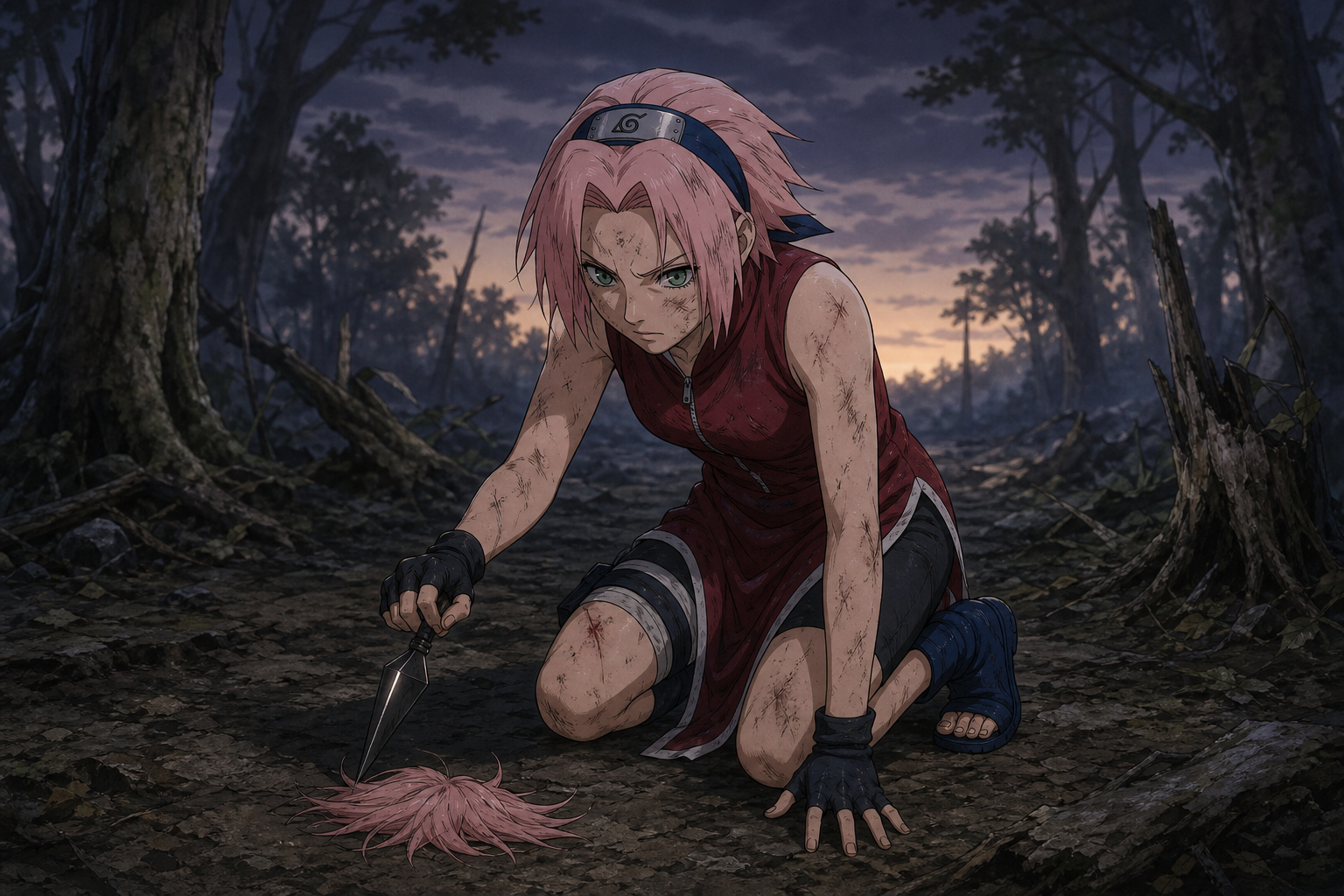
During the Forest of Death, she cuts her long hair to escape Kin Tsuchi’s grip. The action works because the hair has history. Sakura grew it partly because she heard Sasuke liked long hair. Cutting it rejects immediate capture and one piece of approval-seeking at the same time.
Fans sometimes treat that cut as a complete feminist revolution.
Calm down.
One emergency decision does not cure insecurity, end her Sasuke fixation or create combat mastery. The scene matters because Sakura acts while terrified. Growth starts there. Growth does not finish there.
Part II gives her a sleeveless red top, gloves, boots and practical shorts or skirt panels suited to close combat and medical work. The adult design retains the pink hair and red family palette while presenting a clinician, mother and veteran rather than freezing her at age twelve.
The violet diamond on her forehead is the visible result of years of chakra storage. The Strength of a Hundred Seal is not makeup, a random royal mark or proof that Sakura was secretly powerful all along. The design makes discipline visible after a long period when the stored work could not be seen.
05
Childhood bullying and Ino’s first rescue
Sakura is not born loud and confident.
She is a shy child bullied over her forehead. Ino Yamanaka notices, defends her, brings her into a social circle and gives her a ribbon. The official birthday retrospective describes Ino as something close to a childhood savior.
That history matters because Sakura’s earliest major bond is with another girl.
Ino does not hand Sakura combat power. She gives her social permission to occupy space. Sakura slowly stops hiding her face and develops the sharp, competitive personality viewers meet at the Academy.
The inner-Sakura gag externalizes what polite Sakura suppresses. The loud internal voice is funny, but the joke rests on a real split. Sakura wants approval, especially from Sasuke. She also has anger, pride and judgment that refuse to stay buried.
Her confidence therefore grows through performance before it becomes stable.
06
Ino friendship becomes rivalry
Sakura learns that Ino also likes Sasuke. She returns the ribbon and declares rivalry.
The scene can be read as a child choosing equality instead of permanent junior status. Sakura does not want to remain the rescued follower. She wants to stand across from Ino as a peer.
The problem is that the chosen battlefield is a boy who has not invited either contest.
Their friendship becomes strained because both girls use Sasuke as a measure of status. The series participates in that narrowing. Two classmates with shared history, intelligence and ambition spend early chapters framed through romantic competition.
The Chūnin Exam match finally gives the relationship its own arena. Sakura and Ino trade technique, memory, resentment and respect. The draw does not settle who is better. The match proves they know how much the other has changed.
Adult cooperation works because the rivalry never fully erases the first rescue.
07
Academy strengths and the Team 7 imbalance
Sakura begins with excellent classroom knowledge and chakra control.
Those strengths are real. They are also insufficient for a field team facing lethal work.
Naruto has enormous stamina, unpredictability and dangerous sealed power. Sasuke has high combat aptitude and the Sharingan inheritance. Sakura can explain concepts and perform basic control with precision, but her early offensive catalog and field confidence are limited.
The imbalance is not proof that she has no ability. The imbalance shows what the Academy rewards and what missions demand.
Sakura also begins as a child capable of being cruel. She complains about Naruto to Sasuke and invokes Naruto’s lack of parents as the reason for his behavior. Sasuke, an orphan himself, calls her annoying.
The rebuke lands because Sakura has mistaken family security for moral superiority.
She changes her immediate behavior, but the scene belongs in the ledger. Later compassion means more when the profile does not edit out early harm.
08
Bell test: teamwork is the first diagnosis
Kakashi’s bell test exposes Team 7’s central problem.
Naruto rushes. Sasuke operates alone. Sakura chases Sasuke’s approval and becomes vulnerable to a genjutsu built from her fear for him.
All three treat the exercise as an individual contest.
Kakashi’s lesson is that the mission structure cannot survive without cooperation. Sakura understands classroom rules, yet misses the social rule until the team fails together.
Her early genjutsu awareness and chakra control do appear across the opening missions. Those traits later support medical work and resistance. They should not be inflated into a giant offensive genjutsu career the manga never gives her.
09
Land of Waves: protection before power
The Land of Waves mission puts Team 7 inside real killing intent.
Sakura identifies danger, guards Tazuna and watches Naruto and Sasuke move into battles she cannot yet control. During the bridge crisis, her assigned protective position matters. Tazuna is the client. Keeping him alive is the mission.
The camera naturally follows Kakashi against Zabuza and the boys inside Haku’s mirrors. Sakura’s contribution looks smaller because defense lacks the same visual fireworks.
She still feels the emotional cost. Sasuke appears to die protecting Naruto. Sakura’s grief over his body and Naruto’s reaction make the team bond real before any of them can name it cleanly.
Land of Waves gives Sakura a painful diagnosis: knowledge without adequate power leaves her watching other people pay the physical bill.
That helplessness becomes part of the later decision to train.
10
Forest of Death: the haircut is an opening, not a graduation
Orochimaru’s attack leaves Naruto and Sasuke unconscious. Sakura becomes the only active Team 7 member at their camp.
She builds traps, maintains watch and faces the Sound trio knowing she is outmatched. When her hair is used to control her body, she cuts it. She takes repeated blows and keeps trying to protect both teammates.
Rock Lee intervenes. Team 10 later intervenes. Sasuke’s curse-mark eruption ends the immediate threat.
Shared rescue does not erase Sakura’s courage. Courage does not mean she won alone.
The scene works because Sakura stops waiting for a perfect heroic version of herself. She uses traps, teeth, a kunai and stubbornness. The body is bruised, the plan is limited and the choice is hers.
The series then shows the limit. Sasuke wakes under curse-mark influence and brutalizes the attackers. Sakura stops him by holding him and calling his name. Her protection moves in both directions. She wants to save Sasuke from enemies and from the power he is beginning to accept.
11
The Ino match restores history
Sakura and Ino meet in the preliminary round.
Their techniques are not equal in type. Ino has clan mind-transfer training. Sakura has control, basic combat and the internal will that the series has represented through Inner Sakura.
The match returns to childhood, ribbon, rivalry and the decision to stand as peers. Ino cuts her own hair as a feint, which answers Sakura’s dramatic forest gesture with tactics rather than imitation.
When Mind Body Switch reaches Sakura, her resistance becomes a character beat more than a universal anti-possession rule. Inner Sakura and Naruto’s support help her push back. The draw leaves both exhausted.
Neither advances.
That is fitting. Their relationship is not a ladder where one girl must disappear so the other can grow.
12
Konoha Crush and the early combat ceiling
Sakura detects and releases the sleep genjutsu during the invasion, confirming her control and genjutsu aptitude. She joins the pursuit after Sasuke and participates in the attempt to protect teammates.
She also becomes a hostage in Gaara‘s transformed threat.
Early Sakura repeatedly understands more than she can physically change. That gap is frustrating by design and by uneven writing.
The series gives Naruto and Sasuke inherited engines that can explode under pressure. Sakura receives no equivalent shortcut. If the story wants her to remain an equal lead, it needs to invest page time in the construction of expertise.
Part I gives the reason. The apprenticeship arrives only after the team breaks.
13
The Haruno family and the meaning of no famous clan
Sakura’s surname does not arrive with a major Konoha clan institution attached.
The main manga gives her parents little narrative presence. Anime and film material provide expanded family depictions, especially the alternate-world structure of Road to Ninja, but those appearances need medium labels. They cannot be used to manufacture a manga clan history that does not exist.
That absence shapes her position.
Naruto enters the story without parents but with hidden Uzumaki, Namikaze and jinchūriki inheritances. Sasuke carries the Uchiha name, Sharingan and a destroyed political history. Hinata, Shikamaru, Ino, Chōji, Kiba, Shino and Neji all train inside named family systems or inherited techniques.
Sakura has a household, an Academy education and herself.
That difference should not become a cheap claim that she earned everything while everyone else cheated. Naruto and Sasuke train brutally and pay terrible costs. Bloodline advantage and individual labor can exist together.
Sakura’s path does show what Konoha’s public institutions can produce when education connects a student to the right mentor. The Academy gives a foundation. Kakashi gives team experience. Tsunade recognizes the control and discipline that can become medicine.
Her professional lineage is chosen rather than inherited.
That makes Sakura an important test of the village’s supposed merit system. If a child without a prestigious clan can become an elite medic through teaching, then access to teachers matters as much as slogans about effort. Konoha cannot praise her success while ignoring how many children never receive comparable attention.
14
Inner Sakura, mind resistance and the self she edits
Inner Sakura is an early comic device, but the gag reveals a useful psychological pattern.
Public Sakura tries to be appealing, controlled and feminine enough for Sasuke’s approval. Inner Sakura yells, competes and admits irritation. The split is not a separate supernatural personality.
The Ino match turns that language into resistance when Sakura disrupts Mind Body Switch. The scene does not establish universal immunity to possession. Ino’s technique reaches her. Sakura’s will, the internal comic persona and Naruto’s encouragement contribute to pushing back.
As Sakura matures, Inner Sakura appears less often.
One reading is simple tonal change. The series reduces the gag as the story darkens. A character reading adds something more useful: adult Sakura needs less distance between polite presentation and active judgment.
She still suppresses important truths. The Five Kage Summit confession proves that maturity does not erase performance. She constructs a version of herself she thinks Naruto needs to hear and mistakes controlled delivery for honest communication.
Her strongest adult scenes work when speech, judgment and action align. She tells Chiyo what she can do, asks to become the human puppet and follows the plan. She identifies medical problems and acts. She challenges Sasori’s disregard for life because the moral response and the tactical response belong to the same person.
Growth is not becoming quieter.
Growth is needing fewer masks between what she knows and what she chooses.
15
Sasuke’s departure transfers the burden to Naruto
Sakura notices Sasuke preparing to leave Konoha and confronts him at the village exit.
She confesses love, offers to go with him and threatens to scream. Sasuke thanks her, knocks her unconscious and leaves.
The scene is not proof that love almost saves him. Sasuke has already chosen power under Orochimaru. Sakura cannot negotiate away the massacre, Itachi’s return or the curse mark with devotion.
When the retrieval team departs, she asks Naruto to bring Sasuke back.
Naruto turns that request into a promise of a lifetime.
Sakura does not create Naruto’s attachment to Sasuke. Naruto already considers him a bond and rival. Her plea still adds emotional labor to a boy who loves her and is willing to hurt himself proving reliability.
When Naruto returns injured and without Sasuke, Sakura recognizes part of that burden. She stops treating hope as something Naruto can deliver while she waits.
16
Choosing Tsunade is professional reconstruction
Sakura asks Tsunade to train her.
This is one of her most important decisions because no romance makes it for her.
She identifies the gap and chooses a profession that answers it. Medical ninjutsu can keep teammates alive. Precise chakra release can turn her existing control into close-range force. Diagnostic training can make knowledge useful under pressure.
Tsunade is not merely the woman assigned to the girl while Jiraiya and Orochimaru train the boys.
She is Hokage, Sannin, medical reformer and a fighter who has forced the shinobi system to recognize care as battlefield infrastructure. Sakura inherits that professional lineage without inheriting Tsunade’s bloodline.
Training happens through study, control exercises, anatomy, pharmacology, evasion and physical conditioning. The result is not magic puberty.
Sakura works for it.
17
Medical rules make care a combat discipline
The medical-ninja system emphasizes survival, judgment and staying available to treat others. A medic who charges blindly can become another casualty consuming team resources.
Sakura learns to read bodies, control chakra at tiny scales, close wounds, manage poison and make decisions while other people panic.
That work is not passive.
A battlefield medic chooses priority under scarcity. Who can be saved? Which injury will kill first? How much chakra can be spent now without losing the next patient? Is the enemy using poison, disguise or delayed damage?
Fandom arguments often rank Sakura below whoever breaks the largest mountain.
A mountain does not bleed out while three other patients wait.
Medical competence changes whether an army exists after the fight.
18
Kankurō’s antidote proves international value
The Kazekage Rescue mission opens with a medical emergency.
Kankurō has been poisoned by Sasori. Sand medics cannot reverse the compound. Sakura examines him, identifies the poison and creates an antidote under a limited clock.
This is a political achievement as well as a clinical one.
A Leaf shinobi saves a Sand shinobi after the villages were recently enemies. Sakura’s skill produces trust that speeches alone cannot manufacture. Tsunade’s medical system becomes foreign policy through a student who can deliver results.
The antidote also proves that Sakura’s training is not an offscreen excuse for a stronger punch. Chemistry, diagnosis and controlled treatment change the mission before she enters the Akatsuki hideout.
She prepares a limited number of doses. Scarcity matters. An antidote is not a permanent poison immunity or a reusable plot shield.
19
Sakura and Chiyo defeat Sasori together
The Sasori battle is Sakura’s first complete Part II showcase.
Chiyo brings decades of puppetry knowledge, battlefield judgment and personal history. Sakura brings poison preparation, medical response, evasion training, chakra-enhanced force and a body strong enough to destroy puppets once an opening exists.
At first, Chiyo controls Sakura with chakra threads to evade attacks Sakura cannot yet read alone. Sakura then adapts and acts with increasing independence. When conventional puppets fail, she volunteers her own body as the weapon Chiyo can guide.
That is collaboration, not humiliation.
Sakura trusts an older woman to direct movement. Chiyo trusts a younger woman to withstand risk, read the poison clock and strike hard enough to matter. Their skills cover each other’s gaps.
Sakura destroys Hiruko’s shell and later the Third Kazekage puppet. She navigates Iron Sand, hidden weapons and poisoned attacks. She uses the antidote knowing protection is temporary. She is stabbed while shielding Chiyo and treats the injury under pressure.
Chiyo deploys the ten puppets and delivers the final family-shaped trap through Sasori’s Mother and Father puppets. Sasori leaves an opening whose exact emotional meaning remains deliberately complicated.
Sakura does not solo Sasori.
Chiyo does not drag a useless girl through the fight.
They win because a young medic and an old puppeteer choose interdependence.
The victory also produces intelligence about Orochimaru. Sakura’s concern for Sasuke remains part of the mission, but the fight establishes professional identity beyond romance.
20
Reunion and Tenchi Bridge reopen the old wound
Team Kakashi follows Sasori’s lead toward Orochimaru.
The mission adds Sai and Yamato to a team still organized around Sasuke’s absence. Naruto’s transformation under Kurama’s chakra becomes dangerous to allies. Sakura tries to reach him and is injured.
Her later decision to hide the source of that injury from Naruto is compassionate and unhealthy at once. She does not want him carrying more guilt. Secrecy prevents him from understanding the bodily consequence of losing control.
When the team finally sees Sasuke, the reunion is not romantic closure. Sasuke is calm, powerful and willing to attack. Sakura confronts the reality that the boy she remembers has made choices inside Orochimaru’s world.
Sai’s presence matters because he watches Team 7’s bond from outside its mythology. His blunt questions expose how much Naruto and Sakura have allowed the missing teammate to organize their lives.
21
Pain assault: hospital work is still battlefield work
During Pain’s attack, Sakura works inside the medical response while Katsuyu connects information and healing across Konoha.
The village is collapsing. Patients arrive faster than ordinary systems can absorb them. Medical personnel operate under mass-casualty conditions while frontline fighters confront summons and Paths of Pain.
Sakura’s fist destroys a giant centipede, reminding viewers that the medic can fight. Her larger responsibility is keeping people alive.
When destruction overwhelms Konoha, she calls for Naruto.
The cry is often clipped into a meme as proof she can only wait for him. The criticism contains a real structural issue. The story centers Naruto’s arrival as salvation. The meme erases context. Sakura has been treating casualties during a village-level attack and knows Naruto is the person trained to address the specific threat.
After Naruto returns and defeats Pain, Sakura punches him, then embraces him in relief.
The combination is pure Team 7 language. Anger, care and fear arrive in the same gesture sequence.
22
The Five Kage Summit is Sakura’s moral failure
News that Sasuke has joined Akatsuki activity and become an international target pushes Sakura toward a disastrous solution.
She tells Naruto that she loves him and asks him to stop pursuing Sasuke.
The confession is dishonest.
Sakura correctly sees that Naruto is destroying himself under promises, guilt and attachment. She incorrectly assumes she can free him by manipulating the romantic feeling she knows he once held for her.
Naruto rejects the claim because he knows her better than the performance allows.
The scene deserves criticism without turning Sakura into a monster. She is a teenager confronting the possibility that a teammate must be killed, that Naruto may die chasing him and that her earlier plea helped formalize the burden. Panic produces control masquerading as sacrifice.
She then tries to approach Sasuke herself with the intention of killing him. Her resolve collapses. Sasuke attempts to kill her. Kakashi and Naruto intervene.
Sakura also uses a sleeping agent on allies to prevent them from stopping her plan. That choice removes their agency and leaves the group vulnerable.
Nothing about the sequence is clean.
The lesson is not that Sakura is too emotional to act. The lesson is that solitary atonement reproduces Team 7’s worst habit. Naruto, Sasuke and Sakura all decide at different points that they alone should absorb the impossible choice. Each version harms people excluded from the decision.
23
War work begins with bodies and suspicion
Sakura enters the Fourth Great Ninja War as part of the medical corps.
The assignment is central infrastructure. Thousands of shinobi from former enemy villages now share treatment systems, intelligence and supplies.
White Zetsu infiltration turns the hospital into a security crisis. Medical spaces depend on trust. A disguised attacker can reach exhausted personnel and wounded soldiers more easily than a battlefield commander.
Sakura helps identify and confront the threat. The problem suits her combination of observation, medical knowledge and force.
The war also exposes the emotional cost of triage. A healer can save many people without saving everyone. The story gives more visual time to front-line transformations, but the alliance would collapse if medical teams stopped functioning.
24
The Strength of a Hundred is stored time
Sakura reveals the completed forehead seal when Team 7 reunites on the battlefield.
The moment answers her earlier vow not to remain behind Naruto and Sasuke.
The seal represents chakra stored with precise control over years. Sakura has been diverting and accumulating power while continuing missions, study and daily function. The visible diamond appears only when that long project reaches completion.
That makes the symbol perfect for her.
Naruto and Sasuke’s inherited powers announce themselves through bloodline, beasts and prophecy. Sakura’s greatest reserve looks absent until the work is ready.
Once released, the stored chakra supports greater strength, healing and large-scale medical use. Sakura summons Katsuyu, whose divided body can carry healing and communication across many targets.
The Team 7 summoning parallel places Sakura in the Sannin lineage beside Naruto and Sasuke without making the students carbon copies of their masters.
Power still has limits. Stored chakra can be depleted. Healing does not undo every death. A medic can keep a body functioning and still need protection, information and time.
25
Kaguya battle: one strike needs the whole formation
The final Kaguya confrontation distributes roles across Team 7 and its allies.
Naruto and Sasuke carry the sealing requirement. Kakashi receives an extraordinary temporary power. Obito pays with his life. Sakura contributes chakra to Obito’s dimensional search for Sasuke and later strikes Kaguya from above as Naruto and Sasuke close the seal.
The punch matters because Kaguya cannot escape upward without meeting Sakura.
Fans argue over whether the moment proves Sakura can independently defeat Kaguya.
No.
The scene proves coordinated battle geometry. One member closes the route another member cannot cover. That is what teamwork has meant since the bell test.
After Naruto and Sasuke destroy each other’s arms at the Final Valley, Sakura keeps both alive. The series returns world-saving spectacle to a medical fact: heroes who cannot stop bleeding still die.
Sasuke apologizes to her. The apology is necessary. It is not a complete relationship repair compressed into one word.
26
Sakura Hiden and the Blank Period
Licensed Blank Period material expands Sakura’s professional life after the war.
Sakura Hiden places trauma care, medical systems and threats connected to the postwar order closer to the center. That emphasis fits a world where child soldiers and civilians have survived mass violence.
Novel material must remain labeled as novel material. Anime adaptations can change emphasis, sequencing or inclusion. This profile uses the shelf to understand professional development without pretending every reader encountered the same version.
The most important idea is institutional.
Healing cannot mean waiting until the next war produces bodies. A mature medical system needs prevention, rehabilitation and mental-health support as well as emergency ninjutsu.
Sakura’s adult value grows when care becomes policy rather than a personal superpower.
27
Adult medicine is institution-building, not one gifted healer
The most mature version of Sakura’s calling is not a stronger punch or a larger reserve.
It is a system that works when she is not personally standing beside every bed.
War creates obvious injuries. Postwar life produces quieter ones: trauma, disability, displaced children, exhausted caregivers, veterans trained for violence and families rebuilding after mass death. A village that only celebrates battlefield medicine waits until suffering becomes visible enough for an emergency panel.
Sakura’s later medical leadership and mental-health work matter because they move care upstream. Training other clinicians, building programs, coordinating facilities and recognizing psychological wounds distribute expertise.
That is harder to turn into a fighting-game special move.
It is also how public health works.
The Jin-profile standard requires the occupation to be more than a label in a fact box. Sakura is not `a medical ninja` because green chakra appears around her hand. She is part of a professional tradition with rules, triage decisions, mentorship, research, institutional authority and ethical risk.
Medical authority can also become paternalistic. A healer may know the body better than the patient and still owe explanation, consent and respect. Sakura’s own history with controlling solutions makes that boundary important. Wanting to save someone does not grant ownership of their decision.
Her best legacy would therefore be a medical culture that combines technical excellence with honest communication.
28
Power scaling cannot measure a hospital
Fans often ask whether Sakura can beat a specific Kage, destroy a larger object or survive a named dōjutsu.
Those questions can be fun. They become ridiculous when they replace the biography.
A combat ranking compares selected conditions. Sakura’s role spans conditions that a duel chart cannot hold. She may enter after poison has already reached the bloodstream. She may treat dozens of allies while preserving chakra for one critical patient. She may need to protect a hospital, identify an infiltrator or keep a fighter alive long enough to finish a mission.
The Sasori battle shows why categories matter. Sakura’s strength breaks puppets. Her antidote creates the time to fight. Chiyo’s expertise creates movement and openings. Remove any one piece and the result changes.
Late-series Sakura has immense striking force and regeneration support. That does not make every opponent easy. Range, speed, sensory ability, sealing, space-time movement, unknown toxins, genjutsu conditions and chakra supply still matter.
Conversely, losing a hypothetical one-on-one battle does not make her contribution smaller. Tsunade’s village survives Pain partly through a healing network. Naruto and Sasuke survive the Final Valley because Sakura is there afterward. An outcome can depend on a person who did not land the most spectacular attack.
The shinobi system knows this whenever leaders assign a medical corps.
The fandom forgets whenever a tier list opens.
29
Marriage cannot be used as retroactive absolution
Later canon establishes Sakura and Sasuke as married and as Sarada’s parents.
That fact does not erase the road.
Sasuke dismissed Sakura, left the village, attacked her and spent long periods away. Sakura idealized him, hid parts of her judgment inside romance and accepted burdens the story does not always let the couple discuss on page.
They also share childhood, war, apology, travel-era material, parenthood and continuing loyalty.
A serious profile refuses both fandom shortcuts.
Marriage is not proof that every earlier interaction was secretly healthy. Earlier harm is not proof that no later love can exist.
The writing owes the relationship more interiority than it provides. Readers can criticize that absence without inventing private scenes to make the pairing perfect or impossible.
30
Sarada makes care visible and absence measurable
Sakura raises Sarada during Sasuke’s long periods of shadow work.
That makes her the stable parent in daily life. Food, illness, training, schooling, safety and emotional regulation do not pause because Sasuke’s mission is important.
Naruto Gaiden turns family uncertainty into conflict. Sarada questions her parentage after seeing Karin in a photograph and lacking ordinary access to her father. Sakura reacts badly under stress and destroys the house with a punch, which is funny as spectacle and terrible household communication.
The eventual biological answer confirms Sakura as Sarada’s mother. The deeper question was never only DNA.
Sarada wants to know whether the adults around her will tell the truth and whether a father who is absent still understands her life.
When Sakura is taken to Shin’s hideout, she does not wait helplessly. She analyzes, fights and treats within the enemy setting. Sarada chooses to help rescue her.
Their bond works because Sakura is not merely the mother who gives advice. She is the parent whose labor Sarada has lived inside.
The profile should not turn that strength into an excuse for Sasuke’s absence. Competent women are often punished with more work because everyone assumes they can carry it.
31
Complete medical and combat ability shelf
Sakura’s foundation is chakra control.
Medical ninjutsu requires precise application to living tissue. She learns diagnosis, wound closure, cellular stimulation, poison analysis, antidote creation and battlefield stabilization. Exact procedures vary by scene and medium, so the profile does not turn every green glow into the same technique.
Chakra-enhanced strength concentrates and releases chakra at the point of impact. The result can crack terrain, destroy defenses and disable large opponents. Timing matters. A missed strike still spends movement and creates openings.
Evasion is part of Tsunade’s training philosophy because an injured medic reduces the team’s survival. Sakura’s Sasori performance shows learned reading and movement, first with Chiyo’s assistance and then with greater independence.
The Strength of a Hundred Seal stores chakra over a long period. Releasing the seal provides access to the reserve. Creation Rebirth-style regeneration and large-scale Katsuyu support draw on that power but should not be collapsed into one consequence-free immortality button.
Katsuyu can divide, carry chakra, communicate and extend healing across targets. The network depends on the summoner’s available chakra and Katsuyu’s distributed body.
Sakura has strong poison knowledge, but the Sasori antidote is a prepared response to a specific compound. Expertise does not make every unknown toxin instantly harmless.
Her early genjutsu aptitude appears through recognition, release and resistance contexts. The main canon does not give her a giant offensive illusion shelf.
She uses standard ninja tools and basic techniques. Later adaptations, novels, films and games may expand named moves. Those belong on labeled shelves, not inside the manga record by stealth.
Her main limits are not lack of courage. They are chakra supply, time, information, patient volume, range, the need to stay functional and the fact that some damage cannot be reversed.
32
Relationship and accountability atlas
Naruto Uzumaki
Sakura begins by dismissing Naruto and exploiting his feelings. She grows into a teammate who heals him, argues with him, trusts him and shares the Sasuke burden. The false confession is a real violation of that trust. Their later partnership is stronger because Naruto refuses the lie.
Sasuke Uchiha
Sasuke begins as an idealized crush and becomes teammate, missing person, threat, penitent traveler, husband and father. Sakura’s persistence cannot be credited with every change he makes. Sasuke’s eventual love cannot erase the violence. Their adult bond needs both history and off-page limitations stated honestly.
Ino Yamanaka
Ino is Sakura’s first rescuer, former best friend, rival and adult colleague. Their most important bond predates Sasuke. Competition hurts the friendship, but neither woman remains trapped at age twelve.
Tsunade
Tsunade gives Sakura a technical and institutional inheritance. Sakura follows the model without becoming a smaller Tsunade. The lack of a famous clan makes chosen apprenticeship especially important.
Kakashi Hatake
Kakashi teaches Team 7 cooperation and protects Sakura across missions, but gives her less individualized technical training than Tsunade later provides. Their adult relationship carries the familiarity of people who watched the same team break and rebuild.
Chiyo
Chiyo and Sakura begin across a generational and village divide. Each needs what the other knows. Their Sasori victory is one of the franchise’s best examples of women cooperating without becoming interchangeable.
Sai and Yamato
Sai and Yamato enter a team organized around loss. Sakura initially resists Sai’s presence and later learns his own emotional limits. Yamato sees Naruto’s transformation wound her and helps manage a team whose old attachments remain operational hazards.
Sarada Uchiha
Sarada is not proof that the romance worked. She is a daughter with her own ambition, anger and judgment. Sakura provides daily stability and must still answer hard questions about secrecy, absence and family history.
33
Chie Nakamura and the original Japanese performance
Chie Nakamura is Sakura’s original Japanese anime performer across the principal series record.
The credit is verified through the official Naruto and Naruto Shippuden cast pages.
Without a lawful scene-by-scene audio review in this production pass, this profile will not invent claims about pitch, breath or timing. The performance contexts worth studying are clear: Inner Sakura against polite speech, the Forest of Death resolve, the Sasori battle’s tactical strain, the false confession’s deliberate wrongness, war-era command and adult maternal authority.
Those contexts offer a real future performance analysis. A generic sentence claiming that Nakamura `brings emotion to the role` would offer nothing.
34
Manga, anime, novels, films, OVAs and games
The manga is the core chronology.
The original anime and Shippuden adapt that spine while expanding Academy life, missions, medical incidents, friendships and performance beats. Anime-original material must be labeled because added screen time can improve characterization without becoming manga fact.
Sakura Hiden and other licensed novels add postwar professional and relationship material. Their claims should retain book and adaptation labels.
Films place Sakura in different mission and continuity conditions. The Last belongs to the canonical Blank Period bridge more directly than many earlier theatrical adventures. Road to Ninja uses an alternate-world structure. Boruto-era films and adaptations can overlap with manga material.
OVAs range from comedic festival appearances to supplementary missions. Games build large move sets and alternate encounters for play. A game technique is not automatically a manga ability.
The shelf matters because Sakura receives meaningful labor outside the panels fans most often circulate. Medium labels protect that value from becoming a continuity mess.
35
Gendered labor and the camera’s value system
Sakura is judged inside two overlapping systems.
The shinobi world treats bodies as resources. The action genre treats visible destruction as proof of importance. Medical work repairs the first system while receiving less spectacle from the second.
Gender intensifies the problem. Sakura and Tsunade perform care, administration and bodily maintenance while male rivals receive long ideological battles and inherited mythologies. Healing is then dismissed as support, as if an army can operate without survival infrastructure.
The answer is not to claim the writing treats Sakura perfectly.
Kishimoto often gives Sasuke and Naruto more interiority, lineage, teachers, enemies and ideological dialogue. Sakura’s romantic fixation occupies space that could have developed family, professional politics or independent goals earlier.
Calling that imbalance sexist can be part of a serious critique.
Calling Sakura useless because the imbalance exists repeats the same value system. The character gets punished for not receiving the narrative investment readers also complain she lacks.
36
The writing gives her responsibility faster than interiority
Sakura is often asked to respond to other people’s crises.
Naruto is lonely. Sasuke is consumed by revenge. Gaara is kidnapped. Kankurō is poisoned. Chiyo carries family regret. Sai is learning emotion. The village is attacked. The army is wounded. Sarada questions her father.
Sakura acts inside all of those stories.
The series less often pauses to build an equally detailed interior world for her. We receive the childhood forehead wound, Ino history, Sasuke attachment and professional decision. We receive fewer sustained questions about her parents, politics, ambitions beyond competence, feelings about medical authority or anger at being asked to repair Team 7.
That imbalance affects reception.
Characters with long internal monologues can explain contradictions before fandom judges them. Sakura’s contradictions frequently arrive through behavior and leave readers to bridge missing reflection.
The false confession is a clear example. The scene shows panic, guilt and control. More space devoted to the plan’s formation and aftermath could sharpen accountability. Instead, the event becomes ammunition for people who want either total condemnation or instant defense.
Critiquing this construction is different from declaring Sakura empty.
The material supports a complex woman. The adaptation ecosystem sometimes expands that material and sometimes doubles down on comedy or romance. A complete profile should separate what Sakura does from what the camera chooses to value.
RaeRae’s judgment is that responsibility without interiority is a writing tax. Sakura keeps paying it.
37
Confucian duty and chosen professional lineage
Confucian readings emphasize relationships, roles, education and reciprocal duty.
Sakura’s strongest lineage is not biological. Tsunade becomes teacher, Sakura becomes student and the knowledge passes through disciplined practice. Respect is not passive obedience. A good student must eventually act with judgment rather than copy the master.
Team 7 also tests reciprocal duty. Sakura asks Naruto to retrieve Sasuke, then learns that one person’s promise cannot carry a whole relationship. Kakashi owes instruction. Students owe trust and cooperation. The village owes truth and care to the children it deploys.
When duty runs only downward, the system becomes exploitation.
Sakura’s adult medical work matters because she turns personal training into public capacity.
38
Buddhist attachment and the difference between love and grasping
Sakura’s attachment to Sasuke creates suffering when she treats the bond as something determination can control.
Love is real. Grasping appears when she lies to Naruto, tries to decide Sasuke’s death alone or imagines that self-sacrifice will settle everyone’s pain.
The series repeatedly asks characters to preserve bonds without owning other people.
Sakura grows when care becomes action suited to the person in front of her, not a demand that reality match the relationship she wants.
Medical work provides the clearest form. A healer cannot love an injury into disappearing. She must observe what is actually happening, accept limits and choose the next useful action.
39
Fandom court
`Sakura is useless`
False. She saves Kankurō, helps defeat Sasori, supports mass-casualty medicine, completes the Strength of a Hundred, enables the dimensional search for Sasuke, helps close Kaguya’s escape route and keeps Naruto and Sasuke alive after their final battle.
`Sakura soloed Sasori`
False. Chiyo’s knowledge, strings, puppets and final attack are essential. Sakura’s antidote, body, adaptation and force are also essential. Shared victory is not lesser victory.
`Cutting her hair completed her development`
False. The cut is an emergency act and symbolic opening. Years of training and many later failures follow.
`Every criticism of Sakura is misogyny`
False. The orphan insult, false confession, drugging allies and relationship decisions deserve criticism. Misogyny appears when standards change by gender, medical labor is treated as nothing or her whole existence becomes punishment for not returning Naruto’s affection.
`She only became strong to impress Sasuke`
False. Sasuke’s departure helps trigger the decision, but Sakura chooses Tsunade, medicine and professional competence. Her work saves people unrelated to the romance.
`Marriage proves the relationship was always healthy`
False. Marriage proves a later canonical relationship. Health must be evaluated through conduct, repair, communication and consequence.
`She surpassed Tsunade in every possible category`
Too broad. Sakura reaches extraordinary medical and combat ability and inherits the seal tradition. Leadership history, experience, political authority, special knowledge and era-specific feats require separate comparison.
40
Consequence ledger
Sakura’s early insecurity harms Ino friendship and encourages approval-seeking.
Her orphan comment harms Naruto and exposes sheltered judgment.
Her inability to stop Sasuke in Part I becomes motivation for training.
Her plea adds weight to Naruto’s existing promise.
Her apprenticeship produces medical capacity that saves Kankurō, supports war forces and changes Team 7’s survival.
Her false confession damages trust and fails to solve the Sasuke crisis.
Her attempt to act alone puts allies and herself at risk.
Her stored chakra becomes healing and combat power only because years of invisible work preceded release.
Sasuke’s absence leaves Sakura carrying most daily parenthood.
Her competence protects Sarada. Her secrecy and stress still create questions Sarada has the right to ask.
41
Final verdict
Sakura Haruno begins as a clever child who wants the right boy to confirm her worth.
She becomes a woman whose hands can diagnose poison, hold a heart together, crack a battlefield and run toward bodies everyone else has finished breaking.
That growth is not smooth.
She hurts people. She lies badly. She confuses control with sacrifice. She stays attached to a relationship the text does not always develop enough to support its endpoint.
She also studies, changes, apologizes through conduct, accepts unglamorous work and builds skill without prophecy carrying her there.
Naruto asks what recognition can do for loneliness. Sasuke asks what revenge does to love.
Sakura asks a less celebrated question.
Who keeps everyone alive long enough to learn anything?
The answer is not always the person standing in the brightest light.
Sources and canon boundary
Editorial record: Manga chronology controls. Anime expansions, novels, films, OVAs and games are labeled instead of blended into canon.
Primary franchise references: Naruto Official and VIZ Media Naruto.