
Naruto character dossier
Yamato
Orochimaru turns an infant into an experiment. Root turns the survivor into a tool. Team 7 calls him captain, and he quietly uses the stolen Wood Release to build shelter.
Yamato is the mission name that becomes a life
Tsunade assigns the codename “Yamato” when he takes command of the reorganized Team Kakashi. Kakashi Hatake knows him as Tenzō from their ANBU history and keeps using the older name often enough to irritate him. The two names mark different institutions. Tenzō belongs to covert service. Yamato belongs to a team that eventually treats him as a person.
The anime adds the Root codename Kinoe and expands his childhood history. That material can deepen the character, but the boundary matters. Manga canon establishes Orochimaru’s experiment, Wood Release, ANBU service and his connection with Kakashi. The detailed Kinoe timeline, missions with young Kakashi and some Root confrontations are anime-original expansion.
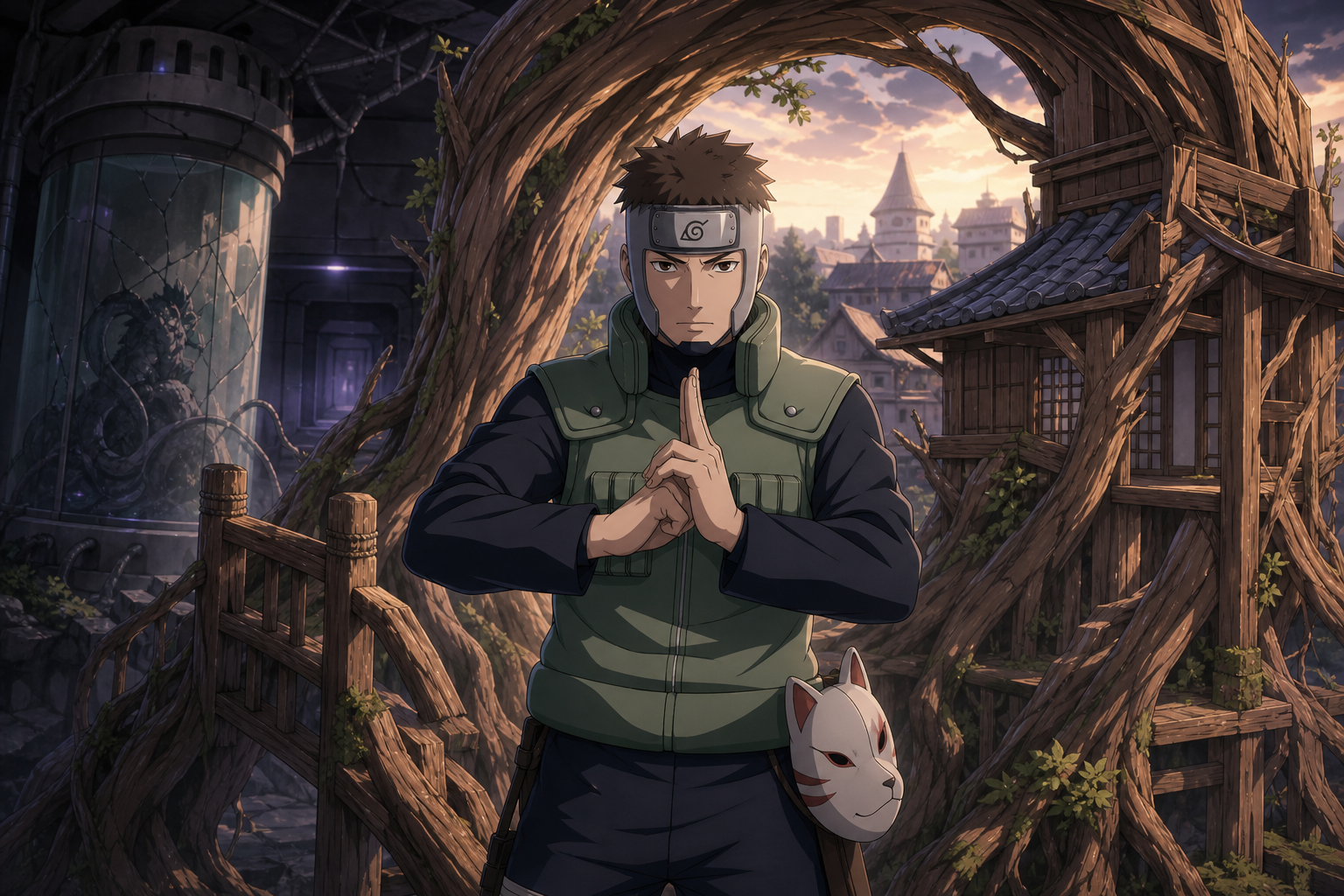
His adult design is deliberately practical: short brown hair, framed Leaf forehead protector, green flak jacket, dark underclothes and a calm face that can become comically terrifying when Team 7 tests him. The special forehead frame distinguishes him from ordinary jōnin without turning him into a costume spectacle.
Yamato’s “scary face” is played for laughs, but the joke depends on competence. He rarely needs to shout. Naruto and the others know the captain can build a prison, a house or a forest before they finish arguing.
Orochimaru uses sixty infants and calls the survivor a success
Orochimaru abducts or obtains infants and implants them with genetic material from Hashirama Senju in an attempt to reproduce Wood Release. The experiment kills the other children. Yamato survives.
The survival becomes a scientific result in the language of the perpetrator. From the child’s perspective, his body is altered before he can consent, remember or refuse. Wood Release is not a blessing that compensates for the crime. Wood Release becomes evidence of the crime and a power Yamato later makes his own.
Orochimaru abandons the experiment after believing all subjects have died. The fact that Yamato lives does not soften the method. One survivor out of a group of dead infants is not a successful trial. The experiment amounts to mass child killing with an unexpected witness.
Hashirama’s cells become a recurring franchise shortcut for healing, chakra, longevity and biological compatibility. Yamato keeps the concept tied to a body. Cells are not neutral upgrade material. Every use has a source, a recipient and a consequence.
His ability to suppress tailed-beast chakra later makes him useful to Konoha. The village benefits from the experiment while condemning Orochimaru. Practical necessity explains the decision to use Yamato’s power. That usefulness does not erase the obligation to treat him as more than a living safety feature.
Danzō finds a survivor and sees another asset
Danzō Shimura brings Yamato into Root and covert training. The institution values emotional control, obedience and silence. A child already altered for one man’s ambition becomes useful to another man’s version of national security.
Yamato later serves in the regular ANBU under the name Tenzō and works with Kakashi. He develops tracking, infiltration, assassination and command skills beyond Wood Release. The mask and codename hide identity while the missions reward precision.
The anime’s Kakashi ANBU arc expands the relationship among Kinoe, Kakashi, Danzō and Hiruzen. Those episodes portray a gradual movement away from Root and toward a less absolute loyalty. The material is valuable adaptation history, not a secret manga chapter.
Kakashi becomes an important comparison. Both boys are elite tools shaped by adult war policy. Kakashi’s losses make him cling to comrades. Yamato’s institutional childhood teaches him to observe before revealing attachment. Their later humor works because both men recognize the machinery under the uniform.
Leaving Root does not remove Root habits. Yamato can compartmentalize, monitor allies and follow uncomfortable orders. His moral difference appears in how he uses those skills. He protects team choice more often than he manufactures obedience.
Captain Yamato inherits a team built around an absence
After Kakashi is hospitalized, Yamato takes command of Naruto Uzumaki, Sakura Haruno and Sai. The mission focuses on an intelligence contact connected to Sasori and the search for Sasuke Uchiha.
The team arrives with incompatible emotional pressures. Naruto wants Sasuke back. Sakura carries guilt and determination. Sai has a secret Root assignment and almost no healthy social practice. Yamato must lead while knowing Danzō may be operating inside the mission.
At Tenchi Bridge, Orochimaru provokes Naruto into a Four-Tails transformation. The chakra cloak injures Sakura and overwhelms ordinary restraint. Yamato uses Wood Release and the Hokage-style suppression technique connected to Hashirama’s power to force the chakra back.
The suppression establishes why Tsunade selected him. Yamato is not merely replacing Kakashi’s tactical role. He is an emergency system specifically matched to Naruto’s seal risk. The assignment protects the team while placing enormous responsibility on a man whose own body was altered without consent.
Yamato then confronts the team with the damage left behind. Naruto’s intentions do not repair the bridge, forest or Sakura’s injury. The captain insists on consequence without treating Naruto as a monster. That balance is rare in Konoha.
He helps Naruto build power without borrowing a beast
Yamato assists Kakashi during Naruto’s wind-nature and Rasenshuriken training. Naruto uses shadow clones to multiply experience while Yamato monitors the Nine-Tails chakra and creates large training environments with Wood Release.
The work is exhausting and mostly thankless. Kakashi designs the learning method. Naruto performs the breakthrough. Yamato keeps the experiment from becoming a tailed-beast disaster and repeatedly restores the landscape. Support labor makes the celebrated innovation possible.
He also explains chakra-nature relationships and observes Naruto’s progress with a teacher’s patience. Yamato is not Naruto’s primary emotional mentor, but he supplies structure, safety and an adult who will say when enthusiasm has become property damage.
The famous temporary houses demonstrate the range of his power and the team’s casual dependence on it. Yamato can create shelter rapidly through Wood Release. Everyone enjoys the result. Almost nobody asks what sustained large-scale construction costs him.
After Naruto loses the First Hokage’s necklace during the Pain crisis, the exact suppression conditions change. Yamato remains capable with Wood Release, but fans should not treat every earlier containment mechanism as permanently available without context.
Kabuto kidnaps the one man the enemy can plug into an army
Before the Fourth Shinobi World War, Kabuto captures Yamato near the island training site. The kidnapping targets his Hashirama-derived body rather than his command knowledge alone. He is brought to Obito’s operation and used to strengthen the White Zetsu army.
This is the original experiment repeating at industrial scale. Orochimaru implants Hashirama’s material into infants. Kabuto and Obito exploit the surviving result to improve mass-produced soldiers. Yamato becomes biological infrastructure again.
While Naruto, Sasuke and the Allied Forces receive the war’s central emotional beats, Yamato spends much of the conflict restrained and used. His absence from the battlefield is not cowardice or irrelevance. The enemy removes him precisely because his body is strategically valuable.
Later, the spiral-faced artificial human commonly called Guruguru uses Yamato’s body and Wood Release in battle. The possession turns his technique against the alliance. Yamato survives but loses control of the power that most clearly defines him.
After the Infinite Tsukuyomi ends and the war concludes, Yamato is freed. The series gives limited space to his recovery. That omission matters. A man abducted, immobilized and used to grow an army should receive more than a return to assignment.
Abilities, mechanics and honest limits
Wood Release
Yamato combines Earth and Water Release to create living wood. He forms barriers, pillars, houses, forests and restraints. His scale is impressive but remains below Hashirama’s legendary output.
Tailed-beast suppression
Hashirama-derived power lets Yamato suppress Naruto’s leaking Nine-Tails chakra through specialized restraints and the Hokage-style technique. Conditions, range and Naruto’s transformation level matter.
Wood clones
He creates durable wooden copies for reconnaissance and combat. Clones extend awareness and deception while dividing chakra and remaining destructible.
Earth and Water Release
Yamato can use the component natures independently for terrain, defense and water production. Wood Release should not erase the broader elemental skill supporting it.
Tracking seeds
He can place chakra-responsive seeds on targets and use Wood Release sensitivity to track movement. Detection can fail if the marker is removed or the target moves beyond practical range.
Construction
Rapid housing, bridges and fortifications turn combat chakra toward civil infrastructure. The creations solve immediate shelter needs but do not replace carpentry, maintenance or long-term planning.
ANBU fieldcraft
Yamato brings infiltration, traps, surveillance and command judgment from covert service. His calm is trained competence, not proof that missions carry no emotional cost.
Limits
Hashirama cells do not grant Hashirama’s full reserve, Sage Mode or every Mokuton technique. Yamato can be exhausted, captured, controlled and overpowered by higher-tier enemies.
Relationship atlas
Kakashi Hatake
Kakashi is senior, former ANBU colleague and the captain Yamato replaces temporarily. Their dry rivalry hides mutual trust. Kakashi relies on Yamato’s labor too easily at times, while Yamato understands the grief beneath Kakashi’s laid-back authority.
Naruto Uzumaki
Naruto is student, mission priority and the jinchūriki Yamato is assigned to restrain. Yamato refuses to define him as a containment problem. He teaches control while preserving Naruto’s responsibility for the damage power can cause.
Sakura Haruno
Sakura and Yamato share the practical side of Team 7. Both track injuries, consequences and mission reality while Naruto’s emotions pull toward Sasuke. Yamato respects her as a capable shinobi rather than treating her as the team’s emotional accessory.
Sai
Both men pass through Root and learn to operate behind masks. Yamato supervises Sai without recreating Danzō’s total control. Their shared history gives the captain a clearer view of what Sai’s awkwardness is hiding.
Orochimaru
Orochimaru is the architect of Yamato’s altered body, not a quirky former villain in this relationship. Later political tolerance cannot erase the children killed in the experiment or Yamato’s lifelong consequence.
Danzō Shimura
Danzō converts survival into service. Root gives Yamato training and purpose while denying the free development that might make either meaningful. Yamato’s later command style quietly rejects Danzō’s model.
Tsunade
Tsunade entrusts him with Team 7 because she understands both the mission and Naruto’s risk. The assignment recognizes Yamato’s ability. The assignment also continues Konoha’s habit of using his body wherever Hashirama compatibility solves a policy problem.
Adult Yamato guards the man who experimented on him
After the war, Yamato is assigned to monitor Orochimaru. The arrangement is darkly absurd. Konoha places the survivor outside the perpetrator’s hideout and calls the duty security.
Yamato is qualified. He knows Orochimaru’s methods, has Wood Release and can observe unusual activity. Qualification does not make the assignment emotionally neutral. The state benefits from the survivor’s proximity to the source of his trauma.
In the Boruto era, he continues surveillance while Orochimaru maintains conditional freedom and participates in new family structures through Mitsuki. Yamato’s presence reminds the audience that rehabilitation policy has an unpaid witness standing nearby.
The sequel often uses him for quick comedy about endless monitoring. The joke lands because Yamato remains reliable. The assignment also exposes Konoha’s weak imagination about survivor care. Apparently the retirement plan is still watching the laboratory.
Yamato turns stolen biology into public shelter
Wood Release enters Yamato’s life through violence. He later uses the same power to restrain dangerous chakra, carry teammates, build bridges and create homes. The transformation does not redeem Orochimaru’s experiment. Yamato redeems his own relationship with the body left behind.
A Confucian lens reveals the failure of institutional reciprocity. Yamato gives Konoha obedience, command, construction, containment and wartime sacrifice. Konoha owes recognition and care. The story shows the service constantly and the repayment rarely.
A Buddhist reading can separate acceptance from approval. Yamato accepts the reality of his altered body and acts skillfully with it. Acceptance does not require calling the original harm necessary. He releases the fantasy of an untouched life without releasing moral judgment.
His construction work carries a creative lens Naruto often neglects. Wood Release can be an attack, but Yamato repeatedly makes habitable space. Peace requires walls, roofs, roads and places where people can sleep. Reconstruction is chakra plus labor, not a victory speech.
Yamato also complicates the franchise’s obsession with bloodline inheritance. He is not a Senju heir in the social sense. He receives Hashirama’s material through experiment. Power travels biologically while belonging does not follow automatically.
Rikiya Koyama and the original Japanese performance
Rikiya Koyama is Yamato’s original Japanese voice in the anime. The role balances quiet authority, dry exhaustion, covert danger and the exaggerated scary-face comedy without turning the captain into a parody. This profile names the verified performer and the written demands of the role. I will not invent claims about tone, timing or breath without a lawful scene-by-scene audio comparison.
The anime gives Yamato substantial additional ANBU and Root material. That expanded screen time shapes fan understanding of Kinoe, Kakashi and his move away from Danzō. A complete profile can discuss the contribution while labeling the adaptation boundary.
Fandom arguments that need better timber
“Yamato is discount Hashirama”
His output is lower. His story is different. Hashirama inherits power and founds a village. Yamato survives an experiment and uses limited power for containment and rebuilding. Ranking language erases biography.
“He only exists to control Naruto”
Suppression motivates the Team 7 assignment. Yamato also commands missions, trains Naruto, reads Sai, builds infrastructure, tracks enemies and survives Root and war exploitation.
“Kinoe is his real name”
Kinoe belongs to the anime-expanded Root backstory. Tenzō is his established ANBU name. Yamato is the mission codename that becomes his lasting public identity. His birth name remains unrevealed.
“Orochimaru gave him a gift”
Orochimaru experimented on infants and killed the other subjects. Yamato later makes valuable choices with the result. The survivor’s skill does not convert the perpetrator’s crime into generosity.
“Guarding Orochimaru means Yamato moved on”
The assignment proves duty and endurance. His continued service does not prove healing, forgiveness or institutional wisdom. The manga gives too little of Yamato’s interior response to claim any of those.
Survival is not consent to the experiment
Yamato is the child who lives, and institutions love using survival to soften the crime that required it. Orochimaru’s experiment killed the other infants. Hashirama’s cells happened to integrate with this one body. That outcome proves Yamato endured. It does not prove the procedure gave him a gift.
The distinction matters because every later employer benefits from what was done to him. Root gains an operative with rare power. ANBU gains a specialist. Team 7 gains a captain able to suppress Kurama’s chakra. Konoha gains instant construction. The Allied Shinobi Forces fear what the enemy can produce through his body. Everybody discovers a use. Very few scenes ask what it means to live as the successful result of a mass child experiment.
Yamato makes the ability his own through choices Orochimaru never authorized. He builds shelter, protects teammates, restrains lethal power, and helps reconstruct a village. Reclaiming the result belongs to the survivor. Credit for that reclamation does not travel backward to the perpetrator.
Root replaces a name with a function
Tenzō, Kinoe, and Yamato mark different institutional uses before they mark a stable public identity. Root prefers codenames because a function is easier to command than a person with a history. The erased birth name leaves that violence visible. We cannot neatly return him to an untouched self because the system intervened too early.
Kakashi’s use of Tenzō carries shared ANBU history and a measure of recognition. Tsunade’s Yamato begins as a mission identity and becomes the name readers know. Neither automatically restores what Orochimaru and Root removed. A survivor may build a real life with names acquired under coercive systems without proving those systems had the right to rename him.
That complexity makes Yamato’s calm more than a personality quirk. He learned to read dangerous rooms, control expression, follow layered orders, and stay useful. Team 7 sees the intimidating face gag. Underneath it sits an adult trained from childhood to make compliance look effortless.
Team 7 needs a captain, not a replacement Kakashi
Yamato enters a team already shaped by Sasuke’s absence and Kakashi’s authority. Naruto and Sakura do not need another mysterious adult performing cool detachment. They need somebody able to keep the mission moving while Naruto’s unstable transformations can kill the people near him.
His Wood Release makes the appointment practical, but leadership requires more than the suppression technique. Yamato sets boundaries, tracks emotional escalation, cooperates with Sai despite Root’s hidden agenda, and manages a team whose members often treat direct orders as opening suggestions.
He is stricter than Kakashi in some moments because the risk is different. Naruto’s four-tailed transformation injures Sakura and destroys ordinary assumptions about teammate safety. Yamato cannot romanticize determination while a tailed-beast cloak is burning through the room. Care sometimes looks like stopping the hero.
Building houses is not a comedy power
The instant-house joke works because Wood Release makes impossible construction look casual. The labor being compressed should not disappear. Shelter changes whether a team sleeps exposed, whether displaced families return, and whether a destroyed village can begin functioning again.
Hashirama’s legendary technique is remembered through forests and battlefield scale. Yamato repeatedly uses the inherited ability for infrastructure. That choice transforms stolen biological power into public care. A wall will never receive the same fandom applause as a giant wooden dragon. The people behind the wall may care more about staying alive.
Konoha leans on that usefulness after Pain’s assault, and the pattern is familiar. The reliable survivor gets more work because he is reliable. Competence becomes an endless invoice sent back to the person who already paid with childhood.
Captivity turns his body back into laboratory property
During the war, the enemy captures Yamato because his body can strengthen the White Zetsu army and support massive Wood Release. The adult shinobi is reduced to biological infrastructure, repeating the original violation at a much larger scale.
That plot function is horrifying and sometimes dramatically under-served. Yamato disappears while his value continues moving through the battlefield. Other characters fight products powered by him. The person becomes invisible inside the resource, exactly as Root and Orochimaru trained the world to see him.
His survival does not remove the violation, and his later assignment monitoring Orochimaru does not provide a tidy healing scene. The victim guards the man responsible for the experiment because Yamato remains one of Konoha’s most dependable operatives. Duty may explain the decision. It does not settle whether the arrangement is fair.
A complete profile should leave that discomfort intact. Yamato is not weak because he continues serving. Konoha is not absolved because the service is voluntary enough to function. Recovery can coexist with institutional habits that still rely on the survivor to manage everybody else’s danger.
The final verdict
Yamato spends his life making other people’s dangerous plans survivable. He survives Orochimaru, leaves Root, stabilizes Naruto, leads Team 7, builds shelter, feeds an enemy army under captivity and returns to guard the man who started it.
Konoha calls that reliability. RaeRae calls it an unpaid national debt with excellent Wood Release. Yamato deserves to be remembered as more than the captain who made houses. He is the child experiment who grew into the adult most interested in keeping everyone else alive.
Care that looks ordinary is still a choice
Yamato rarely receives the sweeping emotional speech attached to louder survivors. His care appears as preparation: a safe place to sleep, a barrier before power escapes, a hard warning before somebody gets hurt, and a structure standing where destruction left open ground.
That ordinary scale is part of his meaning. Orochimaru, Root, and the war all treat bodies as raw material for spectacular power. Yamato keeps using the result to make conditions where other people can remain people. He cannot undo the laboratory. He can decide that the wood growing from his hands becomes shelter more often than a cage.
The choice does not settle his trauma or pay Konoha’s debt. It gives him authorship inside a history built from other people’s claims on his body. Reliability becomes morally valuable because Yamato directs it toward protection, not because institutions are entitled to keep asking.
Sources and canon boundary
Manga chronology controls this profile, with Boruto-era surveillance work labeled as later continuity. Anime Root expansions, databook material, novels, games, and films are identified instead of being blended into one false record.
Primary franchise references: Naruto Official and VIZ Media Naruto. CVM Sekai’s conclusions about Yamato’s experiment, names, Root conditioning, Team 7 leadership, construction labor, captivity, Orochimaru assignment, and institutional debt are editorial analysis, not invented creator quotations.