
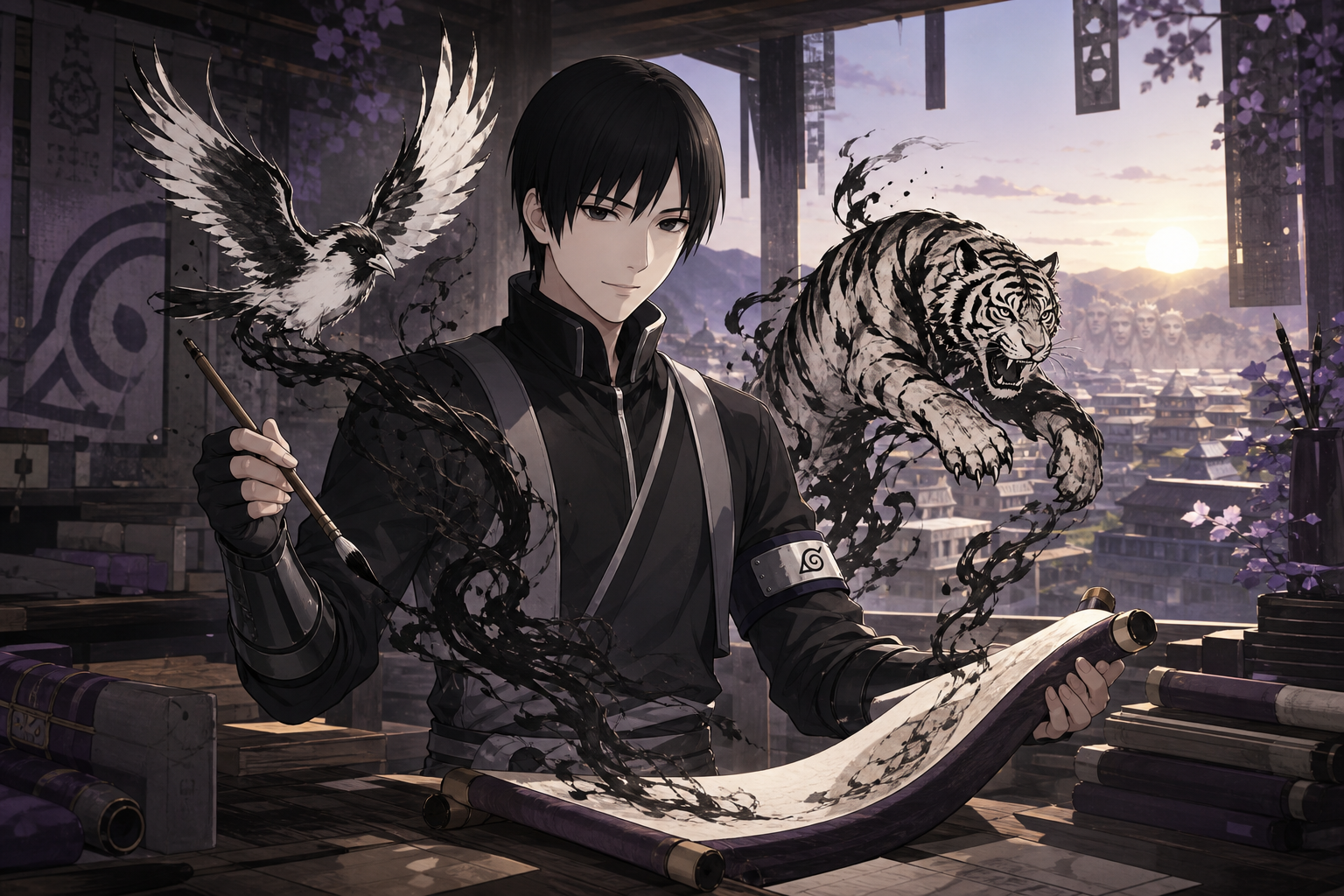
Naruto character dossier
Sai
Root trained him to erase his name, his grief and his attachments. Sai answers by becoming an artist whose drawings literally refuse to stay flat.
Sai is a name assigned after a self is removed
Sai enters Naruto Shippuden as the replacement member nobody requested. He takes Sasuke Uchiha‘s empty place beside Naruto Uzumaki and Sakura Haruno, smiles at the wrong moments and insults the team while pretending he is merely stating facts. The discomfort is deliberate. Sai has studied social behavior as information without being allowed to develop it through ordinary relationships.
“Sai” is a codename. The story never reveals the name he received at birth. That absence matters because Root strips recruits of personal history, emotional attachment and independent identity. A codename makes a child easier to deploy and easier to replace.
His pale skin, black hair, dark eyes and nearly monochrome clothing make him look like a figure waiting for ink. Early Sai wears a cropped black top and short gloves with a sword at his back. Adult Sai adopts more covered Konoha and intelligence-service clothing. The design changes from exposed Root instrument to established village officer without turning him visually loud.
The smile remains one of his most important tools. Early smiles imitate friendliness while hiding confusion or intent. Later smiles carry real affection. The face does not change much. The meaning changes because Sai gains enough relationship experience to place an honest feeling behind it.
Root calls damage readiness
Danzō Shimura builds Root as a covert Konoha program that prizes mission completion, secrecy and obedience beyond ordinary moral restraint. Children are trained to suppress emotion and attachment. The organization treats a human conscience as a security vulnerability.
Sai receives combat, infiltration, art, reconnaissance and assassination training. He also receives a cursed seal on his tongue that prevents him from speaking about Danzō and Root. The body itself becomes an enforced nondisclosure agreement. Silence is not professional discretion when speech triggers punishment.
Root’s ideology teaches that a shinobi should be empty. The lesson sounds like discipline because Naruto’s world already romanticizes self-sacrifice. Root removes the balancing obligations that might make service moral. The village owes the shinobi care. The commander owes the subordinate truth. Danzō demands duty while rejecting reciprocity.
Sai’s initial social cruelty grows from that environment. He evaluates bodies, weaknesses and reactions because those observations kept him alive. His insults are not harmless, but they are learned survival behavior rather than proof that he is naturally cold. Accountability still matters. Explanation gives the repair somewhere to begin.
Shin is the brother Root cannot erase
Sai grows close to another Root child named Shin. They are not biological brothers, but the bond becomes family. Shin encourages Sai’s art, and the two plan a picture book whose opposing pages will eventually meet in the center.
Root’s final training demands that paired recruits fight until one dies. The exercise makes attachment a weapon against the children who form it. Shin is already terminally ill and dies before Sai can complete the ordered killing, but the structure forces Sai to carry the grief as though the bond itself caused failure.
Sai suppresses the memory and cannot complete the center pages of the book. That blank spread is more honest than a speech. He has technical skill and narrative intention. Trauma stops the image where the brothers should meet.
During the Fourth Shinobi World War, a reanimated Shin confronts Sai. Seeing the completed book and Sai’s recovered attachment allows Shin’s soul to release the binding that controls him. The scene does not suggest friendship defeats every jutsu. The scene shows that the truth Root tried to erase remains strong enough to reach the dead.
Team 7 refuses his emotional script
Sai joins the reorganized Team Kakashi under Yamato while Kakashi Hatake recovers. Naruto and Sakura resent the substitution because Sasuke’s absence is an open wound. Sai responds by attacking Sasuke’s character and Naruto’s body. Nobody is operating at peak emotional maturity.
He uses library books and observation to study friendship. The method produces disastrous compliments and blunt insults because social connection cannot be mastered as a phrase list. Sai’s failures are funny, but the comedy has a developmental purpose. He keeps trying after embarrassment, which Root never trained him to do.
Naruto’s loyalty to Sasuke initially looks irrational to Sai. A mission-focused worldview cannot explain why someone would risk reputation, safety and time for a bond that offers no immediate reward. Sai gradually realizes that the refusal to abandon Sasuke is the same moral force Root trained out of him.
Sakura challenges him from another direction. She does not reward cruelty because it comes from ignorance. She also protects him once he starts acting as a teammate. Sai learns that boundaries and care can exist together. Affection is not the absence of correction.
Yamato monitors Sai’s secret assignment while giving him room to choose. That difference from Danzō is crucial. Both men are connected to Root and command covert missions. Yamato treats teammates as people capable of moral decision, not sealed tools.
The bridge mission gives Sai his first adult choice
Danzō secretly orders Sai to work around Tsunade’s command structure, contact Orochimaru and assassinate Sasuke. The public mission involves intelligence and the search for Sasuke. The concealed objective turns Sai into a political instrument inside his own team.
Sai initially cooperates with Orochimaru’s side long enough to advance the assignment. Naruto and Sakura interpret the movement as betrayal because they do not know the Root command. Sai has been trained to treat their lack of information as operational necessity.
Inside Orochimaru’s hideout, he confronts the difference between instructions and chosen purpose. Naruto’s attachment, Sakura’s grief and the unfinished picture book pull him toward a self Danzō cannot fully predict. Sai decides to help the team rather than execute the assassination order.
The choice does not arrive through a dramatic declaration about love. Sai acts, protects the book and begins naming the bond. That restraint suits him. Emotional recovery is often less cinematic than the moment that caused the damage.
When they finally encounter Sasuke, Sai sees the power and hostility surrounding Naruto’s goal. He does not become naïve about the danger. He begins understanding why the relationship matters while retaining the ability to judge Sasuke’s actions.
Learning friendship without becoming socially convenient
After the mission, Sai remains with Team 7 and continues practicing social connection. He gives nicknames based on perceived traits, studies reactions and gradually forms real bonds with Naruto, Sakura and the wider Konoha group.
The growth is uneven. He can still speak too bluntly or treat emotional situations as puzzles. A lesser story would make one friendship scene erase the conditioning. Naruto lets awkwardness persist long enough to feel like a skill under development.
Sai also recognizes Naruto’s self-destructive promise around Sasuke and later tries to explain the burden to Sakura. His intervention is imperfect, but the motive shows progress. The boy once assigned to kill Sasuke now worries about what the rescue promise is doing to Naruto.
During the Five Kage Summit crisis, Sai supports the effort to prevent the group from tearing itself apart. Root trained him to conceal information for control. Friendship pushes him to disclose painful information because secrecy has become harmful.
The war makes his art carry bodies and memory
Sai joins the Allied Shinobi Forces’ Surprise Attack Division. His ink birds provide aerial transport and reconnaissance. Drawn animals allow rapid movement without reducing him to a passenger on someone else’s summon.
He faces reanimated enemies, including Shin. Root’s old attempt to weaponize brotherhood returns as literal battlefield control. Sai’s emotional response does not make him less effective. Anger and grief drive a stronger technique while the completed book gives Shin release.
Sai uses the Sealing Technique: Tiger Vision Staring Bullet to capture reanimated targets. The enormous ink tiger turns art into restraint rather than simple destruction. Root taught him to erase people. Sai’s mature technique contains dangerous bodies while preserving the possibility of release.
He participates in the broader war against the Ten-Tails and the Infinite Tsukuyomi crisis. Sai does not receive the god-tier escalation of Naruto and Sasuke. His contribution remains reconnaissance, transport, sealing and team support. Utility is not narrative failure.
Abilities, mechanics and honest limits
Super Beast Imitating Drawing
Sai channels chakra through ink and brings painted animals to life. Birds support flight and scouting. Lions, snakes and other forms attack, bind or carry. Water and direct damage can disrupt ink constructs.
Ink clones
He creates copies from ink for deception and reconnaissance. The clones are useful information tools rather than durable replacements for his body.
Sealing tiger
The Tiger Vision Staring Bullet draws a large tiger that drags targets into a scroll for sealing. Preparation and a clear execution window limit the technique.
Calligraphy and drawing skill
Artistic precision is not decorative talent. Line quality, speed and imagination affect the combat toolset. Sai trained technique while emotional meaning lagged behind, then later reunited both.
Kenjutsu
He carries a short sword and has Root-level close combat training. The blade supports missions when scroll space or ink timing is poor. Sai is capable without being framed as an elite swordsman on Sasuke’s level.
Root infiltration
Sai excels at observation, concealment, coded missions and emotional masking. Those skills protect Konoha later while also carrying habits that can damage trust.
Flight and transport
Ink birds can carry Sai and allies over distance. Payload, weather, enemy fire and damage to the drawing constrain the advantage.
Emotional reading
Adult Sai becomes perceptive about coercion and hidden distress because he had to learn expression consciously. Insight improves. He does not become a magical lie detector.
Relationship atlas
Naruto Uzumaki
Naruto teaches Sai that a bond can remain valuable when the other person is absent, hostile or politically inconvenient. Sai later protects Naruto by questioning the cost of that loyalty. Friendship moves in both directions.
Sakura Haruno
Sakura refuses Sai’s insults and gradually accepts his genuine effort. Their teamwork shows that compassion does not require pretending harmful behavior is cute.
Sasuke Uchiha
Sai begins as Sasuke’s replacement and potential assassin. He later becomes a teammate who understands Naruto’s bond without needing to imitate it. Sasuke’s empty seat helps Sai confront his own missing brother.
Shin
Shin is chosen brother, artistic partner and the grief Root orders Sai to bury. Completing their book becomes Sai’s first clear recovery of a narrative that belongs to him rather than Danzō.
Danzō Shimura
Danzō trains Sai, names his mission identity and seals his speech. Sai’s eventual disobedience is not betrayal of a benevolent mentor. Sai’s journey becomes moral recovery from institutional abuse.
Yamato
Yamato understands Root’s methods and supervises Sai without reproducing Danzō’s total control. Their shared institutional history gives the new Team 7 a quiet layer of survivor knowledge.
Ino Yamanaka
Ino Yamanaka becomes Sai’s partner and later wife. Their relationship should not be reduced to a visual joke about Sasuke. Ino is skilled at mind techniques, emotional observation and communication. Sai is learning how to speak from a self Root tried to erase. The match has thematic logic.
Marriage, Inojin and a family built after Root
Sai and Ino marry during the era after the war. Sai becomes part of the Yamanaka family, and their son Inojin inherits ink art alongside clan mind techniques. The family joins two very different traditions of interior life.
The Yamanaka techniques enter minds directly and require strict trust. Sai comes from an institution that violated internal autonomy through conditioning and seals. Their household therefore sits at a meaningful intersection of consent, communication and inherited skill.
Sai’s parenting matters because Root tried to make brotherhood lethal and childhood disposable. Raising Inojin gives him a chance to teach discipline without emotional erasure. The sequel does not make him a perfect father. Perfection would be less honest than a man continuing to learn expression while remaining present.
Inojin’s art sometimes struggles when the emotional connection to drawing weakens. Sai can teach mechanics, but the child must find his own meaning. The lesson reverses Sai’s childhood: technique alone is no longer enough.
Adult Sai turns covert skill toward accountability
In the Boruto era, Sai works in Konoha’s intelligence and investigative structure. His Root background makes him valuable when the village confronts hidden organizations, conditioned children and threats that operate beneath normal mission channels.
He participates in investigations involving Root’s legacy and later security threats. The work risks repeating the old institution under a kinder name. Sai’s value lies in recognizing that efficiency cannot be the only measure. He knows what happens when secrecy becomes its own moral permission.
Sai also navigates family life with Ino and Inojin while maintaining village responsibilities. The domestic scenes are not filler beside “real” ninja work. Root denied him ordinary attachment. Cooking, arguing, teaching and returning home are evidence that the program failed to own his future.
The sequel sometimes uses adult Sai as a calm exposition officer. A complete profile should remember the history under that calm. Every sealed file he opens belongs to a man once physically prevented from speaking about his own organization.
Sai is Naruto’s argument against emotional illiteracy as strength
Shinobi culture praises control. Sai exposes the point where control becomes mutilation. Root does not teach him to regulate emotion. Root tries to remove the relationships that give emotion context.
A Confucian reading clarifies Danzō’s failure. Hierarchy creates duties in both directions. A subordinate owes service, but a leader owes moral example and care. Danzō takes obedience while refusing reciprocity. Sai’s disobedience restores a more ethical order than compliance would.
A Buddhist lens helps without turning numbness into enlightenment. Non-attachment is not the same as forced disconnection. Sai’s early emptiness is trauma, not spiritual achievement. Recovery comes when he can hold love and grief without letting either erase choice.
Art provides the creative answer. Root gives Sai drawing as a mission tool. Sai keeps drawing until technique becomes memory, communication, family inheritance and public service. The state teaches a weapon. The person makes a language.
His social mistakes also resist polished recovery narratives. Sai says the wrong thing, studies too hard and sometimes looks mechanical. Human connection is not proven by sounding naturally charming. Consistent effort counts.
Satoshi Hino and the original Japanese performance
Satoshi Hino is Sai’s original Japanese voice in the anime. The role must distinguish an imitated smile from emerging sincerity while keeping the same restrained character. Comedy, covert threat, confusion and grief sit close together. This profile names the verified performer and the narrative demands of the role. I will not invent claims about pitch, pauses or breath without a lawful scene-by-scene audio comparison.
The anime expands Sai’s social practice and adult family presence through additional scenes. Those additions can enrich characterization, but anime-original events should remain labeled when they establish details the manga does not.
Fandom arguments that need more ink
“Sai was a bad Sasuke replacement”
He is written to fail as a replacement because people are not interchangeable team slots. His real arc begins when he stops occupying Sasuke’s absence and becomes Sai.
“Sai has no emotions”
He has suppressed, inaccessible and poorly expressed emotions. The picture book, Shin, anger, loyalty and family make that record clear.
“His insults were harmless”
They hurt people. Root explains the skill gap without turning harm into charm. Sai improves because teammates set boundaries and he keeps learning.
“Ino chose him because he looks like Sasuke”
The visual resemblance begins as a joke. Their adult partnership has its own themes: mind, expression, family, observation and rebuilding after institutional harm.
“Adult Sai became boring”
Stability looks quiet after a childhood built around assassination tests. A spouse, child and ethical intelligence career are not the absence of story. They are the consequence Root tried to prevent.
Root trained compliance, not emptiness
Sai arrives performing the result Danzō wants: a shinobi who can carry an order without allowing grief, affection, or private loyalty to interfere. Other characters read the flat smile and social mistakes as proof that nothing is happening inside him. Root depends on that misunderstanding. Abuse works more smoothly when the survivor’s coping behavior gets mistaken for nature.
He has emotions before Team 7 meets him. The picture book, Shin’s memory, anger toward Danzō’s system, and the effort required to suppress attachment all prove it. A genuinely empty child would not need years of conditioning. Root keeps punishing the evidence that Sai cares until he learns to hide it from other people and eventually from himself.
That makes his recovery different from receiving feelings as a gift. Naruto and Sakura do not install humanity in him. They create conflict inside the training. Their loyalty contradicts Danzō’s rules. Their anger shows that relationships can survive discomfort. Sai begins testing whether the old consequences still apply.
A social mistake can hurt and still be part of learning
Sai’s insults are funny because he approaches conversation like somebody studying a manual that left out tone, context, and the fact that people remember what you call them. They still hurt. The comedy does not need Sakura or Naruto to absorb every remark without boundaries.
Team 7’s reactions teach him information Root denied: intimacy includes repair. A person can say the wrong thing, face anger, apologize badly, try again, and remain connected. In Root, mistakes threaten usefulness and attachment threatens survival. Among teammates, correction does not automatically mean expulsion.
The difference lets Sai develop responsibility without turning his history into an excuse. He did not choose the childhood that damaged his social judgment. He does choose whether to keep learning after somebody tells him the impact. The awkward progress is more believable than a single emotional breakthrough fixing everything.
The picture book is memory that refuses an order
Sai’s unfinished book preserves a relationship Root tried to convert into a lethal examination. The drawings hold a sequence he cannot safely explain aloud. Art stores the bond while official language demands that he treat Shin as an obstacle.
Finishing the central pages does not simply unlock one sad memory. It restores authorship. Danzō’s program assigned Sai a name, mission, emotional posture, and acceptable version of the past. Sai completes the image according to what the relationship meant to him. The institution loses control of the ending.
His ink techniques extend the same argument into combat. Images leave the page, move through the world, gather intelligence, restrain enemies, and carry people. Root wants art to be useful. Sai makes usefulness answer to imagination. A bird can serve a mission and still be a bird he chose to draw.
Replacing Sasuke is a job description, not an identity
Sai enters a team shaped by an absence. Naruto and Sakura do not want a neutral fourth member. They want Sasuke back. Every resemblance and every difference gets measured against somebody who is not in the room.
Danzō exploits that tension by placing Sai inside Team 7 with a private mission. The assignment treats the team’s grief as access. Sai initially sees their attachment as irrational because Root taught him that bonds weaken operational judgment. Then he watches Naruto pursue Sasuke past every reasonable limit and discovers that loyalty can be dangerous without being meaningless.
He never becomes Sasuke, and the team becomes healthier once nobody needs him to. Sai’s own contribution is observation, aerial reach, sealing, intelligence work, and the ability to recognize institutional manipulation from the inside. A replacement slot becomes a relationship because the person occupying it stops being interchangeable.
Family is not a prize for becoming normal
Sai’s marriage to Ino and life with Inojin should not be framed as proof that he finally passed a test of normal humanity. That reading gives society the same authority Root claimed: perform the approved emotional milestones and receive a valid identity.
The family matters because Sai participates in relationships Root trained him to fear. He communicates imperfectly, works inside Konoha’s intelligence structure with ethical memory of its abuses, supports a child developing his own art, and remains recognizably himself. Stability is not personality death. For a survivor raised to assassinate attachment, ordinary continuity can be radical.
Inojin’s drawing also creates a generational correction. Sai’s art once carried grief he could not name. His son grows up able to make images inside a family that knows his name, answers him, and expects him to return home. The technique remains useful. The child is not reduced to its usefulness.
The final verdict
Sai enters Team 7 as a blank page written by Danzō. He leaves Root with a book, a brother’s memory and the first choice that belongs to him. Every later bond adds language without pretending the original damage vanished.
His greatest technique is not the tiger, bird or ink clone. Sai learns to make a mark without asking permission from the institution that erased his name. Then he teaches his son to draw.
Sources and canon boundary
Manga chronology controls this profile, with Boruto-era family and intelligence work labeled as later continuity. Anime expansions, databook material, novels, games, and films are identified instead of being blended into one false record.
Primary franchise references: Naruto Official and VIZ Media Naruto. CVM Sekai’s conclusions about Sai’s Root conditioning, art, Shin, Team 7, social repair, Ino, Inojin, institutional abuse, and recovery are editorial analysis, not invented creator quotations.