
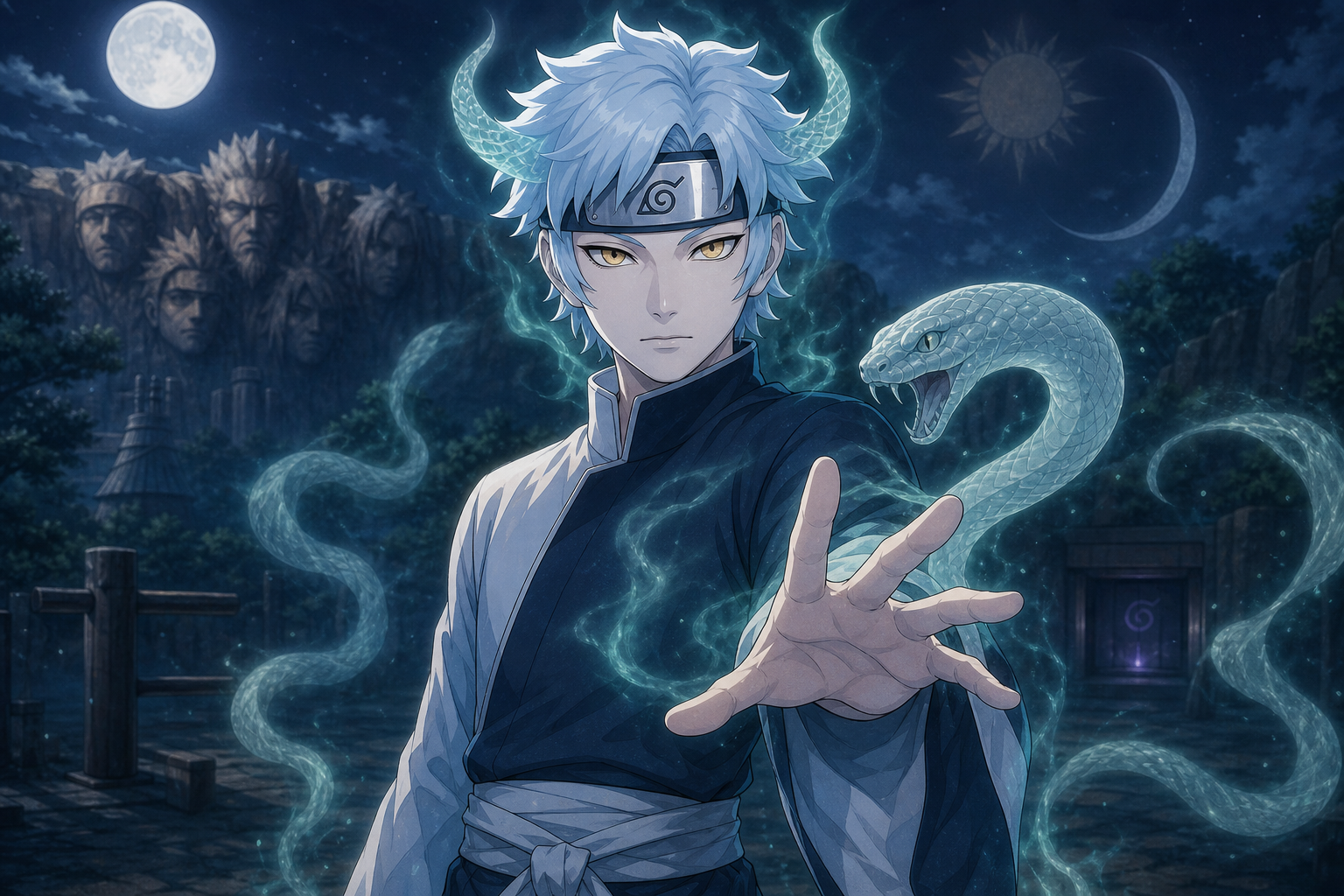
CVM SEKAI CHARACTER FILE
Mitsuki
A manufactured child raised to orbit someone else’s light, then forced to ask the question his creator tried to answer for him: who am I when I choose?
RaeRae’s bottom line: Mitsuki is not interesting because Orochimaru built a pretty genius with snake arms. Mitsuki is interesting because a child engineered for excellence still has to build a self. His “sun” language sounds romantic until you notice the danger. If another person gives your life permission to exist, what happens when memory, fear or authority swaps that person out?
THE SHINOBI FILE
Who Mitsuki actually is
Mitsuki is a genetically engineered clone created by Orochimaru. He enters Konohagakure as a student, graduates and joins a new Team 7 with Boruto Uzumaki and Sarada Uchiha under Konohamaru Sarutobi. His birthday is July 25. The official Naruto site lists scrambled eggs as his favorite food.
“Clone” is the biological fact, not a complete identity. Mitsuki is one of multiple attempts in Orochimaru’s program. Log, an older clone or artificial human from the same project, functions as his brother and as evidence that the experiment did not begin with the child readers meet. Orochimaru gives Mitsuki education, power and a carefully staged choice. That staging is the problem.
Mitsuki’s name can be read through the moon imagery that shapes his story. Orochimaru presents Boruto as a sun whose light will help Mitsuki find a path. The image sounds gentle. The parenting strategy underneath is not. A child is told that autonomy means selecting the answer his parent arranged in advance.
Appearance, body and the ethics of calling him “perfect”
Mitsuki has very pale skin, short blue-white hair and golden eyes. His early Konoha clothing uses cool blue and white layers with a broad sash, arm guards and a Leaf forehead protector. His design places him between laboratory sterility and village belonging. He looks clean, controlled and slightly unreal beside teammates whose emotions spill onto their faces.
His body stretches, bends and heals beyond ordinary human limits. Snake techniques can extend his limbs or emerge from his sleeves. Sage transformation adds a more uncanny silhouette. Those features do not make his body public property. The series repeatedly places engineered children in institutions that discuss their usefulness before their consent.
Calling Mitsuki a “perfect synthetic human” can describe Orochimaru’s ambition, but perfection is not a neutral compliment. Perfection means the creator chose the standard. Mitsuki’s growth begins when he stops treating usefulness, calmness and obedience as proof that he deserves to exist.
THE FULL CHRONOLOGY
The staged escape and Mitsuki’s first choice
In the manga side story commonly known as The Path Lit by the Full Moon, Mitsuki awakens without reliable memory. Orochimaru and Log place him inside a conflict designed to force a decision. Log appears to oppose Orochimaru, secrets about cloning surface and Mitsuki is pushed to reject both available authorities.
His anger and pressure awaken Sage Mode. Mitsuki takes the key or scroll both sides want and leaves to find the “sun” shown in Boruto’s photograph. Orochimaru celebrates because the child chose the intended path. That is manipulation wearing the costume of a test.
The scene still gives Mitsuki something real. A staged choice can produce genuine refusal. He rejects the immediate script, leaves the laboratory and enters a social world where other people can surprise him. Orochimaru cannot fully control what friendship will teach.
Academy entry and the secrecy surrounding his parentage
Mitsuki arrives in Konoha with skills far beyond a normal student and social instincts that feel studied rather than lived. Naruto Uzumaki and a small circle know his parentage. Boruto and Sarada do not. The village accepts a child created by one of its most infamous former enemies while keeping the information compartmentalized.
That decision protects Mitsuki from immediate stigma, but secrecy also denies his teammates informed context. Konoha wants to judge him by conduct, which is good. Konoha also monitors the risk attached to Orochimaru, which is understandable. The village never cleanly solves the tension between a child’s privacy and a security system built on concealed files.
The anime expands Mitsuki’s Academy life through the Ghost Incident, class relationships and early missions. Those episodes give him room to learn humor, embarrassment, curiosity and loyalty. They belong to the anime continuity layer and should not be backfilled into the manga as though every event appears there.
New Team 7: observation becomes participation
On Team 7, Mitsuki initially behaves like the person most willing to stand slightly outside the room and study everybody else. Boruto attracts him because Boruto is emotionally loud, morally impulsive and capable of choosing a direction without laboratory permission. Sarada attracts a different respect. She evaluates evidence, sets standards and expects Mitsuki to contribute rather than worship.
Mitsuki is not only the calm one. Calmness can conceal avoidance. He withholds information, makes unilateral calculations and sometimes treats his own safety as a disposable resource. Teamwork gradually teaches him that trust means allowing other people to factor his life into their decisions.
His loyalty to Boruto becomes explicit when he refuses a scientific-ninja-tool mission if Boruto will not go. The official birthday column calls that stance his basic policy. Sweet? Yes. Healthy as a permanent identity structure? Absolutely not. Friendship should shape a life, not replace one.
The anime’s Mitsuki Disappearance Arc
The anime builds a long defection storyline around Mitsuki leaving Konoha with the Fabrications connected to Kū and the Hidden Stone. He appears to betray the village, injures Boruto and lets his teammates chase a trail of conflicting evidence. The arc explores synthetic life through beings whose bodies and hearts are unstable.
Mitsuki’s conduct has consequences even when his intention is investigative or compassionate. He denies Boruto and Sarada informed choice, exposes them to danger and assumes he can carry the burden alone. The arc refuses a simple evil-clone answer, but sometimes stretches secrecy until the emotional logic wheezes.
Kū and the Fabrications show what Mitsuki might become if created life is valued only by function and survival time. Their desire for hearts does not make every act forgivable. Their existence does make Orochimaru’s controlled experiment look less isolated. The shinobi world keeps manufacturing people and acting shocked when manufactured people want ownership of themselves.
Kara, Kawaki and the Boro battle
When Team 7 pursues Kawaki and becomes entangled with Kara, Mitsuki’s scientific body knowledge stops being background flavor. Against Boro, the team is disabled by a virus hidden in dark mist. Mitsuki uses a snake to gather a sample, obtains blood and develops antibodies that let the team fight back.
Sarada analyzes the threat and leads the counterattack. Boruto and Kawaki create openings. Mitsuki supplies the biological solution. The victory belongs to shared intelligence, not to one child yelling a technique name louder. Sarada’s Chidori destroys Boro’s core because Mitsuki first makes survival possible.
The battle also places Mitsuki beside Boruto’s possession by Momoshiki. The “sun” he trusts contains a force that can take the body, voice and battlefield away from Boruto. Mitsuki’s attachment therefore carries a constant question: is he protecting Boruto, Boruto’s path or the feeling of meaning Boruto gives him?
Code, fear and the promise of violence
After Kawaki kills Boruto and Momoshiki restores him through Karma, Mitsuki and Sarada confront their own powerlessness. Mitsuki admits he does not know what he would do to someone who tried to kill Boruto. The statement is not cute possessiveness. The story is showing a calm child discover rage without a moral framework strong enough to hold it.
That matters because Mitsuki can become frightening very quickly. His body, venom, snakes and Sage Mode make emotional absolutism dangerous. The franchise often treats protective rage as proof of love. Mitsuki’s arc needs the harder question: does love protect the other person’s life, or does love authorize whatever the protector wants to do?
Omnipotence and the counterfeit sun
Eida’s Omnipotence rewrites collective memory so Kawaki occupies Boruto’s place. Mitsuki’s devotion moves with the remembered identity. He sees Kawaki as his sun and Boruto as the enemy who stole everything. The change is one of the clearest demonstrations that his dependency was attached to a role as much as to a person.
Three years later, Mitsuki sedates Kawaki with snake venom and confronts Boruto alone. He enters Sage Mode with killing intent. Boruto does not defeat the identity crisis by winning a larger explosion. He tells Mitsuki the uncomfortable truth: Kawaki no longer feels like the sun Mitsuki claims to need.
More importantly, Boruto says Mitsuki can shine on his own. Mitsuki cannot complete the attack. He later recognizes that without self-affirmation, he loses track of what matters before he notices the loss. That realization is the real Two Blue Vortex upgrade. A stronger technique would be easier. Building an internal source of worth is harder.
POWERS WITH RECEIPTS AND LIMITS
Sage Mode and Sage Transformation
Mitsuki can enter a powerful Sage Mode that draws on nature energy. The transformation brings a chakra aura, horn-like features and a dramatic increase in speed and power. Orochimaru recognizes the state as extraordinary and dangerous. Early Mitsuki uses the ability sparingly because his body may not safely sustain its full output.
The anime makes that physical cost explicit through medical consequences and Orochimaru’s intervention. Manga and anime presentation differ in detail, so a complete profile should not invent one universal usage schedule. The stable point is the limit: Sage Mode is not a free switch. Power can damage the engineered body carrying it.
Boruto’s Rasengan Uzuhiko uses planetary movement and is officially distinguished from the nature energy used by Naruto and Mitsuki in Sage Mode. That distinction matters. Similar cosmic language does not make the mechanics interchangeable.
Snake techniques, altered physiology and medical intelligence
Mitsuki extends limbs, forms snakes from his arms, restrains targets, tracks scents and delivers venom. His flexible body supports evasive movement and infiltration. He also uses Wind and Lightning Release, including snake-lightning combinations in expanded material.
His Boro work proves scientific intelligence is a battlefield power. Sampling blood, identifying antibodies and distributing protection are not support chores beneath “real” combat. They are the reason the team can remain conscious long enough to attack the core.
Regeneration and durability have limits. Mitsuki can be injured, exhausted and medically compromised. His usefulness as a specimen has also meant adults repair or study him in spaces where consent is murky. A power list that celebrates the body while ignoring who owns access to it misses half the story.
What Mitsuki cannot do
Mitsuki cannot safely solve every conflict with Sage Mode. He cannot use loyalty as a substitute for judgment. He cannot assume secrecy protects teammates from a burden they are already walking into. Omnipotence proves his memory and attachments can be redirected.
His calm face does not make him immune to manipulation. Orochimaru designs a choice around him. Konoha withholds context. Omnipotence rewires his certainty. Kawaki accepts devotion he has not earned. Mitsuki’s central skill gap is not combat. He needs an identity that can test the source of its own beliefs.
THE RELATIONSHIP ATLAS
Orochimaru: creator, parent and manipulator
Orochimaru calls Mitsuki a child and shows real investment in his survival. Orochimaru also creates the conditions of Mitsuki’s life, controls information and engineers the escape meant to feel autonomous. Parenthood and experimentation occupy the same relationship.
Orochimaru’s later tolerance looks different from the possession and replacement inflicted on earlier children, but “less monstrous than before” is not the same as ethically clean. Mitsuki is not evidence that Orochimaru’s crimes stopped mattering. Mitsuki is evidence that a creator can care and still manipulate.
Boruto Uzumaki: sun, friend and identity hazard
Boruto gives Mitsuki companionship and a model of unprogrammed choice. Mitsuki’s devotion helps Boruto, comforts him and sometimes sees through him. The same devotion becomes an identity hazard when Mitsuki treats Boruto as the external source of permission to live.
Two Blue Vortex begins correcting that imbalance. Boruto does not ask Mitsuki to resume worship. He tells him to shine independently and, if he still wants a sun, to choose with awareness. That is a better form of friendship than being needed as another person’s oxygen.
Sarada Uchiha: the teammate who expects an equal
Sarada respects Mitsuki’s intelligence and relies on his technical judgment. During the Boro battle, their observation and medical work fit together. She does not need him to orbit her. She needs him to report, reason and participate.
After Omnipotence, Sarada retains the true memory while Mitsuki does not. Their split turns old teamwork into painful evidence. Sarada cannot simply argue him back to reality, and Mitsuki’s rage endangers the people he once protected beside her.
Log, Kawaki, Konohamaru and Team 7
Log
An older clone and brother figure whose role in Mitsuki’s staged origin exposes the experiment’s repetition and the possibility of divergent selves.
Kawaki
Omnipotence places him inside the sun role. Mitsuki’s growing doubt reveals that memory can redirect attachment without perfectly recreating lived intimacy.
Konohamaru
Team leader and institutional guardian. His task is to treat Mitsuki as a child and shinobi, not an Orochimaru surveillance problem wearing a forehead protector.
Naruto
The Hokage who authorizes Mitsuki’s place in Konoha while managing the secret of his origin. Inclusion and surveillance coexist uneasily.
Chōchō
Anime friendship gives Mitsuki social contact outside the Boruto orbit and lets his deadpan humor meet someone unimpressed by mystery-boy theater.
Team 7
The first community where his choices create consequences for peers who can answer back, disagree and still stay.
WHY MITSUKI MATTERS
Created life is still life, not intellectual property
Mitsuki turns a science-fiction premise into a labor and family question. Who owns the body produced in a laboratory? Does technical authorship grant parental authority? Can a creator call a choice free when the available information and desired outcome were arranged?
The shinobi world has always converted bodies into infrastructure. Clans cultivate techniques. villages seal beasts into children. Root strips names from recruits. Orochimaru makes the logic literal by manufacturing a child. Mitsuki’s personhood pushes back against the system’s favorite lie that designed purpose equals destiny.
From a Buddhist lens, the fixed self Mitsuki seeks may never exist as a clean object hidden inside him. Identity emerges through causes, relationships and choices. That does not mean he is empty in the insulting sense. The absence of a permanent essence means Orochimaru cannot finish defining him at the moment of creation.
The sun and moon metaphor is beautiful and dangerous
Moonlight is reflected light. Mitsuki therefore imagines meaning as something received from another person. The metaphor gives his devotion poetry, but also gives dependency a halo. The story becomes richer when Boruto finally challenges the premise.
A Confucian reading finds tension between gratitude to one’s maker, loyalty to companions and cultivation of moral selfhood. Mitsuki can honor relationships without surrendering judgment. Proper reciprocity does not demand self-erasure. A parent, leader or friend who needs blind orbit has failed the relationship.
Two Blue Vortex moves him toward self-cultivation. “Affirm myself first” is not selfishness. Mitsuki needs enough internal ground to evaluate whom he loves and why. Otherwise the strongest emotion in the room can hand him a target.
Fandom arguments that flatten him
“Mitsuki is only Boruto’s simp.” The dependence is textual, but reducing the character to a joke erases the story’s critique of engineered purpose and borrowed identity.
“Orochimaru is a good parent now.” Care, pride and medical support are real. So are manipulation, secrecy and the staged origin test. Growth does not require amnesia.
“Sage Mode means Mitsuki should win every fight.” The state has bodily costs and narrative restrictions. Power ceilings are not character completion.
“Omnipotence proves his bond with Boruto was fake.” The false memory redirects the role, but lived dissonance remains strong enough for Boruto to reach him. The crack proves experience survives beneath imposed certainty.
“A clone has no real family.” Biology produced through engineering is still biology, and family is also built through care, accountability and chosen relation. Mitsuki’s problem is not lack of humanity. His problem is adults treating humanity as a feature they installed.
Japanese performance and adaptation boundaries
Ryūichi Kijima performs Mitsuki in the original Japanese anime. The verified credit belongs here. This edition does not invent pitch, breath or timing analysis without a scene-specific rewatch.
The manga supplies the core clone origin, Team 7, Kara, Boro, Omnipotence and Two Blue Vortex spine. The anime expands Academy life, friendships, missions, the Hidden Stone defection story, body-maintenance consequences and day-to-day humor. Those additions can deepen Mitsuki without becoming manga facts by repetition.
Games such as the Ultimate Ninja Storm line translate his snakes, lightning and Sage Mode into playable spectacle. Promotional move names and game balance should not be used as proof of manga mechanics.
CANON AND CURRENT STATUS
What is confirmed and what remains open
Confirmed core facts include Mitsuki’s Orochimaru-created clone origin, July 25 birthday, Team 7 membership, snake-based altered physiology, Sage Mode, devotion to Boruto, Boro antibody work, Omnipotence’s effect on his memory and his later doubt about Kawaki as his sun.
Anime-only or anime-expanded material must remain labeled, particularly Academy missions, the Mitsuki Disappearance Arc, several friendships and some medical consequences. The manga’s Two Blue Vortex storyline is ongoing. Mitsuki’s final independence, future allegiance, ultimate Sage Mode ceiling and end-state relationship with Boruto are not settled facts.
A complete profile should grow with published canon without mistaking a monthly cliffhanger for a final answer. Mitsuki’s next real milestone will not simply be a stronger snake. The boy needs to choose a life that does not require another person to authorize the light.
CHOICE UNDER DESIGN
A staged choice is still somebody else’s architecture
Orochimaru gives Mitsuki a test that appears to end in freedom. The child rejects the offered sides, takes the key, and chooses a name and direction. That agency matters. So does the fact that an adult designed the room, selected the information, arranged the conflict, and expected a particular awakening.
Mitsuki therefore begins independence inside a maze whose walls belong to his creator. He can make a real choice without the conditions becoming neutral. Children do this all the time in less dramatic forms: they build selves from options adults decided were available. Mitsuki’s problem is simply written in laboratory lighting.
Orochimaru can love the result and still have exercised terrifying control over the process. A parent’s pride does not cancel the experiment. A creator’s intention does not own every future decision the created person makes.
The sun metaphor can warm or burn
Boruto gives Mitsuki a point of orientation outside Orochimaru’s script. Friendship, admiration, and chosen loyalty help him imagine a life in Konoha. The danger begins when orientation becomes permission to exist. A sun that defines every moral direction can turn another person into a compass with no north of his own.
Omnipotence exposes the weakness in that arrangement. Mitsuki’s emotional certainty attaches to Kawaki because memory supplies a new identity for the person at the center. His devotion feels authentic while its object has been exchanged. The feeling is real. The conclusion built from it is wrong.
His confrontation with Boruto matters because doubt finally survives the emotional command. Mitsuki has to evaluate evidence, behavior, and his own response rather than treating intensity as proof. That is not betrayal of love. It is the beginning of love that does not require self-erasure.
Sage Mode is power his body can barely afford
Mitsuki’s Sage Mode visually announces what Orochimaru engineered: speed, perception, chakra force, and a transformation beyond what most young shinobi can approach. The body also pays. Restrictions and physical consequences keep the ability from becoming evidence that the experiment produced a flawless child.
Power designed into a person creates a cruel expectation. If Mitsuki can do something extraordinary, institutions and teammates may begin treating the ability as available whenever danger appears. His capacity becomes duty before he has settled what using it costs.
A complete profile should resist admiring the transformation more than the person surviving it. Mitsuki’s greatest development will not be proving Orochimaru built the strongest vessel. It will be choosing when power serves his values and when refusing use is also an act of selfhood.
Synthetic does not mean disposable or finished
The word artificial tempts people to ask whether Mitsuki is real enough. The better question is why biology would decide moral worth. He experiences attachment, fear, curiosity, jealousy, loyalty, pain, and doubt. Those experiences do not become simulations because a laboratory participated in his birth.
He is also unfinished in the ordinary human sense. Mitsuki changes when relationships contradict his assumptions. He can harm people, misread devotion, resist an order, and revise a judgment. A manufactured origin does not make every later action part of the manufacturer’s plan.
That is why the ongoing story needs room to remain ongoing. Mitsuki does not require a final label proving he became independent. He requires repeated choices that belong increasingly to him. The moon can keep reflecting light while deciding its own orbit.
RAERAE’S FINAL TAKE
Mitsuki does not need a better sun. He needs his own sky.
Orochimaru gives him a body, a name, a test and a destination. Boruto gives him warmth and friendship. Konoha gives him a village file and conditional belonging. None of them can give him a self that counts as chosen.
Mitsuki’s calmness has always made people underestimate the violence inside dependency. When his borrowed meaning is threatened, he is willing to poison, pursue and kill. Two Blue Vortex finally makes him look at that abyss without pretending loyalty makes the abyss noble.
The moon metaphor can stay. Let him reflect love, friendship and community. Just let Mitsuki learn that reflection is not emptiness, and that no sun gets to own the night.
Sources and continuity boundary
The Boruto manga and Boruto: Two Blue Vortex manga control the continuing chronology. Anime-original arcs, novels, games, films, and adaptation expansions are identified instead of being blended into one false record. Ongoing developments should be dated and revised when later chapters change the evidence.
Primary franchise references: Naruto Official and VIZ Media Boruto: Two Blue Vortex. CVM Sekai’s conclusions about Mitsuki’s synthetic origin, Orochimaru’s staged choices, Sage Mode, Boruto, Omnipotence, dependence, and self-authorship are editorial analysis, not invented creator quotations.