
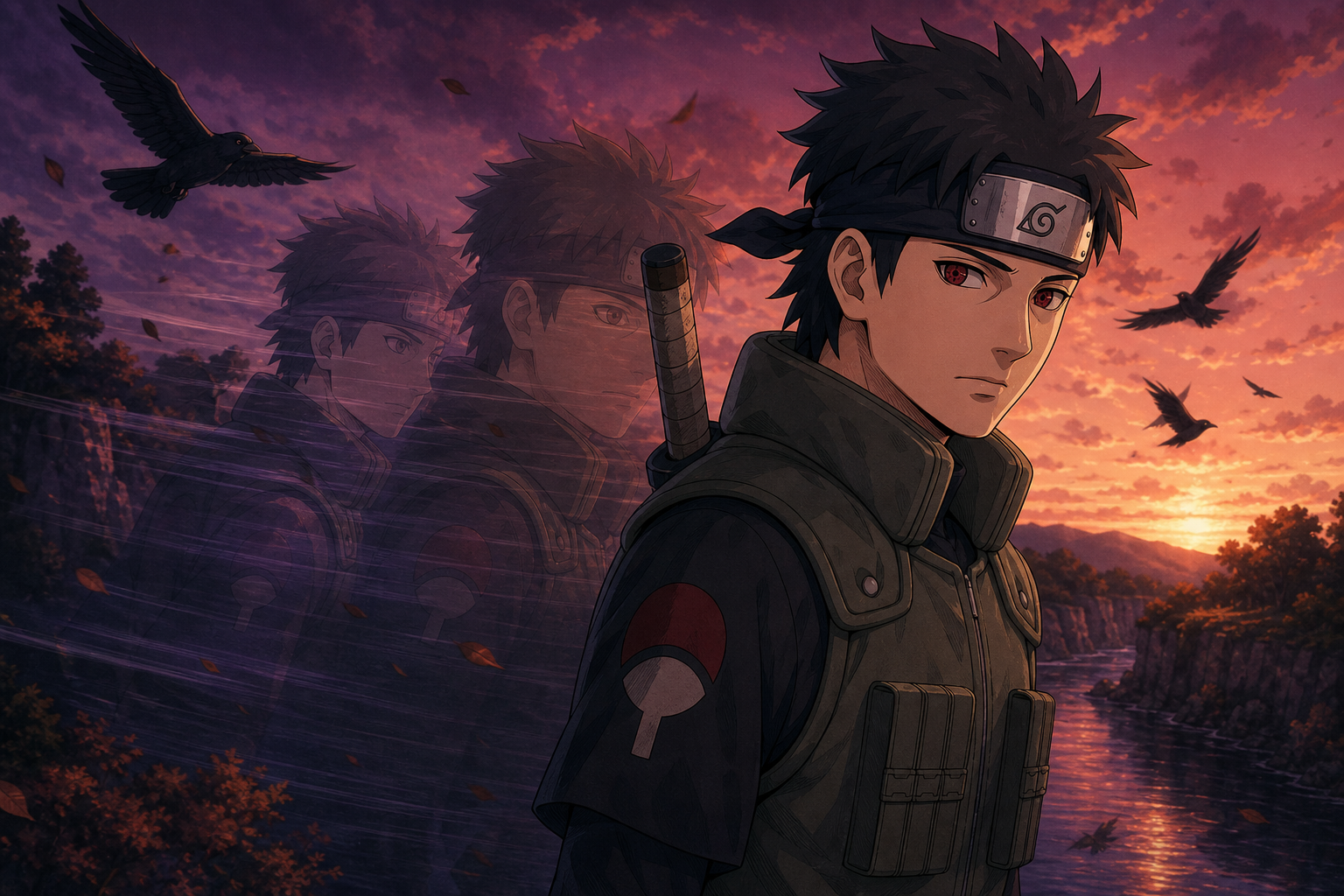
Shisui Uchiha
Bottom line
Shisui Uchiha is a gifted young shinobi asked to solve an adult political collapse with one invisible act of control. He loves his clan. He loves Konoha. He loves Itachi like a younger brother. When the Uchiha coup threatens civil war, Shisui offers Kotoamatsukami, a genjutsu capable of changing a person’s will without the target knowing anything changed. The plan could stop bloodshed. The plan also removes consent.
Both statements belong in the same paragraph. Danzō does not reject manipulation as immoral. He steals Shisui’s right eye and later uses that power on Mifune at the Five Kage Summit. Shisui gives his remaining eye to Itachi, asks him to protect both village and clan, then disappears into the Naka River. The young man is dead. The eye keeps working. Itachi places it in a crow. Naruto carries the crow without knowing. Years later, Kotoamatsukami frees reanimated Itachi from Kabuto‘s control and helps change the Fourth War.
Shisui barely lives on the manga page and still reaches across the whole franchise. That makes him important. That does not make every game move, fan theory and “strongest Uchiha” edit a receipt.
Fast facts and honest blanks
Shisui Uchiha is written うちはシスイ in Japanese. Official English franchise material calls him Shisui the Teleporter. The Japanese epithet Shunshin no Shisui is also rendered as Shisui of the Body Flicker. His birthday is October 19. Supplementary character data lists him at 180 centimeters, 68.9 kilograms and blood type A. He is associated with jōnin and ANBU service in the expanded official record. The accessible official material used here does not publish a definitive age at death. He is older than Itachi and functions as an older-brother friend, but the profile will not convert that relationship into a guessed number. No controlled mission total, Academy graduation age or chūnin promotion age appears in the evidence shelf used for this draft. Empty rows are allowed to remain empty.
His formal manga introduction is chapter 459, where Ao identifies Shisui’s chakra and explains the power connected to Danzō’s eye. Later chapters expand the friendship, eye transfer and death. Anime debut numbering requires a definition. Shisui is referenced or glimpsed before the anime fully dramatizes his life. Some indexes use an early summit-era appearance. Others use the later flashback where he becomes a complete speaking character. The final WordPress version should state which convention the episode field uses instead of pretending those records disagree about the same kind of debut. The manga provides a short posthumous biography. The Itachi Shinden novels and anime add much more. Each medium keeps its label.
Design: a face fandom keeps making older than the record
Shisui is a young man with short dark hair, large dark eyes and the Uchiha clan’s recognizable facial features. His hair rises in uneven spikes toward the back rather than falling in Itachi’s long framing lines. Shinobi clothing changes by medium and mission. Konoha gear, a forehead protector, flak protection and a tantō communicate his professional status in expanded visual material. The Uchiha crest ties clan identity to the body he puts in village service.
His Mangekyō Sharingan design becomes the image everybody remembers, but ordinary expressions matter more. Shisui is often calm, open and warm around Itachi. That makes the final crisis harder. Danzō does not steal an eye from a grim prophecy machine. He steals it from a person who still believes a relationship can carry trust. Fan art regularly ages Shisui into a thirty-year-old commander because confidence plus cheekbones apparently equals mortgage.
The record does not support that. He is a young operative working beside a much younger Itachi inside a political emergency built by elders. The eye loss and river scene should not become aesthetic decoration. Bloodless editorial art can communicate the character through intact eyes, speed, crows and the river without turning bodily violation into a cool poster. Kagami’s descendant, with a family tree that stops early. Later official character data connects Shisui to Kagami Uchiha, the Uchiha member of Tobirama’s wartime team. The exact parent-child chain between Kagami and Shisui is not fully supplied in the accessible record. “Descendant” does not automatically mean grandson, and a profile should not fill the missing generation because the family tree looks lonely. The connection still matters. Kagami serves beside Hiruzen and Danzō under Tobirama. Shisui later serves a Konoha government shaped by that same generation. Danzō steals his eye while claiming to defend the village Kagami helped protect.
The relationship turns the Uchiha crisis into inherited institutional history. The clan is not foreign to Konoha’s founding security structure. One of its loyal descendants becomes a resource consumed by that structure.
Itachi’s friend, brother and first political teacher
Official Naruto history describes Shisui and Itachi meeting young, training together and becoming best friends. Itachi looks to Shisui like an older brother. The relationship is affectionate and intellectual. Shisui helps shape Itachi’s belief that true shinobi do not seek glory and protect from the shadows. That lesson becomes central to Itachi’s life. That is also dangerous. Protecting from the shadows can mean doing necessary work without applause. Iruka protects Naruto without needing a monument. Scouts collect information. Guards stop threats nobody else sees. The phrase can also teach a child that invisibility makes any burden acceptable. Itachi eventually carries massacre, exile, illness, hatred and a plan for Sasuke without public truth. Shisui does not author every choice Itachi later makes. His ideal gives Itachi language for self-erasure. That is how mentorship works in Naruto. A beautiful lesson can grow into something the teacher never intended.
Shisui the Teleporter and the evidence behind the name
Shisui becomes famous for the Body Flicker Technique. Official birthday history says enemy shinobi fear the name and that Ao remembers his chakra from an earlier wartime encounter years later. The reputation is not invented by a character-select screen. Body Flicker uses chakra to create rapid movement that can appear like teleportation. Shisui’s mastery makes speed part of identity. The manga does not provide a complete tournament bracket of Shisui victories. Expanded anime and game material turns the reputation into visible afterimages, clone-like movement and extended combat.
Those scenes are useful when labeled. They do not prove every fan claim about being faster than Minato, untouchable by any contemporary or capable of defeating a clan by jogging through it. Reputation establishes exceptional movement. A missing full battle record establishes a boundary. The interesting creative choice is that the fastest man in the room cannot outrun politics. Shisui can cross physical distance. He cannot create enough time for village and clan to trust each other.
Kotoamatsukami changes a mind without leaving the bruise visible
Kotoamatsukami is Shisui’s defining Mangekyō Sharingan technique. Official Naruto material explains that the genjutsu can overwrite a person’s thoughts and intentions without the target realizing manipulation occurred. The new decision feels natural. That subtlety makes the technique terrifying. Ordinary coercion leaves resistance visible. A prisoner knows the door is locked. A person under Kotoamatsukami may defend the imposed desire as their own. Shisui proposes using the technique during the Uchiha crisis to stop the coup. His purpose is peace. The method removes political agency from the target. That does not make Shisui equivalent to Danzō. Intent, context and future conduct matter. Shisui plans a bounded intervention against imminent civil war and entrusts the plan to recognized leadership. Danzō steals the eye and uses it for personal political control. The difference is morally important.
So is the shared mechanism. Naruto is often about changing another person’s heart through recognition, argument, endurance and relationship. Kotoamatsukami creates the result without the encounter. The technique is peace with the other person’s participation edited out.
Clan loyalty and village loyalty become an impossible exam
The Uchiha clan plans a coup after years of distrust and political exclusion sharpened by suspicion following the Nine-Tails attack. Shisui and Itachi oppose the coup. That does not mean they hate the clan. They fear civil war, Konoha weakness and the possibility that other villages will exploit internal collapse. They also understand Uchiha grievance from inside. Shisui is therefore asked to be loyal in two directions that the adults have allowed to become enemies. Clan elders can call village cooperation betrayal. Village officials can call clan solidarity danger. Conflicted loyalty is not evidence of dishonesty. The institutions have failed to create a role where both duties can survive. Shisui responds by trying to change the coup leadership’s intent before violence begins. The proposal is desperate because the political imagination around him is already narrow. One secret technique must solve segregation, surveillance, clan pride, war fear and Danzō’s appetite for preemption.
No eye should be assigned that workload. Hiruzen receives a plan he cannot protect. Shisui brings his coup-prevention intent into Hiruzen’s orbit. Hiruzen favors a negotiated answer and trusts the young operatives trying to avoid war. The plan never reaches safe execution. Danzō acts against Shisui. Hiruzen’s preference for peace matters. That separates him from Danzō’s method. Preference is not protection. The Hokage cannot prevent a senior official from attacking the young shinobi central to the peace effort. The same institutional weakness later shapes the massacre. Shisui’s story therefore belongs in Hiruzen’s profile as evidence, not as a footnote. A leader can want the right outcome and fail because the machinery under him answers to another man. The tragedy is not simply that Danzō is bad. The tragedy is that Shisui operates inside a state where Danzō has the capacity to make his private judgment final.
Danzō steals the right eye
Official Naruto history is direct: Danzō takes Shisui’s right eye. He does not borrow it. Shisui does not volunteer it. The act is bodily theft. Danzō claims Shisui’s plan cannot be trusted and fears the power may be used against the village or him. He converts that fear into possession. The logic reveals the real rule. An Uchiha holding Kotoamatsukami is a security risk. Danzō holding Kotoamatsukami is security. The eye later appears in Danzō’s right socket. Ao recognizes Shisui’s chakra during the Five Kage Summit. The stolen organ becomes trace evidence. Shisui survives the initial theft long enough to act. How the confrontation unfolds differs by medium. That difference must stay visible.
Manga, novel and anime do not stage the same confrontation. The manga gives the essential facts through later testimony and flashback: Danzō takes the right eye, Shisui expects him to seek the left, and Shisui entrusts that remaining eye to Itachi before his death. The Itachi Shinden novels expand the attack. A Root-linked Aburame operative’s insects impair Shisui, helping Danzō take the eye. Details around pursuit, the note and Shisui’s final decisions receive prose context. The anime dramatizes its own confrontation, including genjutsu and Danzō’s use of Izanagi around the theft. Game material supplies another action-forward version.
These are not interchangeable camera angles on one fully fixed sequence. Each medium solves a production question. How does Danzō catch a shinobi famous for speed? How much action should the audience see? How much agency does Shisui retain after the ambush? The profile can compare answers. The profile cannot build a Frankenstein scene where novel poison, anime Izanagi and game choreography all happened in the same minute.
The remaining eye becomes an inheritance nobody can consent to later. Shisui gives his left eye to Itachi. He asks Itachi to protect Konoha and the Uchiha name. The trust is enormous. So is the burden. Shisui wants to keep the eye from Danzō and preserve the possibility that its power can serve peace. Itachi becomes the person expected to carry that intent while already trapped between clan and village.
This is love expressed through responsibility. That is also another young person passing an impossible job to a younger person because no adult institution is safe enough to receive it. Itachi hides the eye inside a crow. Years later, he places the crow in Naruto with a command intended to protect Konoha if Sasuke turns against the village. Naruto does not consent to carrying it because Naruto does not know. The chain keeps repeating the central problem. Good intentions travel through hidden control.
The river and a death that does not solve the crisis
Shisui falls into the Naka River after entrusting the eye and mission to Itachi. His death is commonly described as suicide intended to prevent further pursuit, conceal the eye’s transfer and influence the clan crisis. Novel and anime treatments add different details around the final note and physical condition. No version should be made beautiful for atmosphere. A young man loses an eye to a state elder, concludes his remaining body and information may endanger his friend or accelerate conflict, and removes himself from the board.
The coup does not disappear. Danzō does not stop. Itachi receives more burden. The clan suspects Itachi in Shisui’s death, increasing internal hostility. Self-erasure fails as political repair because the structure producing the crisis remains alive. The river carries Shisui away. That does not carry the problem away. Itachi’s Mangekyō awakens and grief becomes capability. Shisui’s death awakens Itachi’s Mangekyō Sharingan. Naruto repeatedly binds ocular power to unbearable loss. The result can look like reward if the reader only studies the ability chart.
That is not a reward. Itachi receives new power alongside grief, suspicion and the last request of the person he trusted most. That power later helps him carry out the massacre, join Akatsuki, control his public image and shape Sasuke’s life through trauma. Shisui did not ask for all of those decisions. His death becomes part of the emotional machinery that makes them possible. This is why the older-brother relationship needs more than a wholesome friendship card. Shisui teaches Itachi how to protect invisibly. His death turns that lesson into a command Itachi takes far beyond any healthy limit. Ao remembers what Danzō hoped nobody could identify. Ao of Kirigakure encountered Shisui’s chakra during wartime. Years later, at the Five Kage Summit, Ao uses the Byakugan and recognizes that chakra in Danzō’s right eye. Memory defeats secrecy.
Danzō has changed the body’s owner, hidden the eye under bandages and carried it into international politics. Ao’s sensory experience connects the stolen organ back to the person. That act matters beyond plot exposition. Shisui is dead and cannot testify. His chakra can. The summit learns Danzō manipulated Mifune. The official presenting himself as Konoha’s necessary realist is exposed through evidence taken from the victim he tried to convert into anonymous equipment.
The stolen eye refuses to become provenance-free. Wartime reputation is real, but the battle ledger is incomplete. Ao does not remember Shisui because somebody handed him a character guide. He remembers encountering Shisui’s chakra during conflict with Konoha. Official birthday history calls Shisui formidable enough that the sensory signature remains recognizable more than a decade later. That is strong evidence of professional reputation. Expanded anime material supplies a pursuit involving Kirigakure forces and a team associated with Shisui. Novel and game material add further combat context. Each version helps audiences imagine how the epithet became feared. The main manga does not give a complete service record, opponent list or mission total. That gap matters because Shisui’s power discourse often starts with a confirmed reputation and ends with a fictional résumé. “Ao remembered him” becomes “he defeated every Mist unit.” “Body Flicker specialist” becomes “nobody alive could touch him.” “Mangekyō user” becomes “all Mangekyō abilities shown in games happened in manga.” No.
Shisui is elite without the inflation. He serves Konoha at high level, earns a battlefield name, possesses rare ocular power and gains the confidence of Hiruzen and Itachi. A factual profile can say all of that while refusing to invent the missing box scores. The incomplete record also serves the story. Shisui enters as memory rather than celebrity biography. Other people carry fragments because the institutions surrounding his death cannot tolerate a clean public account.
Danzō uses Shisui’s peace technique for political control. Danzō employs Kotoamatsukami on Mifune so the neutral summit leader will favor his command of the proposed shinobi alliance. This scene answers the moral question surrounding the technique. Shisui’s plan aims to prevent a coup and civil war. Danzō’s use aims to obtain political leadership. The same invisible mechanism serves different purposes. Intent changes our judgment of the users. The mechanism remains coercive. Mifune experiences his judgment as his own until Ao reveals interference. Danzō does not persuade the Kage that he should lead. He tries to manufacture the appearance that neutral authority selected him.
Shisui hoped one imposed change could reopen peace. Danzō uses imposed change to close debate. Naruto carries the crow without knowing. Before dying, Itachi places the crow containing Shisui’s left eye inside Naruto. The command is designed to respond to Itachi’s eyes and compel protection of Konoha. Itachi expects Sasuke may receive his eyes and turn against the village. Naruto becomes storage for another hidden plan. Again. He already carries Kurama because adults made a wartime choice at his birth. He now carries Shisui’s eye because Itachi makes a contingency choice during conflict. Both choices aim to protect people. Neither asks Naruto.
The difference is scale and circumstance, not the disappearance of consent. Naruto’s body keeps becoming the place older shinobi put futures they cannot secure openly. The crow later emerges during the war. The plan does not activate as Itachi expected. That failure becomes rescue. The contingency also reveals Itachi’s inheritance from Shisui. Both men reach for hidden genjutsu when relationship feels too uncertain. Shisui plans to alter coup leadership. Itachi plans to alter Sasuke if Sasuke chooses vengeance against Konoha. They trust the desired outcome more than the target’s future judgment. Naruto offers the franchise’s alternative. He intends to face Sasuke, hear him, fight him if necessary and remain present for the answer. That route is slower, painful and dangerous. The other person remains a person. The crow plan is efficient. Naruto’s promise is relational.
The war activates the efficient plan in an unexpected direction, but accident does not settle the moral argument. Kotoamatsukami frees reanimated Itachi. Kabuto controls reanimated Itachi through Edo Tensei. When the crow responds, Kotoamatsukami overwrites the control with the command to protect Konoha. Official anime anniversary history confirms the genjutsu frees Itachi from Kabuto’s hold. The result helps change the war. Itachi can act independently, confront Kabuto and work toward ending Edo Tensei.
Shisui’s eye finally performs a liberation. That does not make the technique noncoercive. One command replaces another. The ethical difference lies in what the replacement enables. Kabuto uses a dead body as a remote weapon. Shisui’s stored command restores enough agency for Itachi to choose actions inside a protective direction. Naruto loves this kind of irony. A technique designed to alter will becomes the tool that returns a controlled person to himself. Shisui never sees the outcome. His influence reaches a war fought by people carrying decisions he made years earlier.
Complete ability and limit shelf
Shisui possesses the Sharingan and awakens the Mangekyō Sharingan. Kotoamatsukami is the clearest confirmed signature technique. The manga explains a long reuse interval around the eye in Itachi’s crow while Hashirama-cell enhancement affects Danzō’s access. Fandom often assigns perfectly separate rules to the left and right eyes. The record does not justify every confident chart. Body Flicker establishes exceptional movement and his epithet. Expanded anime and game scenes visualize afterimages and high-speed multi-angle attacks. Those mechanics need medium labels. Supplementary data associates Shisui with Fire, Wind, Lightning and Yin Release. The manga does not stage a complete elemental catalog.
Fire Release: Great Fireball and various genjutsu or crow techniques appear in novel, anime or game presentations. The medium belongs beside the move. Shisui carries a tantō in expanded visual material and demonstrates professional weapon skill. The green Susanoo strongly associated with him comes from game-original material such as Ultimate Ninja Storm Revolution and related franchise presentation. The manga does not show Shisui using Susanoo. That does not make the design worthless. That makes it game continuity.
His central limits are political and bodily. Kotoamatsukami cannot create legitimate consent. Cooldown restricts reuse. Danzō can ambush or disable him depending on the medium. Losing the right eye cuts his options. Death ends direct agency even though the eye survives.
Relationship and accountability atlas
Itachi Uchiha. Itachi is best friend, younger-brother figure and chosen heir. Shisui gives him love, philosophy, the remaining eye and a burden no young person should carry alone. Danzō Shimura. Danzō is eye thief and the official who turns Shisui’s civic trust into evidence that trust was unsafe. He does not merely defeat Shisui. He destroys the proposed intervention and later uses its power for himself.
Hiruzen Sarutobi. Hiruzen represents the legitimate peace-seeking authority Shisui approaches. His inability to protect Shisui reveals the gap between benevolent intent and command over covert power. Fugaku and the Uchiha leadership. They are the political target of Shisui’s planned genjutsu. Their coup plan risks civil war. Their grievance still cannot be reduced to irrational clan anger. Ao. Ao is wartime opponent and posthumous witness. His sensory memory gives Shisui’s stolen body a name in public. Naruto Uzumaki. Naruto carries the crow unknowingly. Shisui’s power later passes through him to free Itachi. Their relationship is posthumous and bodily rather than personal.
Sasuke Uchiha. Sasuke inherits the consequences. Shisui’s death awakens Itachi’s Mangekyō, deepens clan suspicion and becomes part of the hidden history Sasuke eventually uncovers. Kagami Uchiha. Kagami is an ancestor tied to Tobirama’s team. The connection links Shisui’s loyalty to an older Uchiha tradition of village service without supplying a complete family tree. Hidenobu Kiuchi and the Japanese performance boundary. Hidenobu Kiuchi performs adult Shisui in the original Japanese anime record. Kengo Kawanishi is associated with younger Shisui in later adaptation material. Those credits must be confirmed against the exact episodes used in the final post.
This profile does not invent observations about softness, speed, breath or grief without a controlled Japanese-audio rewatch. The role requires a difficult balance. Shisui must feel warm enough for Itachi’s trust, skilled enough for the reputation and pressured enough that the final decision does not read as random plot delivery. Episode Reacts can later examine how performance and direction build those transitions with scene receipts. The suicide note and the missing body. Shisui’s death produces immediate suspicion inside the clan.
The body is not recovered. A note presents the death as self-inflicted in versions of the record. Itachi becomes a target of accusation because he was close to Shisui and because the clan’s trust is already collapsing. The novels add handling around the note and Itachi’s role. The anime stages the river encounter with its own emotional rhythm. The manga supplies the essential later account without reproducing every procedural detail.
Those distinctions matter because the note is political evidence. If the clan knows a village elder stole Shisui’s eye, the coup could accelerate. If Danzō knows where the remaining eye went, Itachi becomes an immediate target. If Shisui simply vanishes, suspicion searches for a body and an author. Erasing the body protects one secret and creates several others. The plan asks Itachi to carry them. This is another reason not to romanticize the river. Shisui’s death does not produce peaceful closure. That produces contested evidence, grief and a younger friend forced to perform anger while hiding the last eye. The absence of a corpse becomes part of the clan’s fracture.
Peace, legitimacy and the person whose mind gets edited
Kotoamatsukami invites an uncomfortable hypothetical. If one invisible command prevents hundreds or thousands of deaths, does the target’s consent outweigh the lives saved? Naruto does not provide a clean policy answer. The coup is imminent. Danzō acts before Shisui can try. The massacre then destroys the people Shisui hoped to save. RaeRae’s answer is that urgency can explain coercion without making coercion legitimate.
A leader whose will is secretly altered cannot give the clan a trustworthy new direction because nobody can examine how the decision changed. If the genjutsu is exposed, every peaceful statement becomes suspect. If the technique wears off or cannot solve the surrounding conditions, resentment remains. The plan concentrates peace in one eye instead of building political structures capable of surviving disagreement. That criticism does not blame Shisui for lacking a perfect constitutional reform package while his elders race toward bloodshed. He is a young operative using the tool he has inside the time he is given. The blame belongs upward too. Hiruzen, Danzō, the council and clan leadership allow the crisis to reach a point where a teenager’s secret mind control appears to be the best remaining peace process.
Shisui’s plan is morally compromised because the situation is morally compromised. That is more interesting than calling him either saint or manipulator. The manga gives a shadow and the industry builds an icon. Manga Shisui is sparse. He appears through memory, testimony, an eye, a crow and consequences. The novels and anime supply childhood, missions, conversations and action. Games supply a complete combat fantasy, including Susanoo spectacle.
That expansion is not automatically bad. A franchise recognizes strong demand around Itachi’s most important friend and turns absence into content. Fans receive a face, moveset and more time inside the Uchiha crisis. The problem begins when market familiarity becomes canon certainty. A game animation can feel more real than a brief manga panel because players repeat it for hours. A later anime flashback can become the scene everybody remembers. Memory does not erase medium.
Shisui is therefore a perfect test for fandom literacy. Love all the versions. Label them. Eye, crow, river and Body Flicker symbolism. The eye represents perception and control. Shisui wants to use sight to change political intent. Danzō turns sight into stolen authority. Ao uses sight to expose the theft. The crow carries memory. That moves between Shisui, Itachi and Naruto, holding a command longer than any of the original plan’s political actors remain stable. The river represents disappearance without resolution. Shisui removes his body, but the eye, suspicion and crisis continue downstream.
Body Flicker represents speed without escape. Shisui can move faster than ordinary perception and still cannot outrun inherited politics. These are RaeRae readings, not a claim that Kishimoto supplied a symbolism worksheet. The images recur because they organize consequence. The body vanishes. The organ travels. The friend remembers. The state tries to rename possession. Confucian loyalty and a role system that gives no clean answer. This is an interpretive lens.
Confucian ethics place weight on relationship roles and reciprocal duty. Child, elder, friend, clan member, subject and official each carry obligations. Shisui is clan member and village shinobi. Itachi is friend and junior. Hiruzen is leader. Danzō is elder official. The roles should support each other. They do not. Clan duty demands solidarity. Village duty demands prevention of coup. Friendship demands protection of Itachi. Elder authority should protect the younger operative. Instead, the elder steals his body. Shisui responds by concentrating responsibility in himself. If his eye changes leadership, every role might realign. That hope reveals the failure above him. A young operative should not need supernatural mind control to make elders perform their roles. Buddhist self-erasure and the attachment inside sacrifice. This is also a RaeRae reading.
Shisui lets go of body, eye, reputation and future. The sacrifice can look like freedom from attachment. His final request remains deeply attached to outcome. Protect village. Protect Uchiha name. Carry the eye. Prevent Danzō from taking it. That attachment is human. The problem is believing disappearance can control what follows. Itachi interprets the burden through his own fear and love. Danzō keeps operating. Clan suspicion grows. The massacre occurs. Self-erasure does not remove the self from consequence. That removes the person’s ability to revise the plan. Naruto repeatedly moves toward another answer: remain present, speak, listen and let other people participate in change. Shisui dies before the story can offer him that route.
Fandom court
“Shisui was the strongest Uchiha”. He has elite reputation, Body Flicker mastery and one of the franchise’s most dangerous genjutsu. The manga does not provide the complete battle record needed to rank him above every Uchiha across history. “Danzō beating him proves he was weak”. The confrontation differs by medium and involves surprise, body theft and, in the novel, impairment through Root tactics. Losing an ambush is not a complete power scale.
“Kotoamatsukami would have solved everything”. That might have stopped or delayed the coup. That would not automatically remove segregation, distrust, Danzō or the political causes beneath the plan. “Shisui was a perfect pacifist”. He seeks peace and plans nonconsensual mind manipulation. Compassion and coercion coexist.
“His Susanoo is manga canon”. The famous green Susanoo is game-original franchise material. Enjoy it. Label it. “He gave both eyes away”. Danzō steals the right eye. Shisui entrusts the left to Itachi. Consent distinguishes those events. “His death saved the clan’s honor”. The massacre still occurs. His death shapes Itachi and protects the remaining eye from Danzō, but no clean political rescue follows.
Consequence ledger
Shisui influences Itachi’s philosophy and Mangekyō awakening. His eye theft exposes Danzō’s method. His death increases clan suspicion. His remaining eye enters a crow. The crow enters Naruto. Danzō uses the stolen right eye on Mifune. Ao reveals the chakra. The left eye frees reanimated Itachi. Itachi helps end Edo Tensei. The chain is extraordinary because Shisui is absent for nearly all of it. That absence is not evidence of unlimited hidden power. That is evidence that one person’s choices, body and relationships can remain active inside other people’s decisions.
Shisui’s story is a franchise-scale lesson in posthumous agency. He cannot control the eye after death. Each carrier changes its meaning. Danzō turns it into political coercion. Itachi turns it into a contingency. Naruto becomes the container. The war turns it into liberation from another control system.
Final verdict
Shisui Uchiha wants to save everyone. The adults around him have created a crisis where saving everyone appears to require secretly changing somebody’s mind. That is the heartbreak. He is compassionate, loyal and extraordinarily capable. His peace plan still crosses consent. Danzō’s theft does not prove the plan was wrong and Danzō right. That proves a coercive tool cannot be made safe by trusting an institution that refuses accountability.
Shisui gives Itachi his remaining eye and a final request. The gift protects power from Danzō. The request helps bury Itachi under responsibility. Then the river takes Shisui out of the story while everything he touched keeps moving. The eye reaches Danzō’s summit. The crow reaches Naruto. The command reaches reanimated Itachi. The consequence reaches a war. Shisui is not important because a game gave him a gorgeous green giant. He is important because Naruto uses one stolen eye to ask whether peace counts when the person being changed never gets to say yes.
Sources and canon boundary
Manga chronology controls this profile. Anime staging, databook material, novels, films, games, and later franchise appearances are labeled instead of being blended into one false continuity.
Primary franchise references: Naruto Official and VIZ Media Naruto. CVM Sekai’s conclusions about Itachi, Kotoamatsukami, Danzō’s eye theft, the Uchiha coup, consent, death, the crow, war legacy, and adaptation boundaries are editorial analysis, not invented creator quotations.