
Pryrates
He does not seize the throne. He makes himself indispensable to the frightened man sitting on it, edits consent out of every room, and invoices the apocalypse for research access.
Profile
The scariest man in the room is rarely the one shouting. It is the one deciding which choices everybody else is allowed to notice.
Pryrates is King Elias’s priest, sorcerer, adviser, supplier of soothing drinks, keeper of Hjeldin’s Tower, jailer of Prince Josua, murderer of Doctor Morgenes, and the human negotiator who opens Osten Ard to Ineluki’s return. He is alive at the end of The Dragonbone Chair, publicly protected by the crown, privately feared by nearly everyone near it, and already operating beyond the bargain Elias thinks he made.
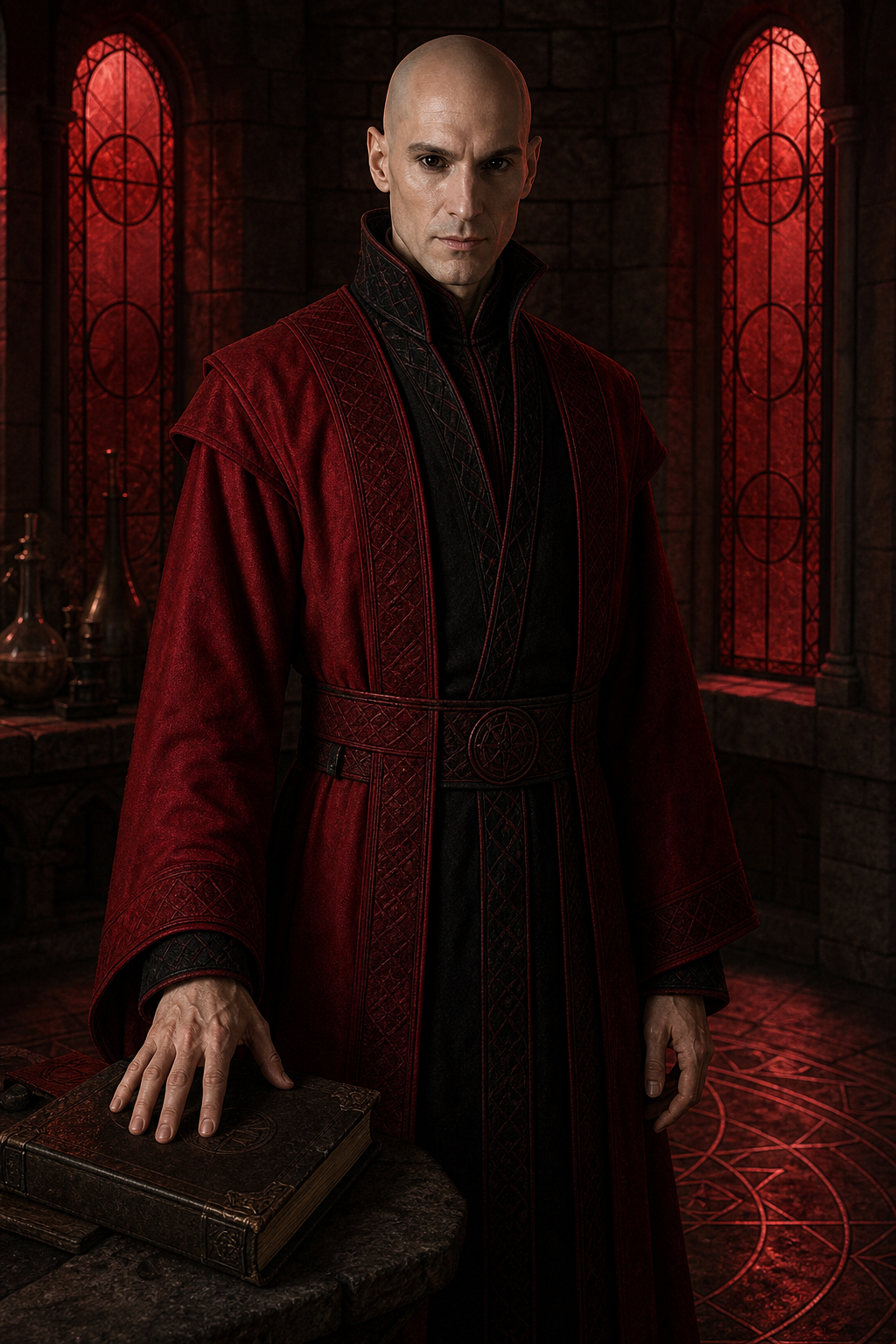
Book 1 marks him instantly: a hairless head, smooth face, black eyes, and scarlet robes. The visual grammar is clean enough to feel ceremonial and wrong enough to make Simon’s instincts start screaming before the plot explains why. Pryrates does not need antlers, corpse skin, or villain smoke. He is a human being whose disciplined appearance makes cruelty look like administration.
His intelligence is not the flattering kind. It has no ethical floor. He studies language, ritual, history, medicine, dream, death, and the hidden structure of the world as permission to take it apart. Where Morgenes treats knowledge as a dangerous inheritance requiring judgment, Pryrates treats any boundary as proof that somebody has hidden a more interesting door behind it.
The Dragonbone Chair · Verified chronology
A puppy, a tower, a chained prince, a dead doctor, a black coffin, and one king learning much too late that “ally” did not mean “servant”
Simon meets the new reign at boot level
Pryrates enters Simon’s world before the boy can name the political machinery around him. A puppy crosses his path. He crushes it beneath his boot and smiles slowly at the horrified scullion. The act is small beside later murders, which is exactly why it matters. There is no strategic excuse, no war, no ritual necessity, no rival power. There is only something vulnerable, a man with power over it, and pleasure.
The scene establishes that later atrocities are not the unfortunate costs of Pryrates’s larger plan. The plan attracts him because it expands the number of living things he can convert into tools. Simon’s revulsion is not childish oversensitivity. It is accurate moral perception arriving before institutional proof.
Elias gives him a workplace; Pryrates turns architecture into jurisdiction
The priest receives the infamous tower and makes its upper chamber a laboratory, ritual room, interrogation space, prison, and protected state within the state. The chamber’s geometry and red windows are not spooky wallpaper. Space, timing, knowledge, and secrecy have been engineered into a machine that permits him to work beyond ordinary court scrutiny.
Morgenes recognizes the danger. Pryrates answers concern with intimidation, including captured birds and the casual display of what he can do to small bodies. Their conflict is not “two wizards disagree.” It is a custody fight over knowledge: whether understanding the world creates responsibility toward it or merely gives the cleverest person better instruments.
The first invasion is intimate enough to be mistaken for thought
Pryrates presses into Simon’s mind without moving his lips, using compulsion so smoothly that the boy can barely distinguish command from his own intention. A gray cat interrupts the encounter. That interruption matters because coercion works best when nobody can prove an outside force entered the room.
Simon later carries fear of the priest through tunnels, dreams, hiding places, and flight. Pryrates’s interest in him does not arise from affection or even ordinary suspicion. Simon has seen too much around Morgenes, Josua, and the tower. To Pryrates, a child with knowledge is not a person to persuade. He is an unsecured container.
The king’s brother becomes ritual inventory
Pryrates keeps Prince Josua drugged, chained, and concealed behind a hidden door. The detention serves court politics, but Stoning Night reveals a deeper purpose. The prisoner has been promised in a covenant that Elias does not fully understand. Josua’s royal body is both obstacle and payment.
This is where “adviser” stops being even a useful disguise. Pryrates controls what Elias knows, what Josua can perceive, who can enter the tower, and what the promised sacrifice means. He does not merely execute the king’s will. He creates the information environment in which royal consent becomes a rubber stamp attached to facts withheld until refusal is nearly impossible.
The scholar dies because he refuses to let knowledge become a delivery system
When Elias’s men and Pryrates come for Simon and Morgenes, the doctor fights to buy the boy time. Pryrates’s assault kills him and destroys the refuge Simon believed education had created. The tower collapses, but the priest survives. Simon escapes with mourning, fragments of instruction, and proof that learning cannot remain politically innocent once power decides it is dangerous.
Morgenes’s death also exposes Pryrates’s limit. He can kill the custodian without controlling the inheritance. Simon carries names, warnings, relationships, and questions out of the Hayholt. The sorcerer wins the room and still fails to close the story.
The black coffin opens, Sorrow rises, and the contract reveals who has been negotiating above the king’s pay grade
At the Anger Stones, Pryrates brings Elias into the ritual while Norns and Ingen Jegger stand inside a covenant already wider than the king understands. Josua is the promised sacrifice. When Josua is no longer available, Breyugar becomes the substitute and Pryrates kills him with a sickle. Human life is interchangeable because the transaction, not the person, is sacred to him.
The coffin opens. Jingizu—Sorrow—enters Elias’s hand and the Storm King’s design. Pryrates forces the moment forward by controlling disclosure: enough truth to keep Elias participating, never enough for meaningful refusal. The king still chooses. That distinction must remain. Manipulation explains the trap; it does not erase Elias’s responsibility for stepping into it.
The realm thinks it has a royal sorcerer. It has a domestic access point for an ancient war.
Pryrates maintains contact with Norns, works through Ingen Jegger, manages Elias’s physical and mental deterioration, and turns political violence into cover for a nonhuman campaign. He knows more about the pact’s architecture than the king he supposedly serves. The priest’s confidence comes from being useful to forces that regard ordinary kingdoms as temporary scenery.
By Naglimund’s fall, every system Pryrates touched has become harder to separate: crown, dream, sword, Norn alliance, military campaign, ritual, and personal dependency. Book 1 ends without punishing him. That is the point. Evil this organized does not wait in a boss chamber. It gets a title, rooms, guards, a budget, and somebody powerful insisting the arrangement remains under control.
Power analysis
He does not replace choice with one giant spell. He narrows the hallway until his preferred door looks like the only door left.
Pryrates uses open terror when it is efficient: murder, captivity, torture, sacrificial threat, and magical force. Yet his most dangerous work is incremental. He isolates Elias, mediates information, prepares drinks, interprets dreams, controls access, and supplies the explanation that makes each new dependency sound temporary. The king retains enough agency to remain morally responsible and loses enough context to become easy to steer.
He also separates labor from understanding. Guards know their order, not the design. Elias knows the promise, not its hidden commitments. Breyugar knows he is useful until the sickle proves he was also available. Simon feels a thought but cannot immediately prove who placed it. Each person holds one piece, while Pryrates keeps the relationship between pieces.
That information monopoly is why calling him “the evil wizard” is technically correct and editorially lazy. The Art gives him reach. Governance failure gives him infrastructure. Elias’s fear gives him intimacy. A court trained to obey titles gives him camouflage. Norn power gives him scale. Remove any one layer and he remains dangerous; combine them and he becomes the human hinge on which an ancient catastrophe can swing.
Relationships
Every relationship is a transaction except the ones where somebody refuses to become usable
King Elias
Pryrates offers certainty, secrecy, ritual power, and relief from fear. He then makes himself the interpreter of every consequence. Elias chooses the bargain, but Pryrates designs the room in which that choice keeps recurring.
Prince Josua
Josua’s political removal becomes occult inventory. Drugging and chaining him allows Pryrates to satisfy both royal paranoia and a covenant whose true terms the prisoner never consented to enter.
Simon
Simon sees the puppy, feels the mental invasion, survives the attack on Morgenes, and carries forbidden knowledge out of the Hayholt. Pryrates repeatedly treats him as disposable and repeatedly discovers that the overlooked boy keeps becoming evidence.
Doctor Morgenes
Both men seek hidden knowledge. Morgenes builds warnings, relationships, and ethical custody around it. Pryrates sees those boundaries as fear wearing scholarly robes. Their conflict ends with murder, not refutation.
Breyugar
Breyugar helps enforce the new order and assumes proximity to power offers protection. At the Anger Stones he learns the governing rule: anyone beneath Pryrates can be reassigned from servant to sacrifice without notice.
Ingen Jegger
Jegger connects Pryrates’s court access to the Norns’ field operations. Their cooperation makes the supposedly human political crisis inseparable from the Storm King’s return.
Ineluki
Pryrates believes access to forbidden knowledge is worth serving power beyond death. Book 1 gives him influence without proving equality. The priest may be the cleverest human negotiator present and still be a useful mortal instrument.
Sorrow / Jingizu
Sorrow is not just Elias’s weapon. It is the material bond through which king, priest, Norns, and Storm King become harder to separate. Pryrates shepherds the blade into the throne’s daily reality.
Inch
Pryrates values skilled labor while usefulness lasts and imagines murder as routine disposal afterward. Inch’s intelligence complicates the relationship because the servant recognizes the threat and studies the master back.
Fandom notes and what the fact box misses
Do not give him an ethics-free genius halo just because he looks excellent in scarlet
Pryrates is fun to watch because competence sharpens menace. He reads rooms, plans beyond immediate politics, understands ritual systems, and rarely wastes motion. None of that turns his atrocities into proof of sophistication. The puppy scene exists partly to kill the fandom loophole before it forms. His cruelty is not confined to strategic necessity. He likes domination.
He is also not secretly the only adult who understands the stakes. Morgenes understands. Jarnauga understands. Geloë understands. Josua understands evidence and uncertainty better than Elias does. Pryrates’s distinction is not that he alone sees the larger world. It is that he is willing to sell everybody else’s place in it for unrestricted access.
Attractive is not absolved
The canonical art keeps him striking because ugliness is not moral evidence and beauty is not character testimony. A smooth face, severe elegance, and controlled black gaze make his social camouflage more plausible. He should look like a man a frightened king could mistake for the only competent person left in the room—not a dungeon mascot wearing a sign that says Evil.
The profile must preserve the chain of responsibility
Pryrates manipulates Elias. Elias still chooses persecution, imprisonment, war, and Sorrow. Ineluki uses Pryrates. Pryrates still chooses murder, sacrifice, coercion, and the covenant. Explaining influence does not dissolve accountability upward or downward. The series is more disturbing because responsibility remains distributed, not because one sorcerer magically causes every bad decision.
Book 1 leaves several later questions open: how Pryrates entered the deeper network, how much of the bargain he understands, what he ultimately wants beyond knowledge and power, and whether his apparent control survives contact with forces older than human ambition. Those belong to sequential later-volume reading. This profile does not smuggle answers backward.
Canonical identity and milestone art
Human, elegant, hairless, black-eyed, scarlet—and never allowed to mutate into Generic Bald Fantasy Villain Number Twelve
Pryrates’s canonical Book 1 image fixes a striking man around forty with a completely hairless head, smooth-shaven face, lean elegant build, severe balanced features, black eyes, and rich scarlet high-medieval priestly robes over dark structured layers. Hjeldin’s Tower supplies red glass, cold stone, an ancient book, and disciplined ritual geometry without turning the portrait into a magic-effects poster.
Future scene art must preserve his facial proportions, hairless head, black eyes, apparent age, body type, and scarlet visual language. Lighting and costume may change by scene. Identity may not. The puppy React can remain aftermath-only; Morgenes, Josua, Elias, Stoning Night, and Sorrow scenes must use this face whenever Pryrates appears.
Stone of Farewell through To Green Angel Tower
He does not worship power. He plans to invoice it.
The adviser becomes the architecture of rule
Pryrates tightens his hold on the Hayholt, Church, messages, and Elias’s shrinking world. Ranessin and Dinivan die as knowledge networks are cut apart. The priest’s menace is institutional: he does not merely cast spells; he removes every person and route capable of contradicting him.
War becomes ritual preparation
The continent’s suffering is not collateral damage to Pryrates’s plan. It is material. Campaigns, winter, terror sites, and the movement of sword-bearers prepare a convergence whose promise everyone else has misread.
Immortality fails because he mistakes partnership for ownership
Pryrates survives Miriamele’s arrow through the throat, seals the wound, summons Cadrach by his buried name, and drives the Three Swords into contact. He opens the Five Houses, speaks the Words of Unmaking, and expects to cage Ineluki inside Elias while taking the bargain’s profit. Ineluki emerges and destroys Pryrates first. The man who treated every relationship as leverage finally meets a power that never considered him a partner.
On the record
What this profile can prove today
This canonical profile now reconciles the complete four-volume series. Book-specific cards use status as of that volume; this canonical page preserves the full chronology and final outcome.
Source: owner-accessed Kindle edition of The Dragonbone Chair, verified front-to-back through page 652 of 652 and reconciled with the complete Book 1 character manifest. Later-volume evidence will be added only after sequential reading verifies it.
The Dragonbone Chair hub → · Book 1 characters → · King Elias → · Prince Josua → · Series hub →