
Prince Josua
Everybody calls him weak because he lost a hand, thinks before swinging, and can imagine the cost of victory. Book 1 keeps handing that supposedly weak man impossible decisions until compassion has to become command.
Profile
The prince called too soft becomes the person hard enough to keep feeling while the kingdom burns
Josua is Prester John’s younger son, Elias’s brother, Miriamele’s uncle, Vorzheva’s partner, prince of Naglimund, and the reluctant rebel who ends The Dragonbone Chair declaring that Elias is king no longer. He is spare-faced, dark-haired, gray-eyed, intellectually restless, and missing his right hand after defending Elias’s wife Hylissa during the ambush that killed her.
John’s private judgment hangs over him: Elias has strength without enough thought; Josua has thought without the strength John believes kings require. Book 1 spends six hundred pages making that binary look increasingly foolish. Josua’s body is not evidence of deficient courage. His caution is not an absence of action. He studies fortifications, distinguishes rumor from testimony, asks what the walls can actually withstand, refuses to trophy-mount a slain Hunë, and keeps trying to build coalitions in a world where every impatient lord wants certainty served before the evidence arrives.
He is also not a flawless empathy machine. Josua can turn suffering inward until leadership stalls. He punishes Vorzheva when grief and fear make control feel easier than conversation. His remaining hope for Elias creates risk. He knows a public claim needs proof, yet sometimes asks love and memory to do the work of proof. The profile gets better when it lets him be humane, intelligent, brave, wounded, occasionally exasperating, and still responsible for choices made in the name of mercy.
The Dragonbone Chair · Verified chronology
Warning, imprisonment, rescue, council, siege, Harrowing—and the crown claim born after the fortress dies
He names Pryrates as danger while Elias hears only a rival arranging the board
Simon first encounters Josua as a hidden witness to the brothers’ chapel argument. Josua knows Pryrates from seminary and warns that the priest’s unhealthy interests will ruin the royal house. Elias receives the warning through succession fear, old grief, and the conviction that his brother is trying to weaken him before John dies.
The confrontation brings Hylissa’s silver scarf and Josua’s lost hand into the same small space. Josua says he would have given his life to save her. Elias cannot accept the claim as love because the outcome remains Hylissa dead, Miriamele half orphaned, and Josua alive. Their political conflict is already carrying an intimate trial neither brother can finish.
A practice sword becomes the family’s entire weapons archive
When Isgrimnur reports the missing Vestvennby garrison, Elias lets Skali’s insinuation redirect the conversation toward Josua. The brothers spar with wooden swords. The exercise turns into accusations about kingship, Naidel, Bright-Nail, the missing hand, and the dead between them. Josua argues that ruling means careful use; Elias reads correction as hatred.
Josua is not winning a philosophical debate from a safe library. The court’s proximity rules, guards, favorites, and information channels belong to Elias. Pryrates knows how to cool the king just enough to preserve access. Josua’s correct diagnosis does not give him institutional control over the patient.
The rival prince who does not want the throne is still useful as a body somebody else promised
Unmarked men ambush Josua’s escort and kill them. Pryrates confines him in a concealed cell beneath the Hayholt, drugs him, chains his remaining wrist and handless arm to a wall-ring, and keeps him alive because the covenant requires a particular captive on Stoning Night. Simon finds him by following the gray cat through a magically concealed door.
Morgenes frees the ring at bodily cost. Simon carries the skeletal, bearded, sore-covered prince and his chains up the ladders while Josua touches the boy’s hair and repeats that rescue is real. Even then, Josua worries what the escape will cost Morgenes. He does not know whether Elias directly ordered the kidnapping and refuses to claim evidence he does not possess.
Morgenes sends him toward Naglimund disguised as a peasant. Josua keeps the blackened leather-capped shackle on his right wrist as a reminder of his brother’s accounting. His escape saves his life and accidentally removes the intended sacrifice from Pryrates’s bargain. Breyugar dies in his place at the Anger Stones.
He builds a case before he builds a rebellion
At Naglimund, Josua studies Dendinis and understands that a fortress undefeated by direct siege can still starve if supply lines fail and no ally strikes Elias from behind. He organizes refugees, livestock, stores, wall repair, and training. When Simon arrives, Josua does not give the boy a prophecy-shaped destiny. He sends him to the guard captain because the keep needs every strong arm.
The formal Raed includes lords, soldiers, churchmen, Binabik, and Simon. Josua wears gray with a silver circlet and displays the prison shackle as evidence. Pressed to choose accommodation, revenge, or the throne, he says he does not want kingship and would trade revenge for fair rule. He also refuses to start a war on rumor alone. Then he introduces Miriamele—the firsthand royal witness who can prove what the court has become.
This evidentiary discipline is one of his defining strengths. It is also agonizing to people already bleeding. Josua’s hesitation can look like aristocratic luxury when others know the danger in their bodies. Book 1 keeps the tension rather than issuing a simple verdict.
He offers himself, the fortress, and the world’s longest search for one chance to recover his brother
Outside Naglimund, Elias demands Miriamele and offers safe conduct only to women and children. Josua truthfully says he does not know her location and will not surrender her unwillingly. He offers his own life, Naglimund’s gates, and a search across heaven and earth if Elias will cast away Sorrow and turn back.
The offer is both magnificent and strategically terrifying. Josua places every remaining bargaining chip on the table because he still believes the brother who loved him exists inside the king holding the black sword. Elias briefly sees Hylissa in Miriamele’s face. Then the severed wrist reopens the old wound, and he rejects the offer.
He loses the fortress and finally claims the duty he spent the whole book refusing
Josua recognizes that Elias’s first attacks have become strangely cursory. When the human army abruptly withdraws and destroys its own siege engines, Deornoth celebrates; Josua knows the retreat is wrong. The black storm arrives with Norns, Hunën, Bukken, and the Red Hand. Naglimund’s iron defenses fail against enemies who turn ancient grievance and supernatural force into a breach.
Jarnauga dies buying the survivors time. Strangyeard finds the escape route. Josua, Vorzheva, Gutrun, Deornoth, Isorn, Einskaldir, Sangfugol, and a small company fight their way out while the fortress burns below. Homeless above the ruin, Josua raises his left fist and swears Elias is king no longer. He will take the crown.
The claim does not arrive in a throne room with banners. It arrives after defeat, among refugees, in darkness. That matters. Josua does not claim kingship because he finally desires the object. He claims the obligation because refusing it has stopped being morally available.
Leadership, compassion, and the cost of deliberation
He keeps asking what victory costs; the harder lesson is that delay also sends an invoice
Josua’s leadership looks different from Elias’s because he treats information as something to test rather than something rank makes true. He distinguishes Miriamele’s direct testimony from rumor. He listens to Binabik, Simon, Jarnauga, Strangyeard, Isgrimnur, Eolair, Deornoth, and military logistics without pretending every source speaks the same language or carries the same confidence. His councils make partial knowledge operational.
Compassion shapes concrete decisions. He refuses to mount the dead Hunë’s head because the creature was a person, even though fear makes a public pyre necessary. He laughs at Simon’s clumsy hope rather than humiliating him. He recognizes that Naglimund’s walls cannot feed people. He accepts that Miriamele will not be surrendered against her will. He apologizes to Vorzheva when he sees that fear has turned him controlling.
Sangfugol identifies the risk: a ruler must feel injury without lying down beside every wound. Josua’s sorrow can become paralysis, especially while he remains trapped beneath John’s shadow and Elias’s remembered goodness. His refusal to make a crown claim before the Harrowing is ethically intelligible. It is not consequence-free. The regime keeps moving while he waits for proof strong enough to satisfy both politics and love.
Once the fight becomes immediate, hesitation does not define him. He issues orders, prepares defenses, negotiates, fights, notices the false retreat, and leads survivors into Wealdhelm. Thought is not the opposite of action. It is what lets action answer the problem that actually exists instead of the one pride would prefer.
Relationships
The prince’s politics are inseparable from the people whose loss, love, testimony, and survival change what he can choose
King Elias
They were reportedly close before Hylissa’s death and Josua’s mutilation. Josua keeps remembering the magnificent king Elias might have been. That love powers the parley and endangers the coalition because memory is not current intelligence.
Vorzheva
Vorzheva sees through his performance of solitary sacrifice. Their bond includes anger, control, apology, tenderness, political disagreement, and the insistence that suffering does not make him the only person in the room.
Prester John
John’s legend defines kingship while his private judgment defines both sons against each other. Josua honors him, questions him, buries Bright-Nail at Elias’s order, and spends Book 1 deciding whether duty to the realm requires opposing John’s chosen heir.
Hylissa
Josua loved Hylissa and believes she loved him. He wishes they had betrayed Elias and blames himself for her death. The lost right hand is not only a war wound; it is the surviving body of an intimate counterfactual.
Miriamele
He protects her from coerced surrender and uses her firsthand testimony at the Raed. Protection becomes a dispute when she seeks risks he will not authorize, forcing both to negotiate the boundary between care and control.
Simon / Seoman
Simon carries him out of the cell. Josua names the act brave, jokes with him, trains him, listens to his strange evidence, and gives his growing strength practical work rather than treating the boy as a prophecy dispenser.
Deornoth
Deornoth turns Josua’s ideals into command on the wall and battlefield. Their loyalty is practical rather than decorative: counsel, defense, disagreement, risk, and the labor required to keep a compassionate prince from becoming merely a good intention.
Jarnauga and Strangyeard
They bring history, warning, manuscript work, and escape knowledge into the war. Jarnauga’s last act transfers both friendship and evidence custody to Strangyeard, preserving the knowledge Josua’s resistance will need after the fortress is gone.
Isgrimnur
Isgrimnur loves Josua without flattering him. He brings northern evidence, practical legitimacy, and the moral pressure of someone who remembers John as a man rather than only a throne-sized story.
Fandom notes and what the fact box misses
The missing hand is not the interesting thing. What everyone projects onto it is.
The court repeatedly translates Josua’s body into a political argument. John sees insufficient strength. Elias uses the wound as accusation. Other men treat physical wholeness as proof of kingly fitness while demonstrating spectacular deficits in judgment, restraint, and courage. Josua’s right-hand loss exposes the culture reading him more than it explains the prince.
That does not mean the disability disappears into symbolism. The leather-capped shackle, the handless arm chained in the cell, the physical problem of fighting, and the final left-fist oath are material. Future art must preserve the missing right hand without turning it into horror decoration, magically restoring it, swapping sides, or hiding it so completely that the visual record becomes evasive.
Yes, he is attractive—and in a different register from Elias
Elias is the obvious royal body: broad, martial, darkly commanding. Josua is leaner, spare-faced, watchful, and beautiful in the way a difficult book becomes beautiful after it has kept you awake. His appeal lives in restraint, gray eyes, dry humor, intelligence, and the feeling that he has already considered the sentence you are about to say from three angles.
The brothers should resemble one another enough to make the family history visible without becoming duplicate faces. Dark hair, strong structure, and royal bearing can carry the kinship. Elias occupies a room through physical command. Josua seems to be studying what the room was built to conceal.
The crown claim is not a personality reversal
Josua does not suddenly discover secret ambition above Naglimund’s flames. Book 1 has tested every alternative: warn Elias, withdraw, gather evidence, convene lords, hear Miriamele, negotiate, offer himself, defend the fortress, recognize the false retreat, escape. When he finally claims the crown, the line completes an argument about responsibility. A person can refuse power for honorable reasons until the refusal gives power to somebody destroying everyone else.
The moment works because the claim is made after losing the material symbols that normally certify it. No throne, fortress, safe road, abundant army, or father’s sword remains. Josua has refugees, a surviving company, one raised fist, and an obligation. That is precisely when the story is willing to let him say king.
Canonical identity and milestone art
The right-hand loss, spare face, and exhausted intelligence remain visible in every future version
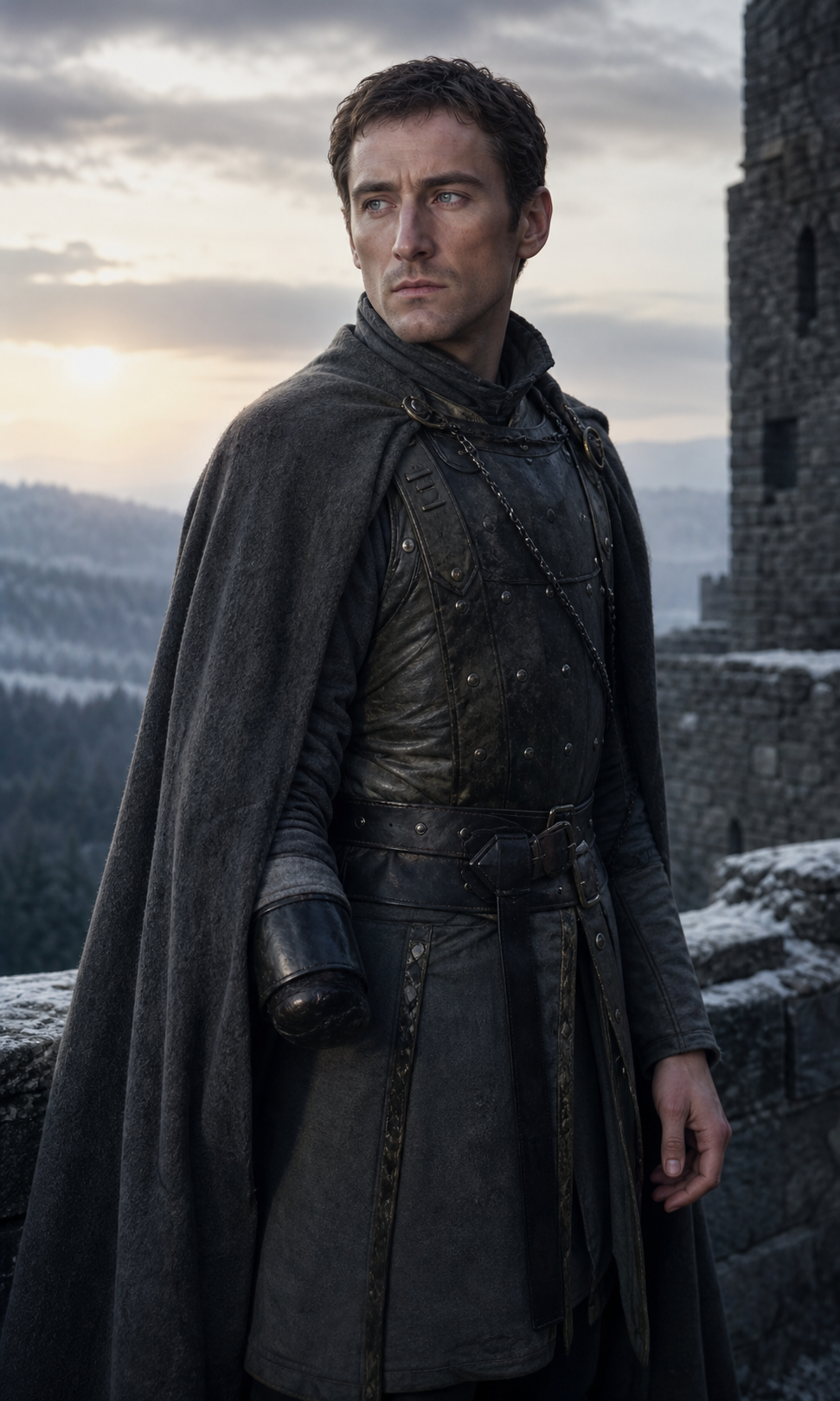
Josua’s canonical Book 1 image fixes an attractive adult prince in his late thirties to early forties with short dark hair, gray eyes, a lean weathered face, restrained expression, black armor, a heavy gray-black cloak, and his missing right hand covered by the leather-capped cuff. Snowy Naglimund places him inside the fortress whose fall creates his crown claim.
Stone of Farewell through To Green Angel Tower
The prince spends three books building a crown claim and survives by refusing it
Sesuad’ra turns resistance into household, marriage, and logistics
Josua gathers refugees and allies at the flooded Stone of Farewell, marries Vorzheva, and tries to make legitimacy out of food, shelter, counsel, and promises rather than spectacle. Every arrival strengthens his coalition and imports another danger.
Leadership keeps colliding with bodies it cannot schedule
He navigates Nabban, Camaris’s restoration, Fengbald’s defeat, Vorzheva’s dangerous pregnancy, and the impossible pressure to turn an old knight into a useful symbol. Josua’s best leadership listens; his worst moments reveal how easily urgency makes even decent rulers treat people as instruments.
A manacle saves his neck; secrecy saves his life
Elias strikes Josua with Sorrow, but the old manacle absorbs the blow. Camaris carries him out. Josua lets the world believe he died, reveals that Camaris was his biological father, refuses the crown he never wanted, and chooses Vorzheva, their twins, hidden Scrollbearer work, and perhaps an inn where friends can arrive without ceremony.
On the record
What this profile can prove today
This canonical profile now reconciles the complete four-volume series. Book-specific cards use status as of that volume; this canonical page preserves the full chronology and final outcome.
Source: owner-accessed Kindle edition of The Dragonbone Chair, verified front-to-back through page 652 of 652 and reconciled with the complete Book 1 character manifest. Later-volume chronology will be added only after sequential reading reaches and verifies it.
The Dragonbone Chair hub → · Book 1 characters → · King Elias’s canonical profile → · Series hub →