
Prester John
The dragon-slayer opens the trilogy unable to lift a cup. That is not the story mocking an old man. It is the story placing mortality, conquest, fatherhood, and unfinished advice on the same bone throne.
Profile
The heroic age does not end cleanly; it sits down, trembles, and leaves its sons the bill
Prester John is the aging High King of Osten Ard, father of Elias and Josua, grandfather of Miriamele, friend of Isgrimnur and Towser, celebrated slayer of the dragon Shurakai, and the ruler whose death releases every fracture the Hayholt’s pageantry had been holding together. Book 1 gives him very little present-tense life and enormous narrative gravity.
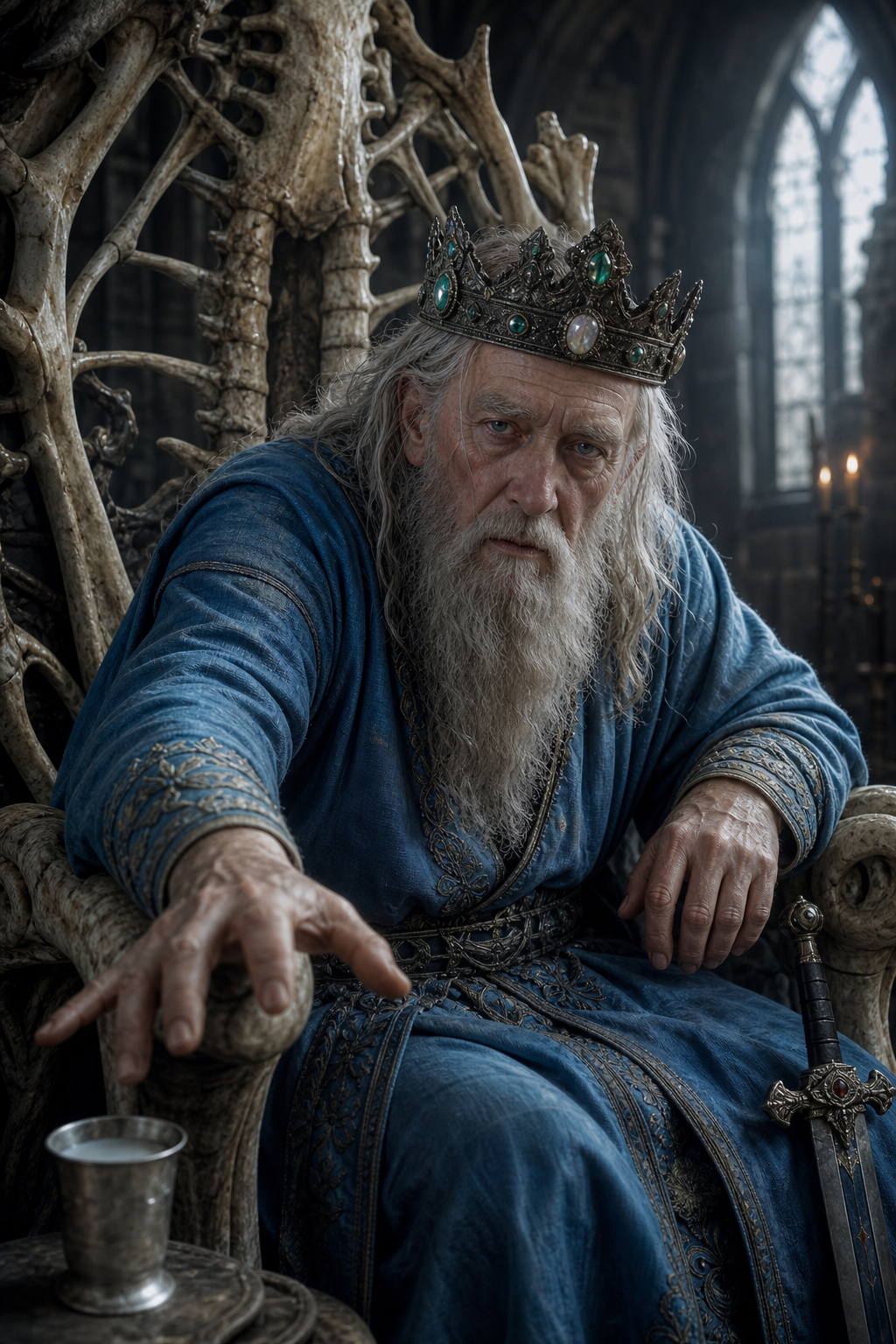
He was once exceptionally tall and formidable. When Simon sees him in the reopened throne room, John is hunched and gaunt, wrapped in a sky-blue robe, with long beard, gray eyes, trembling hands, and the iron crown set with emeralds and opals. The body praised by songs as unconquerable cannot lift a small silver cup of milk. The Chair beneath him is made from the bones of the dragon that established his legend. Victory has become furniture, and the victor is dying on it.
John is not reduced to frailty. He remains proud, sharp, frightened, stubborn, affectionate, dismissive, politically consequential, and capable of recognizing pieces of his own moral uncertainty without finishing the sentence. He believes the law, order, and broad peace he built should count against the violence required to build them. He also treats that accounting as though later stability can settle debts for displaced people who never agreed to the ledger.
The Dragonbone Chair · Verified chronology
A throne-room confession, an interrupted inheritance, forty days of ritual, and a sword buried against the dying king’s order
The farmer’s son becomes the story every later king is forced to perform
Morgenes’s unfinished life of John challenges the court-ballad version of a hero summoned fully formed by providence. People who knew John remember a swordless farmer’s son who reached Erkynland before the dragon ever entered his destiny. The famous slaying matters, but the biography refuses to let the ending colonize the beginning.
John’s public identity eventually gathers conquest, war, Bright-Nail, Shurakai, the Mother Church, the iron crown, and rule over an alliance of kingdoms. The throne made from dragon bone turns one exceptional victory into permanent political scenery. Every petitioner entering the room must look at proof that the king once killed the impossible.
After three closed years, the old king returns to the monument that cannot protect him
The Hayholt starts murmuring because John rises from his sickbed and enters the throne room closed for three years. Towser sits with him. The jester’s rain-and-river song ends with the wind crying “Wait,” and the king weeps. The scene strips royal mortality of ceremony before the funeral can rebuild it.
John’s hands shake. Milk remains beyond reliable reach. He admits that he is dying and fears what follows. The title object arrives not as a magical prize but as a chair built from a corpse, holding another body that will soon become history. Simon’s distant glimpse of greatness begins with helplessness rather than conquest.
He tries to pass down a sword, a doctrine, and one warning he cannot make himself finish
John reviews Bright-Nail’s relics and orders Towser to give the sword to Elias if the king dies before his heir returns from Meremund. He speaks of sword, heart, and hand. Then he starts to say that no noble prize is worth an unnamed cost and abandons the sentence before naming what must not be paid.
The broken warning is the real inheritance problem. Elias receives the object without the full ethical boundary. John retreats to a safer formula about the weapon serving the heart and hand, but those words assume the heart is sound and the hand knows when not to close. Book 1 will spend the rest of its pages demonstrating how dangerous an unfinished moral lesson becomes when attached to kingship.
John’s private ranking helps manufacture the succession crisis later called bad luck
John prefers Elias as the stronger son and treats Josua’s missing right hand as evidence against kingly fitness. He sees thoughtfulness in Josua but doubts the physical authority required to rule. Elias receives the positive half of the comparison; Josua receives the caveat. Neither inherits permission to become a whole person outside their father’s binary.
Book 1 does not claim John created every later choice. Elias remains responsible for Elias. Josua remains responsible for Josua. But the old king’s judgments become family scripture, and the realm has structured succession around them. When the brothers turn wooden swords into civil war rehearsal, John’s definition of strength is already in the room.
A person becomes an institution before the body is cold
John dies on Saint Tunath’s Day, 21 Decander 1164. The next forty days convert the body into a royal event: washing, embalming, linen, armor, delegations, mourning, procession, national offerings, and the ordered choreography of continuity. The kingdom needs the corpse to hold still while everybody rearranges around it.
The preparation rebuilds the vulnerable old man as the warrior-king the realm expects to bury. His servants dress him in ice-white armor, knot beard and hair into war-braids, fasten the iron circlet of the Hayholt, and place Fingil’s iron ring on his finger. Simon watches the person disappear beneath the office piece by piece. The funeral is sincere grief, but it is also the final edit of John Presbyter.
Isgrimnur resists that conversion through touch. He puts John’s battered boots back on, remembers the friend inside the king, and kisses his hand. The boots matter because epic legend has no use for worn leather. Friendship does. They make the dragon-slayer a man who walked, aged, hurt, laughed, and needed someone who knew which old objects still belonged to him.
The promised sword follows him into the earth
John is carried to the windy headland and buried inside his beloved small royal boat, Sea-Arrow. The allied lands answer with objects of their own: Perdruin sends a silken cloak, Nabban a white porphyry Tree, Rimmersgard a silver axe set with mountain-blue gems, and Hernystir a gold-inlaid ashwood spear. The offerings make the barrow a miniature Osten Ard held together by the dead king one last time.
Towser has obeyed the private instruction and presented Bright-Nail to Elias. Elias drops it, accepts it again, says it twists, turns pale, and refuses to touch it afterward. He orders the old relic buried with John and makes Josua place it on the corpse. Miriamele follows behind the bier with her father and uncle, entering the novel’s public chronology inside a procession where grief, bloodline, and succession have already become inseparable.
Thus the sword meant to stabilize succession becomes a withheld inheritance and a mystery beneath the barrow. John’s death does not settle the next reign. It removes the one person whose authority kept contradictions from becoming open war and sends a crucial object into the ground at the exact moment the world needs its history understood.
Legend, conquest, and moral accounting
The peace is real. So are the people required to disappear inside the heroic version of how he made it.
John’s achievement should not be flattened into propaganda. He unifies rival realms, creates broad order, and becomes a living reference point for people who remember less stable rule. Isgrimnur’s loyalty is not the devotion of a fool. Towser’s love is not purchased by title alone. A comprehensive profile must explain why good, intelligent people experience John as friend, protector, and extraordinary king.
It must also refuse the ruler’s own accounting trick. John acknowledges violence against the Sithi and other costs of consolidation, then weighs them against law, order, and the kingdom that followed. The balance sounds reasonable from the throne made from the bones of a defeated being. It sounds different from the perspective of people driven from Asu’a, whose architecture the Hayholt still occupies while human history calls them vanished.
The trilogy opens after the “great king” has already won. This choice relocates the interesting question. We are not asked whether John can defeat the dragon. We are asked what happens after a society turns one man’s victories into the operating system for identity, politics, masculinity, religion, and succession. The peace begins coming apart before his body reaches Swertclif because it depended too heavily on one embodied myth.
His legend also shapes Simon. The scullion initially experiences old battles as grandeur and imagines martial fame as escape from invisible work. Morgenes’s biography intervenes. John becomes not a destiny model but a case study in right place, right time, manufactured story, ethical compromise, and the difference between being celebrated and being understood.
Relationships
The old king survives Book 1 through the people forced to interpret what he loved, misjudged, promised, and left behind
King Elias
John sees Elias as the stronger son and intends Bright-Nail for him. The judgment offers confidence without the unfinished warning’s boundary. Elias inherits the crown, the comparison, and a heroic model that makes admitting fear feel like abdication.
Prince Josua
John recognizes Josua’s mind but reads the missing hand and contemplative temperament as weakness. The realm later needs precisely the evidence discipline, coalition thinking, and compassion the old king undervalued.
Miriamele
Miriamele enters the main story during John’s funeral. Her place in the procession immediately makes family, succession, grief, and political marriage inseparable. The grandfather’s realm becomes the cage her father calls protection.
Towser / Cruinh
Towser gives John language for mortality, receives the private Bright-Nail instruction, and preserves details the formal court discards. The smallest man beside the throne becomes custodian of the king’s most consequential unfinished handoff.
Isgrimnur
Isgrimnur remembers John through boots, fever, touch, anger, and ordinary loyalty. He is valuable because he loves the man strongly enough that official legend cannot completely replace him.
Doctor Morgenes
Morgenes refuses the court-ballad John without reducing the king to a fraud. His biography preserves the farmer’s son, the manufactured hero, the real achievements, and the costs the official version finds inconvenient.
Bright-Nail / Minneyar
John emerges from the Shurakai story with the blade and renames it Bright-Nail. Book 1 reveals that its history predates him. The king’s most famous weapon is therefore both authentic relic and appropriated object carrying a larger story.
Shurakai
The slain dragon supplies the bones beneath John’s throne and the victory beneath his public identity. Shurakai is dead, yet the entire political room continues sitting inside the meaning extracted from that death.
The Sithi
John treats later order as an answer to conquest’s moral cost. The Hayholt itself refuses the neat account: human kings rule inside Sithi Asu’a, using older stone while describing the people who built it as gone.
Fandom notes and what the fact box misses
He is not Fantasy Grandpa Wallpaper. He is the first argument the series makes about heroes.
Prester John could easily become a decorative deceased king: famous sword, dragon bones, iron crown, two troubled sons, exit stage funeral. Book 1 refuses that convenience by opening inside his fear. Before readers can admire the legend, they must watch the old man fail to lift milk and cry at a song about time refusing to wait.
That vulnerability does not cleanse his politics. Age deserves dignity, not automatic absolution. John’s physical decline makes him human; it does not make his colonial accounting correct or his judgment of Josua harmless. The profile should be tender toward the body without becoming sentimental about the throne.
The unfinished sentence may matter more than the finished doctrine
“Sword, heart, and hand” sounds quotable because it closes neatly. The warning John cannot complete does not. That asymmetry is the point. Institutions preserve polished maxims and drop the hesitation where actual ethical knowledge lives. Elias receives a weapon and a slogan. The doubt dies with its speaker.
Bright-Nail’s burial then turns the failed handoff into geography. The sword is not metaphorically inaccessible; it is physically inside the old king’s barrow at Swertclif. Recovery will require people to revisit burial, inheritance, and the version of John they were taught not to question.
The portrait needs old age because the opening depends on it
Milestone art may later show John as the younger dragon-slayer, farmer’s son, conqueror, or reigning father. The canonical profile image remains the elderly John because that is the reader’s first and most honest encounter: the legend after endurance has taken everything spectacle ignores.
He should still be attractive in the way a formidable old face can be attractive—clear eyes, great bone structure, long silver hair, a beautiful beard, and authority surviving inside exhaustion. Making him young would betray the scene. Making him grotesque would betray the person.
Canonical identity and milestone art
Visible age stays visible; former greatness lives in structure, gaze, and scale
John’s canonical Book 1 image fixes a dignified, attractive very elderly king in his late seventies or early eighties, once exceptionally tall and broad but now hunched and gaunt, with long white-gray hair and beard, gray eyes, large trembling hands, a sky-blue high-medieval robe, and the old iron crown set with emeralds and opals. The Dragonbone Chair and unreachable milk cup identify the opening scene.
On the record
What this profile can prove today
This canonical profile covers John through The Dragonbone Chair. Book 1 verifies his old age and appearance, return to the throne room, fear of death, friendship with Towser, Bright-Nail instruction, preference for Elias, doubts about Josua, death on Saint Tunath’s Day, forty-day funeral preparation, Isgrimnur’s intimate grief, burial inside Sea-Arrow at Swertclif, and the sword’s burial against his intended handoff.
Source: owner-accessed Kindle edition of The Dragonbone Chair, verified front-to-back through page 652 of 652 and reconciled with the complete Book 1 character manifest. Later-volume evidence and historical expansion will be added only after sequential reading verifies it.
The Dragonbone Chair hub → · Book 1 characters → · King Elias → · Prince Josua → · Series hub →