
Identify Yourself: Powerful New Rivals
Team 7 walks into the Chūnin Exams expecting a larger test. Rock Lee gives them something more dangerous: a person who does not fit the story they tell themselves about talent. Before the paperwork is finished, Sasuke’s inherited genius meets a boy who has made effort visible in every movement.
The feeling of the episode
Everyone arrives to identify themselves by clan, reputation, crush, rivalry or confidence. Lee identifies himself through action and forces Sasuke to confront the possibility that another person’s ordinary-looking body can outrun his inherited eyes.
Episode 21 is an entrance hall pretending to be an episode. New faces keep appearing. Names are exchanged. Old classmates posture. Teams gather behind their instructors. The room swells until Konoha stops feeling like Naruto’s private world and becomes one node in a much larger competitive system.
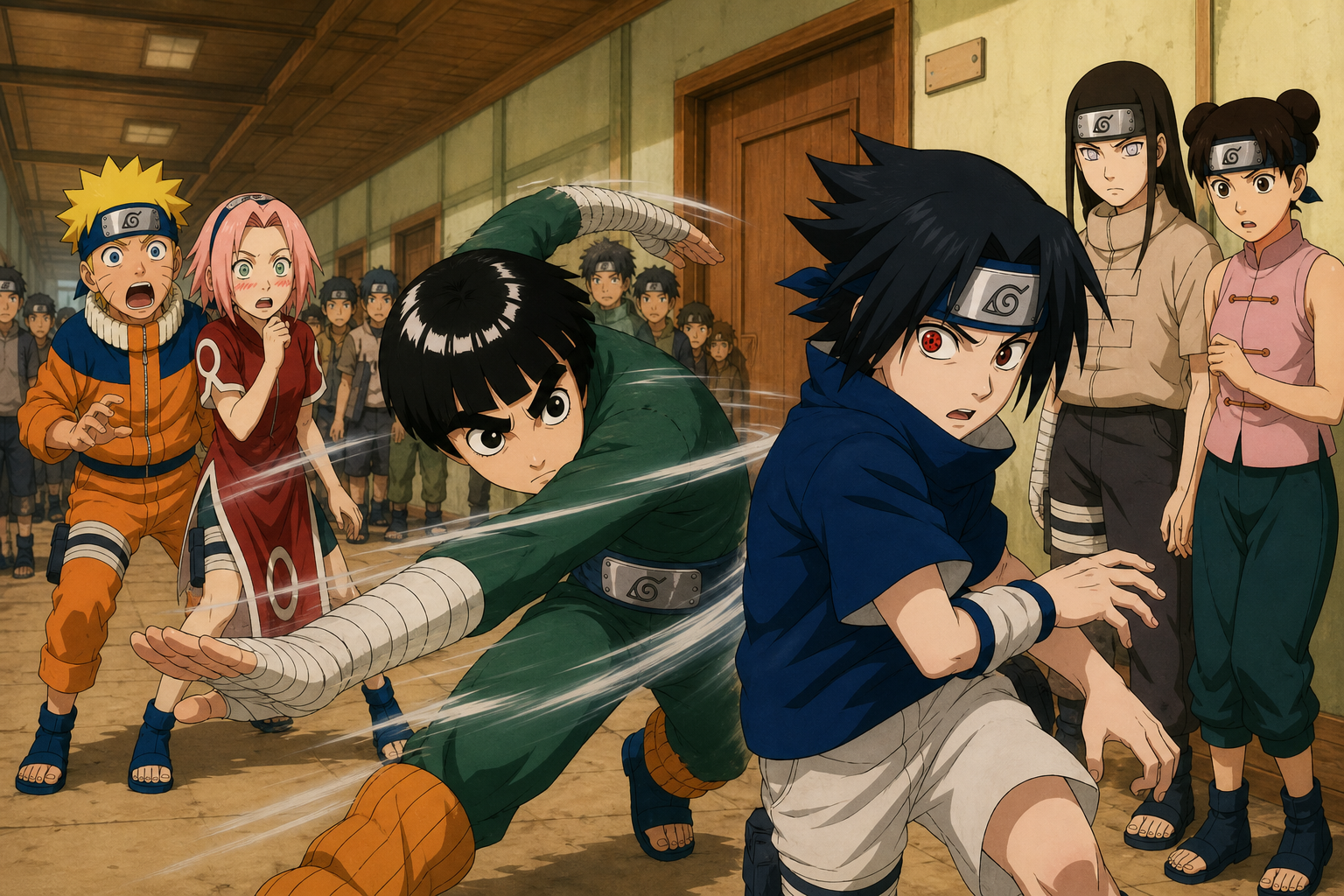
Then a boy with a bowl haircut, enormous eyebrows and absolute sincerity asks Sakura on a date, challenges Sasuke Uchiha, and nearly humiliates the series’ designated prodigy before the exam begins.
That tonal sequence of comedy, embarrassment, combat and revelation is pure early Naruto. The joke walks into frame first so our hierarchy is relaxed when the threat arrives.
The recap: Team 7 enters a room full of mirrors
Kakashi has nominated Naruto, Sasuke and Sakura for the Chūnin Exams. The recommendation flatters them, but it also converts their recent survival into evidence that they are ready for greater responsibility.
The team approaches the Academy and meets familiar classmates. Ino immediately resumes her rivalry with Sakura. Shikamaru complains. Chōji eats. Kiba boasts. Hinata tries to exist near Naruto without announcing the emotional emergency in her chest. Shino remains so quiet that his silence becomes an introduction.
The “Rookie Nine” are together again, but childhood familiarity has changed. They are no longer classmates taking the same lessons. They are three competing squads whose teachers have placed professional bets on them.
The room asks every friendship a new question: are you still happy when the person you know becomes the person standing between you and promotion?
The hallway illusion is the first exam nobody announces
Older genin crowd a doorway labeled as the third-floor exam room. Two boys guard it and push back younger candidates. The floor number is wrong: the confrontation occurs on the second floor under a genjutsu that makes it appear to be the third.
Sasuke identifies the illusion. Sakura also understands it, and Sasuke gives her explicit credit. That small acknowledgment matters. Sakura has spent much of Team 7’s formation measuring herself against her teammates’ obvious gifts. Here, her classroom intelligence and genjutsu aptitude become operational.
Exams begin before institutions admit they have begun. The candidates who follow signs without observing their environment reveal themselves. The candidates who detect the manipulation still have to decide whether exposing it is strategically wise.
Knowledge is not only seeing the truth. Courage means choosing what to do once you see everyone else being tested by the lie.
Lee enters as a joke the camera knows is dangerous
Rock Lee appears with a green jumpsuit, glossy bowl haircut, thick eyebrows and an intensity so sincere it reads as socially impossible. He asks Sakura to be his girlfriend and promises to protect her with his life.
Sakura refuses immediately and insults his eyebrows. The scene plays as comedy, but it establishes Lee’s defining risk: he presents desire without protective irony. He cannot pretend not to care.
Then he calls out Sasuke.
Lee wants to test himself against the celebrated Uchiha. Sasuke accepts because being challenged by this strange boy feels almost insulting. Naruto is furious for a different reason: another person has once again bypassed him to make Sasuke the center of value.
Three boys stand in one hallway carrying three versions of recognition. Naruto wants to be selected. Sasuke expects to be selected. Lee selects the standard he intends to surpass.
Sasuke versus Lee: the hierarchy breaks before the exam starts
Sasuke activates the Sharingan and expects perception to solve the problem. Lee moves faster than Sasuke can physically answer.
This is the crucial distinction. The Sharingan can read movement. Reading does not make muscles strong enough, reflexes trained enough or the body fast enough to respond. Information is not execution.
Lee knocks Sasuke back with clean taijutsu and begins setting up the Front Lotus, a dangerous technique involving bandages, aerial rotation and bodily sacrifice. The fight stops only when a giant turtle intervenes and Might Guy arrives.
Sasuke’s humiliation is not that he lacks talent. The deeper problem is that talent has become Sasuke’s explanation for the world. Lee shows him a different causal chain: repetition, pain, obsession, coaching and a body rebuilt around one narrow promise.
The episode does not say effort always beats inheritance. Lee’s kick says inherited perception cannot skip the body’s required work.
Why Lee chooses Sasuke instead of Naruto
Lee challenges Sasuke because the Uchiha name carries prestige and because Sasuke is recognized as the strongest rookie of his graduating class. Defeating him would measure Lee against both individual skill and inherited reputation.
Naruto experiences this as erasure. He has spent years demanding that people acknowledge him, and now even the bizarre newcomer sees Sasuke as the meaningful opponent.
But Naruto and Lee are closer than either understands. Both are publicly underestimated. Both construct identity through relentless performance. Both refuse the social verdict placed on their starting point.
The difference is that Lee already has a mentor who has converted his desperation into disciplined training. Naruto has enormous power and improvisational brilliance, but his development has been irregular, secretive and emotionally chaotic.
Lee is not Naruto without chakra. He is what wounded persistence looks like after an adult builds it a curriculum.
Sakura’s position: desired, insulted and finally acknowledged
Sakura spends the episode inside other people’s evaluations. Ino treats her as rival. Lee treats her as instant beloved. Naruto wants her approval. Sasuke’s opinion carries disproportionate emotional weight.
Her strongest moment is quieter: she sees through the hallway genjutsu, and Sasuke names her perceptiveness. This is recognition attached to competence rather than appearance or romantic availability.
Lee’s proposal is funny because it is excessive and immediate, but Sakura’s refusal is valid. She does not owe affection because his sincerity is touching. Later respect cannot require retroactive consent.
The episode also exposes the cruelty she uses as social armor. Calling Lee’s appearance disgusting is not necessary to say no. Sakura is still learning the difference between setting a boundary and protecting status through humiliation.
Neji and Tenten are introduced through watching
Neji Hyūga and Tenten observe Lee’s impulsive challenge with the exhausted familiarity of teammates who have seen this intensity before.
Neji’s calm carries the confidence of someone accustomed to being called a genius. Lee’s obsession with defeating him sits behind the Sasuke challenge: another inherited prodigy has already become the wall against which Lee measures his life.
Tenten acts as practical social ballast. She understands the absurdity without dismissing Lee’s actual ability.
Team Guy arrives as a philosophical counterweight to Team 7. Kakashi’s team contains two boys tangled in rivalry and a girl struggling for equal narrative space. Guy’s team contains a genius, a hard-working self-declared failure and a weapons specialist watching both.
Might Guy is ridiculous until you see what his ridiculousness protects
Guy enters with matching green clothing, shining teeth and theatrical devotion. He disciplines Lee for using a forbidden technique outside the right circumstances, then collapses into an emotional exchange that makes bystanders question reality.
The comedy is deliberate camouflage. Guy has given Lee something Naruto lacks for much of childhood: an adult who sees the impossible dream, names a training path and remains present through failure.
Guy does not merely praise hard work. He designs conditions under which Lee’s work can accumulate into expertise. He also sets boundaries because Lee’s determination can become self-destruction.
Mentorship is not telling a child to believe in himself. Mentorship means staying long enough to teach belief a method.
The Rookie Nine: classmates become a generation
Team 7
Naruto, Sasuke and Sakura arrive with recent real-combat experience and unresolved psychological aftermath.
Team 8
Hinata, Kiba and Shino bring tracking, sensory work, clan partnerships and a quieter team identity.
Team 10
Shikamaru, Ino and Chōji inherit a coordinated clan alliance beneath their familiar bickering.
Team Guy
Neji, Lee and Tenten are one year older, which means the rookies are entering a field where age, attempts and training time are already unequal.
The episode assembles them like a class photograph. The Chūnin Exams will spend the next arc revealing that a generation is not a collection of equal children. The exam is a collection of differently inherited resources forced into one ranking system.
The Chūnin Exam rewards self-presentation before leadership
The title commands, “Identify Yourself.” Names, clan symbols, team affiliation and visible confidence all become signals. Candidates study one another before any proctor explains the rules.
This is realistic institutional behavior. Selection begins in waiting rooms. People decide who looks threatening, weak, connected, unserious or prestigious. Those judgments shape alliances and aggression before formal evidence appears.
Sasuke benefits from a name that arrives ahead of him. Naruto fights a reputation that also arrives ahead of him. Lee wears an appearance that invites underestimation and then weaponizes the gap.
Identity in the exam is part truth, part inheritance and part tactical performance.
Easter eggs and craft details
- The false floor: the wrong room number previews an exam built around gathering information under deception.
- Sakura’s recognition: Sasuke identifying her genjutsu perception foreshadows an aptitude that the series will not always develop as fully as it could.
- Lee’s weights remain secret: his speed is astonishing before the story reveals he has been training under additional burden.
- The turtle: Ningame stopping Lee establishes that summon relationships exist beyond Team 7’s recent toad-and-dog expectations.
- Guy and Kakashi: Guy’s immediate comparison with Kakashi introduces an adult rivalry that parodies and comments on Naruto and Sasuke’s.
- One-year advantage: Team Guy did not enter the previous exam, showing that nomination timing is a teacher’s strategic choice rather than automatic progression.
- Lee’s bandages: what first looks like costume detail is functional equipment for a technique that converts his own body into the weapon.
RaeRae reacts: excuse me, the EYEBROWS just humbled the Uchiha?
Baby Sasuke walked into that hallway with the confidence of a child who has never met a bowl cut capable of reorganizing his worldview.
And I understand it. If a boy in a green jumpsuit proposes to Sakura, insults your clan prestige by implication and announces a challenge, you assume the universe has sent comic relief.
Then comic relief kicks you faster than your magic trauma eyes can solve.
That is cinema.
Also, Sakura: reject anybody you want. Absolutely. But we do not need to drag the eyebrows into court. Those eyebrows are holding up an entire philosophy of human effort.
And Guy? I would walk away from the sunset-hug too. I would also secretly want one adult in my life to believe in me with even ten percent of that terrifying volume.
What the author is really telling us
Naruto has spent twenty episodes teaching us to recognize visible categories: dead last, genius, clan heir, jinchūriki, weak girl, elite jōnin, missing-nin. Episode 21 introduces a body that makes the categories unreliable.
Lee cannot use ninjutsu or genjutsu effectively. In the Academy’s broad curriculum, that absence should define him as deficient. Guy narrows the field until Lee’s limitation becomes the boundary around specialization.
Existentially, Lee refuses to wait for an essence that will authorize his dream. He does not possess the “natural” signs by which the village recognizes greatness, so he constructs a self through repeated action.
But this is not a lonely bootstraps sermon. Lee’s action becomes possible through relationship. Guy sees him, teaches him and gives his effort form. The episode’s radical claim is not merely that hard work beats talent. Lee’s history shows that recognition can turn suffering into practice instead of spectacle.
The shadow beneath hard work
Lee’s philosophy is inspiring because it protects dignity from inherited hierarchy. The slogan is dangerous because effort can become another impossible purity test.
If Lee wins, people say hard work works. If he destroys his body and loses, the same culture can say he simply did not work correctly enough. Structural difference disappears into individual virtue.
The series is strongest when it remembers that Lee has Guy, medical care, teammates, time and a body capable of surviving extraordinary conditioning. Effort is real. So are conditions.
Sasuke’s bloodline does not cancel his work. Lee’s work does not cancel his limits. The interesting question is why the exam insists on converting all of these lives into one ladder.
Lee breaks the hierarchy before the exam can formalize it
Sasuke enters the building carrying a reputation he did not ask for but has learned to use. Other candidates see the Uchiha name, the Sharingan, and the survivor of a famous clan. Lee sees a measuring point. His challenge matters because effort reaches Sasuke before the official exam can arrange everyone into scores and promotions.
The fight unsettles the story’s early assumption that inherited talent determines immediate superiority. Sasuke can see Lee’s movement and still fail to make his body answer quickly enough. Vision is not velocity. Knowing what is coming does not guarantee the training needed to stop it.
Lee’s sincerity makes the comedy sharper, not softer
The haircut, eyebrows, declaration to Sakura, and formal posture invite laughter. Lee is funny because he commits to every feeling without embarrassment. The episode then reveals that the same commitment shaped years of physical training.
His presentation does not hide competence. It makes the audience’s assumptions visible. We are encouraged to underestimate him for looking unusual, then forced to confront how quickly visual shorthand became judgment. Sasuke experiences the same correction with much higher stakes.
Sakura receives acknowledgment in a hallway built for posturing
Sasuke explicitly credits Sakura for seeing through the genjutsu. That moment is small, but it names a skill the team depends on. Sakura’s classroom knowledge and chakra control are not decorative intelligence. They let her identify when the environment is lying.
Lee’s romantic attention is louder, yet Sasuke’s professional acknowledgment should matter more. Sakura deserves to be seen as a teammate whose perception changes what the group can do, not merely as the girl two boys evaluate differently.
The hallway guards test whether candidates obey appearances
The false floor number turns institutional space into part of the examination. Candidates who follow signage, crowds, or intimidation without checking their surroundings reveal something before they reach a proctor. The test rewards suspicion as competence.
That is useful for shinobi work and unsettling as education. The village trains children to expect deception inside the building meant to assess them. Trust becomes a liability unless verified. The lesson may keep them alive, but it also teaches what kind of professional world they are entering.
The Rookie Nine become competitors without ceasing to be children
Naruto’s classmates arrive with familiar habits intact. Ino and Sakura resume old friction. Shikamaru complains. Chōji eats. Hinata struggles to speak near Naruto. Those behaviors make the gathering feel like school until the exam reframes every relationship as competition.
The adults have nominated squads, but the children must carry the social consequences. Friends may block promotion. Former classmates become sources of intelligence. Clan expectations enter the room through bodies too young to have created them.
Neji and Tenten understand Lee through observation
Lee charges into the scene, while Neji and Tenten watch the consequences. Their reactions establish a team history without pausing for biography. They know his habits, the scale of his training, and the line he is approaching by revealing too much before the exam.
The contrast also prevents Team Guy from becoming a single joke. Lee’s openness, Neji’s reserve, and Tenten’s grounded attention suggest three different relationships to talent and performance. The team already contains an argument about what strength means.
Might Guy’s spectacle protects a boundary
Guy arrives theatrically, but beneath the pose is a teacher stopping his student from exposing a dangerous technique and exhausting himself before the actual test. The comedy does not cancel the care. Guy understands Lee well enough to interrupt the exact place where sincerity becomes self-destruction.
That protection distinguishes mentorship from admiration. Praising effort is easy. Teaching a child when effort has crossed into harm requires attention, authority, and a willingness to disappoint them.
RaeRae’s final take
Episode 21 is an identity parade disguised as a hallway delay. Clan names, crushes, rivalries, village affiliations, and reputations enter before the written exam does. Lee cuts through all of them with disciplined movement and forces Sasuke to discover that being able to see an attack is not the same as being prepared for it.
The episode also asks us to notice our own shortcuts. Lee looks like comic relief until the designated prodigy is on the floor. Sakura looks like the romantic center until her perception exposes the genjutsu. Guy looks ridiculous until his interruption reveals responsible care.
The Chūnin Exam has already begun because everyone is already being measured. The danger is believing the loudest label tells us what the person underneath it can do.
Episode file
Final verdict
Episode 21 looks like an introduction parade and lands like a philosophical ambush.
The episode expands the cast, establishes the exam’s deception, gives Sakura a deserved competence beat and lets Rock Lee detonate Sasuke’s confidence without a bloodline or flashy elemental technique.
Most importantly, it changes the question. The Chūnin Exams are not merely asking who is strongest. They are asking whose form of strength the institution knows how to recognize.
Lee walks in looking like the wrong answer.
The hallway learns better.