
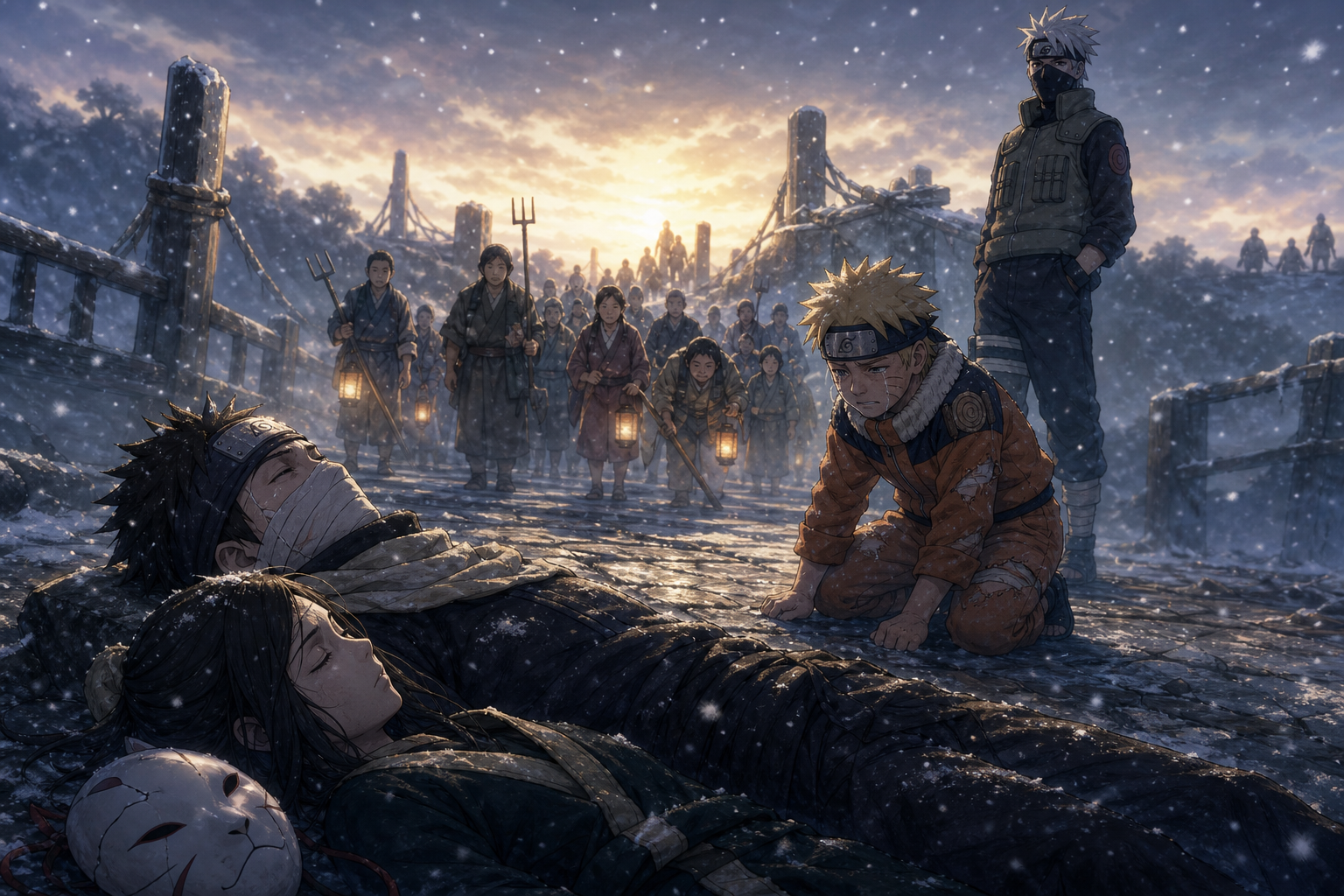
A demon cries, a village arrives, and snow refuses to choose sides.
Naruto’s words reach the human being beneath Zabuza’s legend. The arc’s final victory belongs not to a special technique but to grief accepted, courage shared, and ordinary people who finally step onto their own bridge.
The demon’s mask is emotional, not literal
Naruto Uzumaki has accused Zabuza of accepting Haku’s devotion while pretending Haku was only a tool. Zabuza has built a life around the identity “Demon of the Hidden Mist,” a name that converts feeling into weakness and people into functions.
Episode 19 asks whether that identity can survive Haku’s absence. The episode also asks whether the people of Wave can become more than frightened witnesses to their own exploitation.
The recap: when recognition arrives too late
Naruto’s words strike where weapons could not. He names Haku’s loyalty, suffering, and love, refusing Zabuza’s attempt to describe a human life as completed equipment.
Zabuza initially clings to the shinobi doctrine. Emotion has no place. Haku chose the role. A tool fulfills its purpose. Yet the voice begins failing beneath the argument.
Tears appear. The Demon of the Mist admits, through the body before speech, that Haku mattered. Naruto has not installed a new feeling. He has forced Zabuza to stop hiding a feeling that shaped their entire relationship.
This distinction matters. Zabuza’s grief does not absolve exploitation, violence, or the years Haku spent measuring worth through usefulness. Recognition is morally significant and catastrophically late.
Then Gatō arrives with mercenaries. His presence clarifies the economic structure behind the arc. The ninja battles have been extraordinary, but the original violence is organized by a businessman who profits from isolation and fear. He hired Zabuza, betrayed the arrangement, and treats every fighter as disposable labor.
Gato’s contempt for Haku breaks the last layer of Zabuza’s detachment. The man who used Haku as a weapon now hears a more powerful employer describe both of them as replaceable. Exploitation looks different when reflected from above.
Zabuza turns toward Gato. Wounded and outnumbered, he no longer acts for the coup that brought him here or the money promised. He acts because Haku cannot answer the insult.
The charge is brutal, but its emotional meaning exceeds revenge. Zabuza spends the remaining force of the demon identity in service of the person that identity denied. Violence cannot repair Haku’s life. The final charge can, however, reveal that Zabuza’s loyalty belongs somewhere other than profit.
Gato’s power collapses because it depended on distance. He expected paid bodies to absorb consequence while he remained untouched. Zabuza crosses that distance. The bridge, built to connect the people of Wave to economic possibility, becomes the site where an exploiter discovers he is not beyond reach.
The mercenaries remain, and Team 7 is exhausted. This is where the arc refuses to let elite shinobi solve everything. Inari arrives with the people of Wave.
Their tools are ordinary. Their courage is collective. They do not need to surpass Kakashi or Zabuza individually. They need to demonstrate that Gato’s army can no longer terrorize an isolated population one household at a time.
Inari’s arrival completes the lesson Naruto began in Tazuna’s home. Courage does not mean being free from fear or grief. Courage means refusing to let fear decide that action is impossible. Kaiza’s example was not disproven by his death; it survived in the child who once used that death as evidence against hope.
The mercenaries retreat when exploitation loses its psychological advantage. Gato’s system depended on everyone assuming everyone else would remain afraid. The moment people appear together, the arithmetic changes.
After the conflict, Zabuza asks to be placed beside Haku. Snow begins falling. The weather returns the bridge to the visual world of Haku’s childhood, but the meaning has changed. Snow once marked abandonment. Now it marks companionship acknowledged at the end.
Zabuza looks at Haku without the language of tools. The request does not undo the past. The request grants Haku a name and a place in Zabuza’s final consciousness.
Naruto watches and learns a cruel truth about the ninja world. People can love one another and still participate in systems that destroy them. Strength cannot guarantee a just ending. Recognition can arrive after the person who needed it can no longer build a life from it.
The episode closes gently because spectacle would be dishonest. Haku and Zabuza lie together under snow. The bridge remains. The people remain. Grief becomes part of the structure they will cross.
Zabuza’s tears are not redemption by themselves
Popular memory sometimes turns this episode into a simple redemption scene. Zabuza cries, attacks Gato, and therefore becomes good. The text is more complicated.
Grief proves that Zabuza’s tool philosophy was a lie, but feeling love does not mean loving well. Haku needed acknowledgment while alive. Zabuza’s tears reveal emotional truth and the tragedy of withholding it.
His final action matters because he redirects loyalty away from ambition and payment. Still, it cannot return choices or years to Haku. Redemption is not a feeling that cancels consequence. Redemption is a change in relation to truth, sometimes made when almost no future remains.
The episode allows us to mourn Zabuza without acquitting him. That moral complexity is one reason the Land of Waves arc remains powerful. Villains are not secretly innocent; they are human enough to be responsible.
Gato and the violence behind ninja violence
Gato lacks bloodline techniques, legendary weapons, and chakra spectacle. His power is capital, hired force, and control of infrastructure. He isolates Wave economically, making resistance expensive and hope dangerous.
This reveals that the shinobi world’s violence serves ordinary material interests. Missions may be framed through honor and rank, but someone often profits. Zabuza and Kakashi become opposing weapons inside a conflict structured by Gato’s attempt to own circulation.
The bridge threatens him because connection reduces dependency. People able to trade and travel have alternatives. Gato therefore attacks not only construction but the possibility of collective autonomy.
His defeat is political before it is physical. The people’s arrival proves fear no longer fragments them. Once the population acts as a population, the mercenary model becomes unstable.
Inari’s courage and the return of Kaiza
Inari does not stop grieving Kaiza. He changes what the grief means. Earlier, Kaiza’s death proved that bravery was foolish because powerful men could punish it. Naruto forces Inari to consider that surrender also carries a cost.
When Inari leads the townspeople, Kaiza returns as an ethic rather than a ghost. A hero is not someone guaranteed to win. A hero enlarges the range of actions other people can imagine after the hero is gone.
This is why Inari’s contribution cannot be reduced to comic backup arriving late. Team 7 can defeat individual enemies, but only Wave’s people can end Wave’s passivity. Liberation performed entirely by outsiders would leave the social structure unchanged.
Naruto inspires; Inari translates inspiration into local action; the community gives that action scale. Heroism becomes a network rather than a single exceptional body.
The bridge as the arc’s final argument
A bridge connects separated places, but the Land of Waves bridge also connects isolated people. Tazuna builds the physical span. Naruto connects Inari’s grief to action. Haku connects Naruto to an enemy’s humanity. Zabuza finally connects feeling to acknowledgment.
Every major change in the arc crosses a distance someone had treated as permanent. Naruto enters Sasuke’s danger. Sasuke enters the attack meant for Naruto. Haku crosses the battlefield for Zabuza. Zabuza crosses the mercenary line toward Gato. The people cross fear toward one another.
Connection does not guarantee safety. Bridges expose travelers as well as enabling movement. The arc’s mature hope is not that connection eliminates vulnerability. The mature hope is that isolation was already a form of defeat.
Easter eggs and craft details
Haku’s childhood weather reappears, transforming abandonment into a final acknowledged companionship.
Zabuza’s body contradicts the identity that claimed emotion had been removed.
The townspeople arrive with work implements, visually opposing Gato’s hired weapons with collective labor.
Gato demonstrates the series’ wider political world: money and infrastructure can organize violence as effectively as jutsu.
The child does not merely believe differently. He turns belief into collective movement.
Zabuza’s final request recognizes Haku as a particular person, not a replaceable function.
RaeRae reacts: I cry every single time, and I am still mad
Yes, Zabuza’s tears destroy me. No, they do not make everything okay. Both reactions belong together.
Haku deserved to hear that he mattered while there was still time to imagine a life beyond usefulness. Zabuza’s grief is real, and the lateness is the tragedy. Sometimes people protect themselves from vulnerability so successfully that they only admit love when love can no longer ask anything from them.
Then Inari arrives, and the episode expands grief into politics. Naruto did not save Wave alone. He helped one child believe action was possible, and that child helped neighbors arrive together. That is how courage actually travels.
The snow at the end is almost unfair in its beauty. The series gives Haku and Zabuza tenderness only after the world has exhausted them. I mourn what they had, what they misunderstood, and what they never got time to become.
What the author is really telling us
Episode 19 argues that dehumanization injures the person who performs it as well as the person subjected to it. Zabuza’s demon identity protects him from acknowledging dependence, but it also prevents him from receiving Haku’s love consciously.
Existentially, identities can become prisons when we mistake repetition for essence. Zabuza has acted like a demon for so long that he treats demonhood as what he is. Naruto’s accusation restores choice: if the tears are real, another self has existed all along in the acts Zabuza refused to interpret.
The episode also rejects the fantasy of individual salvation. Exceptional fighters create openings, but Wave’s people must claim collective agency. Freedom cannot be delivered as a completed product by outsiders because freedom includes the practice of acting together.
Naruto leaves the bridge with a more complicated ninja way. Perseverance remains, but innocence does not. He has seen a world where devotion and exploitation coexist, where adults recognize love too late, and where courage may end in grief. He chooses connection anyway.
What Team 7 carries home
The mission began as an escort assignment mislabeled by a client who could not afford the truth. Team 7 expected danger appropriate for new genin and encountered political assassination, child soldiers, inherited persecution, and an economy organized through fear.
Naruto carries proof that his compassion can alter another person’s final decision. That is empowering, but it also risks creating a savior burden. He cannot assume that seeing pain guarantees the power to prevent tragedy. Haku remains the lesson that understanding and rescue are not identical.
Sasuke carries evidence that attachment has entered his reflexes. Sakura carries the discipline of holding a mission position while the people she loves fight beyond reach. Kakashi carries responsibility for children who survived by developing under conditions no teacher should welcome.
The arc has made them more capable and less innocent. Growth in the shinobi world is always morally double-edged. Experience may keep them alive next time, but the experiences producing it should never be treated as merely useful training material.
Their task after Wave is not simply to become stronger. Their deeper task is to decide what strength will protect, what orders deserve obedience, and whether bonds formed through danger can become relationships capable of existing outside crisis.
Naruto forces Zabuza to acknowledge the debt
Naruto’s speech does not reveal information Zabuza lacked. Zabuza watched Haku train, fight, and organize an entire life around being useful to him. What Naruto destroys is the emotional distance Zabuza used to keep that knowledge from becoming obligation.
The tears matter because the demon performance finally fails. They do not refund Haku’s childhood or transform Zabuza into a safe guardian. Recognition arrives after Haku can no longer ask what it means. That lateness is the source of the scene’s grief and its accusation.
Zabuza’s final charge is not a complete redemption
Zabuza turns on Gatō after hearing Naruto and after Gatō desecrates Haku’s body. The charge is moving because Zabuza spends his last strength refusing the man who treated both missing-nin as disposable labor. It is also the final act of a person who accepted that arrangement until the contract was broken.
One righteous movement cannot erase every earlier choice. Redemption is too tidy a word for what the episode offers. Zabuza achieves honesty, directs his violence toward the architect profiting from it, and asks to be placed beside Haku. That is meaningful. It is not restitution.
Gatō reveals the economy behind the ninja spectacle
Gatō arrives with hired men and explains that Zabuza was always expendable. The bridge battle has featured rare eyes, bloodline techniques, assassination craft, and elemental power, but money sits behind the assignment. Gatō expected professional violence to eliminate Tazuna and then intended cheaper violence to eliminate the professionals.
This is the arc’s clearest political point. The shinobi system sells force. A wealthy client can redirect that force toward maintaining a monopoly. The most spectacular fighters remain labor when somebody else controls payment and purpose.
Haku’s body becomes the boundary Zabuza finally refuses
Gatō kicking Haku is cruel because it repeats the reduction Haku accepted in life. A tool that no longer functions can be discarded and disrespected. Zabuza’s reaction admits that Haku was never merely equipment, even if he spent years benefiting from that claim.
RaeRae is not letting him off the hook because he cries beautifully in the snow. The emotional truth is that he loved Haku. The moral truth is that he allowed love to live inside a hierarchy where Haku’s worth depended on service. Both truths belong in the same frame.
Inari returns with the village because courage becomes collective
Inari does not defeat Gatō’s army through individual strength. He arrives with neighbors who have decided fear will no longer make every household feel alone. Kaiza’s legacy returns not as one replacement hero but as a community willing to stand together.
That is the answer to Gatō’s method. He governed by persuading each person that resistance would be solitary and fatal. The crowd changes the calculation. Even before the hired men retreat, the town has broken the most important part of his control.
The bridge is named for Naruto, but the victory belongs to many people
Naruto inspires Inari and helps expose Zabuza’s grief, yet the bridge exists because Tazuna kept building, Tsunami kept a family intact, workers returned, Team 7 protected the site, and Haku’s death changed the final confrontation. Naming it the Great Naruto Bridge captures one emotional thread, not the entire labor history.
The gesture makes sense within the story. Naruto represents the hope Inari recovered. It is still worth remembering how fandom narratives can compress collective action into one heroic name, especially after an arc that worked so hard to show a country’s resistance.
Snow gives Haku the tenderness life withheld
The falling snow softens the bridge after sustained violence, and Zabuza asks to lie beside Haku. The image is beautiful because it grants physical closeness after emotional honesty arrived too late. It is painful because the request can only be fulfilled in death.
Haku deserved more than a moving ending. Haku deserved ordinary days, relationships without employment conditions, and a future not measured by sacrifice. Mourning should not turn deprivation into destiny.
Team 7 leaves with a different understanding of missions
The mission began as escort work and revealed economic exploitation, child soldiers, village prejudice, and the cost of treating people as tools. Naruto learns that enemies have precious people. Sasuke discovers his body will protect a teammate. Sakura sees how quickly a client’s concealed circumstances can consume a squad. Kakashi confronts opponents whose choices echo parts of his own profession.
They return to Konoha stronger, but strength is not the only change. The official mission rank can no longer contain what they know about the world that sends missions to the desk.
RaeRae’s final take
Episode 19 earns the tears because it refuses to make them uncomplicated. Zabuza acknowledges Haku, then dies before acknowledgment can become changed behavior. Gatō loses control because the people he isolated appear together. Naruto helps, but the bridge carries more lives than his name.
Haku and Zabuza lying in the snow remains one of Naruto’s defining images. I cry because love was present. I stay mad because presence was not enough. Love that cannot challenge the terms of another person’s exploitation may be sincere, but sincerity does not make the arrangement kind.
The Land of Waves ends by asking whether shinobi must remain weapons. Naruto’s answer begins here: a person is always more than the role a frightened village, a paying client, or a grieving adult assigns them.
Episode file
| Episode | 19 |
|---|---|
| Title | The Demon in the Snow |
| Arc | Land of Waves |
| Key conflict | Zabuza accepts his grief, turns on Gato, and Wave’s people collectively end the reign of fear. |
| Emotional center | Recognition arriving too late but still changing the final choice. |
| Official guide | Naruto Official Episode 19 guide |
| Watch officially | Crunchyroll · Netflix availability varies by region |
Final verdict
Episode 19 closes the Land of Waves conflict by turning every central metaphor inside out. The demon cries. The tool becomes irreplaceable. The frightened child leads. The isolated town arrives together. The unfinished bridge already performs its purpose before construction is complete.
Rating: 10/10. One of anime’s most enduring arc endings because it honors emotion without confusing emotion for absolution.