
The “weapon” makes the most human choice on the bridge.
Haku’s philosophy says shinobi exist as tools. Haku’s final movement says something else: attachment survives the ideology meant to erase it, and even Zabuza must face the person concealed inside his weapon.
Haku’s philosophy reaches its consequence
Naruto Uzumaki has defeated Haku and reached the person behind the hunter-nin mask. Haku’s past revealed how an abandoned child found purpose by becoming useful to Zabuza. Now Haku asks Naruto to accept the logic of that identity: a tool that can no longer fulfill its purpose has no remaining claim.
Naruto rejects the conclusion, even while recognizing that the shinobi world teaches it. Before their argument can produce a new path, Haku senses that Zabuza is in danger.
The recap: from object to subject in a single movement
Naruto stands before defeated Haku with a weapon in hand and hesitation in his body. The combat outcome is settled. What remains is the moral demand Haku places upon him.
Haku describes shinobi life as service to another person’s goal. Strength exists to fulfill purpose. Victory confirms usefulness; defeat removes it. Naruto hears an ideology that is both alien and disturbingly familiar.
Konoha has also taught that shinobi endure, follow missions, conceal feelings, and become instruments of the village. Kakashi’s bell test challenged blind obedience, but the larger system still rewards function. Haku’s language is not an isolated pathology. The language represents the shinobi ideal spoken without comforting decoration.
Naruto resists because the person in front of him cannot be reduced to the role. He met Haku in the forest. He heard kindness, curiosity, and a dream of protecting someone precious. Those qualities do not vanish because Haku lost.
The argument stops when Haku senses Zabuza’s crisis. Across the bridge, Kakashi has overcome the killing mist and prepares the Lightning Blade. Zabuza, who controlled the terms of combat, faces an attack he cannot safely answer.
Haku moves.
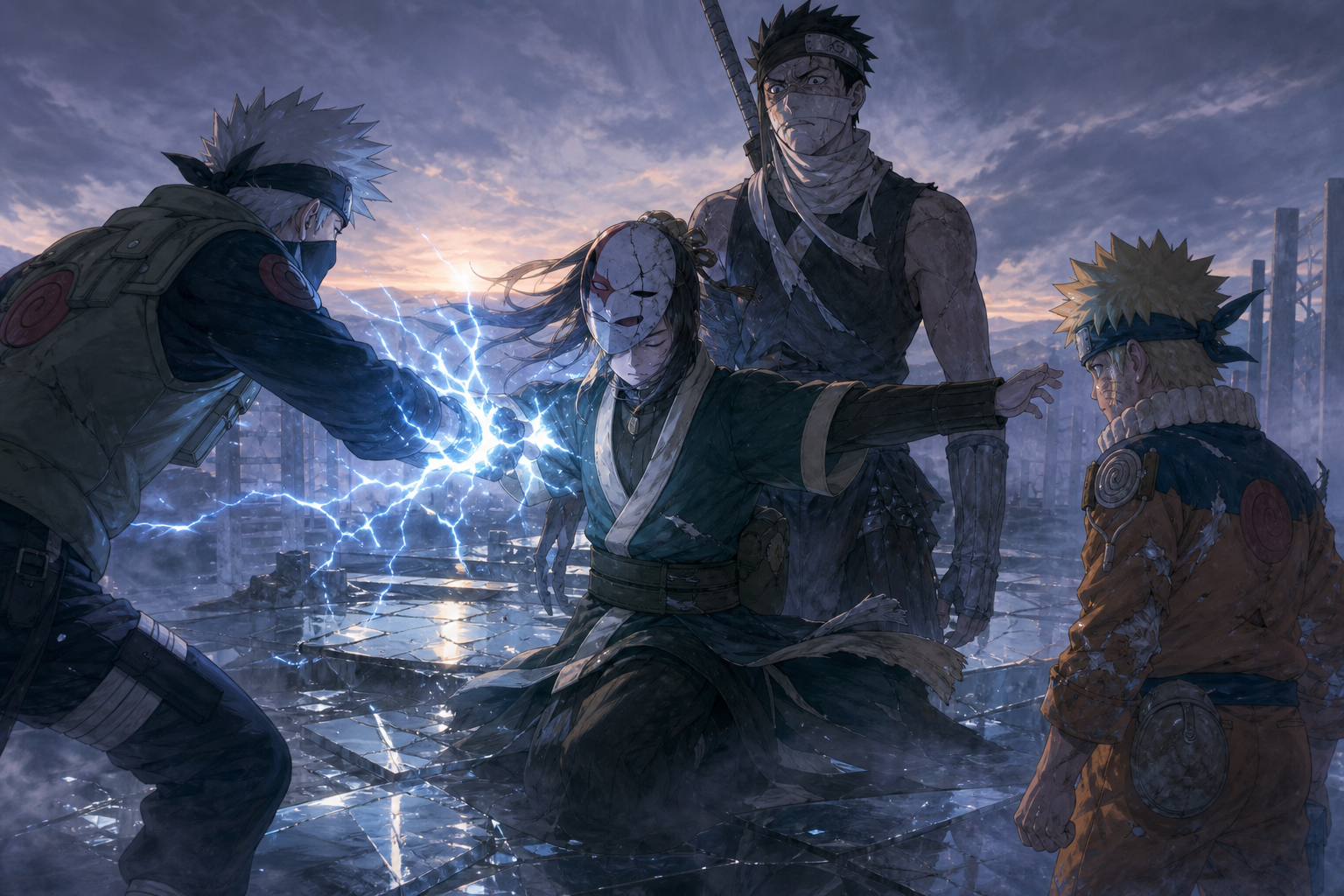
The speed that once served calculated offense becomes an act of protection. Haku leaves Naruto, crosses the battlefield, and places a body between Kakashi and Zabuza. There is no time for permission or strategy. Devotion becomes action.
Kakashi’s lightning-charged hand reaches the person who intervened. The moment is sudden, but it has been prepared across the entire arc. Haku said strength grows when protecting someone precious. Now the belief reaches its absolute expression.
Yet the act is not simple proof that Zabuza’s ownership was justified. Haku chooses under conditions shaped by abandonment, training, and conditional belonging. The choice is real, and the conditions are unjust. Both truths must be held together.
Zabuza survives because Haku absorbs the consequence intended for him. For a man who calls Haku a tool, this creates an unbearable moral debt. A tool is supposed to be replaceable. Haku’s particular life cannot be replaced, and the sacrifice exposes that fact.
Naruto watches. His earlier rage against Haku transforms into rage on Haku’s behalf. The enemy who apparently took Sasuke has become another child consumed by an adult’s purpose. Naruto’s moral attention changes direction without forgetting harm.
He confronts Zabuza’s indifference. If Haku gave everything, how can Zabuza speak as though a broken implement has merely completed its function? Naruto attacks the emotional lie required to maintain the shinobi mask.
Zabuza attempts to remain what the world trained him to be. Emotion is weakness. Shinobi are weapons. Haku chose the role. The vocabulary creates distance between the man and the person who protected him.
Naruto refuses that distance. His words insist that Haku cried, hoped, suffered, and loved. Haku’s devotion was not mechanical. Treating it as mechanical allows Zabuza to receive love without becoming accountable to it.
This accusation marks Naruto’s development. In Episode 1, he needed Iruka to recognize the person behind the Nine-Tails label. Now Naruto performs that recognition for Haku and demands it from someone else.
The episode does not fully resolve Zabuza’s response. That belongs to the next movement of the arc. Here, the essential event is the crack. Naruto’s words reach the place Zabuza has hidden beneath professionalism, brutality, and mist.
Are shinobi weapons?
The title states the ideology plainly. Weapons known as shinobi are trained to subordinate private feeling to assigned purpose. Villages need this belief because missions often require people to act against ordinary human attachment.
But the episode undermines the metaphor through Haku’s behavior. A weapon does not decide whom to protect. A weapon cannot form a theory of precious people, remember snow, fear abandonment, or choose sacrifice. Calling Haku a weapon is not a neutral description. The label is a political strategy for using a person without acknowledging reciprocal obligation.
The metaphor also protects Zabuza. If Haku is a tool, Zabuza need not ask what he owes. Ownership replaces relationship. Naruto’s accusation destroys that convenience by naming the emotional reality both men have lived.
The same question will follow Team 7. Are Naruto, Sasuke, and Sakura future weapons of Konoha, or people whose skills must remain answerable to conscience? Kakashi’s instruction about comrades suggests an alternative shinobi ethic, but the bridge shows how costly that alternative can be.
Haku’s agency without romanticizing exploitation
Describing Haku as having no choice would repeat the erasure the episode criticizes. Haku chooses Zabuza repeatedly. The affection is authentic. The final intervention is Haku’s action.
Treating Haku’s choice as evidence of a healthy relationship would also be wrong. Agency exists inside conditions. Haku’s earliest meaningful experience of being wanted was being identified as useful. That history narrowed the futures Haku could imagine.
Mature compassion holds both truths. Haku is not an empty victim, and devotion does not retroactively make exploitation benevolent. The tragedy is that an extraordinary capacity for love was taught to express itself through disappearance.
Naruto cannot save Haku by denying the bond. He can only insist that the bond should have recognized Haku as more than service. That distinction becomes the moral foundation of his speech to Zabuza.
Naruto’s first great moral confrontation
Naruto’s power on the bridge is not the Nine-Tails’ chakra. Naruto’s real power is the refusal to let dehumanizing language close the case. He does not possess rank, authority, or polished philosophy. He has emotional evidence and the courage to say what the adults avoid.
This is the beginning of the Naruto pattern sometimes reduced to “talking enemies down.” The phrase misses the mechanism. Naruto identifies the contradiction between a person’s performed ideology and the attachments their life reveals. He does not win by eloquence alone. He forces recognition.
With Zabuza, the contradiction is visible beside them. A supposedly disposable tool made a choice saturated with love. Zabuza’s attempt at indifference becomes harder to sustain because Naruto names what the sacrifice means.
Naruto can do this because he knows how it feels to be mistaken for a function. Konoha treated him as a container for danger. Haku was treated as a container for useful power. Naruto’s protest is personal and political: a person is never identical to what others can extract.
Easter eggs and craft details
The same movement that terrorized Naruto and Sasuke becomes the means by which Haku protects someone precious.
Kakashi’s concentrated visible force meets Haku after the reflective technique has collapsed. No mask of multiplication remains.
Iruka once recognized Naruto behind a label. Naruto now performs that ethical recognition for Haku.
Even after the literal mist clears, Zabuza uses shinobi language to conceal feeling from himself.
Haku’s intervention is not commanded. Spontaneous protection demonstrates agency the metaphor cannot contain.
Naruto is not only mourning Haku. He is demanding that the recipient of devotion acknowledge its human source.
RaeRae reacts: do not call someone a tool after accepting their whole heart
This episode makes me furious in exactly the productive way. Zabuza receives everything Haku has and tries to protect himself with the language of weapons. Sir, no. You do not get to benefit from a child’s love and then pretend the love was mechanical because admitting it would hurt.
Haku’s choice is beautiful, but I refuse to call the system beautiful. The shinobi world trains children to make self-erasure look like the highest form of devotion. Naruto honors Haku by seeing the love and condemning the conditions that made disappearance feel necessary.
That distinction is why Naruto’s speech works. He does not say Haku never chose Zabuza. He says the choice came from a heart, and a heart creates responsibility in the person who receives it.
Naruto is still a messy child with no elegant vocabulary, but he is morally clearer than the adults. He knows the central fact: if someone cries for you, dreams for you, trains for you, and spends everything for you, you are not holding a weapon. You are holding another person’s trust.
What the author is really telling us
Episode 18 examines the stories institutions tell to make human sacrifice administratively convenient. “Weapon” is such a story. The word converts a person’s decision into an expected function and converts another person’s grief into professional inefficiency.
Naruto’s protest restores subjectivity. Haku acted. Haku loved. Haku suffered. Each verb returns ownership of the life to the person who lived it.
Existentially, Haku’s final choice remains ambiguous. Haku’s act is both authentic devotion and a choice constrained by an identity formed under abandonment. Freedom is rarely pure. We choose from possibilities the world has taught us to imagine.
The moral demand falls on the survivor. Zabuza cannot change the conditions that shaped Haku’s choice, but he can decide whether to continue lying about its meaning. Recognition arrives late, yet late recognition can still alter what a person does next.
This is the episode where Naruto’s ninja way begins expanding beyond personal perseverance. “Never give up” becomes “never surrender another person’s humanity to the role imposed on them.” That principle will eventually challenge villages, enemies, and inherited history itself.
Kakashi at the center of an impossible result
Kakashi’s position deserves attention because the Lightning Blade is aimed at Zabuza, not Haku. He acts within the battle’s immediate logic: remove the enemy threatening the client and students. Haku’s intervention changes the moral meaning of the attack after the commitment has been made.
This is another way the episode rejects clean categories. Kakashi is not cruel for striking. Haku is not merely passive for intervening. Zabuza is not innocent because someone protects him. Each person acts from a different obligation, and the collision produces a result none can fully own alone.
Kakashi’s shock matters. Experienced shinobi survive partly by converting action into technique: target, angle, timing, consequence. Haku’s body reintroduces relationship into that calculation. The person in front of the attack is suddenly not the intended enemy but someone choosing another’s survival.
The event also complicates Kakashi’s lesson about comrades. Haku follows the same principle to its limit: a precious person matters more than rules and safety. Yet Kakashi’s ethic was meant to humanize shinobi, while Haku’s version has been absorbed into self-erasure. Principles cannot be judged apart from the identities and power structures through which they operate.
Kakashi will carry the event as part of his own growing understanding of Team 7. Protecting comrades cannot mean teaching children that the best proof of love is always a body placed in harm’s path. The harder task is creating conditions where they can live for one another.
Haku’s final movement is both choice and evidence of the cage
Haku abandons the fight with Naruto the instant Zabuza is in mortal danger. The mirrors, the mission, and even Haku’s own survival become secondary. That movement is agency. It is also the clearest proof of how completely Haku’s sense of self has been organized around protecting one person.
Calling the sacrifice voluntary does not make the conditions around it healthy. Haku chooses from within a life narrowed by persecution, homelessness, and conditional belonging. The choice belongs to Haku. The world that made self-erasure feel like fulfillment deserves judgment too.
Kakashi’s hand becomes the instrument of somebody else’s devotion
Kakashi aims the Lightning Blade at Zabuza and finds Haku’s body in its path. He did not intend to kill Haku in that moment, yet intention cannot prevent the result. The scene places a professional shinobi inside the machinery the episode is questioning. Kakashi’s lethal skill serves the defense of Tazuna, but a child absorbs it.
That does not make Kakashi equivalent to Gatō or Zabuza. It does make the outcome harder than a clean hero-versus-villain frame. The adults’ missions intersect, and the youngest fighter pays the final cost.
Zabuza’s tool language protects him from obligation
Zabuza calls Haku a weapon because weapons do not require grief. If Haku was only useful, then Haku’s death is simply the loss of an asset. The language lets Zabuza preserve the identity of a demon who cannot be reached by attachment.
Naruto hears the lie because he has spent his own childhood being reduced to what he contains. The village saw the Nine-Tails before it saw Naruto. He recognizes what it means to make a person carry a label large enough to hide their humanity.
Naruto’s anger becomes moral argument instead of raw force
The broken seal gave Naruto terrifying power in the previous episode. Here, his most important weapon is speech. He refuses Zabuza’s claim that Haku’s devotion was meaningless, and he names the emotional debt Zabuza is trying not to acknowledge.
Naruto is not delivering a perfectly measured analysis. He is grieving, furious, and speaking from his own need to believe that love leaves a claim on the people who receive it. The lack of polish is why the confrontation works. He is not debating shinobi philosophy. He is demanding that an adult stop hiding behind it.
The shinobi system rewards emotional denial
Training people as tools requires teaching them that attachment is weakness until attachment becomes useful for sacrifice. Haku’s loyalty improves Zabuza’s survival. Sasuke’s bond with Naruto makes him intercept needles. Kakashi’s care for his team sharpens his choices. The system depends on relationships while pretending professionals should stand above them.
Episode 18 exposes that hypocrisy. Emotion is never absent. It is managed, renamed, and exploited. A shinobi who claims to feel nothing may simply be using doctrine to avoid responsibility for what feeling would demand.
Haku’s kindness remains real even when the mission is wrong
Haku’s care in the forest, restraint inside the mirrors, and devotion to Zabuza all come from the same person. None of those qualities cancels the harm done to Naruto and Sasuke. None of that harm proves the tenderness was fake.
The episode asks viewers to hold moral complexity without turning it into moral fog. Haku was exploited. Haku also participated in violence. Zabuza offered belonging. He also built that belonging around usefulness. Understanding every part is not the same as excusing every part.
Sasuke’s awakening changes Naruto before Sasuke even rises
Naruto believes Sasuke has died for him, and that belief reorganizes their relationship. The rivalry can never return to being only competition after Naruto has felt the terror of losing it. Sasuke’s body made the bond visible; Naruto’s grief makes its depth undeniable.
Even before the misunderstanding is corrected, the consequence is real. Naruto now knows that another person chose him without being forced, and that knowledge will remain part of how he understands Team 7.
RaeRae’s final take
Episode 18 asks what happens when people trained as weapons insist on loving anyway. Haku turns devotion into a shield. Sasuke has already done the same. Kakashi’s attack becomes part of a result he did not seek. Zabuza tries to survive it by reducing Haku to function.
Naruto refuses. His confrontation matters because he demands recognition after the person who needed it can no longer receive it. That timing is devastating, but it is also the crack in Zabuza’s demon mask. Haku’s life cannot be returned. The lie that it meant nothing can still be challenged.
The episode is not telling us that sacrifice proves love. It is showing how cruel a world becomes when children believe sacrifice is the only language strong enough to make their love undeniable.
Naruto’s recognition also arrives painfully late. He can see Haku as a whole person only after the battle has made repair impossible. That failure is not his alone, but it becomes part of his education. Looking beneath the assigned role cannot wait until the mask breaks. A shinobi world that sorts children into ally, enemy, vessel, and weapon depends on everyone postponing curiosity until grief forces it.
Haku deserved that curiosity while alive, before sacrifice became the only testimony the adults around Haku were willing to understand.
Episode file
| Episode | 18 |
|---|---|
| Title | The Weapons Known as Shinobi |
| Arc | Land of Waves |
| Key conflict | Haku makes a final protective choice, and Naruto challenges Zabuza’s claim that shinobi are merely tools. |
| Emotional center | Receiving another person’s devotion creates responsibility. |
| Official guide | Naruto Official Episode 18 guide |
| Watch officially | Crunchyroll · Netflix availability varies by region |
Final verdict
Episode 18 transforms Haku from the subject of Naruto’s empathy into the author of a final choice. The episode also transforms Naruto from a child demanding recognition into someone who demands recognition for others.
Rating: 10/10. The episode’s power comes from refusing to let “weapon” remain a metaphor without a victim.