
What happens when a weapon can no longer be useful?
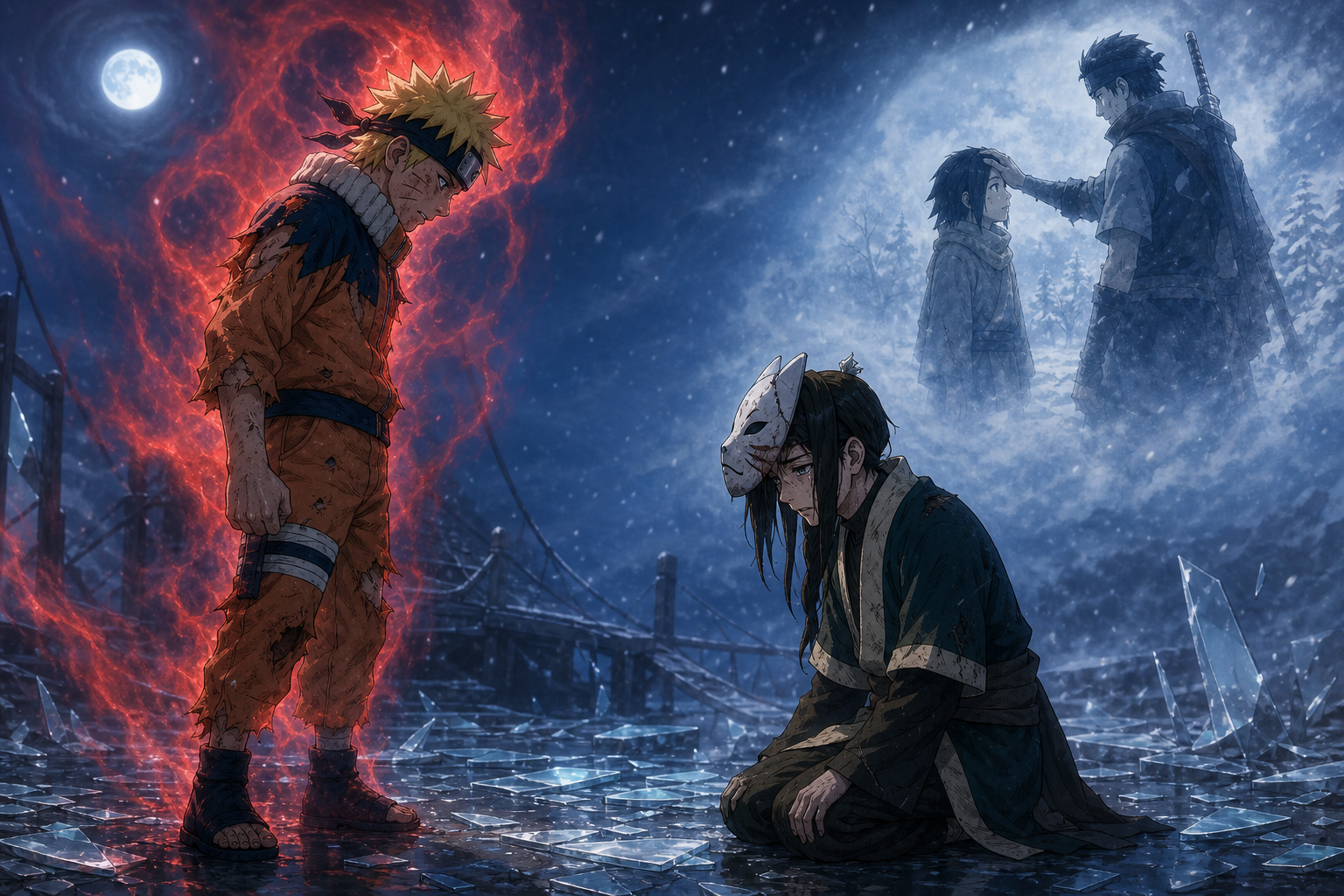
Naruto breaks Haku’s mirrors and reaches the person behind the mask. The real battle begins after victory, when Haku reveals a life built on the belief that usefulness is the only price anyone will pay for belonging.
After the seal breaks
Naruto Uzumaki believes Sasuke has died protecting him. Grief has released the Nine-Tails’ chakra, healing Naruto’s wounds and overwhelming the limits that governed the mirror fight. Haku, who controlled every previous exchange, can no longer match the force approaching.
The question appears to be whether Naruto will defeat Haku. Episode 17 answers that quickly, then replaces it with something harder: what does defeat mean to a person who believes existence is justified only by serving someone else?
The recap: rage reaches the person behind the mask
Naruto’s chakra tears through Haku’s advantage. Speed that once looked supernatural can no longer protect the masked hunter. Naruto tracks the movement, closes distance, and strikes with force powered by the beast sealed inside him.
The Crystal Ice Mirrors break. Their collapse is both tactical and symbolic. Haku’s technique transformed one body into a system of reflections, hiding the individual behind perfect function. Naruto’s rage destroys the system and leaves one exhausted person in front of him.
Haku’s mask cracks. Naruto recognizes the gentle stranger from the forest, the person who spoke about becoming strong for someone precious. The enemy and the kind traveler become the same human being.
This recognition interrupts Naruto’s violence. Moments earlier he had a clean emotional story: Haku hurt Sasuke, therefore Haku deserves destruction. The revealed face makes that certainty difficult to sustain. Naruto has shared a peaceful conversation with this person. He knows the dream beneath the weapon.
Haku does not use that recognition to plead for safety. Instead, Haku explains that defeat has made continued existence feel empty. Zabuza needed a capable tool. If Haku cannot meet that expectation, the purpose organizing life appears to have vanished.
Naruto is horrified and understands more than he wants to. He has also built his life around being acknowledged by another authority. Becoming Hokage is a personal dream, but it is entangled with the hope that the village will finally confirm his worth. Haku’s dependence on Zabuza is more extreme, yet the emotional structure is familiar.
We learn the white past behind the mask. Haku was born in a region where kekkei genkai became objects of fear after war. The inherited Ice Release that made Haku extraordinary also made the child dangerous in the eyes of ordinary adults.
Haku’s mother hid the bloodline. When the ability surfaced, family safety collapsed. Fear turned domestic love into violence, and Haku was left alone in the snow with power, guilt, and no protected place in the world.
The snow matters. The snow is beautiful, quiet, and indifferent. A child can disappear inside it without the world changing. Haku’s early life teaches that being special does not guarantee being cherished. Difference can attract terror before it attracts wonder.
Zabuza finds Haku in that condition. He identifies the bloodline’s usefulness and offers a role. To an abandoned child, being useful feels dangerously similar to being loved. Zabuza does not need to promise tenderness. He needs only to say that Haku is wanted.
Haku accepts. Training turns survival into function, function into identity, and identity into devotion. The mask is not simply professional equipment. The mask is the face of a bargain: if Haku can become the weapon Zabuza needs, abandonment might never happen again.
Back on the bridge, Naruto listens. His chakra begins settling because empathy competes with rage. This is one of Naruto’s defining abilities, though no academy test could measure it. He can recognize the lonely child inside an opponent because he has spent his own childhood waiting to be recognized.
Naruto struggles with what Haku asks of him. The request would complete Haku’s weapon logic: a failed tool should be discarded. Naruto’s reluctance is therefore not weakness. Refusing to reduce Haku to an object is the first genuine resistance to the system that produced this fight.
Meanwhile, Kakashi and Zabuza continue their battle, separated physically from the moral conversation but connected to it. Haku’s entire understanding of worth depends on what Zabuza expects. Naruto sees a precious bond. The episode leaves open whether Zabuza sees a person or only an instrument.
Episode 17 ends without resolving that tension. Haku’s past explains the devotion but does not make the devotion healthy. Naruto’s compassion does not magically give Haku a new identity. Understanding arrives before rescue, which is honest. A life built around usefulness cannot be rebuilt in one conversation.
Usefulness is not the same as worth
Haku’s tragedy is not merely loyalty to the wrong person. Haku’s deeper tragedy is the belief that worth must be earned through utility. Zabuza’s need provides structure after chaos, but the structure requires Haku to remain effective.
This belief is common far beyond the shinobi world. People learn to justify their place by productivity, obedience, beauty, emotional labor, or the ability to solve someone else’s problems. When performance fails, shame does not say “I did poorly.” Shame says, “I should not exist here.”
Naruto’s reaction matters because he has been treated as socially useless and actively dangerous. The village did not value him for what he could do. The village blamed Naruto for what he contained. His dream of becoming Hokage partly answers that wound by imagining maximum usefulness and recognition. Haku shows him the danger of making external need the foundation of identity.
The humane alternative is unconditional personhood. Haku matters before service, after defeat, and outside Zabuza’s ambition. Naruto senses this before he can articulate it. His lowered fist says what the shinobi world refuses to teach: failure does not cancel humanity.
The politics of inherited difference
Haku’s kekkei genkai is inherited, not chosen. Communities shaped by war convert that inheritance into suspicion. The bloodline becomes a symbol for historical suffering, and a child becomes the available target for fear that should have been directed at systems and armies.
This pattern parallels Naruto’s treatment as a jinchuriki. In both cases, adults collapse the distinction between a child and a dangerous power. Haku is feared for Ice Release. Naruto is feared for the Nine-Tails. Each grows up carrying meanings assigned before either could consent.
The hidden villages claim to organize power rationally through clans, ranks, and missions. Yet the world outside them reveals how quickly extraordinary ability can become stigma or commodity. Difference is feared when uncontrolled and exploited when useful.
Zabuza does not cure the prejudice that isolated Haku. He converts the stigmatized ability into labor. That conversion feels like salvation because exploitation can be warmer than abandonment. Episode 17 asks us to notice that “needed” can still be a cage.
Mask, face, and fractured identity
Haku’s hunter-nin mask hides age, gender presentation, tenderness, and history beneath professional function. Inside the mirrors, the mask multiplied until function occupied every visible surface. When the mirrors and mask break, Naruto can no longer pretend he is fighting an abstract enemy.
But the face underneath is not a simple “true self” untouched by the role. Haku genuinely loves Zabuza. Haku genuinely chose training and takes pride in usefulness. Oppression does not make every attachment false. Oppression makes attachments complicated by the conditions under which they became necessary.
Naruto’s task is not to tell Haku that none of those feelings are real. Naruto must challenge the conclusion that those feelings require self-erasure. Love that demands a person become only a tool has confused devotion with disappearance.
Easter eggs and craft details
The title connects Haku’s name, the snow of childhood, and a memory visually emptied of ordinary warmth.
Physical damage reveals personhood, but Haku’s internal weapon identity remains intact. Seeing a face is only the beginning.
Naruto contains a feared beast; Haku contains a feared bloodline. Adults treat both children as extensions of power.
The forest conversation returns with its moral ambiguity. Protection can inspire growth, but it can also justify self-erasure.
Naruto wins physically early enough that the episode can ask whether defeating an enemy has solved anything human.
Naruto’s signature power is already emerging: he interrupts inherited cycles by recognizing himself in the opponent.
RaeRae reacts: Haku deserved to be wanted without becoming useful first
This episode hurts because Zabuza’s offer really did save Haku from one kind of death. That is why the bond cannot be dismissed as fake. A lonely child was seen, selected, trained, and given direction. Gratitude grows naturally in that soil.
But baby, being useful is not the same as being loved. If your entire right to remain beside someone disappears when you lose, then the relationship has built a trapdoor under your identity.
Naruto understands because he is chasing a village’s acknowledgment with everything he has. Haku is a warning about what happens when another person’s need becomes the only mirror capable of showing you a face.
I also love that Naruto’s anger does not vanish because Haku is innocent. Haku did hurt Sasuke. Compassion does not require pretending harm never happened. Compassion requires holding accountability and personhood at the same time. Naruto lowers his fist because he sees a human being, not because the pain has become imaginary.
What the author is really telling us
Episode 17 asks whether a self built for another person is still a self. Haku has desires, memories, affection, and extraordinary skill, yet every element has been organized around Zabuza’s ambition. When usefulness fails, Haku cannot imagine a remainder.
Existentially, this is bad faith in a devastatingly sympathetic form. Haku treats “tool” as an essence rather than a role repeatedly chosen under constrained conditions. The role feels inevitable because the alternative once looked like abandonment in the snow.
Naruto introduces freedom by refusing the role’s conclusion. If Haku is a person, then defeat creates uncertainty, not nonexistence. Uncertainty is frightening, but it is also where a different future could begin.
The hidden village system benefits when shinobi believe they are tools. Tools do not ask whether missions are just, whether children should fight, or whether loyalty is reciprocal. Haku’s private tragedy therefore exposes a political ideal shared across rival communities.
Kishimoto’s deepest move is making Naruto’s compassion arise from similarity rather than superiority. Naruto does not stand above Haku as a morally pure savior. He recognizes a nearby version of his own hunger to be acknowledged. Saving Haku would also mean learning not to build his entire worth on Konoha’s applause.
Why Naruto pauses
Naruto’s pause is sometimes described as mercy, but mercy can imply a powerful person graciously sparing someone beneath them. The scene is more intimate. Naruto’s certainty has been disrupted by knowledge. He cannot return to the emotional simplicity he possessed while the mask was intact.
This is a crucial pattern in Naruto’s later moral development. He does not overcome hatred by denying the reasons for it. He lets another person’s story enter the space where hatred had promised a complete explanation. The story does not erase injury; it prevents injury from becoming the only truth available.
That willingness is costly. Rage offers momentum and a clear target. Empathy creates hesitation, contradiction, and responsibility. Naruto must now hold Sasuke’s apparent death, Haku’s agency in causing it, Haku’s childhood, and Zabuza’s exploitation at once. Maturity begins when no single fact is permitted to cancel all the others.
The pause also returns Naruto to himself. The Nine-Tails’ chakra gave grief a terrifying efficiency, but efficiency cannot decide what should happen next. By listening, Naruto resumes ethical authorship over his actions. He does not eliminate anger. He places anger inside a larger consciousness.
Haku’s childhood explains the cage without making it destiny
The flashback gives Haku a life before the mask: a mother, a frightened father, a village shaped by war, and a bloodline ability treated as proof of danger. Haku learns that being known can get the people closest to you killed. Concealment becomes survival long before Zabuza arrives.
That history explains why usefulness feels like safety. It does not mean Haku was born for Zabuza’s purpose. The tragedy is that a child whose difference was punished later meets an adult who values that difference primarily as a weapon. Rejection and recruitment become two sides of the same system.
Fear turns inherited difference into collective punishment
The village’s response to kekkei genkai grows from memories of conflict, but trauma does not become justice because many people share it. Families hide, neighbors suspect, and children inherit consequences for battles they did not choose. Haku’s mother knows exposure could destroy the household because the surrounding culture has already decided that blood can be evidence of guilt.
The episode is sharpest when it shows how violence enters the home. A political history becomes a father’s terror, a mother’s secret, and a child standing among bodies with a power nobody taught them to understand.
Zabuza offers belonging with a job attached
Zabuza finds Haku at the point of complete isolation and gives the child a place to go. That matters. Food, direction, and companionship can feel like rescue when the alternative is dying alone. The offer also defines Haku’s value through service from the beginning.
Haku accepts the language of being a tool because tools are kept while they remain useful. It is a devastating bargain disguised as certainty. Zabuza does not need to promise unconditional care. Haku has been taught not to expect it.
Naruto pauses because the enemy becomes a person
Rage carried Naruto through the mirrors until Haku’s mask broke and the kind stranger from the forest appeared underneath it. The recognition interrupts the simple story Naruto was using to fight. He can no longer imagine Haku as only the person who hurt Sasuke.
That pause is not weakness. It is Naruto’s moral imagination refusing to stay smaller than the evidence in front of him. Haku’s kindness does not erase the attack, and the attack does not erase the kindness. Naruto has to hold both while grief is still burning.
Haku and Naruto share a need but not the same answer
Both children want acknowledgment and someone precious to protect. Naruto chases recognition from a village that rejected him, while Haku anchors existence to one person who offers conditional belonging. Their similarities make the difference more painful.
Naruto insists a person should be more than a tool because his own survival depends on believing the village’s label is not his identity. Haku insists the chosen purpose is enough because losing it would reopen the emptiness Zabuza interrupted. Neither argument is abstract. Each child is defending the story that made continued life possible.
Sasuke’s apparent death changes the meaning of rivalry
Naruto’s grief confirms what Episode 16 already showed through Sasuke’s body. Their competition has become relationship. Sasuke was not merely the standard Naruto wanted to defeat. He was a witness, irritant, partner, and person whose attention carried weight.
The series often uses rivalry as a machine for improvement. Here it becomes evidence of mutual attachment. Naruto’s fury is frightening because the bond is real, and because he has so little experience surviving the loss of something he was finally allowed to have.
The mask protects Haku and permits everyone else to simplify Haku
Behind the hunter-nin mask, Haku can perform lethal competence without asking the opponent to recognize a child. The disguise offers safety from intimacy as much as anonymity. Once it breaks, Naruto must reconcile the face from the forest with the violence inside the mirrors.
Zabuza benefits from the simplification too. A masked weapon does not visibly ask whether devotion is returned. A face makes the arrangement harder to keep emotionally clean.
RaeRae’s final take
Episode 17 refuses to let Haku remain an elegant obstacle. The flashback shows how war, prejudice, family terror, and conditional rescue narrowed a child’s understanding of worth until being useful felt like the same thing as being loved.
Naruto’s pause is the episode’s most important action. He is furious enough to destroy the person in front of him, then recognizes somebody who once spoke gently about precious people. That recognition does not solve the battle. It restores the moral difficulty the battle was trying to erase.
Haku deserved a world where power did not make family afraid and belonging did not require becoming a weapon. Understanding that truth is not the same as excusing every choice made inside the cage. It is how we see the cage clearly enough to condemn the people and systems that built it.
Haku still possesses agency inside that history, but agency under dependency is never simple. The meaningful question is not whether Haku chose Zabuza in some technical sense. It is what choices were imaginable to a homeless child who had already learned that being fully seen could end in blood.
Episode file
| Episode | 17 |
|---|---|
| Title | White Past: Hidden Ambition |
| Arc | Land of Waves |
| Key conflict | Naruto defeats Haku physically, then confronts Haku’s belief that losing usefulness means losing worth. |
| Emotional center | The difference between being needed and being loved. |
| Official guide | Naruto Official Episode 17 guide |
| Watch officially | Crunchyroll · Netflix availability varies by region |
Final verdict
Episode 17 breaks more than Haku’s mirrors. The episode breaks the distance that allowed Naruto to understand the masked hunter only as an enemy. Haku’s past transforms an elegant technique into the architecture of a life built on conditional belonging.
Rating: 10/10. A foundational Naruto episode because it discovers that winning a fight can be the moment a moral responsibility begins.