
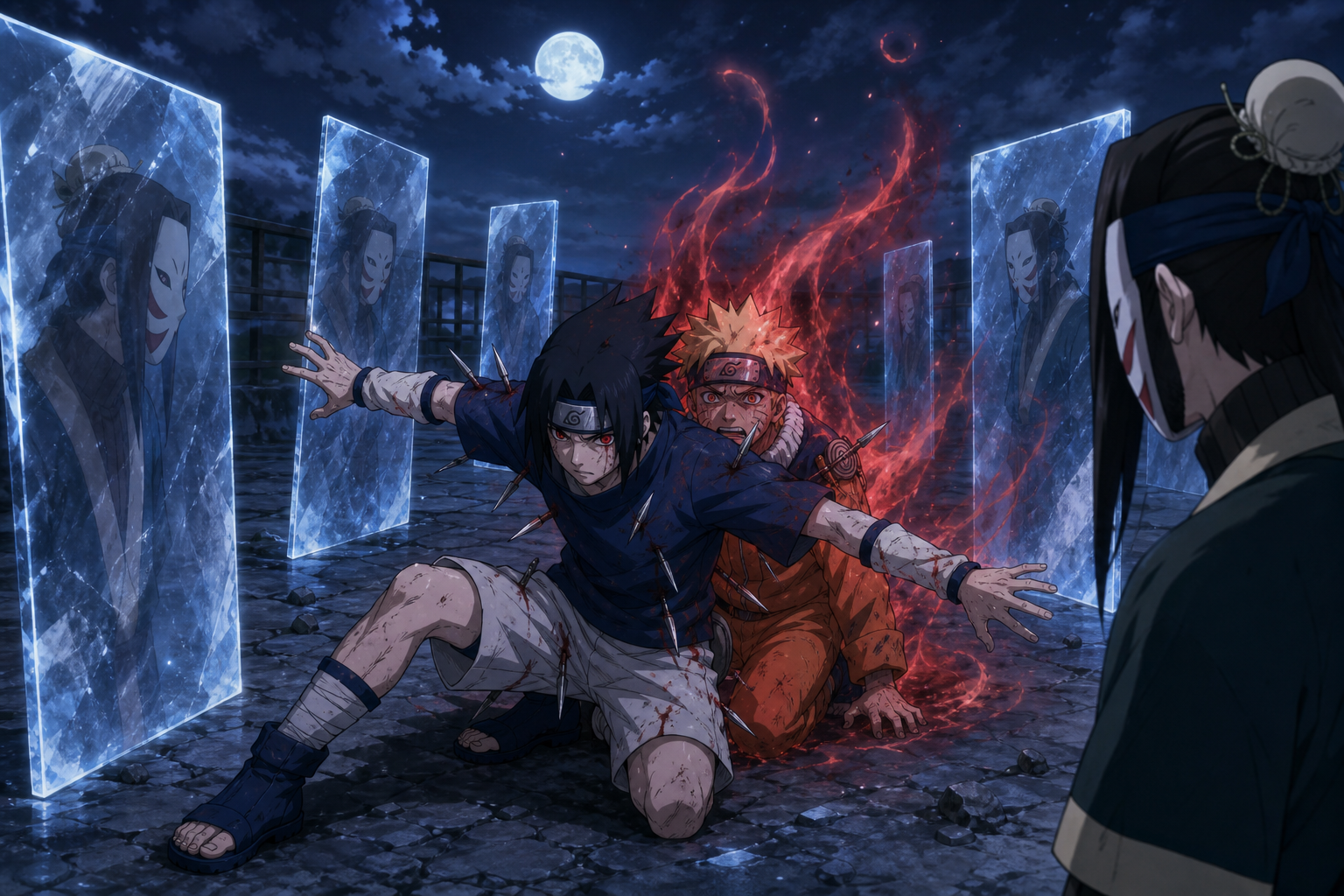
Sasuke’s body admits the friendship before his mouth can.
The boy who built his life around distance steps between Naruto and death. Grief answers sacrifice by cracking open the seal, and the bridge discovers that Naruto’s loneliness has always contained something enormous.
The moment before everything changes
Naruto Uzumaki can barely stand. Haku’s senbon and relentless speed have reduced his shadow-clone offense to exhaustion. Sasuke, however, is beginning to see. His Sharingan emerges under pressure, allowing him to track fragments of Haku’s movement and evade attacks that were invisible moments earlier.
That improvement threatens Haku’s control. If the fight continues, Sasuke may fully solve the mirrors. Haku therefore stops treating time as an ally and chooses to finish the battle by targeting the more vulnerable Naruto.
The recap: instinct outruns identity
The episode begins with punishment already in progress. Naruto and Sasuke are covered in the evidence of every failed attempt. Haku’s technique remains beautiful from a distance and merciless inside it. Ice reflects the masked face in all directions while senbon arrive with surgical restraint.
Sasuke’s new perception changes the rhythm. His eyes follow Haku’s path between mirrors. He bends away from needles that would have struck cleanly and begins forcing Haku to acknowledge him as a growing problem. The Sharingan is not a victory button. Sasuke’s awakened eye returns a fraction of a second to a boy who has been fighting without enough time.
Haku understands what that fraction can become. Sasuke develops while wounded, which means delay favors the Uchiha. Haku decides to end the contest immediately and directs the next assault toward Naruto, whose body has reached its limit.
Naruto sees danger but cannot answer fast enough. Sasuke does.
There is no speech, no calculation delivered to the audience, and no proud declaration of teamwork. Sasuke moves. He places himself in the path of the senbon and takes the attack meant for Naruto. The rival who mocked Naruto’s incompetence becomes a shield.
The scene is iconic because it exposes the difference between a chosen self-image and a lived self. Sasuke believes he is solitary, controlled, and organized around revenge. Yet when Naruto is about to die, an older and more immediate truth takes control. He cares.
As Sasuke collapses, Naruto tries to understand what has happened. Their language remains characteristically rough. Sasuke does not suddenly become tender. He can barely explain why he moved. His body acted without permission from the identity he has spent years constructing.
Naruto catches him. The emotional shock is larger than the apparent tactical event. Naruto has wanted recognition all his life, but recognition usually meant applause, attention, or the Hokage title. Sasuke gives him a terrible form of recognition: proof that Naruto’s life matters enough for another person to spend his own.
Grief enters before certainty. Naruto believes Sasuke is dead. The boy who constantly declares that he will never give up is confronted with a loss determination cannot reverse. Anger does not merely rise in him; it reaches the sealed chamber at the foundation of his identity.
The Nine-Tails’ chakra erupts.
Red energy distorts the air around Naruto. His wounds begin healing. His features sharpen into something feral, and the pressure of his presence changes the enclosure. The mirrors that made Haku seem absolute now face a force outside the scale of their previous contest.
Haku, who has controlled every beat, is stunned. The chakra is dense, hostile, and connected to a creature whose attack defined Konoha’s recent history. Naruto does not consciously choose a technique. The power answers pain, making grief both emotional experience and battlefield event.
The broken seal is not total. Naruto has not become the Nine-Tails. He remains recognizably himself, but the boundary between boy and imprisoned beast has opened enough for rage to pour through. This distinction matters. Naruto’s pain does not reveal a secret “true monster.” The pain creates a moment in which the monster assigned to him can lend its language to feelings he cannot otherwise contain.
Haku’s mirrors begin losing their invincibility. The episode shifts from careful observation to raw force, but the force is born from relationship. Naruto does not access it because he wants personal glory. He accesses it because he believes Sasuke has been taken from him.
Outside the ice prison, the other battles continue, but the emotional center has collapsed inward. Sasuke’s protective choice and Naruto’s answer redefine what Team 7 means. The bell test taught them to share food. The bridge teaches them that comrades can enter the body’s deepest reflexes.
Episode 16 closes inside that eruption. The consequences will continue, but this chapter belongs to the instant the seal breaks and the rivalry’s hidden tenderness becomes impossible to deny.
Why Sasuke’s sacrifice matters
Sasuke is not simply being heroic. He is contradicting the narrative he tells about himself. Revenge requires him to survive. His entire future supposedly points toward killing his brother. Protecting Naruto risks erasing that future for a relationship he has barely admitted exists.
This makes the act existential. Identity is not only the plan we announce. Choices made when planning disappears reveal the pattern underneath. Sasuke’s reflex says that he is already connected to the living, despite his devotion to the dead.
His action also mirrors the loneliness he recognizes in Naruto. Both boys lost family. Both learned to use superiority or noise as armor. Sasuke can see Naruto because Naruto’s hunger for acknowledgment resembles his own hunger for a world before massacre. The sacrifice is not pity. Sasuke’s choice is recognition moving faster than language.
The seal as politics, psychology, and metaphor
Konoha sealed the Nine-Tails inside a newborn, then allowed the village to treat that child as the disaster itself. The seal is therefore more than a magical mechanism. The mark on Naruto’s body gives physical form to a social contradiction. Naruto contains the village’s danger and is punished for containing it.
Psychologically, the seal resembles repression. Naruto survives by building an identity around optimism, mischief, and ambition, while fury accumulated through abandonment remains beneath conscious performance. Sasuke’s apparent death makes that division impossible to maintain. The feeling below the seal does not arrive as articulate grief. Grief arrives as power.
The episode does not say anger is evil. Naruto’s anger is morally intelligible. Someone he loves has been harmed while protecting him. The danger lies in becoming unable to distinguish justice from annihilation once pain controls the available vocabulary.
This is one of the series’ central problems: how can Naruto integrate rage without letting it define him? The village wants the power contained. The Nine-Tails offers power without ethical guidance. Naruto will need a third path, one that acknowledges what was done to him and still preserves his capacity to recognize other people.
Haku’s terrible professionalism
Haku targets Naruto because the decision is tactically correct. That is precisely what makes it painful. The gentle person Naruto met in the forest has learned to translate human beings into vulnerabilities. Naruto is slower and wounded; therefore Naruto becomes leverage against Sasuke.
Haku’s surprise at Sasuke’s sacrifice reveals that complete instrumental thinking has limits. A tool protects its user. A comrade spends himself for another comrade. Haku understands devotion to Zabuza, but he has organized that devotion around usefulness. Sasuke’s act comes from a bond neither boy has formalized, making it difficult to predict within the logic of weapons.
Then Naruto’s grief produces power Haku could not model. Love becomes the variable that breaks the system. The break does not happen gently. The series refuses the easy idea that love only heals. Love can also unlock rage terrifying enough to destroy the person standing in front of it.
Easter eggs and craft details
Sasuke cannot explain why he moved because the bond has developed beneath the vocabulary he uses to deny it.
Sasuke’s inherited perception and Naruto’s sealed inheritance surface in the same fight, both triggered by protection.
Haku aims with precision rather than spectacle, reinforcing that control, not cruelty for its own sake, defines the technique.
The visual temperature flips. Haku’s cold ordered prison meets chakra shaped like uncontrolled heat and grief.
Kakashi said those who abandon comrades are worse than scum. Sasuke now obeys that lesson at the possible cost of his life.
Naruto finally receives undeniable proof that he matters to someone, but the proof appears to be Sasuke’s death.
RaeRae reacts: this is where the rivalry becomes love
I know “love” makes people want to sort the relationship into a neat category, but the episode is stronger than the category debate. Sasuke moves because Naruto has become precious to him. Call it friendship, brotherhood, comradeship, or the earliest form of a bond neither can explain. The body has already voted.
That is what wrecks me. Sasuke has one stated reason to live, and in one instant he acts as though Naruto’s life matters more. He does not get a polished heroic speech. He is confused by himself. That confusion makes it honest.
Then Naruto receives the recognition he always wanted in the cruelest possible package. Sasuke saw him. Sasuke valued him. Sasuke may have died proving it. Of course the seal breaks. Naruto has spent years swallowing the village’s rejection, but this loss cannot be turned into a prank or a boast.
The red chakra is thrilling, and it should also scare us. The first power that fully answers Naruto’s grief is not a teacher, a village, or a healthy emotional language. The beast imprisoned inside Naruto answers first. That answer is not a triumph of support. The answer exposes how alone Naruto still is.
What the author is really telling us
Episode 16 argues that action can reveal a self more truthfully than intention. Sasuke intends to live for revenge. He acts to save Naruto. Naruto intends to win through determination. He is transformed by grief. Haku intends to function as a perfect tool. The human unpredictability of his opponents begins destroying that framework.
The hidden village trains people to control bodies, chakra, and information, but it cannot fully control attachment. Relationships create obligations that compete with missions, revenge, hierarchy, and survival. That competition is dangerous to the system because it makes tools choose one another.
Existentially, Sasuke becomes through the act he did not plan. We often imagine authenticity as discovering a stable truth inside ourselves. The episode offers something harsher and more hopeful: sometimes the truth is created at the instant we choose another person.
Naruto’s broken seal poses the inverse question. If pain releases a power inside you, is that power who you are? The episode says no, but it does not pretend separation is easy. Naruto must eventually take responsibility for what passes through him without accepting the village’s claim that he and the Nine-Tails are identical.
The cruelty of needing catastrophe to prove you matter
Naruto has asked for acknowledgment through every harmless method available to a neglected child. He paints the Hokage Monument, interrupts class, boasts, challenges Sasuke, and dreams publicly enough that the village cannot entirely erase him. Most adults interpret those acts as nuisance rather than communication.
Sasuke’s sacrifice answers the request at maximum volume. Naruto matters. The answer is undeniable because it appears to cost a life. That structure is emotionally powerful and socially damning. Why did recognition have to arrive through catastrophe? Why could the village not teach Naruto his value before a teammate bled for it?
The scene therefore contains both healing and injury. Naruto receives proof of connection, but the proof reinforces the idea that love is measured through suffering. The long work ahead will involve learning that bonds can be maintained in ordinary time, through attention, patience, disagreement, and return, not only through dramatic self-destruction.
Sasuke also deserves more than martyrdom. His instinct to protect Naruto is beautiful, yet a healthy future would let him choose relationship without believing death is the clearest gift he can offer. The shinobi world romanticizes sacrifice because sacrifice keeps its missions functioning. The series’ deepest challenge is to honor courage while questioning the institutions that continually demand it from children.
Sasuke’s body admits the bond before his voice can
Sasuke moves in front of Naruto without time to turn the choice into a strategy or an excuse. That is why the sacrifice lands so hard. The boy who insists his future belongs to revenge spends his body protecting the teammate he once dismissed as dead last. His instinct reveals a life larger than the single purpose he has been forcing himself to serve.
The moment does not erase Sasuke’s trauma or transform him into somebody openly affectionate. It proves Team 7 has entered the part of him that still chooses connection. He may not know what to call Naruto, but his body already answers the question.
Naruto’s rage is grief arriving before understanding
Naruto sees Sasuke fall and experiences the loss as immediate, absolute, and unbearable. The Nine-Tails chakra answers that emotional rupture. Power arrives before reflection, shaped by the terror that somebody who finally acknowledged him has been taken away.
This is not a triumphant upgrade. Naruto’s strength becomes frightening because it does not feel fully chosen. The seal loosens under pressure, and the chakra changes his body, perception, and intent. The child who wanted power to protect a friend is suddenly close to becoming another danger inside the same enclosure.
The seal is also a political decision written onto a child
Naruto did not consent to carry the Nine-Tails, and the village built much of his social identity around a containment choice made when he was an infant. Episode 16 shows the private cost of that public solution. Adults gained safety. Naruto inherited isolation, secrecy, and a reservoir that emerges when his emotional defenses collapse.
The power saves him from immediate helplessness, but it does not make the arrangement just. A weaponized childhood remains a weaponized childhood even when the weapon proves useful.
Haku recognizes the change but cannot abandon the assignment
Haku has controlled the battle through precision and restraint. Naruto’s transformed chakra destroys that rhythm. The mirrors no longer feel like a perfect world because raw force begins breaking the assumptions that made them absolute.
Haku still responds as Zabuza’s tool. That loyalty has been framed as gratitude, purpose, and love, but the episode makes the cost impossible to romanticize. Haku’s place beside Zabuza depends on continuing a fight against children whose devotion mirrors Haku’s own.
Kakashi cannot reach the crisis he can sense
Outside the mirrors, Kakashi remains trapped in Zabuza’s fog and focused on keeping Tazuna alive. The parallel battles expose the limits of adult protection. Kakashi trained Team 7 and anticipated Haku’s deception, yet he cannot simply step away from one lethal opponent to rescue the students from another.
The mission system placed children in a situation where every adult has a strategically defensible reason for not reaching them. Procedure does not make that outcome acceptable.
Sakura is denied the information the audience receives
Sakura knows Naruto and Sasuke are inside the mirrors, but she cannot see the full exchange or confirm what has happened. She must continue guarding Tazuna while uncertainty does its own violence. Her role demands control at the exact moment panic would be reasonable.
The story again uses her as the reliable point holding the objective together. RaeRae’s issue is not that defense lacks value. It is that Sakura’s fear and calculation deserve more space than the narrative gives them.
Acknowledgment becomes Naruto’s deepest vulnerability
Sasuke’s apparent death devastates Naruto because their rivalry has become recognition. Sasuke watches him, competes with him, expects something from him, and increasingly trusts him in battle. Naruto has spent his life demanding that the village see him. Losing the person who has begun seeing him without ceremony tears open every older rejection.
That history explains the fury. It also warns what happens when one bond is asked to carry an entire childhood’s unmet need. Love can anchor Naruto, but grief can pull the same anchor through the floor.
RaeRae’s final take
Episode 16 is where rivalry becomes love through action and where love immediately becomes dangerous through loss. Sasuke chooses Naruto over the revenge he claims defines him. Naruto answers the apparent sacrifice with power he neither requested nor fully controls.
The broken seal is not a victory banner. It is proof that the village’s buried decision lives inside Naruto’s most vulnerable moments. He wants to protect somebody precious, just as Haku does. The episode’s tragedy is that both children have been taught to express devotion through how much of themselves they are willing to destroy.
That is why the episode hurts beyond the apparent death. Naruto is not only mourning Sasuke. He is confronting the possibility that acknowledgment can arrive, become precious, and still be taken before he learns how to hold it.
Episode file
| Episode | 16 |
|---|---|
| Title | The Broken Seal |
| Arc | Land of Waves |
| Key conflict | Sasuke shields Naruto from Haku’s finishing attack, and Naruto’s grief releases the Nine-Tails’ chakra. |
| Emotional center | A body admitting love before the conscious identity can explain it. |
| Official guide | Naruto Official Episode 16 guide |
| Watch officially | Crunchyroll · Netflix availability varies by region |
Final verdict
Episode 16 is the emotional detonation of the mirror fight. Sasuke’s sacrifice makes the Team 7 bond undeniable, and Naruto’s broken seal turns grief into a power no one on the bridge is prepared to contain. The spectacle works because the source is intimate: one lonely child realizes another lonely child chose him.
Rating: 10/10. Iconic not merely because Naruto becomes terrifying, but because Sasuke becomes honest.