
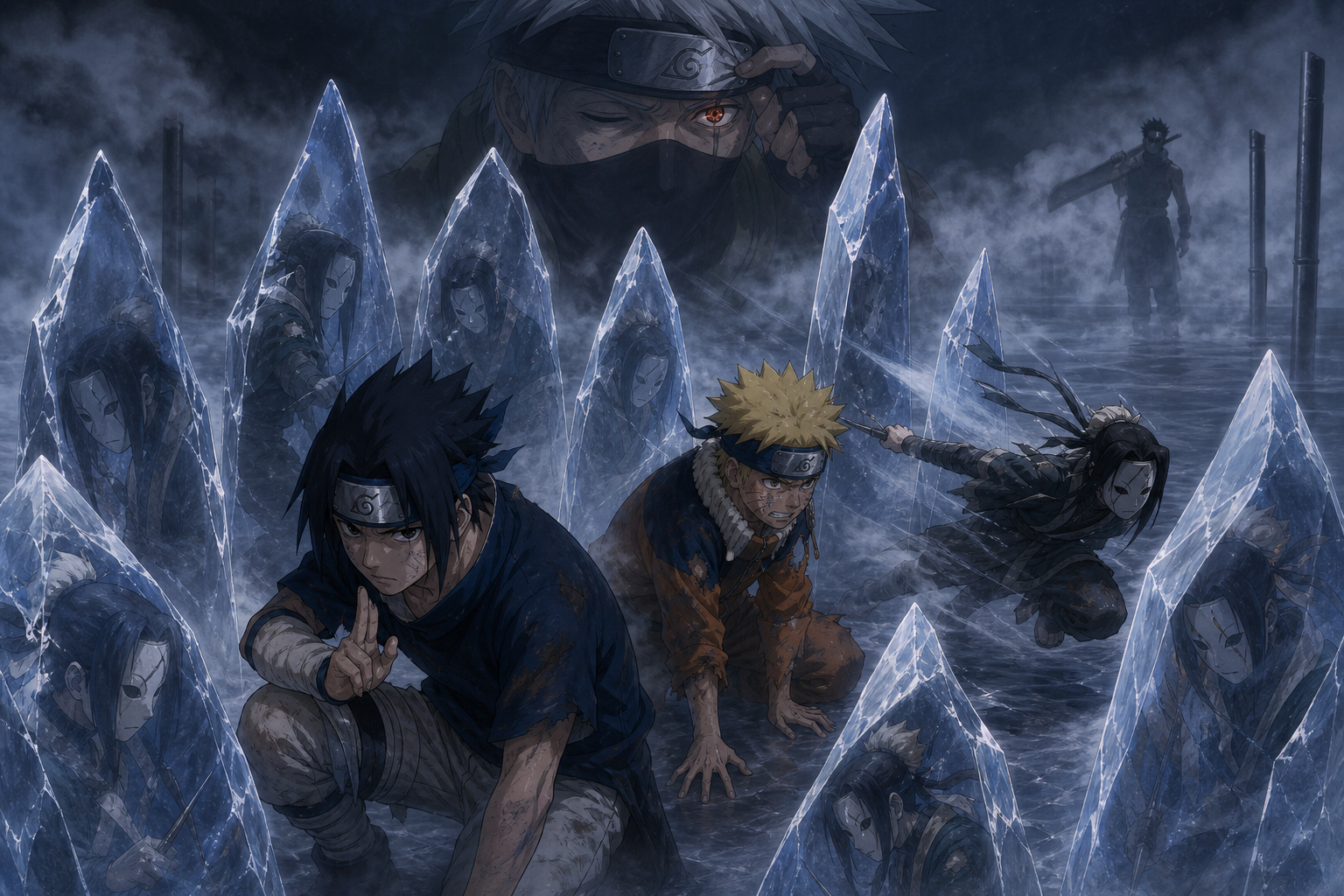
Seeing everything is useless when experience knows where not to look.
Sasuke’s eyes begin catching Haku’s impossible rhythm just as Zabuza learns how to erase himself from Kakashi’s sight. Episode 15 turns perception into a battlefield and asks whether talent can survive long enough to become wisdom.
Where the battle stands
Naruto Uzumaki and Sasuke are trapped inside Haku’s Demonic Mirroring Ice Crystals. Naruto’s decision to enter the prison destroyed their inside-outside advantage, and his shadow clones have not managed to touch the masked hunter. Yet their repeated failures are producing something valuable: evidence. Every shattered clone gives Sasuke another angle, another interval, another fragment of Haku’s route.
Outside, Kakashi faces Zabuza while Sakura guards Tazuna. Kakashi’s Sharingan ended their first confrontation by reading and copying Zabuza’s techniques. Zabuza has returned with a counter built from that humiliation. He does not need better eyes. He needs a battlefield where eyes are irrelevant.
The recap: two lessons in lethal experience
Inside the mirrors, Haku’s senbon continue falling with frightening accuracy. Naruto strains against an opponent he cannot locate, while Sasuke stops wasting energy on every reflected image. His attention narrows. He begins measuring the attacks rather than merely reacting to them.
Sasuke realizes that Haku’s movement is not truly instantaneous. Haku only moves faster than their untrained eyes can process. That distinction matters. A miracle cannot be solved. A technique, however extraordinary, has mechanics. If Haku moves from one mirror to another, there must be a body in transit and a moment in which that body can be read.
Naruto attacks again, multiplying himself into the enclosure. The clones are dispatched, but Haku’s response is no longer invisible to Sasuke. He starts catching glimpses. The improvement is small enough to feel believable. Sasuke has not suddenly become stronger than Haku. His perception is approaching the speed required to participate.
This is where the boys’ accidental teamwork pays off. Naruto generates chaos through persistence. Sasuke converts chaos into information. Naruto is the experiment repeated until a pattern appears; Sasuke is the observer who finally recognizes it. Neither method succeeds alone.
Haku notices the change. The masked hunter remains faster and more experienced, but Sasuke’s growing awareness forces adjustments. A gifted child is becoming dangerous in real time. Haku has spent years being shaped into Zabuza’s tool. Sasuke is still at the beginning of that process, and the episode makes us watch talent being awakened by the threat of death.
On the other side of the bridge, Kakashi reads the overall battlefield. His students lack Haku’s experience. Every second extends a contest they are unlikely to win. Kakashi decides he must finish Zabuza quickly and reaches again for the Sharingan.
Zabuza is ready. Their first battle taught him exactly how Kakashi’s advantage works. The Sharingan can observe movement, anticipate techniques, and destabilize an opponent by seeming to predict the future. So Zabuza attacks the precondition of observation itself. Thick mist floods the bridge until bodies, distances, and intentions disappear.
The title says the Sharingan shatters, but the eye is not literally broken. Its authority is. Kakashi possesses a legendary power and is forced into a situation where it cannot provide the information he needs. Zabuza has turned the bridge into an argument: no ability is absolute outside the conditions that allow it to function.
He also suppresses his presence. Zabuza is one of the Seven Ninja Swordsmen of the Mist, trained to kill without offering a visible approach. Kakashi cannot rely only on the red eye in his face. He must listen for breath, disturbance, killing intent, and changes in the air.
Sakura and Tazuna become targets within that uncertainty. Zabuza does not have to defeat Kakashi directly if he can force Kakashi to defend someone else from an attack whose origin cannot be seen. Protection stretches attention. The same moral commitment that makes Kakashi a teacher and guard also creates angles an assassin can exploit.
Inside the mirrors, Sasuke’s development continues through pain. Needles strike, muscles fatigue, and the cost of every incorrect read accumulates. Yet his eyes begin tracking Haku more clearly. The episode visually pairs this awakening with Kakashi’s obscured Sharingan. One Uchiha eye is emerging as another Sharingan is strategically neutralized.
That parallel keeps Sasuke’s talent from feeling like a simple upgrade. An eye can offer access, but battle experience determines what the user does with it. Kakashi has years of survival behind his perception. Sasuke has instinct, intelligence, and the urgent need to keep Naruto alive. He is learning because the alternative is watching a teammate be pierced by attacks he might have understood one second earlier.
Naruto remains frustrated by the change he cannot yet name. Sasuke’s concentration can look like superiority, but the emotional foundation is collaboration. Naruto’s earlier recklessness created the problem; his relentless refusal to stay down now supplies the repetitions Sasuke needs. Their rivalry is being rewritten as mutual dependence.
The episode closes without release. Haku still controls the mirrors. Zabuza still owns the mist. Kakashi and Sasuke have exceptional eyes, yet both are being taught that perception is not mastery. The battle has become a race between adaptation and injury.
Borrowed sight, inherited sight, earned knowledge
Kakashi’s Sharingan is borrowed from a history the episode has not yet explained. Sasuke’s potential comes through his Uchiha bloodline. Both eyes carry power from beyond the immediate self, but neither frees its user from learning. Inheritance creates possibility, not competence.
Zabuza’s answer is experience. He lost once, survived, analyzed the loss, and returned with a battlefield designed around what he learned. His intelligence is easy to overlook because his presence is so physically threatening. Episode 15 insists that the Demon of the Mist is dangerous because he reflects. He is not repeating the previous encounter. He is revising it.
Sasuke does the same thing on a smaller timescale. Each volley revises his understanding of Haku. He cannot leave the mirrors and train for months, so learning happens inside consequence. The shinobi world calls this battle experience, but that clean phrase hides something brutal: children acquire professional knowledge while weapons are entering their bodies.
The hidden village and the education of fear
Konoha’s academy teaches transformation, clones, weapons, and rules. The academy cannot simulate the moral and sensory confusion of the bridge. Real combat is not a harder exam. The bridge becomes a different institution with pain as its instructor.
This matters because the village sends genin into missions while calling them inexperienced as though inexperience were a personal deficiency. Naruto and Sasuke did not choose to lack battle history. Their system placed them here before they possessed it. Then the adults judge survival through the very experience the children can gain only by surviving.
Haku embodies the endpoint of that logic. He is young, highly experienced, and catastrophically useful. His competence proves what the system can create when childhood is converted completely into function. Sasuke’s awakening is thrilling, but Haku stands before him as a warning: becoming excellent at violence can also mean becoming someone else’s perfect instrument.
The existential conflict is therefore larger than winning. Sasuke must develop the capacity to act without allowing capacity to become his entire identity. Naruto must turn feeling into effective care. Kakashi must protect students within a structure that repeatedly exposes them. Haku must decide whether being needed by Zabuza is the same as having a reason to exist.
Easter eggs and craft details
Kakashi’s mature Sharingan is blinded by conditions while Sasuke’s perception begins awakening inside another sealed field.
His clones fail offensively but reveal Haku’s rhythm. Failure becomes data when a teammate is paying attention.
Haku multiplies visible surfaces until sight is unreliable. Zabuza removes surfaces entirely. Master and apprentice control perception in opposite ways.
Zabuza’s counter is born from his earlier defeat. The villain models the adaptive intelligence Team 7 must acquire.
Guarding Tazuna looks static, but it preserves the mission while every personal feeling pulls her toward Sasuke.
The Sharingan “shatters” when belief in its absolute authority fails. Zabuza breaks the assumption, not the eye.
RaeRae reacts: the children are doing accelerated professional development with needles
I love the Sasuke material because the episode lets his intelligence breathe. He is not simply the talented pretty boy who receives a new ability. He watches Naruto fail over and over, refuses to treat those failures as meaningless, and starts building a model of Haku’s movement. That is teamwork without sentimental dialogue.
That teamwork is also horrifying. We celebrate because Sasuke’s eyes are getting sharper, but why are they getting sharper? A child is being pierced in an enclosure by another child who has already learned how to kill for an adult. The awakening is beautiful because Sasuke is trying to protect someone. The conditions producing it are monstrous.
Zabuza’s mist makes the adult fight just as satisfying. Kakashi looked almost supernatural during their first clash, and now Zabuza says, essentially, “I studied.” That makes the rematch feel earned. Power scaling is not a staircase. Information moves in both directions.
And Naruto, bless him, is still contributing by being impossible to discourage. He cannot see the pattern yet, but his willingness to attempt the impossible keeps generating chances. Sasuke supplies precision. Naruto supplies time purchased with stubbornness. Team 7 is becoming a team in the least tidy way possible.
What the author is really telling us
Episode 15 argues against the fantasy of perfect perception. We often imagine that if we knew enough, saw enough, or possessed the right insight, we could avoid vulnerability. Kakashi’s Sharingan embodies that dream. Zabuza’s mist exposes its limit. There will always be conditions in which knowledge arrives late, incompletely, or not at all.
Meaning cannot depend on total certainty. Kakashi still has to protect. Sasuke still has to move. Naruto still has to stand. Their choices matter precisely because they do not possess a complete view.
The same is true for identity. Sasuke does not know what his eyes will become. Haku cannot see a future beyond usefulness to Zabuza. Naruto has no proof that the village will recognize him. Each acts from an unfinished understanding of self. Existentially, that is the human condition dressed as a ninja fight: we choose before the fog lifts.
The episode’s mature lesson is that experience is not omniscience. Zabuza’s experience gives him a counter. Kakashi’s experience lets him understand the danger. Haku’s experience makes him lethal. Experience expands possibility, but values determine its direction. Wisdom is not merely learning what works. Wisdom also means deciding what the knowledge should serve.
Sasuke and Naruto: rivalry becoming an instrument
Early Team 7 treats rivalry as a hierarchy. Sasuke wants distance from people he considers weaker. Naruto wants the recognition that defeating Sasuke might provide. Each boy uses the other as evidence in a private argument about worth.
Haku’s mirrors make that arrangement impossible. They cannot survive as separate rankings. Naruto’s abundance and Sasuke’s discrimination have to interact. One creates too much movement to ignore; the other identifies which movement matters. Their differences stop being proof that one should replace the other and become parts of a shared instrument.
This is why Sasuke’s attention to Naruto matters emotionally. To learn from Naruto’s failed attacks, Sasuke must treat Naruto as consequential. He must watch what happens to him, remember it, and alter his own behavior because of it. Attention is one of the first forms their friendship takes.
Naruto offers the complementary gift. He assumes Sasuke can do something with the time his clones buy, even when neither boy says so elegantly. Trust appears before either is comfortable naming it. The bond is not soft yet. The connection remains bruised, competitive, and expressed through urgent commands. But it has moved from comparison toward coordination.
That development complicates Sasuke’s revenge. His stated life is organized around the past and the brother he intends to kill. The bridge introduces a present tense capable of making claims on him. Every time Sasuke protects Naruto, he chooses a living relationship over the isolated identity vengeance requires. The choice is not complete, but the possibility has entered the mirrors with them.
Sasuke learns to see because he has someone to protect
The Sharingan develops inside a fight Sasuke cannot control. Haku is faster, the mirrors determine the terrain, and senbon keep turning every failed read into pain. Sasuke’s answer is not a sudden victory. He begins narrowing the gap between movement and perception, which gives Naruto a chance to survive beside him.
That context matters. Sasuke has spent years treating power as the private road toward Itachi. Here, inherited power wakes more fully while he is accounting for another person. Revenge remains part of him, but protection becomes part of the body’s decision before Sasuke can explain it.
Seeing more does not mean controlling more
The episode resists the easy assumption that special eyes solve a battle automatically. Sasuke can increasingly follow Haku’s transitions, yet his muscles still have to respond, Naruto still has to understand the plan, and Haku still owns the enclosure. Information is an advantage only when the person receiving it has time and capacity to act.
Kakashi faces the same truth outside the mirrors. Zabuza’s mist attacks the condition the Sharingan needs most: a visible opponent. A famous technique can be neutralized by changing the environment around it. Reputation makes Kakashi dangerous, but it also tells an experienced enemy what to prepare for.
Zabuza turns silence into a weapon
The Hidden Mist Technique is frightening because it removes the reassuring shape of combat. Kakashi cannot simply meet an attack he can see coming. He must protect Tazuna, locate Zabuza, and prevent his own concentration from becoming predictable. The bridge becomes an acoustic map built from footfalls, breath, and threat.
Zabuza’s recitation of vulnerable body points is psychological pressure as much as tactical information. He wants the group imagining each possible death before he chooses one. Fear multiplies his presence while the fog hides his actual position.
Sakura’s guard position becomes the center of the adult duel
Tazuna remains the target, which means Sakura’s placement is not a side assignment. Zabuza’s entire approach is designed to slip past Kakashi and reach the client. Sakura has to hold her ground while the jōnin-level fight makes certainty impossible.
The series often frames action as forward movement, but defense asks for a different courage. Sakura cannot chase the boys into the mirrors or rush toward Kakashi. She has to remain available for the attack nobody else stops. That discipline deserves the same narrative seriousness as a charge.
Naruto’s clones become expensive noise until the team finds rhythm
Naruto keeps producing bodies because multiplication is the tool he trusts. Haku keeps proving that more targets do not matter if they repeat the same readable behavior. The lesson is not that the Shadow Clone Jutsu is weak. It is that abundance without coordination gives the enemy more versions of the same mistake.
Sasuke’s developing vision creates the possibility of rhythm. One boy can notice the opening while the other can fill space. Their rivalry starts becoming a fighting language, but neither has mastered listening yet.
Haku’s professionalism is built from a child’s fear of disposability
Haku speaks calmly, avoids waste, and controls the pace with the discipline of somebody much older. That polish is evidence of training, and it is also evidence of what Haku believes must be offered to remain beside Zabuza. Usefulness is not a task. It has become identity.
The restraint shown toward Naruto and Sasuke proves Haku has moral feeling. It does not create an innocent position. Haku continues hurting children to protect a mission serving Gatō’s control. Compassion survives inside the violence, which makes the violence more tragic rather than less real.
The episode is about inherited tools finding new purposes
Kakashi carries a borrowed Sharingan tied to grief and promise. Sasuke carries inherited eyes tied to clan, massacre, and revenge. Haku carries a bloodline ability that once made family and neighbors afraid. Each power arrives with a history somebody else helped write.
What matters is not only who possesses the ability. The question is whether the person can choose what the inheritance will be used for. Episode 15 does not offer an easy answer. Kakashi protects a bridge. Sasuke protects Naruto. Haku protects Zabuza. Similar devotion can lead toward radically different consequences.
RaeRae’s final take
Episode 15 makes perception the battlefield. Sasuke begins seeing Haku, Kakashi loses sight of Zabuza, and Naruto still confuses motion with progress. Nobody needs a new speech about teamwork. The structure of the fight forces them to discover whether their abilities can become useful to somebody besides themselves.
The Sharingan does not shatter because it is unimpressive. It shatters as a guarantee. Special vision cannot eliminate fog, close the distance between insight and action, or decide whether loyalty is serving liberation or exploitation. Those decisions still belong to people.
Episode file
| Episode | 15 |
|---|---|
| Title | Zero Visibility: The Sharingan Shatters |
| Arc | Land of Waves |
| Key conflict | Sasuke begins reading Haku while Zabuza neutralizes Kakashi’s visual advantage with mist. |
| Emotional center | Turning repeated failure into knowledge before injury ends the lesson. |
| Official guide | Naruto Official Episode 15 guide |
| Watch officially | Crunchyroll · Netflix availability varies by region |
Final verdict
Episode 15 is a battle of adaptation disguised as a battle of special eyes. Sasuke learns to transform Naruto’s chaos into usable information. Zabuza transforms defeat into a counterstrategy. Kakashi confronts the limits of a legendary technique, and Haku reveals the terrifying advantage of experience purchased through lost childhood.
Rating: 9/10. A tense, intelligent bridge episode that makes perception feel physical, political, and deeply personal.