
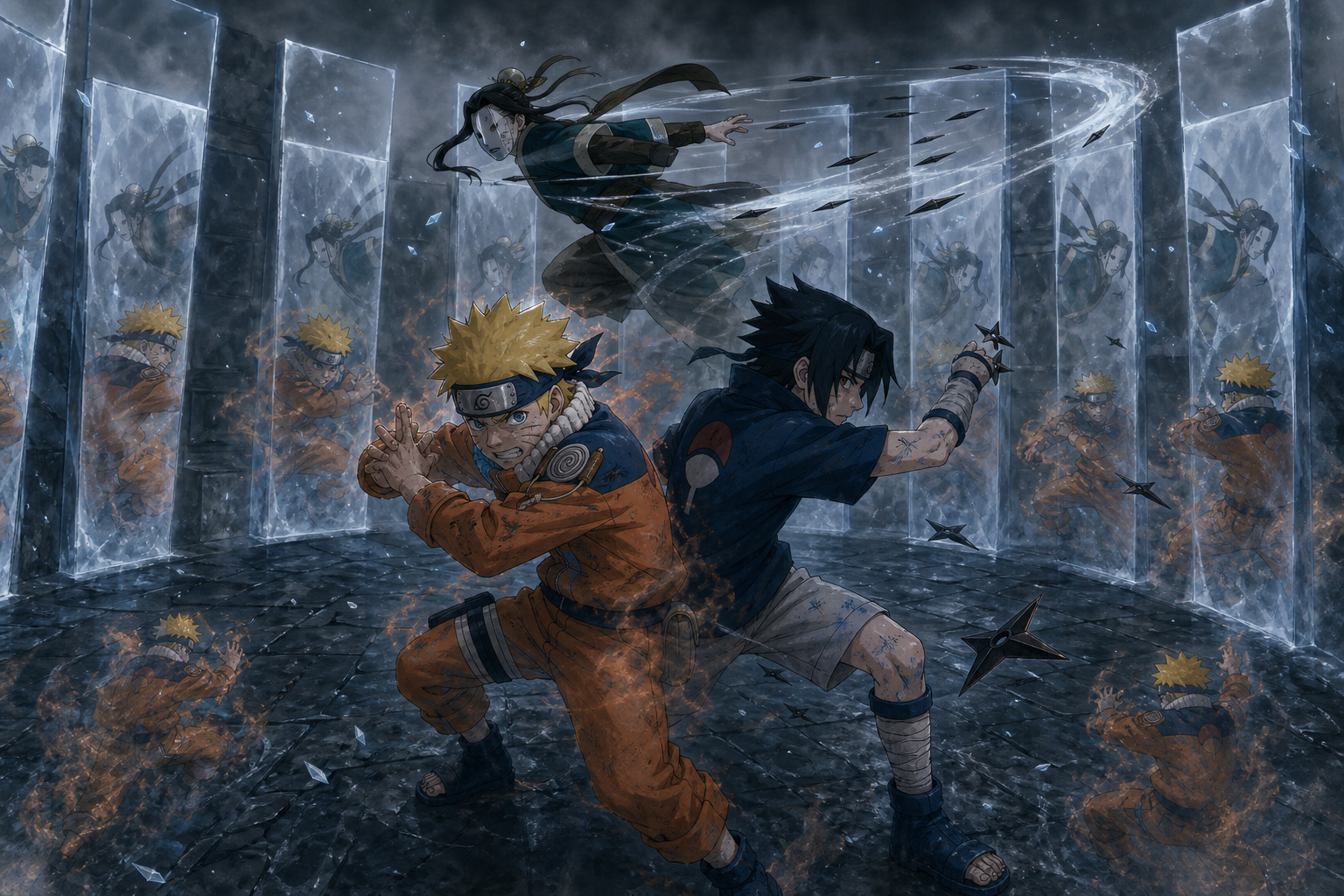
The loudest boy in the room runs straight into the trap.
Naruto sees Sasuke imprisoned inside Haku’s impossible hall of ice and does the most Naruto thing imaginable: he charges in. The charge is reckless, ridiculous, loyal, and far more revealing than a simple rescue attempt.
Before we go back into the mirrors
Episode 13 ended with Sasuke sealed inside Haku’s Demonic Mirroring Ice Crystals. The mirrors are not merely walls. They are a complete combat system. Haku can appear in any reflective surface, cross the enclosed space faster than Sasuke can follow, and release senbon from angles that make ordinary defense meaningless. Outside the prison, Sakura remains beside Tazuna because protecting the client is still Team 7’s mission. Kakashi is locked against Zabuza, who understands that a single lapse will cost the bridge builder his life.
Then Naruto Uzumaki arrives. His entrance has all the swagger of a hero reaching the stage at exactly the right second. The problem is that he has not read the stage. He sees his teammate in danger, sees an enemy, and assumes courage will solve the geometry.
The recap: one terrible entrance, made with love
Naruto’s shadow clones swarm toward Haku from outside the ice formation. For one brief instant, the attack looks sensible. Sasuke is trapped within; Naruto can pressure the mirrors from the exterior and create the two-front problem that Sasuke needs. Sasuke recognizes it immediately. If Naruto stays outside, the pair can force Haku to divide attention between an internal opponent and an external one.
Naruto, however, is not satisfied with helping from a safe angle. He announces himself, breaks through the opening, and lands beside Sasuke. The number one hyperactive knucklehead has joined the fight by voluntarily entering the enemy’s sealed arena.
Sasuke’s expression says what every viewer is thinking. Naruto has destroyed their best tactical advantage. This is not the funny stupidity of a classroom prank. The cost is immediate. Both boys are now contained inside a jutsu they do not understand, facing a hunter whose speed already overwhelmed the more observant of them.
Yet Naruto’s mistake is emotionally legible. From the academy onward, he has experienced exclusion as a physical fact. He knows what it is to stand inside an invisible enclosure while everyone else remains outside. When he sees Sasuke alone in a cage, instinct overrules strategy. Naruto cannot yet distinguish solidarity from proximity. To him, saving someone means entering the place where they are suffering.
Haku resumes the assault. Images fill the mirrors. The real body moves among reflections too quickly to isolate, while needles arrive in cold, precise volleys. Naruto answers with more clones. Shadow Clone Jutsu transformed his life in Episode 1 and proved that he is not the failure everyone named. Here, quantity meets a battlefield designed to make quantity irrelevant. Clones crowd the enclosure, but each additional body offers another target and another burst of smoke.
Sasuke does what he has been doing since the bell test: he watches. His eyes scan the mirrors, the trajectories, the intervals between attacks. Naruto reacts to danger by multiplying himself. Sasuke reacts by compressing the world into a problem. Their styles conflict, but those styles are beginning to function as a team. Naruto creates movement and information. Sasuke studies the chaos for a pattern.
Outside, the adult battle becomes its own prison. Zabuza keeps Kakashi occupied and uses the mist, the bridge, and Tazuna’s vulnerability to control the terms of engagement. Kakashi knows his students are in mortal danger, but he cannot simply turn away. A teacher in a shinobi system is asked to care for children while obeying a mission structure that can prevent him from reaching them. The tension is not that Kakashi does not care. Care has been divided into incompatible duties.
Sakura’s position hurts for a similar reason. She hears and sees fragments of the battle, yet stays with Tazuna. Earlier Sakura’s strict obedience could feel like textbook behavior. Here it becomes discipline. Running to Sasuke would satisfy her feelings and abandon the client. Remaining still looks passive, but it is the harder choice. Naruto rushes inside suffering; Sakura protects the purpose that brought them there; Sasuke tries to understand the machine closing around him.
Inside the mirrors, Naruto attempts to overwhelm Haku again. His declarations grow louder as his options shrink. That contrast is central to his character. Bravado is not evidence that Naruto feels no fear. The noise is how he refuses to let fear dictate his identity. Every boast is a small act of self-creation.
Haku does not respond with Zabuza’s cruelty. The masked hunter remains controlled, almost sorrowful, and avoids immediately striking fatal points. That restraint makes the scene more disturbing, not less. Haku is gentle enough to understand the boys and committed enough to keep hurting them. The episode asks whether kindness matters when it is placed entirely in service of another person’s violence.
Sasuke begins to see more than before. Not enough to stop the attack, but enough to anticipate slivers of movement. The visual language lingers on his eyes because this battle is pushing perception toward transformation. Naruto’s clones may be failing as weapons, yet their destruction generates repetitions. Each volley gives Sasuke another sample. Naruto’s chaos is becoming Sasuke’s data.
The boys are battered, frustrated, and still standing. They have not escaped. There is no clean victory at the end of this chapter, only the tightening awareness that survival will require them to become something together that neither can be alone.
Why this episode feels bigger than its plot
On paper, Episode 14 is simple: Naruto enters the mirrors, the boys are attacked, and Sasuke begins adapting. Emotionally, it is a study of immature love. Naruto cares deeply, but his caring has no patience yet. He does not pause to ask what Sasuke needs. He assumes that sharing the danger is the same as reducing it.
That is a painfully human mistake. We often enter another person’s crisis because standing outside feels like abandonment. Sometimes presence is salvation. Sometimes it gives the crisis one more person to consume. Naruto has the correct moral impulse and the wrong tactical expression. The series does not punish him for loving Sasuke. The lesson forces love to become skill.
Sasuke, meanwhile, is forced to accept help in its most irritating form. Naruto is loud, careless, competitive, and now trapped beside him. But Sasuke no longer treats Naruto as disposable. The insults remain, while underneath them a bond is becoming operational. They are not friends because they have confessed affection. They are friends because each has begun including the other in his calculations of survival.
The hidden village under the hidden village
Konoha calls itself a village, a word associated with home, neighbors, and communal protection. Yet its children are trained to enter sealed rooms built by other children and exchange weapons until one of them cannot rise. The Land of Waves arc keeps peeling back the comforting language of the shinobi world. A “mission” can mean guarding a man targeted by a private army. A “tool” can be a child with a gentle heart. A “comrade” can be someone you learn to love while both of you are being shaped for violence.
Masashi Kishimoto’s mirror imagery makes the contradiction visible. Haku appears everywhere but is difficult to locate as a person. The shinobi system works similarly. The system multiplies roles, masks, ranks, and techniques until the human being inside them becomes hard to see. Naruto’s loud insistence on his own name is the opposite movement. He wants to be recognized as a particular person, not a disposable function.
The existential question is not merely “How will they escape?” The deeper question asks, “Who are they choosing to be while escape is impossible?” Naruto chooses the boy who enters. Sasuke chooses the boy who keeps looking. Sakura chooses the girl who holds her post. Haku chooses the weapon who still cannot extinguish compassion. None of those identities are complete, and that incompleteness is the point. Character is not a secret essence waiting to be revealed. Decisions made under pressure build character.
Easter eggs, craft, and details worth watching
Sasuke’s plan depends on attacking from both sides. Naruto’s entrance collapses that spatial advantage and turns the episode’s title into a joke with consequences.
The shadow clones fail to hit Haku, but every destroyed clone exposes another trajectory. Sasuke’s progress is partly built from Naruto’s repeated failures.
Haku is hidden twice: behind a hunter-nin mask and inside reflections. The kind person Naruto met in the forest has been buried under roles.
Kakashi, Sakura, Sasuke, and Naruto each perform a different meaning of duty. The episode lets none of them hold the whole answer.
Senbon are visually small. Their quiet precision contrasts with Naruto’s huge gestures and makes Haku’s control feel almost clinical.
Sasuke’s visual concentration signals that his inheritance is being approached through desperation, observation, and the need to protect.
RaeRae reacts: baby, why would you go inside?
I love Naruto here and I also want to grab him by the orange collar. Sasuke practically receives the perfect partner position outside the mirrors, and Naruto turns it into a dramatic entrance because of course he does. The secondhand frustration is real.
But the scene works because the stupidity is not random. Naruto has spent his entire life trying to get inside the circle. Inside the classroom’s approval. Inside the Hokage Monument’s meaning. Inside another person’s concern. When Sasuke is trapped, Naruto finally has a chance to prove that someone will enter the circle for him. He gives Sasuke the act Naruto wished another person had given him.
That makes the moment sweeter and sadder. Naruto does not yet know that devotion without understanding can become another danger. Team 7 is teaching him. Kakashi’s lesson at the memorial stone was that comrades matter more than rules. The Land of Waves adds the missing clause: valuing comrades is not only feeling strongly. Valuing comrades also requires learning what actually keeps them alive.
And Sasuke notices. He complains, because he is Sasuke, but he starts fighting as part of a “we.” That tiny grammatical shift is the heartbeat under all the ice.
What Haku understands about power
Haku’s technique is frightening because the mirrors do not simply overpower the boys. The technique reorganizes what they are able to know. In an ordinary fight, an opponent occupies one place, an attack has a readable origin, and distance offers some protection. The mirrors abolish those assumptions. Haku seems present everywhere; therefore Naruto and Sasuke cannot decide where resistance should be aimed. Power here is control over another person’s reality.
That is also how the larger shinobi world preserves itself. Villages teach official histories, assign ranks, define enemies, and decide which deaths count as sacrifice. Gatō controls the Land of Waves by convincing ordinary people that resistance has no possible direction. Zabuza controls through fear and mist. Haku controls through reflections. Each system makes the source of danger feel unreachable.
Naruto’s shadow clones answer with the opposite philosophy. Instead of one hidden self projected into many surfaces, Naruto creates many embodied selves that all declare the same identity. Haku disappears into representation. Naruto insists on presence. The clones are destroyed, but they keep making the enclosure noisy, crowded, and difficult to treat as a perfect machine.
This is why Naruto’s apparent uselessness matters. He has not solved the jutsu, yet he has changed the emotional physics of the room. Sasuke is no longer alone. Haku must manage unpredictability. The closed system now contains a boy whose defining talent is refusing the role assigned to him.
And still, good intentions do not erase consequences. Naruto is hit. Sasuke must protect more than himself. The episode respects devotion without romanticizing incompetence. Its lesson is not that reckless loyalty is secretly flawless. Its lesson is that loyalty is raw material. Training, trust, and attention must shape it into something capable of saving a life.
The worst entrance can still reveal the best instinct
Naruto entering the mirror prison is the kind of decision that makes a viewer yell at the screen because the tactical mistake is obvious from the couch. Haku has created a closed attack system. Sasuke is trapped inside it. Naruto sees an opening and treats the opening as permission instead of asking who benefits from it.
Yet the choice also reveals the moral center Naruto is building. He will not watch a teammate suffer from a safe distance. The episode lets both truths stand. His loyalty is real, and loyalty without battlefield awareness can make rescue harder.
Sasuke begins translating chaos into a pattern
Sasuke cannot match Haku’s speed yet, so he looks for the structure underneath it. Where does Haku emerge? How long does the transition last? Which attacks are meant to injure, and which are meant to control movement? The analysis is not flashy, but it is the first credible route out of the mirrors.
He is also forced to account for Naruto. That changes the problem. Sasuke can no longer plan only around his own reflexes because his teammate’s clones, interruptions, and exposed positions become part of the field. Working together means accepting that another person will not move exactly as you would.
Shadow clones finally become shared information
Naruto’s clones are usually framed as force through numbers. Inside the mirrors, numbers alone are useless. Haku can destroy copies faster than Naruto can turn them into a plan. The real opportunity appears when Naruto and Sasuke use each attempt to learn.
This is the beginning of Naruto understanding that persistence is most powerful when repetition produces knowledge. Getting back up matters. Noticing why you fell is what makes the next attempt different.
Haku controls the pace because Haku controls the rules
The ice mirrors determine sightlines, movement, and timing. Naruto and Sasuke are not simply fighting a faster opponent. They are fighting inside an environment designed to make Haku’s strengths feel absolute. Haku can appear merciful because the system already guarantees control.
That mercy remains complicated. Haku avoids immediate killing blows, but every senbon advances Zabuza’s mission and keeps two children inside sustained terror. Kindness expressed only within the boundaries of someone else’s exploitation cannot make the exploitation safe.
The Sharingan begins with desperation, not dominance
Sasuke’s developing perception is exciting because it grows under conditions he cannot command. This is not Kakashi calmly unveiling a famous eye. It is a boy trying to keep up with attacks that are already landing. The ability does not erase the fear, pain, or need for cooperation.
That distinction matters for Sasuke’s larger story. Clan inheritance gives him access to extraordinary power, but inheritance arrives tangled with massacre, expectation, and the belief that strength must justify his survival. Every advance carries history with it.
Sakura’s distance from the mirrors is part of the tension
Sakura can see that Naruto and Sasuke are in trouble, but Tazuna remains her responsibility. Leaving him would turn concern for her teammates into abandonment of the mission. Staying asks her to trust boys who rarely make trust easy.
The series keeps placing her in defensively important positions while giving the emotional spotlight to movement elsewhere. Her discipline deserves to be read as action. It also deserves more narrative consequence than the early episodes are willing to grant it.
Two battles are testing two kinds of prediction
Kakashi and Zabuza trade professional counters outside the mirrors while Sasuke tries to read Haku within them. Both confrontations revolve around prediction, but the adults have experience and the children have urgency. Kakashi knows a revealed technique becomes vulnerable to planning. Sasuke is learning that lesson while being struck.
Zabuza’s fog and Haku’s mirrors both attack certainty. One removes the visible enemy. The other provides too many visible versions. Team 7 has to learn that perception is not the same as understanding.
RaeRae’s final take
Episode 14 earns its tension by making every admirable quality insufficient on its own. Naruto’s devotion cannot replace attention. Sasuke’s intelligence cannot immediately defeat speed. Haku’s gentleness cannot absolve violence. Sakura’s discipline cannot bring her teammates back within reach.
The breakthrough begins when Naruto and Sasuke stop behaving like adjacent solo acts and start becoming a pair. It is messy, painful, and late. That is why it feels true. Teamwork is not a slogan Kakashi taught during the bell test. It is the difficult practice of letting another person change how you survive.
Episode file
| Episode | 14 |
|---|---|
| Title | The Number One Hyperactive, Knucklehead Ninja Joins the Fight!! |
| Arc | Land of Waves |
| Key conflict | Naruto enters Haku’s Crystal Ice Mirrors and joins Sasuke inside the trap. |
| Emotional center | The difference between sharing someone’s danger and knowing how to help them. |
| Official guide | Naruto Official episode guide |
| Watch officially | Crunchyroll · Netflix availability varies by region |
Final verdict
Episode 14 does not deliver a decisive reversal. The episode delivers something more foundational: the first real shape of Naruto and Sasuke fighting as a pair. Naruto’s entrance is tactically disastrous and morally beautiful. Sasuke’s observation is cold on the surface and increasingly protective underneath. Haku’s mirrors reduce all three boys to the identities they have chosen, then begin testing whether those identities can survive contact with one another.
This is the episode where Naruto’s promise to never abandon a comrade becomes physically visible. The episode also begins teaching him that love needs more than courage. Love needs attention, restraint, and the humility to understand the battlefield another person is already standing in.
Rating: 9/10. The fight advances by inches, but the relationship advances by miles.