
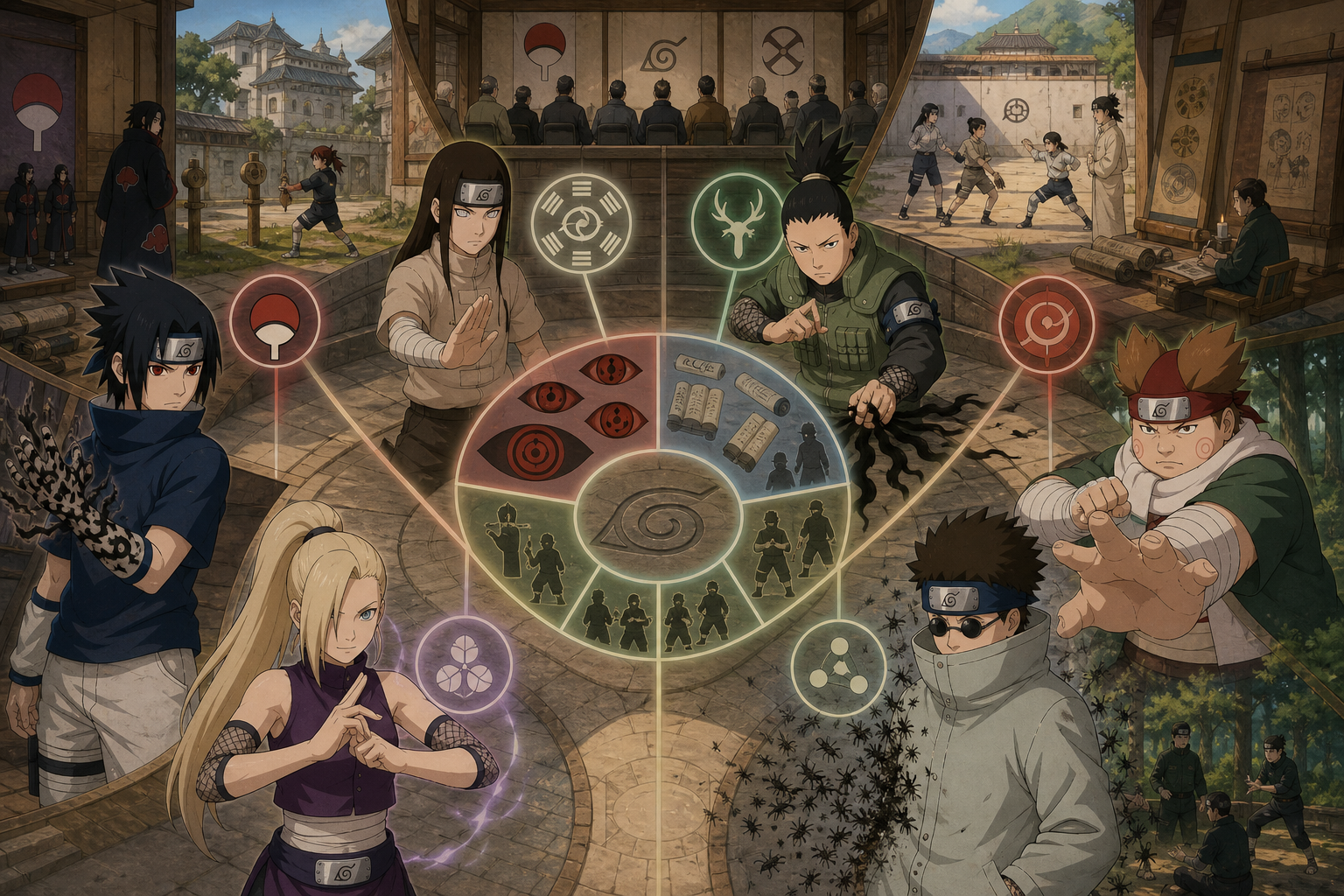
Clans, Hiden & Kekkei Genkai
A clan can preserve a biological trait, guard a teachable technique, control land and marriage, run a business, fill military roles, or do all of those at once. Naruto’s family systems are archives of power,and arguments over who is allowed to inherit.
The one-sentence truth
Kekkei genkai are inherited abilities; hiden are secret techniques taught within groups; clans are social and political organizations. Confusing the three hides how power is reproduced and who controls access.
Clan
A kinship group or extended family institution with shared name, history, property, roles, techniques, and political interests. Not every member has the same ability.
Kekkei genkai
A “bloodline limit”: an inherited biological or chakra trait that generally cannot be learned through ordinary teaching.
Hiden
A secret technique transmitted within a clan or organization. The ability is guarded knowledge, not necessarily genetic.
Dōjutsu
An eye technique. Sharingan and Byakugan are dōjutsu and kekkei genkai. The categories overlap without becoming synonyms.
Fandom calls almost every family technique a bloodline because biology feels dramatic and tidy. The story is less tidy. A body can inherit an eye. A child can be taught a shadow method. A clan can preserve insect knowledge through a living partnership. A village can regulate all three through politics. The source of the power changes what theft, consent, teaching, and reform mean.
That difference changes the fantasy of merit. If a technique is teachable but guarded, access is a social decision. If it requires inherited anatomy, effort still matters but cannot create the starting organ. If a partnership depends on years of care, copying one movement gives you nothing. Naruto keeps making power communal even while fights put one body in the center of the panel.
The quick comparison
| Category | How it passes | Can outsiders learn it? | Examples |
|---|---|---|---|
| Clan membership | Birth, marriage, adoption or recognized affiliation | Sometimes | Uchiha, Hyūga, Nara, Akimichi |
| Kekkei genkai | Biological/chakra inheritance | Not normally; transplantation or experimentation may grant access | Sharingan, Byakugan, Ice Release, Wood Release |
| Hiden technique | Instruction, guarded practice and resources | In principle, often yes; access is restricted | Shadow techniques, Mind Transfer, Akimichi expansion |
| Clan partnership | Culture and training | Requires social access and practice | Inuzuka ninken, Aburame kikaichū |
Why clans matter in a hidden village
Hidden villages do not replace clans; they federate them. Konoha is founded through an alliance between Senju and Uchiha, then grows by incorporating families whose specialized knowledge strengthens the military institution.
A clan can supply ready-made training, housing, intelligence networks and techniques. In return, the village offers security, missions and political influence. The arrangement is never perfectly equal. Large clans can hold seats, land and leverage unavailable to unaffiliated families.
This is why “teamwork” in Naruto operates alongside inherited blocs. A genin team may cross clan lines while each child carries obligations older than the village assignment.
The Uchiha: biological inheritance under political surveillance
The Sharingan is a dōjutsu kekkei genkai associated with distinctive chakra changes in the brain and eyes. It can perceive motion, read chakra, support copying, cast genjutsu, and evolve under severe emotional conditions. Not every Uchiha awakens it, and awakening does not grant instant mastery.
Konoha places the clan in charge of the Military Police, then isolates and surveils it after the Nine-Tails attack. An honored institution becomes a containment mechanism. Prestige does not cancel exclusion when the same office keeps a community visible, useful, and away from central decisions.
The massacre turns bloodline politics into extermination. Bodies and eyes remain strategic assets after their owners die. Danzō’s collection makes the obscenity literal: the institution fears the clan’s power, helps destroy its people, then stores pieces of that power for state use.
Sasuke carries family grief, technique, and biological continuity as the clan’s visible survivor. His desire to restore the clan is not merely a breeding plan or logo obsession. It is a traumatized child trying to make mass death stop feeling final.
Sharingan evolution is often flattened into “trauma gives upgrades.” That makes pain sound like a training strategy. The Mangekyō develops through extreme loss and exacts visual cost. The system does not reward suffering kindly. It makes grief usable, then invoices the eyes.
The Hyūga: bloodline protection becomes family domination
The Byakugan offers near-panoramic sight and detailed perception of chakra pathways. Gentle Fist turns that perception into intimate violence by disrupting the chakra network and internal organs. The clan’s combat system depends on anatomy, precision, and training, not eyesight alone.
The Hyūga divide into main and branch families. Branch members receive the Caged Bird Seal, allowing main-family punishment and preventing Byakugan theft at death. The policy claims to protect biological property by making relatives subject to pain and destruction.
Neji reconstructs main-house techniques through observation and genius. His existence destabilizes the claim that hierarchy tracks merit. The institution marks him as lesser while relying on a seal to keep that judgment enforceable.
Hinata and Hanabi reveal another cost. Main-house status grants privilege, but daughters are evaluated as succession assets. Hinata’s temperament is treated as failure; Hanabi becomes the preferred heir. One branch controls bodies directly while the other disciplines children through expectation.
Hiashi’s remorse and changing relationship with Neji matter, but kindness does not automatically abolish the structure. A reform claim needs receipts: seals removed, coercive authority ended, branch descendants treated as kin rather than security equipment. Naruto gives us emotional movement more clearly than a constitutional update, so the boundary stays visible.
Hiden clans: secret does not mean genetic
Nara
Shadow techniques extend and shape the user’s shadow for restraint or attack. The clan manages forests and medicinal deer knowledge. Shikamaru inherits teaching and infrastructure, not a shadow organ.
Yamanaka
Mind techniques transfer consciousness, communicate telepathically, and support intelligence work. The flower shop keeps civilian enterprise beside military knowledge.
Akimichi
Expansion methods convert calories into chakra and size. Food culture, medicines, and body knowledge support the practice. Chōji inherits technique and a social world that understands his body.
Aburame
Members form a symbiotic contract with kikaichū living in the body. The insects consume chakra and answer trained commands; clan culture sustains the relationship.
Because hiden can theoretically be taught, secrecy becomes governance. Who is old enough to learn? Who is trusted? Can someone marry out and keep using it? Canon does not answer every household rule, and we do not need to invent a clan handbook to recognize the politics.
Ino-Shika-Chō proves that guarded knowledge can still be outward-facing. Three clans preserve separate methods and coordinate them across generations. Their strength comes from combination: information, restraint, and force. Adult team formation keeps the inheritance alive. “Natural chemistry” has been scheduled by families and teachers for years.
Food around the Akimichi is the cleanest warning against shallow body jokes. Calories are operational resources, family care, and cultural knowledge. Chōji’s body is not a gag that occasionally becomes powerful. The joke belongs to people who fail to understand what his clan trained that body to do.
Partnership clans: culture lives between species
The Inuzuka raise ninken alongside human shinobi. Scent training, coordinated transformation and shared combat develop through years of interspecies communication. Kiba and Akamaru are powerful because of relationship, not a dog-related bloodline limit.
The Aburame relationship with insects begins earlier and is more physically intimate. Kikaichū nest in a host’s body in exchange for chakra. Outsiders may see a frightening technique; the clan preserves ecological knowledge and behavioral discipline.
These systems expose a limitation in individualist power rankings. The “user” is sometimes a community of organisms and training traditions.
Kekkei genkai beyond eyes
Nature transformations
Some bloodline limits combine elemental natures: Ice Release joins wind and water; Lava Release commonly combines fire and earth; Boil Release joins fire and water. Expression can vary by lineage.
Body traits
Kimimaro’s Shikotsumyaku manipulates skeletal growth; Sakon and Ukon merge bodies; Jūgo’s clan absorbs natural energy. Inheritance can shape anatomy, not only project an element.
Kekkei tōta
A more advanced category combining three nature transformations, exemplified by Dust Release. It is rarer than ordinary bloodline limits.
Unique mutation
Wood Release naturally appears in Hashirama and is later reproduced experimentally through his cells. A trait can become a political resource even when ordinary inheritance fails.
Can a kekkei genkai be stolen?
Biological inheritance can be transplanted, harvested or experimentally reproduced. Kakashi receives Obito’s Sharingan. Danzō implants multiple Sharingan and Hashirama cells. Ao possesses a transplanted Byakugan. Orochimaru’s research treats bodies as technique archives.
Transplantation does not create equal use. A non-Uchiha Sharingan drains Kakashi because he cannot deactivate it normally. Compatibility, chakra cost and rejection remain important.
The black market around eyes and bodies explains why clans guard corpses, deploy hunter-nin and build seals. Security concerns are real; they do not automatically justify every internal abuse performed in the name of protection.
Marriage, children and the politics of continuity
Bloodline clans have strong incentives to track genealogy and protect inheritance. Naruto rarely maps formal marriage policy in detail, so a responsible guide should not invent rigid rules where canon remains quiet.
What the story does show is that children carry political expectation. Hinata is evaluated as an heir. Hanabi becomes alternative heir. Sasuke is pressured by the Uchiha name after massacre. Clan continuity can transform family affection into succession management.
Mixed lineage may produce new combinations or uneven inheritance, but children are not predictable breeding equations. Himawari awakens Byakugan; Boruto does not display it conventionally. Biology remains story logic, not a simple spreadsheet.
Ino–Shika–Chō: alliance as inherited infrastructure
The Yamanaka, Nara and Akimichi clans preserve a multigenerational formation. Their techniques combine information, restraint and force. Sarutobi mentors traditionally present earrings marking the trio’s maturity.
The formation is not a kekkei genkai. It is a social technology reproduced through family friendship, team assignment and complementary training. Its strength demonstrates that inheritance can be relational rather than biological.
Because the village deliberately teams descendants, institutional planning helps maintain the tradition. “Natural teamwork” is actually supported by adult decisions and repeated shared life.
Clans are archives,and archives can become prisons
Clans preserve medicine, ecological knowledge, combat forms, oral history, records, property, and corrective experience that a centralized academy could lose. A teacher who knows why a technique fails is as important as the scroll describing how it starts.
They also control who receives instruction and which history children hear. Neji receives a story about Hizashi’s death shaped by hierarchy. Sasuke receives fragments of Uchiha political history through trauma and manipulation. Secret knowledge can protect a community from theft while protecting leaders from accountability.
Confucian family duty explains the emotional force. Children inherit names, obligations, ancestral memory, and expectations to continue the line. The ethic can produce care. It becomes abusive when elders demand obedience without reciprocal protection, or when family honor means the youngest person must carry the oldest mistake.
A Buddhist lens adds attachment. Preserving tradition is not automatically clinging. Treating one fixed form as the clan’s permanent self can turn continuity into suffering. Neji becomes freer when he interprets Hizashi’s choice beyond the seal’s official story. Sasuke becomes freer when memory stops requiring endless revenge.
The question is not whether clans should retain culture. It is whether continuity requires controlled bodies, sealed foreheads, arranged silence, or children carrying reputations they did not choose. An archive should give descendants more language, not fewer exits.
Common confusions
Is every clan technique a kekkei genkai?
No. Nara shadow arts, Yamanaka mind techniques and Akimichi expansion are hiden,guarded teachings,rather than explicitly biological bloodline limits.
Can Sharingan copy hiden?
Seeing execution does not automatically grant required biology, resources, contracts or specialized knowledge. Copying movement is not the same as owning a system.
Does clanless mean powerless?
No. Sakura, Minato, Jiraiya and many others achieve extraordinary ability through training, mentorship and innovation without a famous inherited clan technique.
Are all clan members related closely?
Clans are extended kinship institutions, not single nuclear families. Degree of relation varies, and named households may sit inside broader clan identity.
What clan power is really about
Naruto’s clans make power historical. A technique does not appear from nowhere. Somebody discovered, guarded, taught, bred, stole, modified, or suffered for it. Every spectacular ability carries infrastructure.
Inheritance offers belonging and burden together. It can give a child language for their body and a community able to teach it. It can also decide what that body is for before the child speaks. The family that protects knowledge can make the heir feel owned by it.
Clanless characters matter too. Sakura, Minato, Jiraiya, and others build extraordinary repertoires through mentorship, observation, discipline, and invention. They do not prove inheritance is irrelevant. They prove the village has other ways to distribute knowledge when adults bother to teach.
Clan characters do not become free by becoming originless. Freedom means choosing how to continue, revise, share, or refuse inheritance. Sasuke can remember the Uchiha without repeating every demand made in its name. Hinata can love family without accepting hierarchy as destiny. Shikamaru can inherit an alliance and still make each relationship personal.
The archive remains available. It stops being the entire author. That is the version of inheritance worth surviving for.
A clan is a family and a political institution
Naruto clans hold affection, memory, training, property, reputation, and obligation in the same structure. That is why “family” never explains enough. The Uchiha share blood and grief, but they also possess a police role, a district, classified techniques, and a political relationship with Konoha. The Hyūga preserve the Byakugan through rules that reach directly into marriage, inheritance, and the bodies of branch-family children.
Clan identity can give a young shinobi teachers who understand their abilities and a community that remembers where those abilities came from. It can also decide a child’s future before the child has language for refusal. Naruto treats inheritance as power, then keeps showing the bill attached to it.
Hiden techniques are protected knowledge, not bloodline magic
A hiden technique is traditionally guarded and transmitted within a clan or group. It may depend on specialized training, resources, body conditioning, partnership, or accumulated instruction, but it is not automatically a kekkei genkai. The Nara shadow methods, Yamanaka mind techniques, Akimichi body-expansion arts, and Aburame insect practices are recognizable family systems because knowledge and preparation move through generations.
The distinction matters because fandom often turns every clan specialty into genetics. That erases teaching. It also erases labor. Shikamaru does not wake up knowing battlefield geometry. Ino’s techniques demand timing, vulnerability, and precision. Chōji’s body is trained through methods connected to food, medicine, and clan trust. Shino’s relationship with kikaichū begins in the body but develops through discipline and mutual function.
Kekkei genkai make biology politically valuable
Bloodline limits can pass through inheritance and produce abilities other people cannot simply learn from a scroll. That rarity invites admiration, fear, marriage strategy, surveillance, theft, experimentation, and violence. A village may praise a bloodline as heritage while also treating its bearer as an asset whose choices affect state security.
Haku’s history shows fear turning inherited difference into persecution. The Hyūga’s caged-bird system shows a clan trying to protect the Byakugan through coercion inside its own family. Orochimaru treats bodies as research material and containers for abilities. Danzō converts stolen Sharingan into a private arsenal. The bloodline is never merely a cool effect once institutions decide it has military value.
The Uchiha prove that belonging without power-sharing is unstable
Konoha celebrates the Uchiha as a founding clan while isolating them politically and physically. The police role grants authority but also contains that authority inside a function the village can monitor and resent. After the Nine-Tails attack, suspicion hardens into surveillance and removal from the center. The attempted coup grows inside that history. So does the state’s decision to answer dissent with massacre.
This does not make every Uchiha decision correct. It makes the political record necessary. Calling the clan naturally emotional or uniquely dangerous repeats the kind of essentialism used to justify controlling them. Their Sharingan responds to intense feeling, but biology does not write one inevitable political destiny. Institutions, grief, manipulation, and choice still act.
The Hyūga show how protection language can hide ownership
The main and branch houses preserve bloodline security through a seal that can punish, control, and destroy the Byakugan after death. Leaders call the system protection. Neji experiences it as a sentence placed on him because of birth order. Both descriptions refer to the same mechanism, which is exactly why institutional language deserves suspicion.
Hinata’s gentleness does not reform that system by itself. Neji’s genius does not make the seal acceptable. Hiashi’s regret matters only when it changes practice. Family reconciliation can begin repair, but the clan still owes structural answers about consent, hierarchy, and inherited punishment.
Mixed inheritance refuses tidy clan boxes
Characters do not remain pure demonstrations of one family chart. Sarada carries Uchiha inheritance while being raised through Sakura’s labor, medical knowledge, and values. Boruto and Himawari inherit from Uzumaki and Hyūga lines while growing inside a household shaped by Naruto’s orphanhood. Clan identity travels through stories, habits, names, techniques, absences, and chosen relationships as well as biology.
That wider view keeps mothers, adoptive bonds, mentors, and ordinary caregiving from disappearing behind the flashiest eye technique. A bloodline may explain capacity. It does not explain the whole person who learns to live with it.
RaeRae’s bottom line
Keep the terms separate. A clan is a social and political family structure. A hiden is protected transmitted knowledge. A kekkei genkai is an inherited ability or trait. Then ask the harder questions: who controls the archive, who gets trained, who is allowed to leave, whose body protects the secret, and who benefits from calling coercion tradition.
Naruto’s clans are compelling because inheritance can become love, language, skill, and belonging. They are dangerous for the same reason. Anything powerful enough to shape identity can be used to shelter a child or trap one.
Source shelf and continuity boundary
Clan and bloodline explanations use the manga’s Uchiha, Hyūga, Konoha-founding, and Chūnin Exam material alongside official Naruto retrospectives. The official Neji retrospective supports Hyūga succession, seal, and ability context. The official Shikamaru retrospective supports Nara training and Ino-Shika-Chō development. Interpretation and judgment are original to CVM Sekai.
Guidebooks and adaptations add names and details, but not every family rule is documented. This guide does not invent marriage law, genetic probability, or clan policy where canon stays quiet. It separates inherited traits, guarded teaching, transplantation, and game-only moves instead of tossing everything into one bloodline bucket.