
Jutsu: how chakra becomes a method, a weapon, a tradition, or a secret
Chakra is the available energy. A jutsu is a reproducible technique: learned forms, physical actions, mental control, elemental change, inherited access, and tactical intent working together.
A jutsu is not the same thing as chakra
Calling chakra and jutsu the same is like calling breath and song the same. One supplies capacity. The other is a patterned act that turns capacity into a particular result.
A jutsu can require chakra molding, hand seals, shape transformation, nature transformation, movement, tools, a target, environmental conditions, specialized anatomy, or knowledge guarded by a teacher or clan. Some techniques omit seals. Some rely principally on the body. Some manipulate perception. Some require a contract, blood, a written formula, an inherited trait, or a cost severe enough to change the ethics of using them.
The word jutsu broadly means an art, technique, method, or skill. English subtitles often render compounds as “Jutsu,” “Art,” “Technique,” or a release style. Those choices can make one system look like several. The useful question is not whether every localization uses identical labels. Ask what the user is doing, what activates it, what kind of chakra or body it needs, what interrupts it, and who taught the method.
A technique name is not a complete instruction manual. Two people can perform the same named jutsu with different scale, speed, efficiency, tactical purpose, and risk. Naruto’s Shadow Clone Technique becomes a training network because his reserves and imagination let him exploit the experience return. Kakashi’s clones are often decoys because he cannot spend chakra as casually. Same technique, different biography.
The three foundational technique families
Ninjutsu
Uses chakra to create effects the unaided body ordinarily cannot: clones, transformations, elemental attacks, summoning, medical procedures, barriers, sealing, and specialized clan methods. “Ninjutsu” is a broad family, not a synonym for every supernatural action.
Genjutsu
Interferes with perception and the chakra system supporting sensory experience. The scene can be false while its consequences, hesitation, disclosure, pain, paralysis, or a fatal opening, remain very real.
Taijutsu
Centers physical combat, movement, timing, conditioning, and body technique. Chakra can enhance performance, but the category emphasizes trained action rather than an external manifested effect.
Beyond the simple three
Fūinjutsu, medical ninjutsu, barriers, sensory methods, senjutsu, dōjutsu-related techniques, bukijutsu, puppetry, and clan traditions make the beginner boxes leak. Classification orients us; it does not imprison every technique.
Rock Lee is the best correction to fandom’s “no jutsu” shorthand. Lee struggles with ninjutsu and genjutsu, so Guy develops the taijutsu capacity the boy can actually use. Lee still channels chakra as a shinobi and later opens the Eight Gates. His limitation narrows his route. It does not turn him into a civilian who wandered into the exam with ankle weights and hope.
Genjutsu also deserves more than “illusion magic.” A target may notice a contradiction, disrupt their own chakra flow, receive chakra from an ally, or use a specific counter. Ocular genjutsu can add eye-contact conditions and extreme potency. Sound-based methods enter through hearing. The category works because information is part of combat. If an enemy controls what you perceive, they can make your correct decision arrive inside a false world.
Summoning shows why categories overlap. The user signs a contract, supplies blood and chakra, performs seals, and brings a living partner across space. The result is ninjutsu, but the relationship is not a disposable special effect. Gamabunta can refuse, argue, negotiate, and judge Naruto. A contract gives access, not ownership.
How a technique becomes executable
| Knowledge | The user must know the method. Scrolls, teachers, clans, observation, experimentation, and theft decide distribution. |
|---|---|
| Chakra | The technique needs sufficient energy, appropriate control, and sometimes a specific nature or unusual quality. |
| Hand seals | Many techniques use patterned signs to mold and direct chakra. Skilled users may perform them faster, reduce their number, or use methods with different activation rules. |
| Shape transformation | Controls form and behavior. Rasengan is the signature example: rotation, power, and containment without an elemental nature in its original form. |
| Nature transformation | Changes chakra’s elemental property. Combining nature and shape at a high level produces Naruto’s Wind Style: Rasenshuriken. |
| Conditions and cost | Range, terrain, line of sight, preparation, contracts, blood, tools, seals, stamina, bodily damage, and tactical openings decide whether a known jutsu is usable now. |
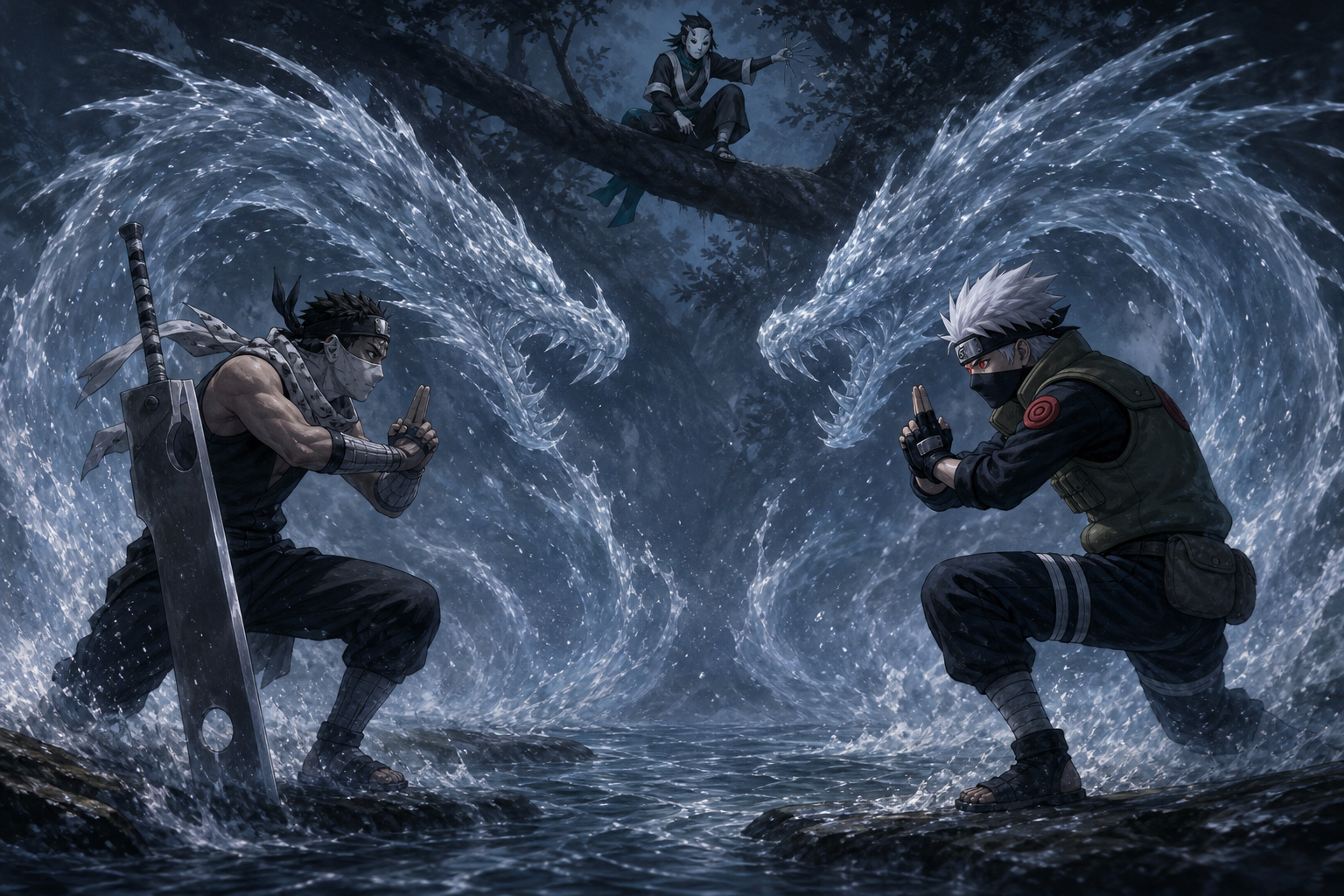
Kakashi versus Zabuza is an early masterclass because copying the visible sequence is only part of the victory. The Sharingan helps Kakashi read and mirror movement, but he also manages timing, chakra, Water Release, battlefield psychology, and Zabuza’s growing uncertainty. A technique lands in the opponent’s mind before the water does.
Hand seals make preparation visible. The twelve common signs borrow the Earthly Branch animal sequence: Rat, Ox, Tiger, Hare, Dragon, Snake, Horse, Ram, Monkey, Bird, Dog, and Boar. Fiction turns that cultural vocabulary into executable grammar. A long sequence gives an opponent information and interruption time. An expert shortening the sequence demonstrates fluency, not that seals were always decorative.
Tools and terrain matter because jutsu are performed somewhere. Zabuza’s Water Dragon uses nearby water in the early fight. Fire can expose or deny space. Earth can change cover. A wire, tag, shuriken, puppet, hidden clone, or prepared formula can finish work that raw output cannot. Naruto’s battles stay interesting when a small setup beats a large assumption.
Failure can happen at every stage. The user may lack chakra, lose control, choose the wrong target, miss a condition, suffer recoil, meet a counter, or discover the opponent understood the setup first. Knowing a technique is not the same as being able to use it safely under pressure. That gap is where training, fear, teamwork, and judgment live.
Ranks describe difficulty, not moral permission
Techniques are commonly discussed from E-rank through S-rank according to difficulty, danger, or required skill. The letter does not guarantee battlefield superiority. A low-ranked transformation used intelligently can decide a fight; a devastating high-ranked technique can be wasteful, countered, or impossible to deploy in the current space.
Basic does not mean useless
Transformation, Clone, and Substitution teach deception, timing, and control. Naruto and Sasuke’s transformed-shuriken plan demonstrates that foundational skills can free an elite jōnin.
Forbidden does not mean “evil spell”
Kinjutsu are prohibited because they create unacceptable danger, violation, instability, or political risk. A ban may protect users and victims, or protect institutional control over knowledge.
Secret is not identical to inherited
Hiden techniques are transmitted within clans or groups through guarded knowledge. Kekkei genkai are tied to inherited traits. A family can monopolize a method without encoding it in blood.
Signature is not exclusive
A technique can become identified with one character through style, innovation, or repeated use even when others can learn, copy, or inherit it.
Naruto’s opening scroll makes the politics plain. The Multi Shadow Clone Technique is forbidden because dividing chakra among many bodies can kill an ordinary user. Mizuki wants the scroll as stolen state knowledge. Iruka sees Naruto use that prohibited method to protect him. One technique is simultaneously dangerous, restricted, exploited by an adult, and lifesaving in a child’s hands. The label cannot do the moral thinking for us.
Ranks also tempt fandom into fake arithmetic. An A-rank technique does not automatically defeat a B-rank one, and a technique’s listed rank does not equal its user’s shinobi rank. Mission rank is a third system again. Naruto builds several classifications because institutions need shorthand. Readers get into trouble when they turn shorthand into destiny.
Forbidden techniques reveal whose safety counts. Edo Tensei violates corpses and enslaves souls for military use. The Eight Gates place catastrophic cost on the user. Orochimaru’s body-transfer research spends other people. A village may prohibit all three, but the harms are not morally interchangeable. “Forbidden” is the beginning of the question, babes, not the answer wearing a red stamp.
Who gets to learn what
Teachers are distribution systems
Iruka gives Naruto foundational recognition; Kakashi teaches control and tactical judgment; Jiraiya transmits summoning and Rasengan; Tsunade builds medical lineages. A mentor does not merely increase power. A mentor decides which knowledge survives, who receives time, and what ethical frame travels with the method.
Bad teaching matters too. An institution can give every student the same exercise and call the opportunity equal while ignoring seals, trauma, disability, poverty, or a clan education happening at home. Naruto’s control problem is worsened by interference in his body. Lee needs a teacher willing to build around a narrow repertoire. Sakura needs advanced instruction equal to her control. Fair training is not identical treatment.
Clans convert family into infrastructure
The Uchiha pass fire methods and ocular history. The Nara, Yamanaka, and Akimichi preserve specialized repertoires and an alliance structure. Hyūga training organizes bodies, hierarchy, and secrecy around the Byakugan. Technique inheritance can create belonging while also enforcing obligation, surveillance, and inequality.
Hiden knowledge proves that “bloodline” is often fandom laziness. Shadow Possession, Mind Body Switch, and body-expansion methods are guarded family arts, not automatically kekkei genkai. The distinction changes the political reading. A biological trait cannot simply be taught; a guarded method might be shared, but the institution chooses not to share it.
Copying exposes ownership anxiety
Kakashi’s reputation as the Copy Ninja destabilizes the idea that technique belongs naturally to its originator. Observation can reproduce form, but not every body, reserve, lineage, contract, or lifetime of practice. The Sharingan reads movement and chakra patterns. It does not hand Kakashi Haku’s inherited Ice Release or Guy’s conditioned body.
Innovation is an argument with inheritance
The official Minato retrospective traces Rasengan from Minato’s creation through Naruto’s training and elemental completion. Naruto honors inheritance by refusing to preserve it untouched. He studies what Minato could not finish, uses clones to solve his own control problem, and makes the technique answer his body.
Sasuke does something similar with Chidori. Kakashi transmits the technique and the tactical need for perception. Sasuke adds his speed, Sharingan, elemental growth, and later variations. A student’s difference is not disrespect. It is proof that teaching produced another thinker instead of a photocopier.
What jutsu means beneath the spectacle
Technique is disciplined memory
A jutsu lets knowledge outlive an individual. Names, seals, teaching sequences, scrolls, demonstrations, and clan practice turn bodily discovery into transmission. That makes technique culture as much as combat. The ninja world’s power is accumulated human memory, sometimes shared, sometimes hoarded, sometimes buried with the people a government feared.
This is why erased clans and dead teachers matter mechanically. When a community is destroyed, the world does not only lose relatives. It loses methods, corrections, ethics, stories, and the person who knew why step four could kill you. Scrolls preserve instructions. They do not reproduce trust.
Every shortcut moves a cost
Forbidden techniques, body modification, stolen eyes, cursed seals, and forced contracts promise to bypass time or limitation. They rarely eliminate cost. They transfer it to the body, another person, or the future. Orochimaru’s horror is not curiosity. It is the conviction that other bodies are acceptable research material.
The same question follows scientific ninja tools in the sequel era. A tool can widen access, reduce training time, replace a limb, or conceal power a user has not learned to govern. Technology is not automatically cheating or liberation. Ask who designed it, who owns it, what dependency it creates, and who absorbs failure.
Tactics outrank fireworks
Naruto’s best fights remain readable because information matters. What does the opponent know? Which technique is bait? Which body is a clone? What condition has been hidden? How much chakra remains? Spectacle rewards viewers who read underneath it, just as shinobi read beneath visible actions.
The series sometimes loses that clarity when late-war scale becomes enormous. Bigger attacks can flatten the social specificity that made early techniques memorable. Yet even then, the strongest payoffs come from relationships and knowledge: a seal prepared years ago, a name finally learned, a teammate’s chakra arriving on time, or an inherited method used for a purpose its creator never imagined.
A repertoire is a moral autobiography
Naruto transforms for mischief, then protection and infiltration. Sakura turns control into medical care and decisive force. Kakashi carries techniques from teachers, enemies, and a dying friend. Haku’s elegance serves a dependency he did not freely enter as an equal. The move list cannot tell us whether a person is good, but it can show what shaped them and whose life their competence now serves.
That is the bottom line. Jutsu are not collectible spells floating above the story. They are labor, memory, access, inheritance, and consequence made visible enough to fight with.
A jutsu is a process, not a magic-word coupon
The finished attack gets the screenshot, but Naruto’s better fights care about everything that happens before impact. The user gathers and shapes chakra, forms any required seals, controls timing, reads distance, protects an opening, and adapts when the opponent understands the same system. A technique can be powerful on paper and useless in the wrong body, terrain, or second.
That is why hand seals matter even after elite shinobi start moving too quickly for casual viewing. Seals give form to trained knowledge. Shortening them can signal mastery, but mastery does not erase method. Kakashi copying Zabuza is frightening because he reads the sequence, reproduces it, and weaponizes anticipation. He does not press a universal “water dragon” button.
Classification describes method, not moral worth
Ninjutsu, genjutsu, and taijutsu help viewers identify how a technique acts. Medical ninjutsu, barrier ninjutsu, sealing arts, sensory methods, space-time techniques, and clan arts add practical specialization. None of those labels answers whether using the technique is just. Healing can support an abusive army. Genjutsu can prevent bloodshed. Taijutsu can protect or brutalize. The user’s purpose and the target’s consent still matter.
The forbidden-technique label also needs care. “Forbidden” may reflect danger to the user, harm to others, political control, ethical risk, or some combination. It does not mean the technique disappears. Konoha preserves forbidden knowledge in a scroll, which tells us immediately that prohibition and possession are different policies.
Ranks are warnings, not guaranteed outcomes
Jutsu ranks estimate difficulty and demand. They do not create a clean ladder where every A-rank technique defeats every B-rank one. Matchups, preparation, chakra reserves, accuracy, experience, information, and terrain can reverse the expected result. A basic substitution used at the correct instant may matter more than an enormous technique launched after the opponent has already solved it.
This is also where fandom power charts can get silly. Naruto’s combat writing is often at its best when the clever answer is not “make the explosion larger.” Shadow clones collect information. Transformation changes the social reading of a scene. Wire, tags, mud, insects, smoke, and feints create decisions. Technique is grammar. Strategy decides what the sentence says.
Teaching reveals who controls knowledge
Every jutsu has a route into the world. Someone invented it, inherited it, copied it, stole it, recorded it, or chose to teach it. Clans can protect techniques as family property. Villages can classify methods as military secrets. Mentors decide which students receive dangerous knowledge and when. Orochimaru turns access into dependency. Jiraiya gives Naruto tools while forcing him to develop control. Tsunade’s medical system links skill to institutional reform.
So a repertoire is never merely a list of cool moves. It records relationships and access. Sasuke carries Uchiha inheritance, Kakashi’s instruction, Orochimaru’s interference, and his own invention in the same body. Naruto’s techniques carry forbidden archives, Iruka’s recognition, Kakashi’s fundamentals, Jiraiya’s mentorship, shadow-clone labor, and Kurama’s changing consent. The moves remember who helped and who took.
RaeRae’s bottom line
Jutsu stays compelling when technique, character, and consequence remain attached. Learn the categories so the action makes sense. Then look past the label. Ask what the move costs, who taught it, why this person chooses it, and what the choice does to everybody standing nearby. Fireworks are fun. Meaning is why the fight survives after the smoke clears.
Original techniques are character writing
Creating a jutsu means refusing to remain only a student of inherited answers. Minato develops the Rasengan, Kakashi develops Chidori, Tobirama leaves a terrifying library of innovation, and Naruto reshapes what he receives through clones, wind nature, and stubborn experimentation. Innovation can liberate, but it can also leave dangerous tools for institutions to misuse.
The important question is not simply who invented the strongest move. It is whether the creator understood the cost, controlled the teaching, and accepted responsibility for what followed. Naruto repeatedly admires invention while warning that brilliance without ethics becomes somebody else’s funeral. That tension belongs beside every rank chart and elemental diagram. It also explains why a technically perfect attack can still represent a moral failure. Skill measures execution. The story keeps asking whether the person using that skill deserves our trust. That question matters long after any single battle ends completely.
Source shelf and continuity boundary
Episode 9 event checks use the official “Kakashi: Sharingan Warrior” page. Hand-seal and historical-ninjutsu context uses the official Ninja Descendant interview. Rasengan inheritance and evolution use the official Minato Column. Explanations and judgment are original to CVM Sekai.
Anime staging may lengthen hand-seal sequences or add techniques. Games often create moves for playable balance and spectacle. Those versions belong on a labeled adaptation shelf, not inside the core system by stealth. Translation also varies between jutsu, technique, art, and release terminology. This guide keeps the mechanics stable while respecting those wording boundaries.
Now connect the method to the energy.
Read Chakra for reserves, control, elemental nature, exhaustion, seals, and the politics of power carried inside bodies.
Open Chakra Explained → · Return to Naruto 101 → · Read Episode 9 →