
Arthur Cavendish
The eldest brother, trained from birth to inherit, and dead before he could. When Nigel asks whether it was an accident, his father answers “Not really,” and the novel does not elaborate.
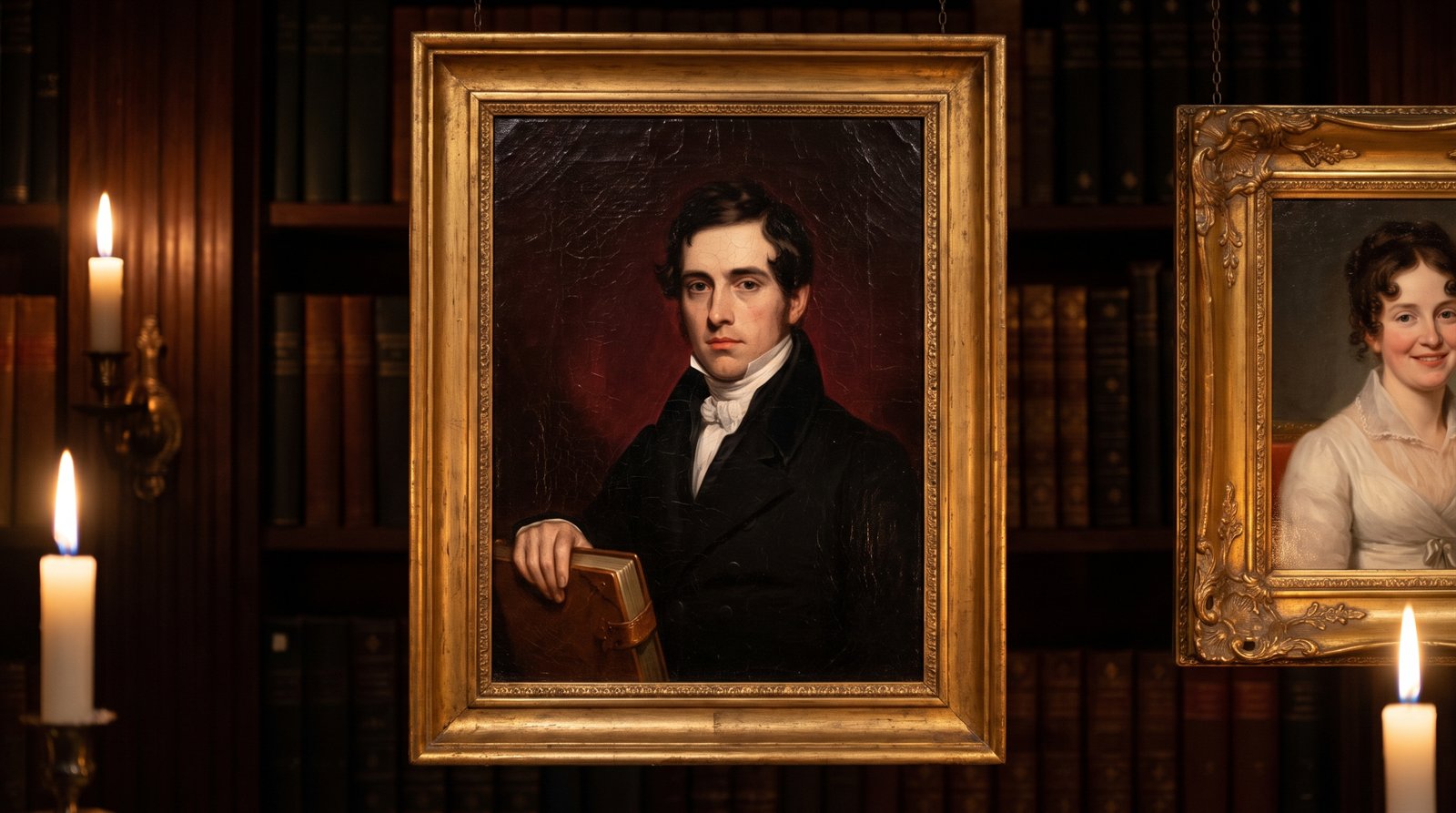 Arthur Cavendish, as a portrait of the period. CVM Sekai original art.
Arthur is the brother the Cavendish family was built around, and he is the one nobody in the present day describes with any warmth. Lionel gets “I worshipped him” and a portrait his brother still looks at. Arthur gets duty, responsibility, a serious nature, and a death his own brother will not call an accident.
He matters because his existence is why Edmund was expendable. There was an heir and a spare, so the third son could have a commission bought for him and be sent to Spain. Arthur’s whole function in the family was to make Edmund’s life optional.
Then within a short span the family lost Lionel to a duel, the father to a sudden illness, and Arthur to whatever “not really an accident” means, and the son who was sent away came home to run everything.
The file
| Name | Arthur Cavendish |
|---|---|
| Position in his family | The eldest of three sons. Brother to Lionel and to Edmund |
| Relation to Nigel | Paternal uncle, dead long before Nigel’s adulthood |
| Raised to be | The next viscount. “Trained since birth for the position” |
| Temperament | Duty and responsibility. A serious nature. Disapproved of Lionel’s behavior |
| Cause of death | Not settled. Nigel asks whether it was an accident and his father says “Not really” |
| When | Within the same period as Lionel’s duel and their father’s sudden illness, while Edmund was in Spain or shortly after |
| Status | Deceased |
| Book and series | What a Lady Wants, Last Man Standing book 2, by Victoria Alexander |
Trained from birth
I never expected to be the next viscount, you know. My oldest brother, Arthur, had been trained since birth for the position. Since I was the third son, my father was happy to purchase my commission. After all, I was expendable.
At any rate, my father still had his heir and a spare to boot.
Heir and a spare, and then a third. That arithmetic sent Edmund to fight Napoleon in Spain, and it is the same arithmetic that makes Nigel’s position so different: Nigel has been the heir from birth and has never been anybody’s spare.
The opposite of his brother
While Arthur was intent upon duty and responsibility, Lionel thought of little more than his next game of chance or his next amorous conquest. You could not have found two men whose natures were more in opposition than Lionel and Arthur, and yet they were fond of one another.
I worshipped Lionel, but then everyone did, even Arthur in spite of his disapproval of Lionel’s behavior and his own serious nature.
Read that second one carefully, because it is the only thing in the novel that gives Arthur any interior life. He disapproved of his brother and adored him anyway. The man built entirely out of duty could not help loving the one built out of appetite.
It is also, quietly, the family’s verdict on itself. Two brothers, one dutiful and one delightful, and the surviving brother’s tribute is “everyone worshipped Lionel.”
Three deaths and a mess
I was in Spain when he died. By the time I received word of Lionel’s death, a sudden illness had taken my father’s life as well.
…as I was later to learn, my father’s affairs were in something of a mess when he died.
[I came] home at once. I was shocked to discover the sorry state of the family’s finances.
This answers a question left open on other pages here. The Cavendish fortune was described as being “once again on sound footing” thanks to Lady Cavendish’s money and judgment, and the failure it recovered from was not vague mismanagement: the grandfather died with his affairs in a mess, and Edmund inherited the wreck.
Nigel, incidentally, knew almost none of this before this conversation.
Nigel’s knowledge of his father’s family was little more than dim recollections of chance comments.
Not really an accident
Arthur was an excellent horse man. No one sat a horse as he did. It was a curious way for him to meet his fate.
Do you suspect it was other than an accident?
Not really, but as I said, given Arthur’s skill, it was odd.
So it was an accident, and his brother has never quite been able to believe it. Not suspicion, exactly. Forty years of a small wrongness that will not settle: the best horseman anyone knew, killed by a horse.
The novel raises it, lets Nigel ask the obvious question, and closes it with odd. Nobody investigates. This page records the oddness because the Viscount clearly still carries it, and records that the book supplies no more than that.
What the book withholds
Whether the fall was really an accident. His brother says not really, and then says it was odd. The book never returns to it.
His age at death, and whether he married. Neither given.
What he was doing about the estate. The novel says only that he had made no progress and that there was “a fair amount of evidence to indicate he had no idea what to do”. Whether that was inexperience, illness or something else is not explained.
Any of his own words. He never speaks. He exists in one brother’s summary.
Whether a portrait of him hangs beside Lionel’s. The library portrait the novel names is Lionel’s. The art on this page is an interpretation and no companion canvas is described in the text.
Where he connects
Edmund Cavendish, Viscount Cavendish
The expendable third son who inherited everything Arthur was raised for.
CharacterLionel Cavendish
The brother he disapproved of and adored.
CharacterThe Honorable Nigel Cavendish
Hearing all of this for the first time at thirty.
CastAll characters
Everyone who speaks or is spoken to in this book.
The heir who could not do it
I was shocked to discover the sorry state of the family’s finances. Arthur had made no progress in that respect. Indeed, there was a fair amount of evidence to indicate he had no idea what to do.
This is the detail that turns Arthur from a dutiful blank into something sadder. He was trained from birth for the position, he took it seriously, he outlived his father long enough to hold it, and he could not do the job. The evidence Edmund found was not of neglect. It was of a man who did not know how.
What Edmund did instead is the other half of it, and he states it without any romance at all.
So it fell to me. I worked, borrowed, sold some property and used the proceeds to invest in estate improvements, and I did what men in my position have always done. I found a wife with excellent connections and an impressive dowry.
The expendable third son fixed what the trained heir could not, and part of how he fixed it was marrying a woman with money.
The RaeRae take
Arthur is the saddest entry on this shelf so far and the book barely notices. He did everything right. He was trained from birth, he took duty seriously, he disapproved of the correct things, he inherited at the worst possible moment, and he had no idea what to do. Then the best rider anybody knew came off a horse.
There is something quietly brutal in the structure of that conversation. Edmund is trying to tell his son that being like Lionel is a compliment. To do it he has to explain who Lionel was, and to explain who Lionel was he has to hold up Arthur as the dull one. The dutiful brother’s entire posthumous function is to make the reckless brother look better.
And then the book withholds his death, which is the one thing that might have given him a story of his own. “Not really” an accident is a door left open. I want to know what is behind it, and I am recording that I do not know yet rather than filling it in, because filling it in is exactly the habit this shelf was rebuilt to stop.
Sources
Primary source is the novel itself: What a Lady Wants by Victoria Alexander, Last Man Standing book 2, 389 pages, read front to back on Kindle and currently complete through page 80, with page-numbered receipts confirmed by in-book search on the term Arthur, which returns nine results.
No secondary source, wiki, blurb or adaptation has been used. The portrait on this page is an interpretation; unlike Lionel’s, no canvas of Arthur is described in the text.