
Lionel Cavendish
Nigel’s uncle, dead decades before the book opens, killed in a duel by a jealous husband. His portrait hangs in the library where his brother hands the family fortune to the nephew who is his living image.
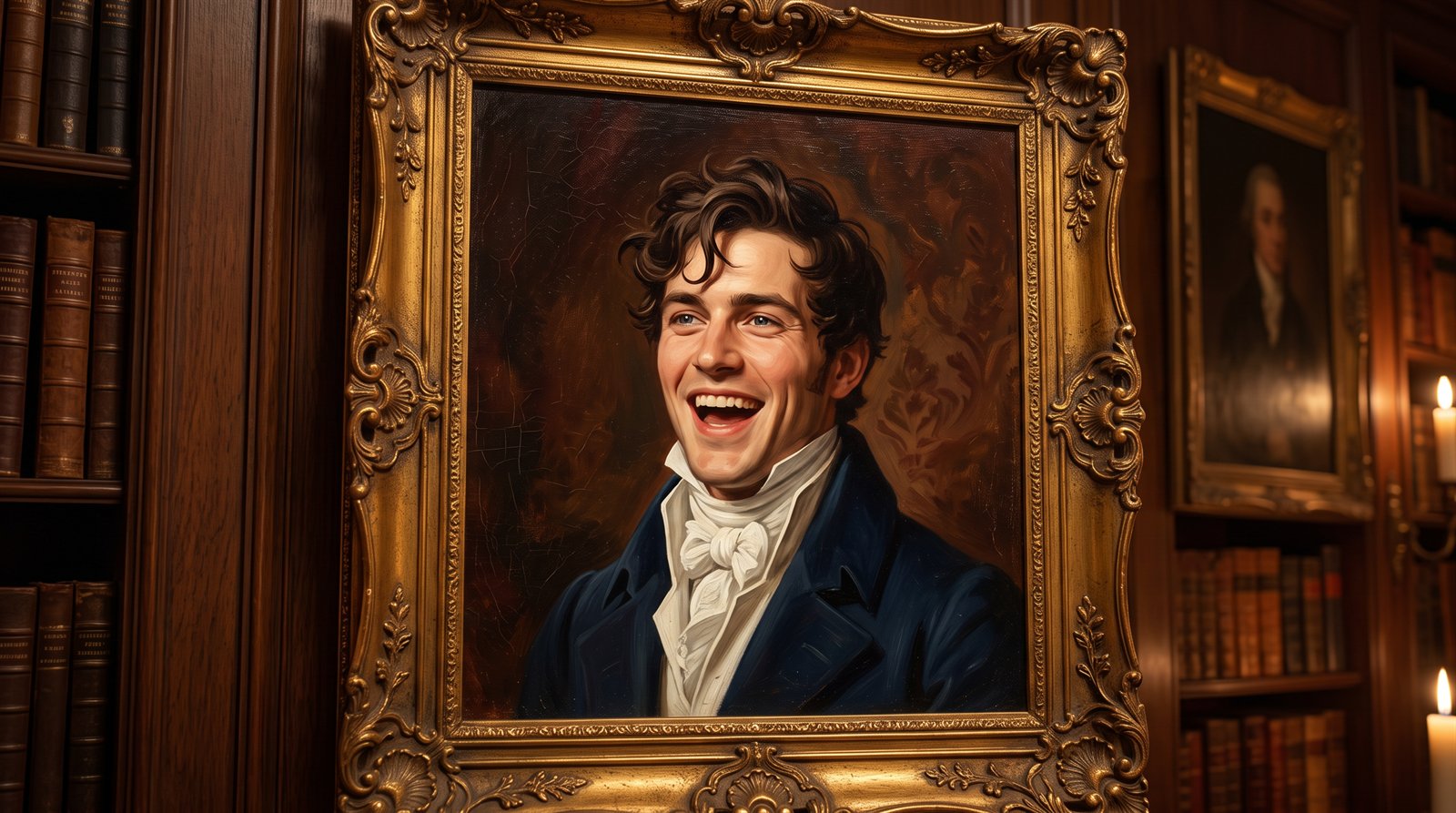 The small portrait of Lionel Cavendish that hangs in the library. CVM Sekai original art.
Lionel is the reason the ultimatum scene lands. Without him it is a father telling a rake to grow up. With him it is a man looking at his son and seeing a brother who died doing exactly this.
The detail that makes it work is that Lionel was loved. He is not a cautionary tale the family tells with disapproval. His brother says outright that everyone worshipped him, including the serious brother who disapproved of everything he did. The warning is not that Lionel was bad. It is that he was delightful and it killed him anyway.
And the timing is cruel. Days before this conversation, Nigel was fired on by a jealous husband and survived. The Viscount is not speaking in metaphor.
The file
| Name | Lionel Cavendish |
|---|---|
| Position in his family | The second son. Brother to Arthur, the eldest, and to Edmund, the third |
| Relation to Nigel | Paternal uncle. Died long before Nigel’s adulthood |
| Cause of death | Killed in a duel, at the hands of a jealous husband |
| When | While Edmund was serving in Spain. Edmund learned of it by dispatch, after the fact |
| Temperament | Amusing, clever, fun-loving, “not wicked in nature”. Also foolhardy and reckless |
| Occupation of his time | “His next game of chance or his next amorous conquest” |
| Resemblance | Nigel looks remarkably like him. Stated by the Viscount and confirmed by Nigel looking at the portrait |
| Where he still is | A small portrait hanging in the Cavendish library, to the right of where his brother sits |
| Status | Deceased |
| Book and series | What a Lady Wants, Last Man Standing book 2, by Victoria Alexander |
Two brothers, opposite in every way
While Arthur was intent upon duty and responsibility, Lionel thought of little more than his next game of chance or his next amorous conquest. You could not have found two men whose natures were more in opposition than Lionel and Arthur, and yet they were fond of one another.
Their father, meanwhile, had “his heir and a spare to boot”, which is how Edmund ends up describing his own position as expendable and gets a commission bought for him. Lionel’s frivolity was affordable precisely because Arthur existed.
The Viscount also grades his brother against his son, and Lionel wins.
…was an existence even more frivolous than yours.
Everyone worshipped him
I worshipped Lionel, but then everyone did, even Arthur in spite of his disapproval of Lionel’s behavior and his own serious nature.
He was great fun, Lionel, that is.
He was not wicked in nature, simply fun-loving. Lionel was amusing and clever and somehow made you think the world was not as dire a place with him in it.
The narration notes that the Viscount says this with a sad, wistful expression Nigel has never seen on him before. This is a man in his sixties still visibly missing a brother.
The resemblance, and the compliment
You remind me of Lionel a great deal.
Then I fear that is not a compliment.
Oh, but it is.
That exchange is worth reading slowly. Nigel hears the comparison and flinches, because he assumes any comparison to a Cavendish who came before is a measurement he has failed. His father is doing the opposite: he is saying that the thing about his son everyone treats as a defect is the thing he loved most in his brother.
Nigel then looks at the portrait and asks whether it is only about the face.
Nigel’s gaze shifted to the small portrait of Lionel that hung to the right of his father. “Because I look like him?” “The resemblance is remarkable, but no, that’s not what I meant.”
Spain
I was in Spain when he died. By the time I received word of it…
The sentence continues past the point this read has reached, so this page quotes only what the search returned. What is already clear is the shape of it: the third son, sent abroad because he was expendable, learning by dispatch that the brother everyone worshipped had been shot over a woman.
It also reorders the family’s losses. Edmund did not inherit through one death but through a father and two brothers, and at least one of those he was not present for.
Why he is the key to the book
Strip Lionel out and the library scene at pages 62 to 69 is a wealthy father telling a wealthy son to take responsibility. Put him back and it is this:
A man in his sixties, who was sent to war as the expendable son, who came home to a title three deaths made his, is sitting under a portrait of the brother he worshipped, talking to a son who has that brother’s face, that brother’s habits, and who three nights ago was shot at by a jealous husband exactly as that brother was.
He does not say any of that. He says the resemblance is a compliment, hands over the notebook, and suggests his son might casually look for a wife. See the Viscount for the full scene and Nigel for what he does with it.
What the book withholds
When he died, and how old he was. Only that Edmund was in Spain at the time, which places it in the Peninsular War years.
Who killed him, and over whom. A jealous husband. No name, no circumstances.
Whether he was married. Not addressed.
What Edmund did when the word reached him. The sentence is cut off in the passage available at this point in the read.
Any of his own words. He never speaks. He exists in one brother’s memory and one small painting.
Where he connects
Edmund Cavendish, Viscount Cavendish
The brother who worshipped him and was in Spain when he died.
CharacterThe Honorable Nigel Cavendish
His living image, and lately shot at by a jealous husband.
CharacterAlfred, Lord Pomfrey
The jealous husband who missed.
CastAll characters
Everyone who speaks or is spoken to in this book.
The RaeRae take
This is the best-built thing in the novel and it is entirely offstage. A dead uncle nobody in the book has met, one small portrait, and about a page of dialogue, and he reorganizes the meaning of every scandal Nigel has ever caused.
What I admire most is that the book refuses the easy version. Lionel is not a warning because he was dissolute and came to a bad end. He is a warning because he was the best company anyone in that family ever had, his own disapproving brother adored him, and it killed him anyway. Charm is not presented as the flaw. Charm is presented as genuinely valuable and separately fatal, which is a much harder thing to dramatize.
And the Viscount never uses him as a threat. He could say you will end up like my brother and he does not. He says the resemblance is a compliment and means it. That restraint is why the scene works, and it is also, I suspect, why Nigel walks out of it having heard nothing at all.
Sources
Primary source is the novel itself: What a Lady Wants by Victoria Alexander, Last Man Standing book 2, 389 pages, read front to back on Kindle and currently complete through page 80, with page-numbered receipts confirmed by in-book search on the term Lionel, which returns ten results.
No secondary source, wiki, blurb or adaptation has been used. The portrait on this page is CVM Sekai original art, painted to the two facts the novel supplies: that a small portrait of him hangs in the library, and that Nigel is his remarkable likeness.