
The Honorable Nigel Cavendish
Heir to a viscountcy, thirty years old, six weeks from inheriting the management of everything, and famous for being a fool. His sister says he performs the foolishness on purpose, because the alternative is competing with his father and losing.
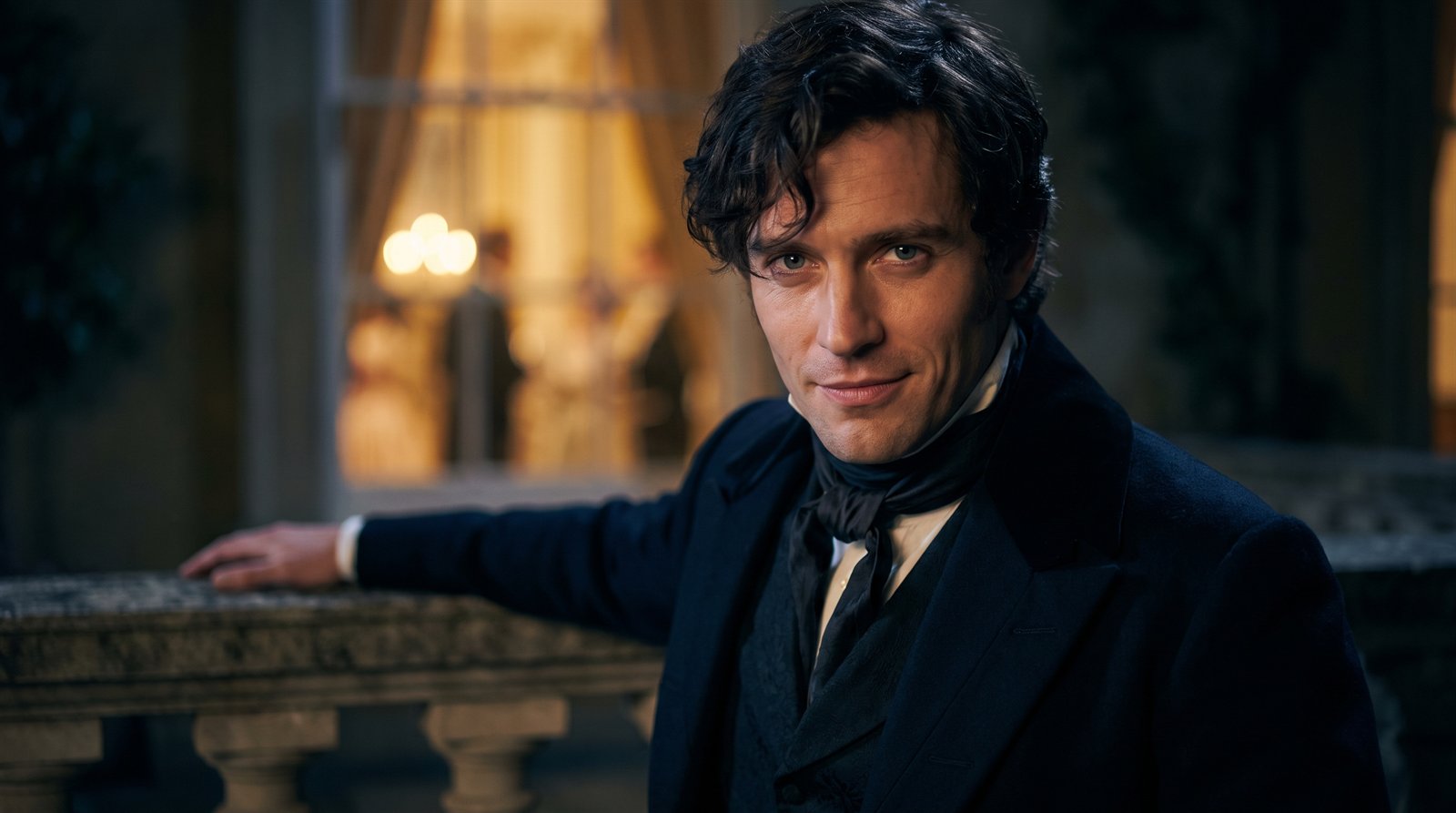 Nigel Cavendish. CVM Sekai original art, drawn to the description at page 38.
Nigel is not a rake because he wants things. He is a rake because he has decided in advance that he cannot be anything else worth being, and scandal is the one field where his father is not already the record holder.
The book gives you that diagnosis twice, from opposite directions, and neither speaker hears the other. Nigel tells his father it is easier to live down to expectations than up to them. Fifteen pages later his twin sister tells a near stranger that their father is the kind of man legends are made of, that being the heir to a legend is unbearable, and that Nigel therefore does not try. Same answer. Never once said between them.
Everything else follows from that. The charm is real and it is a costume. The intelligence is real and he actively hides it. And the thing that finally cracks him is not seduction, it is being seen: a woman who notices he is clever and asks, honestly puzzled, why a man would want to be thought a fool.
The file
| Name and style | The Honorable Nigel Cavendish, heir to Viscount Cavendish |
|---|---|
| Age | Thirty, turning thirty-one in six weeks. “It was exceedingly difficult for a man of thirty years to live under his parents’ watchful eyes” |
| Father | Edmund Cavendish, Viscount Cavendish |
| Mother | Not named in the pages read. Blue eyes “so deep a man could surely drown in them”. Brought money as well as, in her husband’s ranking, wisdom and courage |
| Twin | Madeline, Countess of Windham |
| Other siblings | Robert, called Robin, a scholar of antiquities in his twenties. Phoebe, sixteen and expensive |
| Dead uncles | Arthur, trained from birth for the title. Lionel, killed in a duel by a jealous husband. Nigel is Lionel’s image |
| Education | Oxford. Confirmed at page 87, when his sister says she would like to have attended “as you did” |
| Reputation | The most scandal-prone of the tontine, “particularly with members of the opposite sex. More specifically, with widows, or with wives of a certain persuasion” |
| Stated rule | “Marriage-minded virgins, as well as members of their families, especially their mothers, are to be avoided at all costs” |
| Circle | The tontine. With Warton and Helmsley married off, the field is Nigel, Norcroft and Sinclair |
| Status as of page 80 | Alive, unmarried, and being campaigned for by a woman he does not yet know is campaigning |
| Book and series | What a Lady Wants, Last Man Standing book 2, by Victoria Alexander |
What he looks like, per the book
Recorded because the novel is unusually specific, and the art on this page is drawn to it rather than invented.
His jaw was nicely square, with a distinctly determined set to it. His hair was dark, a walnut color, and with a slight unruly hint of curl… His nose was the tiniest bit crooked, which enhanced rather than detracted from his appearance and made him seem just a touch dangerous. But it was his eyes, clear and blue as a summer sky, with a spark of amusement in their depths, that made him appear truly wicked.
The crooked nose is the detail worth keeping. The book decides its romantic lead should be slightly damaged-looking and says the damage improves him.
The reputation, and the night it nearly ended
I daresay there are few who do not know about your late-night encounter with Lord Pomfrey’s dueling pistol, not to mention the assignation that preceded it with Lady Pomfrey.
One tends to be impatient when one has been shot at, forced to climb down a building, scaled a wall, and lost one’s favorite coat in the process, all with the proverbial hounds of hell nipping at one’s heels.
His own accounting of the evening is a list of inconveniences ending with a ruined coat. A man was firing at him. He files it under bad luck with tailoring.
Maids and footmen, valets and cooks all derived great amusement from the antics of the upper classes. Nigel certainly did his part to entertain the masses. Indeed, he considered it a sort of responsibility. Noblesse oblige, as it were.
It is a joke and it is also the clearest statement of his method. He has taken the one obligation of his rank he cannot fail at, being a spectacle, and elevated it into a principle.
What actually catches his attention
What has piqued my curiosity was why a young woman who should certainly have known better given her age did not sound an alarm when she saw me drop into her garden. Or when I approached her balcony. Or when I climbed her trellis.
I have no intention of involvement of any kind with this particular virgin beyond a simple conversation. I am curious; there’s nothing more to it than that.
Norcroft warns him off in plain terms and he goes anyway.
Because she is not married nor has she ever been married. And I am fairly certain she wishes to rectify that.
What he liked, before he knew who she was, was nerve.
There was something about her he liked. Something beyond her ability to keep her head when confronted with a strange man in the middle of the night in her garden. She obviously had courage, even if misplaced.
Six weeks
In six weeks you’ll be thirty-one years of age. At that time, I will hand over management of the majority of all this to you.
“I’m not ready for this.” “No one ever is.”
He responds by promising to spend the six weeks badly.
Then you shall no doubt enjoy the next six weeks. I warn you, Father, I plan on having a rousing good time.
There might even be a minor scandal or two.
And when the second condition arrives, a suggestion that he look for a wife, he refuses it flatly and with a reason that is more honest than it sounds.
I have no desire to be shackled to one woman for the rest of my days as of yet, and I suspect I will be no more ready in six weeks than I am today. I am less ready for a wife than I am for this.
The fear he states out loud once
But what if I fail miserably? Lose the entire fortune? Plunge the family into poverty? Or worse? You have the futures of two other children to consider. Why, Robin is barely in his twenties and Phoebe is only sixteen. What ever I do will surely affect their lives. No doubt adversely.
That is not a rake’s objection. It is an accurate assessment by somebody who has thought about it, and it names his brother and sister rather than himself.
It’s easier, I suppose, to live down to people’s expectations rather than live up to them.
Nigel fears he cannot live up to Father’s standards, and therefore he makes no attempt to do so.
Two people, fifteen pages apart, in different rooms, reaching the identical conclusion about him. His father is present for the first one and does not follow it up. See Madeline for the fuller version.
His response to his father’s confidence tells you how deep it goes.
“How do you know I won’t muck it up?” “I have every confidence in you.” Misplaced, no doubt.
Lionel
He was not wicked in nature, simply fun-loving. Lionel was amusing and clever and somehow made you think the world was not as dire a place with him in it. Unfortunately he was foolhardy and reckless as well. He met his fate in a duel at the hands of a jealous husband.
I worshipped Lionel… You remind me of Lionel a great deal.
Then I fear that is not a compliment.
Lionel’s portrait hangs in the library where this conversation happens. Nigel looks at it and asks whether the resemblance is why. His father says the resemblance is remarkable but not what he meant.
Timing is everything here. Days earlier Nigel was running from Lord Pomfrey’s dueling pistol. His father is not scolding a young man about manners. He is watching a dead brother walk around in his son’s face, repeating the exact behavior that killed him.
The tontine he is now favorite to win
A shilling from each of four men and a bottle of Cognac, on whoever stays unmarried longest. Warton proposed it and then married Judith at the end of book one. Helmsley went before that. Three remain: Nigel, Norcroft and Sinclair.
“Freedom,” Cavendish said firmly. “The right to do exactly as we please when we please without having to answer to anyone.”
Norcroft’s reply is the reason that definition will not survive the book.
You have yet to come into your title and the responsibilities that accompany it. You have the freedom, and the money I might add, to do precisely as you wish, and you do. You’re charming and great fun to be with and a good friend, but your life to this point has consisted entirely of frivolity and nothing of substance whatsoever.
“That’s rather harsh.” Cavendish winced. “True, but harsh.”
Nigel defines freedom as answering to no one. His father hands him a fortune that means answering to everyone. The tontine and the inheritance are the same argument.
What the book withholds
His mother’s name. Referred to throughout, never named in the pages read.
What he is actually good at. Madeline says he hides his intelligence. The novel has not yet shown him applying it to anything.
Whether he knows he resembles Lionel in behavior as well as face. He asks about the face. Nobody raises the rest.
Everything after page 80. This profile is written from a front-to-back read currently at page 80 of 389, plus the prologue. His status is as of that point and this page will be revised as the read continues.
Where he connects
Lady Felicity Melville
The woman whose garden he fell into, who has since decided he is fate.
CharacterEdmund Cavendish, Viscount Cavendish
The legend he declines to compete with.
CharacterMadeline, Countess of Windham
His twin, who has him diagnosed and has been hunting him a wife for years.
Book hubWhat a Lady Wants
Last Man Standing book 2. Plot, arcs, tropes, reacts and the full cast.
The RaeRae take
Every rake in this genre gets a wound, and most of them get a dead fiancee or a cold father. Nigel gets something better and much less flattering: a father who is genuinely magnificent, genuinely kind, and has never once made him feel small on purpose. There is nobody to blame. The damage is entirely self-inflicted and entirely comprehensible.
What makes him worth reading is that he is not lying to anyone except himself. He tells his father he plans to misbehave. He tells his friends he wants no involvement with Felicity. He tells Norcroft the scandal is not worth defending. The performance is completely transparent to everyone including him, and he keeps it up anyway, because dropping it would mean trying, and trying means being measured.
The moment I would build the book hub around is Felicity’s question at page 78. Not a seduction, not a kiss. A woman looks at him and asks, genuinely confused, why a man would want to be thought a fool when he so obviously is not one. Nobody in his family has ever asked him that to his face.
Sources
Primary source is the novel itself: What a Lady Wants by Victoria Alexander, Last Man Standing book 2, 389 pages, read front to back on Kindle and currently complete through page 80. Every page number cited above falls inside that read.
No secondary source, wiki, blurb or adaptation has been used, and nothing beyond page 80 has been consulted for this page. Where the book does not say something, this page says that it does not say it.