
Madeline, Countess of Windham
Nigel’s twin sister. She has been hunting a wife for him for years, and when one turns up on her doorstep uninvited and announces the plan, she recruits her on the spot.
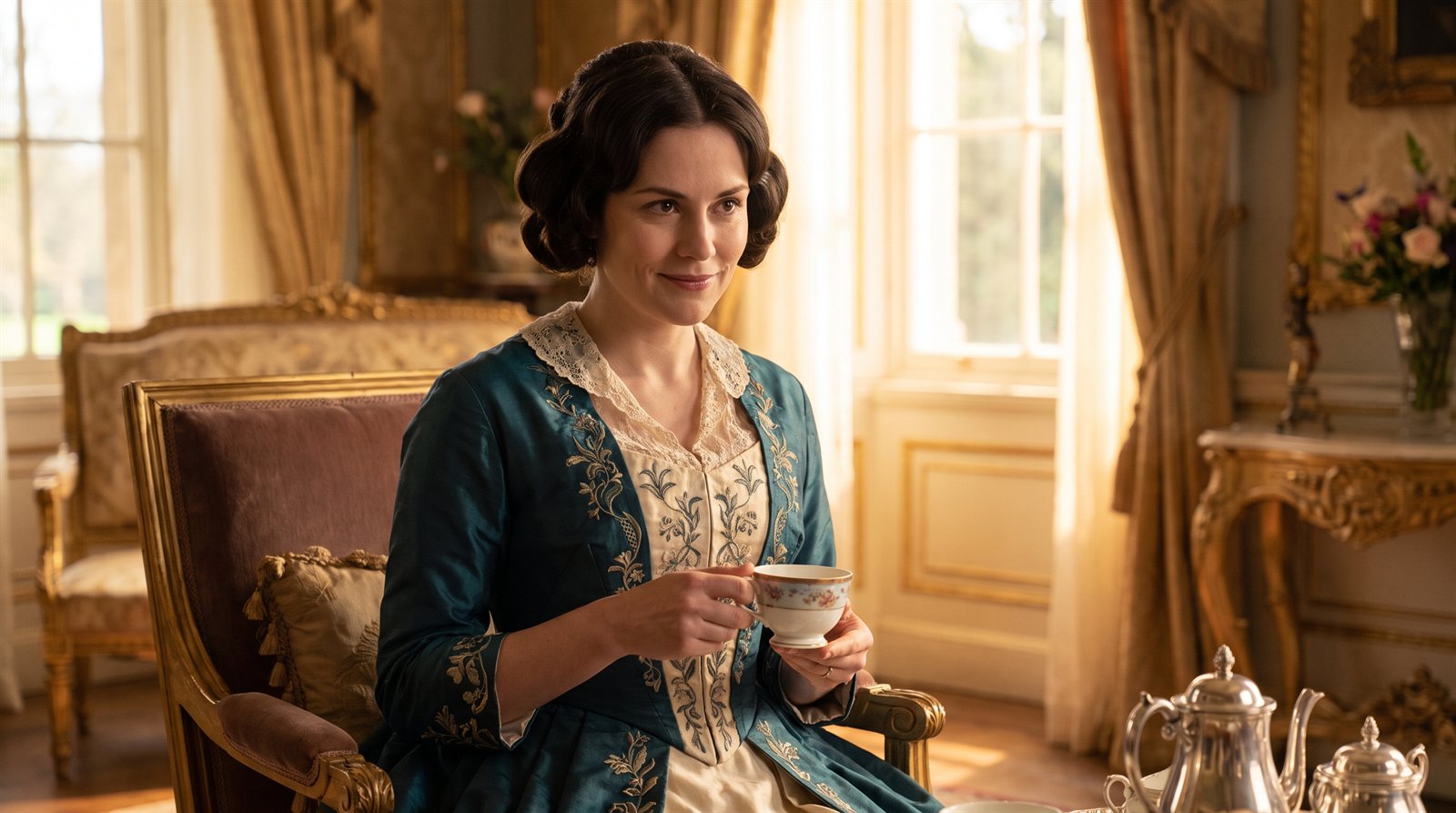 Madeline, Countess of Windham. CVM Sekai original art.
Madeline is the book’s second brain. She gets three chapter epigraphs in her own name, which in a novel whose chapters are headed “What a [somebody] really wants” means the author hands her the argument three separate times.
Her function is to say out loud what neither Cavendish man will. Nigel tells his father he finds it easier to live down to expectations. His father never hears it. Madeline, forty pages later, gives a stranger the full diagnosis unprompted: their father is a legend, being the heir to a legend is unbearable, so Nigel declines the contest. Same conclusion, arrived at independently, spoken to the one person who can do something with it.
She is also proof of her own advice. She barely knew her husband when she married him and has been happy for ten years, which is why she can tell Felicity that knowing a man beforehand is nonsense without it sounding reckless. She is not gambling with somebody else’s life. She is describing her own.
The file
| Name | Madeline Windham, nee Cavendish. Named in full in the first line of chapter four |
|---|---|
| Title | Countess of Windham. Addressed as Lady Windham throughout |
| Called | Maddy, by her father |
| Relation to Nigel | Twin sister |
| Other siblings | Robert, called Robin, a scholar of antiquities in his twenties. Phoebe, sixteen |
| Father | Edmund Cavendish, Viscount Cavendish |
| Husband | Lord Windham, the Earl. Not given a first name in the pages read. He is not merely offstage: he is present at a family gathering at page 239, alongside Madeline and Nigel’s brother |
| Married | About ten years, and she says she scarcely knew him when they wed |
| Children | Five sons, including a set of twins. She is a twin herself |
| Appearance | Does not resemble her twin. “While there was a vague similarity in coloring, Nigel’s twin didn’t look the least bit like him. Except for the twinkle in her eye”, page 82 |
| Household | Her own, well staffed enough that tea and biscuits arrive unbidden, page 81. She cannot, however, keep a governess: she pays them the equivalent of their weight in gold and her children are high-spirited |
| Long-running project | Finding her brother a wife. “I’ve been keeping my eyes open for a prospective bride for my brother for years” |
| First appearance | Page 72, receiving Felicity, who has arrived uninvited with a calling card |
| Status at this point in the book | Alive. Read complete through page 80 of 389, plus searched receipts to page 148 |
| Book and series | What a Lady Wants, Last Man Standing book 2, by Victoria Alexander |
The wrong brother
“You what?” The Countess of Windham, Madeline Windham nee Cavendish, stared at her guest as if she had suddenly sprouted wings and a tail.
Felicity says she intends to marry her brother. Madeline is delighted, and guesses wrong.
“You plan to marry Robin? How wonderful.”
“Who is Robin?” “My brother, of course. Robin, or rather, Robert Cavendish.”
Felicity is mortified, assumes she has called on entirely the wrong family, and tries to leave. Then she says the words twin sister of Mr. Nigel Cavendish and Madeline chokes.
Her explanation of the mistake is the most efficient statement of Nigel’s market position in the novel, and it comes from the person best placed to make it.
When you said you wished to marry my brother, I simply assumed you were speaking of Robin because he is the sort of man women do wish to marry, whereas Nigel, well, Nigel is the kind of man marriage-minded women tend to avoid. Nigel is not at all inclined toward marriage, and he makes no attempt to hide that fact.
The interrogation
In order: where did you meet him, is there insanity in your family, are you compromised, and are you only after the inheritance. Delivered pleasantly, over a calling card she keeps turning over in her hand.
Might I ask you if there is any insanity in your family?
And there isn’t…That is, you and Nigel haven’t…On the night you met…Given the odd circumstances…Oh dear. I don’t know how to put this delicately. You’re not…compromised?
If your interest is merely due to his position as my father’s heir, then I—
Then the audit, which Felicity does not enjoy:
You appear to be quite acceptable, practically perfect at least in regards to a potential wife. You may well be the answer to my prayers… You’re attractive but not overly so. You’re of good family. Your demeanor is proper but not too proper.
And the question underneath all of it, asked without cruelty and without softening:
If you’re not insane or ruined, why on earth would someone like you wish to marry someone like Nigel?
The diagnosis nobody in her family can deliver
You noticed that? It has always seemed to me that Nigel goes to extremes to avoid any display of intelligence.
He has always been well aware that he is our father’s heir and the next viscount. My father is extremely intelligent and capable, whether that involves leading men into battle or management of the family estates or politics. In truth, he is the kind of man legends are made of. It’s rather daunting to be the heir to a legend. Nigel fears he cannot live up to Father’s standards, and therefore he makes no attempt to do so.
Put that beside what Nigel told their father at page 62, which their father did not pursue: “It’s easier, I suppose, to live down to people’s expectations rather than live up to them.”
Two people in one family have the same answer. Neither has ever said it to the other. Madeline says it to a woman she met twenty minutes ago, because a stranger who wants to marry him is the first person who has ever had a use for the information.
It also lands on Felicity harder than any of the flirtation has.
She never would have imagined this man who exuded confidence had even the least bit of doubt as to anything about himself. Her heart twisted for him.
The alliance, and its terms
“I believe as well that my brother needs a good, sensible, proper—” “But not too proper?” “No. A not too proper woman to set him on the right path. It will be a great deal of work, you know. Reforming my brother. He shall not go down the road of acceptable behavior willingly. Are you up for the task?”
Felicity raised her chin. “I am.” “Excellent.”
Note the correction in the middle. Madeline starts to say proper, Felicity interrupts with but not too proper, and Madeline accepts the amendment immediately. They negotiate the specification for a wife in half a sentence and agree.
She has also already ruled out the obvious candidate type, which is why she is prepared to back somebody eccentric enough to arrive uninvited.
The last thing Nigel needs in a wife is some insipid little beauty with no mind of her own who will do precisely what he wants without question. He would be bored to tears within a month.
Her own marriage as evidence
The idea that one should know one’s husband well before marriage is utter nonsense. I scarcely knew my husband at all when we wed, and we have been blissfully happy for nearly ten years now.
One never truly knows a man until one marries him anyway. I have often thought the less one knows of one’s spouse, at least in the beginning, the better off one is. It makes life together a constant discovery. Oh, certainly one should be confident that one’s choice is a good and honorable man.
That last clause is the guardrail, and she puts it in deliberately. Not knowing a man is survivable. Not being sure he is honorable is not. It is the same distinction her father draws about heroes and cowards, arrived at from the domestic side.
She also believes in fate, which is why she does not laugh at Felicity for saying it.
Well, I, for one, do believe in fate. I always have. It explains so much in life. And there are stranger things than meeting the right man when he climbs over your balcony in the dead of night.
What she would have been
Nigel teases her about being a countess, hostess, wife and mother, and asks how many children she has now, seventeen? Five, she says. And then she stops joking.
Regardless, wife and mother is no more my chosen profession than becoming the next viscount and head of the family is yours.
It suits you though. You’re very good at it.
Thank God. But perhaps it only suits me, indeed perhaps it only suits most women, because we have no real choice. It’s not as if there were legitimate professions open to us. Oh, certainly we are permitted to dabble in the arts. And if one is poor but well bred, one can become a teacher in a boarding school or a governess for disgracefully low wages and less respect.
She is careful to say she is not unhappy, and the care is the point.
I love my children. I adore my husband. I relish my position in society, and all in all I am quite satisfied with my life. Still, it would have been nice to have had a true choice. To have been able to become something other than what I was expected to be.
There was a wistful note in his sister’s voice he’d never noticed before.
Thirty years of marriage, five sons and a brother who has never heard that note before.
I should have liked to have attended Oxford as you did. It would be great fun, I think, to be in politics or study the law. Or the sciences. I would have enjoyed becoming, oh, say, an astronomer.
“An astronomer.” He stared at his sister. “Why would you say that?” “No reason in particular.” She smiled in a too innocent manner. “It just came to mind.” He narrowed his gaze. Nothing just came to mind when it came to his sister. “I don’t believe you.”
Both halves are true at once, which is why the scene is so good. She is planting Felicity in her brother’s head on purpose, and she is also telling him something about her own life she has apparently never said out loud. The book lets a piece of matchmaking strategy carry its most serious argument.
It also quietly hands us a fact about Nigel: he went to Oxford. The man she says goes to extremes to avoid any display of intelligence is university educated. The stupidity is not a deficit, it is upkeep.
Three epigraphs
The chapters of this novel are headed with one-line quotations attributed to characters, on the pattern What a [role] really wants. Madeline gets at least three, which is more than anyone except the two leads.
Page 72, opening chapter four: “What a sister really wants is to be helpful.”
Page 86: a line ending “…just like any man, needs the helping hand of a good woman.”
Page 131: a line about children who are “healthy and intelligent. Regardless of the price.”
That third one is a different register from the other two and worth watching. Regardless of the price is not a light phrase, and it arrives from a woman whose own children the book has not yet shown us. This section gets revisited when the read reaches page 131 in full.
What the book withholds
Her husband. The Earl of Windham is referred to by her title and by her account of the marriage. He is not named and does not appear in the pages read so far.
Her children’s names. Five sons, one pair of them twins, and not one of them named in the pages read.
Her exact age. She is Nigel’s twin and Nigel is thirty, so she is thirty. The book states his age, not hers.
Whether she has ever said any of this to Nigel. Nothing in the pages read suggests she has.
Where she connects
Edmund Cavendish, Viscount Cavendish
Her father, the legend, and the reason her brother stopped competing.
CastAll characters
Everyone who speaks or is spoken to in this book.
Book hubWhat a Lady Wants
Last Man Standing book 2. Plot, arcs, tropes, reacts and the full cast.
SeriesLast Man Standing
The tontine, the five books, and who falls in what order.
The RaeRae take
The meddling sister is a stock part and this one is doing something the stock part does not. She is not scheming behind her brother’s back for comic effect. She is conducting a job interview, and she is honest in it: she tells Felicity what is wrong with Nigel, what kind of work it will be, and that he will not cooperate. Then she asks whether she is up for it and waits for an answer.
What I like most is that her matchmaking is not romantic optimism. It is a decade of watching a man she shares a birthday with refuse to try at anything, and correctly identifying that the problem is not appetite but fear. Her father, who is in the same house and loves his son, has not managed that. She has, and she has been quietly looking for the right person to hand it to for years.
The scene is also very funny, which is easy to undersell. A woman arrives uninvited, announces she is marrying your brother, and gets asked in sequence whether she is insane, ruined or a fortune hunter. Both women come out of it liking each other. That is hard to write.
Sources
Primary source is the novel itself: What a Lady Wants by Victoria Alexander, Last Man Standing book 2, 389 pages, read on Kindle. Pages 72 to 80 are from a continuous front-to-back read. The page 86, 131, 137, 139 and 148 references are from in-book search on the term Windham, which returns page-numbered text, and are flagged above where the surrounding context has not yet been read in full.
No secondary source, wiki, blurb or adaptation has been used. Where the book does not say something, this page says that it does not say it. This profile will be revised as the read continues.