
Lady Felicity Melville
An amateur astronomer in her sixth season who does not believe in wishing, wished on a star anyway, and had a man fall into her garden within the minute. She has decided he is the answer. She has met him twice.
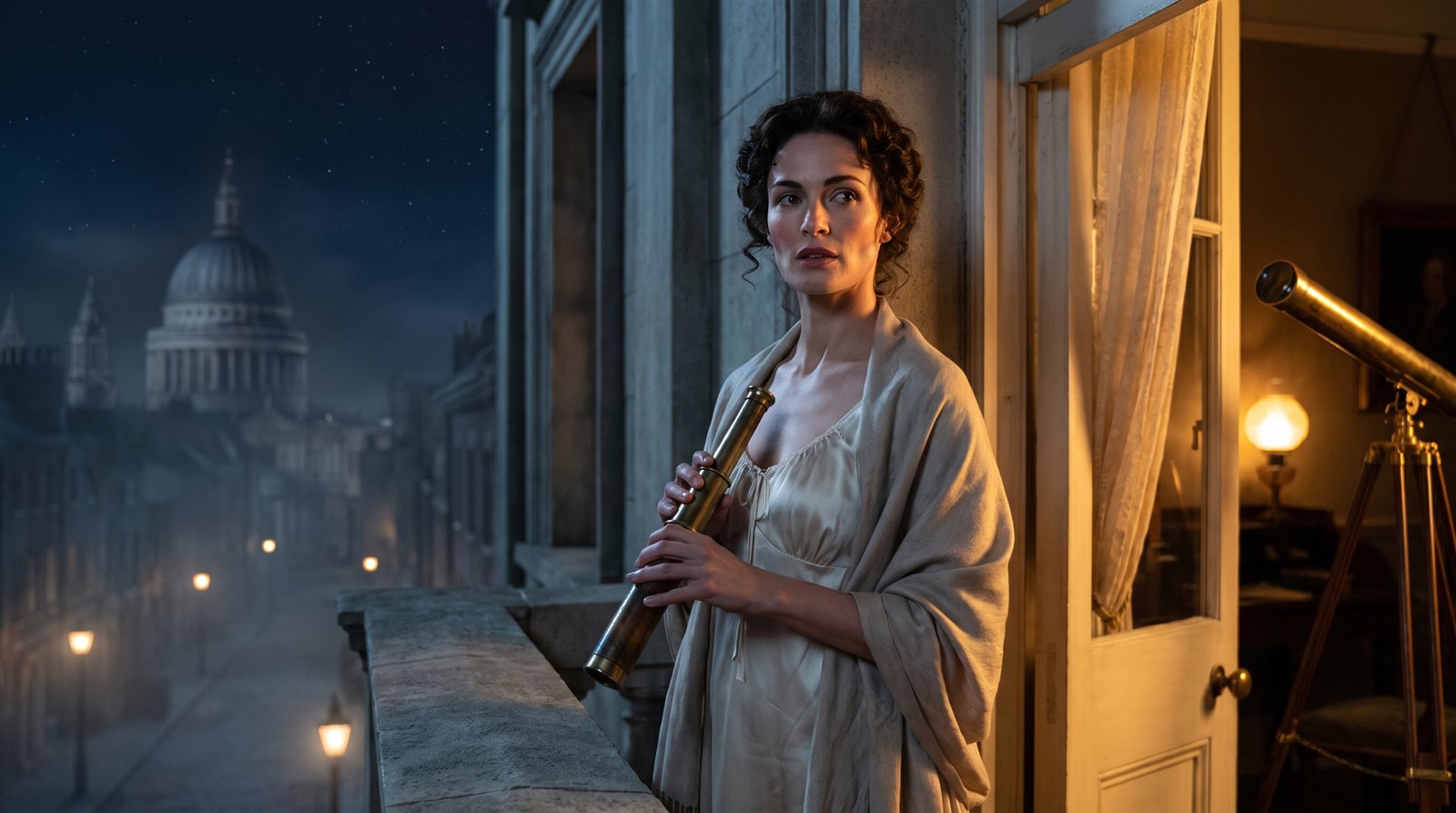 Lady Felicity Melville. CVM Sekai original art.
Felicity is not a woman waiting to be chosen. She is a woman running an experiment. She worked out years ago what she actually wanted, tested the obvious hypothesis, watched it fail, and has now committed to a wildly improbable one and started executing it on her own initiative.
The detail that makes her is the astronomy. She is a scientist by temperament, she says so at length, and she has spent five seasons applying that temperament to the marriage market. She sought out men of a scholarly nature on the reasonable theory that a shared interest would supply excitement. They were, in her words, extraordinarily dull. The theory was sound and the data killed it.
So when she says the scandalous Mr. Cavendish is her fate, that is not a girl swooning. It is a rigorous person who has run out of rational explanations and is following the evidence somewhere she did not expect to go. She is aware of how absurd it sounds, says so out loud, and proceeds anyway.
The file
| Name | Lady Felicity Melville |
|---|---|
| Full name | Felicity Constance Evanston Melville, given in full at page 37 |
| Father | The Earl of Dunbury, confirmed at page 77. She is his only daughter and his only child |
| Age | Twenty-three. “When one reaches the age of three-and-twenty and is still unwed, desperation begins to nip at one’s heels like an ill-mannered spaniel” |
| Season | Her sixth. She missed her fifth for a grand tour of Europe |
| Appearance | Tall, above average height, dark hair, slender, and noted for the graceful way she moves. Brown eyes, which Nigel registers while telling himself she is the wrong woman |
| Occupation of choice | Amateur astronomer. “I am something of an astronomer, nothing but an amateur really, although it is a passion of mine” |
| Instruments | A telescope kept in her room directly behind the open balcony doors, and a brass spyglass she found as a child in her father’s desk. The spyglass began her study of the stars and had belonged to a seafaring relative |
| Home | A London house separated from Lord and Lady Pomfrey’s by an expanse of lawn and a garden wall, which is the entire reason this novel happens |
| Closest friend | Eugenia Went-whistle, now Lady Kilbourne |
| Languages | Italian, much improved by the grand tour |
| Marriage offers | Several. All refused. “I could have a husband; I have had offers. Perfectly acceptable offers” |
| Known as | The immovable Lady Felicity, a phrase of Norcroft’s that Nigel adopts |
| Status as of page 80 | Alive, unmarried, and openly campaigning to marry Nigel Cavendish with his sister’s backing |
| Book and series | What a Lady Wants, Last Man Standing book 2, by Victoria Alexander |
The wish, and what she actually asked for
I’m not simply wishing for a husband. I should make that clear. I could have a husband; I have had offers. Perfectly acceptable offers. What I want…what I’m wishing for… Is a future that’s not staid and boring and ordinary.
I want a man who will make the rest of my days an adventure. The grandest of adventures. That’s what I wish.
Read the order of those two. She rules out the ordinary reading first, on the record, before making the request. She is not lonely and she is not desperate, whatever the spaniel joke suggests. She has supply and is refusing it on quality grounds.
She is also impatient, which is very much in character for someone used to instruments that do what they are told.
I would appreciate some haste on your part. I do want to marry, and if I have to settle for an ordinary life, I should decide that fairly soon and make my peace with it.
A dog barks. A shot goes off next door. The wish is answered inside a page, and the man who climbs her garden wall is running from an outraged husband.
The astronomer, and the experiment that failed
she’d actively sought the acquaintance of men of a scholarly nature in hopes that a shared interest in the heavens would provide a certain element of excitement, but in that she had proven sadly mistaken. Beyond discussion of constellations, the astronomers she’d met were extraordinarily dull.
This is the most underrated thing about her. She did not sit and hope. She formed a hypothesis, went and collected a sample, and honestly recorded that it disproved her. Most romance heroines are not shown doing methodology.
I have always believed in science, in rational, sensible, irrefutable facts. Take the stars, for example. Their study is one of observation of what is, and yet throughout history many people have believed they are mystical, even divine.
I have never believed in silly nonsense like magic or fate, omens or signs. You, Mr. Cavendish, have persuaded me otherwise.
She even flags the contradiction herself before wishing, twice, at length, which is a very particular kind of person: one who cannot do an irrational thing without first filing a written objection to it.
I’m really quite sensible, you know. I don’t believe in superstitious nonsense; I never have.
The immovable Lady Felicity
“Immovable?” She widened her eyes. “Why would you call me immovable?” “A comment Norcroft made. It scarcely matters at the moment, although I assure you it was meant as a compliment.” “Was it?” She wasn’t at all sure if she liked being called immovable.
Norcroft means it as praise for a woman who cannot be pushed. Nigel repeats it as a challenge. Felicity hears it as a description of somebody nothing ever happens to, which is precisely the future she is trying to escape.
The joke the men make out of it is genuinely good, and it is the premise of the book in one exchange.
“I simply have the oddest vision in my head of two immovable objects crashing head on into one another.” “Couldn’t happen. Immovable objects can’t crash into one another. They’re immovable.” “Exactly. Now, introduce me to the immovable Lady Felicity.”
Her parents, and the life she is running from
They’re quite wonderful, all in all. Why, they’ve never pressured me to marry… So I am extremely fortunate. Still, they are content with their lot in life. Their terribly ordinary, eminently forgettable, and not the tiniest bit exciting lot in life.
It was a lot Felicity saw herself heading directly toward.
Sometimes I wonder if I am truly their child. If perhaps explorers or adventurers or at the very least dreamers deposited me as an infant on their doorstep.
This is the engine underneath the wish and it is not a complaint about them. It is a fear about herself: that she is going to become that, by default, without anything bad ever happening. She is not escaping cruelty. She is escaping inertia, which is harder to argue with and gets far less sympathy.
She does the pursuing
I intend to marry your brother.
Not I hope. Not I wonder whether. She turns up at a countess’s house, hands in a card, and announces a plan concerning a man she has met twice, then sits through an interrogation about insanity in her family, whether she has been compromised, and whether she is after the inheritance.
She handles it. She also gets one of the best lines in the novel out of it, when Madeline calls her demeanor “proper but not too proper.”
And that’s good? I’ve always considered that more of a flaw than anything else.
She had already kept his shoe from the trellis. The pursuit did not begin at the countess’s door.
A rational woman says the word fate
last night, when I met him again, well, my heart thudded and my mouth was dry and I wanted nothing more than to fling myself into his arms. For the rest of my days. I can tell you nothing like that has ever happened to me before. Beyond that he seems…right. I can’t explain it any better than that. I’ve never felt that sense of rightness about any man. It seems a feeling one should not ignore. Ultimately, I believe…he is my fate.
And the private version, in italics, which is the whole book in six words:
Because I wished for him and there he was.
She knows exactly how it sounds. She says so in the same breath, which is the difference between conviction and delusion.
It sounds absurd, I know. I might add I have never been so confident of anything in my life. I know I should have been terrified when he climbed onto my balcony.
What the book withholds
Her mother. Both parents are characterized as a pair and neither is named or brought on stage in the pages read so far.
Her fortune. She is an earl’s only child, which has obvious implications for what she inherits, and the novel has not stated any figure or settlement.
Whose spyglass it was. A seafaring relative, possibly a sea captain, possibly a pirate. Her own speculation, offered as romance rather than fact.
What she actually does with the astronomy. She observes, she owns instruments, she has met other astronomers. Whether she records, calculates or corresponds is not established.
Everything after page 80. This profile is written from a front-to-back read that is currently at page 80 of 389. Her status is given as of that point and this page will be revised, not retro-fitted, as the read continues.
Where she connects
Madeline, Countess of Windham
The sister she recruits, who interrogates her and then signs on.
CharacterEdmund Cavendish, Viscount Cavendish
The father whose six-week ultimatum runs on a parallel track to her campaign.
Book hubWhat a Lady Wants
Last Man Standing book 2. Plot, arcs, tropes, reacts and the full cast.
CastAll characters
Everyone who speaks or is spoken to in this book.
The RaeRae take
The wishing-on-a-star opening had me braced for a passive heroine, and it is a fake-out. The star is answered by a man fleeing a husband with a gun, and from there Felicity does essentially all of the moving in this book. She identifies the target, keeps evidence, secures the sister, and states her intention out loud to a stranger. Nigel’s contribution so far has been to fall into her garden.
What I would put on the book hub is the astronomer detail, because it is doing more work than it looks like. The novel could have made her stargazing a whimsy. Instead it makes her a person who thinks in observation and evidence, has already run one experiment on her own future and reported the failure honestly, and is now betting everything on a result she cannot justify. The tension in her is not head versus heart. It is a scientist meeting one data point she cannot explain and refusing to discard it.
And the fear underneath is unusually well chosen. Not poverty, not ruin, not a cruel family. Two nice parents and the horror of turning into them by simply letting the seasons go by. That is a real fear and it is rarely given to a heroine because it makes her slightly unlikeable, which the book is willing to risk.
Sources
Primary source is the novel itself: What a Lady Wants by Victoria Alexander, Last Man Standing book 2, 389 pages, read front to back on Kindle and currently complete through page 80. Every page number cited above falls inside that read.
No secondary source, wiki, blurb or adaptation has been used, and nothing beyond page 80 has been consulted for this page. Where the book does not say something, this page says that it does not say it.