
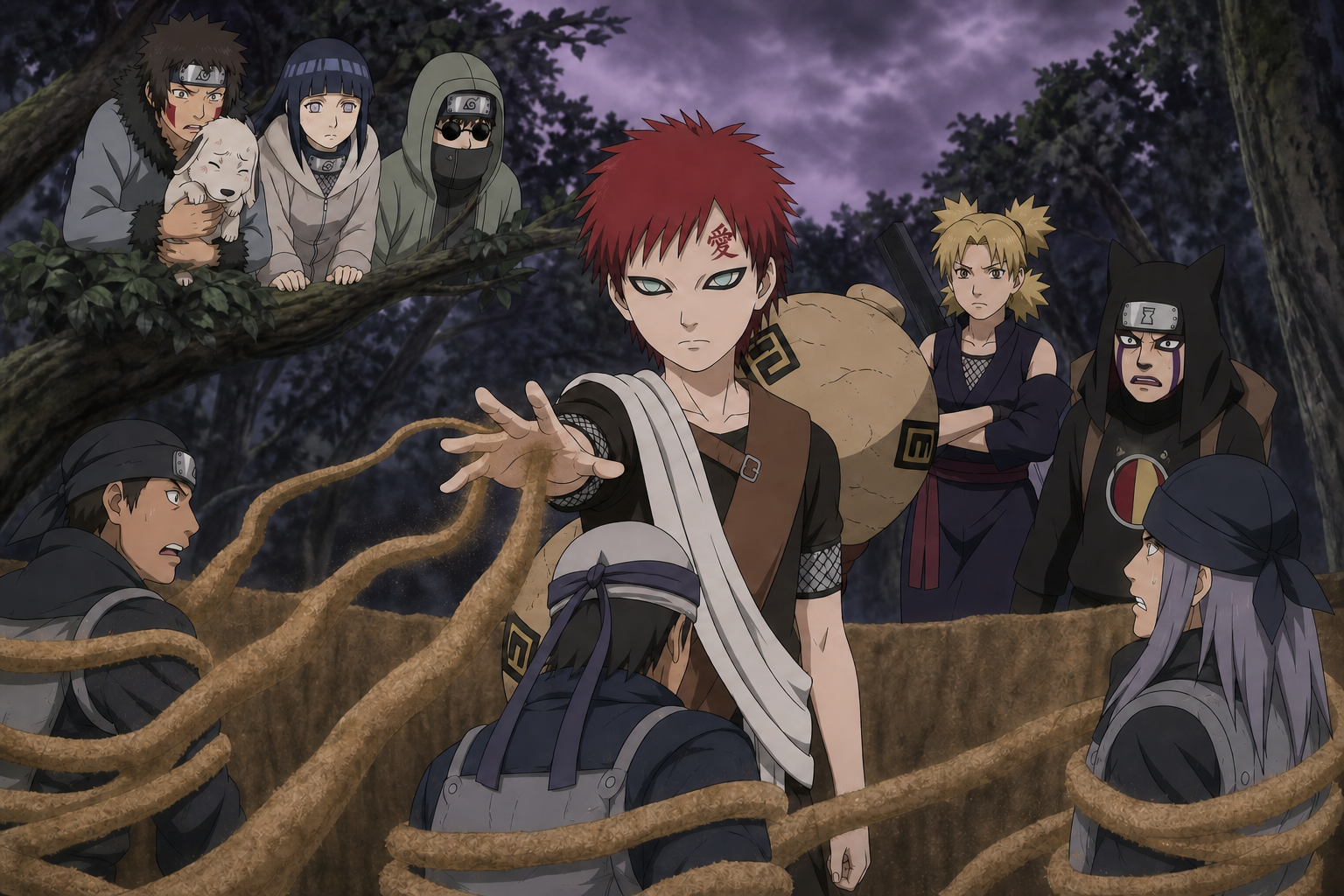
Akamaru Trembles: Gaara’s Cruel Strength!
Team 8 reaches the tower, but first Kiba remembers the moment Akamaru smelled something worse than danger. Gaara did not merely win. He made killing look like routine exam work.
Episode 34 introduces Gaara’s power through the body that understands it fastest: Akamaru. Kiba can posture. Hinata can watch. Shino can calculate. The dog smells blood and terror before the children finish translating the scene into words.
Gaara’s sand is frightening, but raw power is not the whole point. Temari and Kankurō are afraid of their own teammate. Three Rain genin become proof that the Chūnin Exam does not merely allow violence. It gives a traumatized weapon an audience and calls the result qualification.
Team 8 reaches safety with fear still attached
Kiba Inuzuka, Hinata Hyūga and Shino Aburame reach the tower with their scrolls. That is a competent result. The episode refuses to frame it as a clean victory because Kiba is still carrying the memory of what they witnessed.
The flashback structure matters. Gaara’s confrontation is not presented only as live spectacle for us. It is an event Team 8 survived by hiding and remembering. The fear already has an afterlife inside them.
That is a more honest consequence than a tournament story that resets everybody after the cool move. Kiba’s usual confidence has been punctured. Hinata’s quiet attention becomes survival. Shino’s restraint keeps the team from advertising itself to a person whose limits they do not know.
Akamaru is not a cute alarm system
Akamaru trembles before Kiba fully understands the threat. His senses register blood and murderous intent in ways the human characters cannot easily dismiss. The title gives that reaction narrative authority.
Ninken partnerships are not ownership with extra tricks. Kiba relies on Akamaru’s judgment as field intelligence, and Akamaru relies on Kiba for protection. When the dog recoils, Kiba does not shame him for cowardice. He reads the fear as evidence.
That reciprocity is one reason Team 8 survives. Kiba’s ego might invite a closer look or a challenge. Akamaru supplies information that makes caution harder to confuse with weakness. The smallest body in the group has the most accurate threat assessment.
Gaara’s sand makes defense look automatic
Gaara carries a large gourd and controls sand that moves to protect him even before he consciously directs every response. The automatic defense separates him from ordinary genin immediately. Attacks do not simply fail against his skill. They are intercepted by a system wrapped around his body.
He then turns defense into capture and execution through Sand Coffin and Sand Burial. The names tell the truth. These are not neutral movement tools. Sand becomes a hand, a prison and a crushing force.
The technique’s terror comes from control. Gaara does not look physically strained while opponents panic inside material he commands. The visual gap between his stillness and their helpless movement makes the violence feel administrative.
The Rain team makes a catastrophic reading error
Shigure and his teammates treat Gaara as another young competitor who can be pressured with superior numbers and prepared weapons. That assumption would be reasonable in an exam allegedly sorting peers. Gaara exists outside the scale they expect.
The Rain genin are not innocent tourists. They initiate violence and intend to take scrolls. The episode still refuses the childish equation that losing a shinobi fight means deserving death. Their aggression does not make Gaara’s excess morally empty.
They also come from a smaller hidden village navigating a system dominated by larger military powers. The exam promises status through performance, then places them against a host carrying a tailed beast and a village’s political project. Everybody has a headband. They do not have equal institutional weight behind it.
Temari and Kankuro already know this is not normal
Temari and Kankurō do not celebrate Gaara’s escalation. Their fear tells us the behavior is familiar and uncontrollable enough to structure the family around it. They are teammates, siblings and handlers at the same time.
That position is cruel to all three children. Gaara has been turned into a weapon and denied ordinary attachment. Temari and Kankurō are expected to travel beside the weapon while knowing kinship may not protect them from it.
The siblings’ caution should not be mistaken for lack of love. Fear can coexist with responsibility, resentment and care. The Sand village has made emotional clarity nearly impossible by assigning children to manage consequences adults created.
The kanji on Gaara’s forehead is not decorative menace
The tattoo reads 愛, love. Gaara carved it into himself after concluding that he could rely only on self-love. That history is not fully unpacked here, but the mark already creates a brutal contradiction. A child displaying love on his face produces terror everywhere else.
The symbol does not mean Gaara secretly represents healthy self-care. His version of self-love was formed through betrayal, isolation and repeated attempts on his life. It protects a self that expects every relationship to become violence.
That is why reading him as naturally evil misses the institution around the child. His choices remain his choices. The Sand’s use of him as a jinchūriki weapon helped manufacture the conditions in which killing became proof of existence.
Gaara and Naruto are being built as mirrors
Naruto and Gaara both carry tailed beasts and grew up under village suspicion. Their paths differ through relationship. Naruto found Iruka, Team 7 and people willing to challenge his behavior without treating him as disposable. Gaara learned that attachment was a trap.
Episode 34 does not explain the full parallel yet. It plants the visual and emotional evidence. Gaara is a child near Naruto’s age whose impossible reserve has not become comic chaos or protective loyalty. It has become quiet isolation.
The contrast prevents a lazy lesson that Naruto survived because he was simply nicer. Naruto had unusual resilience, but he also received interventions Gaara did not. Individual character matters. So does who shows up before the worst belief hardens.
The Forest of Death is working exactly as badly as designed
The exam permits lethal force and removes immediate adult supervision. Gaara’s actions therefore sit inside the rules even when they horrify other participants. The institution gets to call the outcome evidence of strength while pretending it did not create the stage.
This is military labor disguised as education. Hidden villages observe children under extreme stress, rank the survivors and convert trauma into a promotion signal. The cruelty is not an accidental glitch beside the exam. It is part of what the exam measures.
Team 8’s response shows the lesson being transmitted. Do not intervene. Do not reveal yourself. Carry the memory and reach the tower. Those choices keep them alive, but they also teach children how to witness atrocity as professional information.
The Sand village is outsourcing policy through a child’s body
Gaara does not enter the exam as a private citizen with an unfortunate temper. He represents Sunagakure, carries Shukaku and travels with the Kazekage’s other children. His body is part of village strategy even before the later invasion plan becomes visible.
That makes the scene an industry problem as well as a family tragedy. Hidden villages compete for contracts, prestige and military credibility. A terrifying genin can advertise power to clients and rivals. The same system that fears an unstable jinchūriki also benefits from letting outsiders witness what the weapon can do.
Temari and Kankurō absorb the unpaid care work around that policy. They monitor Gaara’s mood, warn other people, calculate distance and live with the possibility that their sibling may turn on them. The village receives deterrence. The children carry the daily risk.
Direction turns waiting into part of the violence
The encounter does not need constant motion. Gaara’s stillness gives the sand permission to dominate the frame while the Rain team struggles against material that seems to be everywhere. Pauses force viewers to anticipate what he will choose after control has already been established.
Reaction shots do real narrative labor. Akamaru’s trembling translates scent into emotion. Kiba’s face converts animal knowledge into human caution. Temari and Kankurō confirm that the danger is not a first impression invented by strangers. Three separate observers reach the same conclusion from different relationships to Gaara.
The muted forest and earth colors also stop the sand from reading as a bright elemental trick. It feels heavy, dirty and close to the body. That visual choice supports consequence. This is not a fireworks demonstration. It is soil becoming an execution mechanism.
Fear can be wisdom without becoming worship
Kiba’s fear of Gaara is accurate. That does not mean Gaara should be admired as the coolest person in the forest or treated as unbeatable forever. Power rankings often convert another character’s terror into fan applause and lose the human consequence.
Shino’s restraint offers a better use of fear. He observes, limits exposure and protects the team’s objective. Hinata does not need a loud reaction for the scene to affect her. Her attention becomes part of the team’s shared knowledge.
A Buddhist lens frames Gaara’s violence through attachment to a fortified self. He clings to survival as the only trustworthy proof of being alive. The more he protects that isolated identity, the more suffering he produces for himself and others.
Japanese performance makes Gaara’s stillness dangerous
Akira Ishida performs Gaara in the original Japanese anime. The threat does not need constant shouting. Gaara’s controlled delivery sits against opponents’ panic and makes the imbalance feel worse.
Kōsuke Toriumi performs Kiba with swagger that can crack into alarm when Akamaru reacts. Nana Mizuki’s Hinata and Shinji Kawada’s Shino support Team 8’s quieter observation without flattening both characters into silence.
Romi Park’s Temari and Yasuyuki Kase’s Kankurō carry the sibling fear around Gaara. Their reactions tell us more than an explanatory monologue would. They have seen versions of this before, and familiarity has not made it safe.
What changes after Episode 34
Team 8 now has direct evidence that another genin team contains a force outside the expected scale. Gaara becomes a major threat before he meets Team 7 directly. Temari and Kankurō become more than confident Sand competitors because their behavior reveals a family organized around danger.
Akamaru’s response establishes that intimidation has a bodily reality. The episode does not need a numerical power score. A trained ninken smelling the scene and trembling communicates the consequence immediately.
The Chūnin Exams also lose another layer of innocence. Orochimaru has already invaded the test. Now a sanctioned participant kills with a level of excess that scares his own teammates. The adults built a container that cannot distinguish assessment from catastrophe.
RaeRae’s verdict
Gaara’s sand is impressive. The episode is smarter when it refuses to let impressive mean admirable. Akamaru trembles, Rain genin disappear inside the technique, and Gaara’s siblings watch like people standing beside a bomb their village named family duty.
The most important power in the episode may be Akamaru’s ability to tell Kiba, without a speech, that surviving this scene requires humility.
Fandom misreadings I am rejecting
“The Rain genin attacked first, so whatever happens is fair.” Initiating a fight creates responsibility. It does not make unlimited killing morally neutral.
“Temari and Kankuro fear Gaara because they do not care about him.” Their family has been structured around danger, secrecy and adult weaponization. Fear is evidence, not the absence of attachment.
“Gaara was born evil.” He makes violent choices inside a history of isolation and state abuse. Explanation does not erase accountability, and accountability does not require pretending context is fake.
“Akamaru is only reacting for comic effect.” His senses give Team 8 the earliest and most honest threat assessment.
“The exam proves Gaara deserves promotion.” It proves he can overwhelm peers. Leadership, judgment and protection remain different questions.
Receipts and official routes
Episode number and official English synopsis: Naruto Official Site. Japanese broadcast title and synopsis: TV Tokyo. Streaming availability varies by region; use the official options linked from the episode directory.