
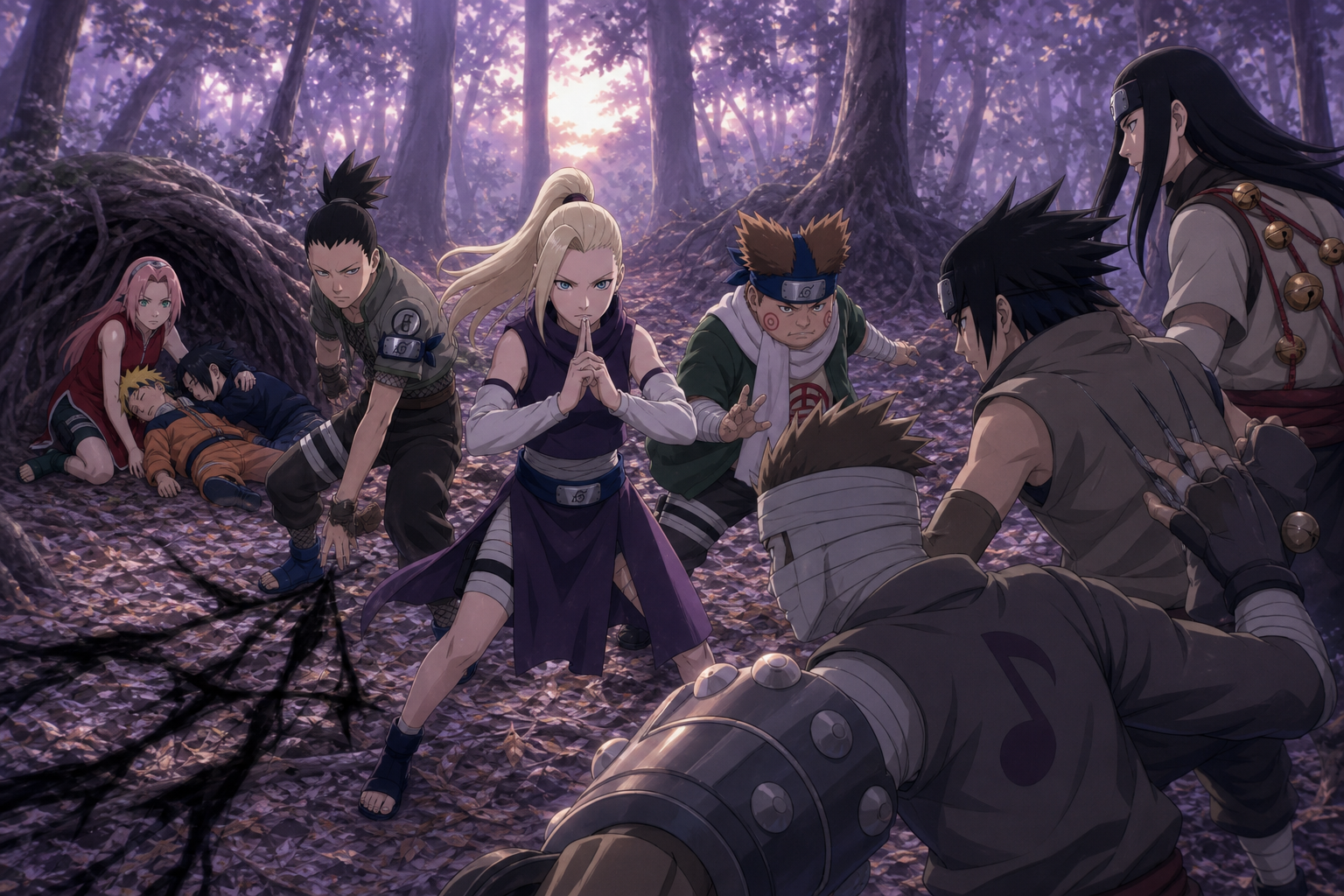
Battle Formation: Ino-Shika-Cho!
Ino stops treating Sakura like a rival long enough to remember she is her friend. Shikamaru and Choji complain, calculate and follow her into danger anyway.
Episode 33 is not about a perfect formation. It is about three children deciding that friendship matters more than the exam’s invitation to mind their business. Ino watches Sakura keep rising against Dosu, Zaku and Kin. She can preserve Team 10’s scroll hunt or step into somebody else’s disaster. She chooses Sakura.
Shikamaru sees every reason this is troublesome. Choji sees every reason it is dangerous. They still move with Ino. That is what makes Ino-Shika-Cho more than inherited branding. The formation is a relationship before it is a technique.
Ino’s choice starts before the formation
Ino Yamanaka has already seen enough. Sakura is injured, exhausted and still using her body as the last barrier between Team 7 and the Sound trio. Ino does not receive a new order, a tactical reward or permission from an adult. She recognizes a moral claim.
That is important because the Chūnin Exam trains competitors to read another team’s pain as opportunity. A weakened squad can be robbed. A distracted enemy can be bypassed. Ino interrupts that logic. Sakura is not a useful resource, but she is still somebody Ino refuses to abandon.
The decision also repairs something their Sasuke rivalry damaged. The girls did not begin as enemies fighting over a boy. Ino defended a lonely child, gave her a ribbon and helped her build confidence. Sakura later returned the ribbon when she declared herself a rival. Episode 33 shows that rivalry did not erase the original care. It merely buried it under adolescent theater.
Shikamaru complains because he understands the risk
Shikamaru Nara does not leap into the scene with Lee’s romantic declaration. He calls the situation troublesome because it is. Team 10 risks injury, losing its scroll and failing the exam against opponents whose abilities remain partly unknown.
His reluctance is not cowardice disguised as intelligence. Shikamaru calculates consequences before acting, and his analysis is usually right. The character becomes useful when calculation informs responsibility rather than replacing it. Ino makes the ethical choice. Shikamaru works out how to give that choice a chance.
That distinction will define his growth. Leadership is not simply having the highest IQ in the clearing. It is deciding what intelligence serves. A plan that protects only the planner can be clever and morally useless at the same time.
Choji follows before the world respects him
Chōji Akimichi enters a fight that offers no guaranteed food, applause or advancement. He is frightened and physically vulnerable, but he does not make Ino prove Sakura deserves help. His loyalty moves faster than his confidence.
The episode still uses Choji’s appetite for comedy. Naruto will return to that joke too often and sometimes lazily. Here, the important receipt is behavior. When Team 10 commits, Choji commits with them. The boy other characters reduce to eating becomes part of the wall between wounded classmates and Orochimaru’s hired children.
Akimichi expansion techniques make his body tactically visible, which means the comedy and the combat system are tied to the same physical trait. The better reading is not that Choji finally makes his size useful. His body was never a defect waiting for combat permission. His clan developed techniques that turn expansion, mass and stored energy into inherited skill.
Ino-Shika-Cho is family history turned into field practice
The Yamanaka, Nara and Akimichi clans maintain a long alliance across generations. The formation’s name joins the first syllables of their clan names and also echoes the ino-shika-chō card combination in hanafuda: boar, deer and butterfly. Naruto turns that familiar cultural pattern into a military and social inheritance.
Ino provides mental intrusion and disruption. Shikamaru restricts movement through shadow. Choji supplies physical pressure and area control. None of the three functions is complete alone. The structure assumes coordination across different bodies and specialties.
That inheritance is useful, but it is not automatic competence. These are genin using clan techniques under stress. Timing can fail. Targets can resist. The Mind Body Switch leaves Ino’s own body vulnerable and becomes dangerous when an opponent can harm the body she enters. Shadow possession depends on reach, position and chakra. Expansion still exposes Choji to counterattack. A famous formation does not come with plot armor.
Mind Transfer makes trust physically necessary
Ino’s Mind Body Switch Technique sends her consciousness toward a target. If it connects, she can control that body, but her own body collapses and requires protection. Missing the target leaves her exposed during the return. The technique is not generic telepathy with convenient rules. It is a tactical exchange of agency and vulnerability.
That is why Shikamaru’s restraint matters. A moving opponent makes Ino’s line difficult. Shadow possession creates the stillness her technique needs. Choji guards the bodies and applies pressure. The formation is literally built around each person trusting the others with a weakness.
Ino targets Kin, but the Sound genin understand leverage. Zaku threatens Kin’s occupied body, knowing harm could force Ino to choose between staying and being injured through somebody else. Their counter is cruel because it weaponizes the same interdependence Team 10 treats as care.
The Sound trio also coordinates, but their hierarchy is different
Dosu, Zaku and Kin are not random solo villains sharing a uniform. They read one another’s positions and adjust attacks. Their teamwork has real competence. The difference lies in what holds the team together and who benefits from its labor.
Orochimaru sent them toward Sasuke as disposable instruments inside his recruitment experiment. They can cooperate horizontally while being exploited vertically. Both facts remain true.
Zaku’s willingness to threaten Kin’s body exposes the fragility of their solidarity. Winning the immediate exchange outranks protecting a teammate. Team 10 accepts vulnerability and distributes its protection. The Sound team treats vulnerability as a bargaining chip. That contrast says more than their village symbols.
Sakura’s stand changes the people watching it
Episode 32 gave Sakura authorship over her resistance. Episode 33 gives that resistance a social consequence. Ino does not rescue a passive object. She responds to a person who has already made surrender morally embarrassing.
Sakura’s courage does not shame Ino because women must compete over who suffers better. It recalls a relationship both girls allowed rivalry to distort. Ino once helped Sakura stand. Now Sakura’s stand calls Ino back to herself.
This is why the scene works better than a speech about female friendship stapled onto the fight. The relationship changes decisions, and the decisions change bodies in danger. Affection becomes plot mechanics. That is the receipt.
The exam keeps making compassion look like rule-breaking
The Forest of Death rewards speed, secrecy and scroll possession. Helping another team spends time and energy without advancing the written objective. The exam therefore makes moral action appear strategically irrational.
That design reveals the hidden village’s priorities. Konoha wants future officers who can judge a battlefield, yet its test encourages children to narrow obligation to assigned teammates and national symbols. Ino’s choice suggests a better leadership capacity than leaving Sakura would have shown.
Confucian ethics helps explain why. Proper conduct emerges through relationships and duties, not isolated self-optimization. Ino’s history with Sakura creates an obligation the exam did not write down. Shikamaru and Choji’s bond with Ino creates a reason to support her choice even when they dislike the odds.
Attachment can trap people or move them toward care
A Buddhist lens does not demand that these children feel nothing. Attachment becomes harmful when rivalry, possession or fear controls action. Ino’s attachment to Sakura has carried jealousy and pride, but here it produces compassionate risk.
The episode does not claim every act motivated by friendship is automatically wise. Team 10 can still be injured. Compassion needs skill, and skill needs limits. The healthier movement is away from protecting ego and toward reducing another person’s suffering with clear eyes.
Sakura’s attachment to Team 7 produced her stand. Ino’s attachment to Sakura produces the formation. The chain is not sentimental padding. It is how care travels across teams when formal systems fail.
Girlhood is doing more than decorating the boys’ story
Sakura and Ino’s conflict began around belonging, insecurity and the social rules girls absorb before they can name them. Sasuke became the visible prize, but the deeper wound was that friendship started to feel incompatible with recognition. Both girls believed standing beside the same boy required standing against each other.
Episode 33 breaks that script without pretending the rivalry never existed. Ino does not need Sakura to become agreeable before helping her. Sakura does not need to apologize while bleeding. The emergency reveals that their bond contains obligations deeper than romantic competition.
This is not feminism because two girls occupy the same frame. It matters because one girl’s choice changes the tactical structure, protects another girl’s agency and forces the boys on her team to organize around her moral judgment. The story gives Ino authority without turning Shikamaru and Choji into idiots. They contribute different skills to a decision she had the courage to make first.
Consequences travel beyond this clearing
Team 10 will remember that its first famous formation in this exam served a rescue rather than a promotion. Ino and Sakura will carry this moment into their preliminary match, where rivalry can return without erasing care. Shikamaru will keep learning that leadership means accepting troublesome obligations. Choji will keep proving that loyalty is a form of courage long before other characters respect his power.
The Sound trio also receives information. Konoha’s teams do not always remain isolated units, and Sasuke’s classmates are willing to build an improvised alliance around him. That makes Orochimaru’s experiment messier. He can manipulate individuals, but relationships keep creating resistance he did not assign.
Japanese performance keeps three personalities inside one decision
Ryōka Yuzuki performs Ino in the original Japanese anime, and the character’s sharp confidence has to coexist with an older tenderness she rarely admits around Sakura. Showtaro Morikubo gives Shikamaru the drag of somebody who sees the work coming before everybody else. Kentarō Itō makes Choji’s anxiety audible without removing his loyalty.
The performances keep Team 10 from becoming one heroic voice. Ino pushes. Shikamaru objects and plans. Choji worries and follows. Their differences remain active even while the formation works.
Chie Nakamura’s Sakura is battered rather than inspirationally polished. That matters. Ino is responding to visible cost, not to a pristine empowerment pose. The episode lets exhaustion remain part of the moral evidence.
The formation is not invincible, despite the title
The Japanese title calls the formation invincible, which is delightful bravado and not a literal power ranking. Team 10 can pressure the Sound trio, but the match is unstable. Their abilities depend on sequence, positioning and mutual protection.
That limitation makes the scene useful. A team formation should not be a button that erases stronger opponents. It is a way of combining imperfect tools so three people can create options none possessed alone.
The episode also prepares a larger intervention. Other genin are watching, alliances are shifting, and Sasuke’s curse mark is not finished changing the battlefield. Team 10’s choice matters even though it cannot close the entire conflict.
RaeRae’s verdict
Ino-Shika-Cho becomes real when Ino chooses a friend, Shikamaru chooses to make the reckless choice workable, and Choji chooses not to let fear separate him from his team. The technique is inherited. The loyalty is practiced.
The episode’s best argument is simple: intelligence, strength and mental skill all become better when they serve somebody besides the person who owns them.
Fandom misreadings I am rejecting
“Ino only helps because she wants to look good.” She risks her body and exam position after watching Sakura’s stand recall their buried friendship.
“Shikamaru’s reluctance makes him disloyal.” He understands the danger, voices it and still converts Ino’s choice into a plan.
“Choji is just comic relief here.” His clan technique and willingness to enter danger are structural parts of the formation.
“The trio’s clan inheritance makes the fight easy.” Every technique carries limits, and the Sound team identifies those limits quickly.
“Sakura stops mattering once Team 10 arrives.” Her resistance causes Ino’s decision and changes the social field around the fight.
Receipts and official routes
Episode number, title and official synopsis: Naruto Official Site. Japanese broadcast title and synopsis: TV Tokyo. Streaming availability varies by region; use the official options linked from the episode directory.