
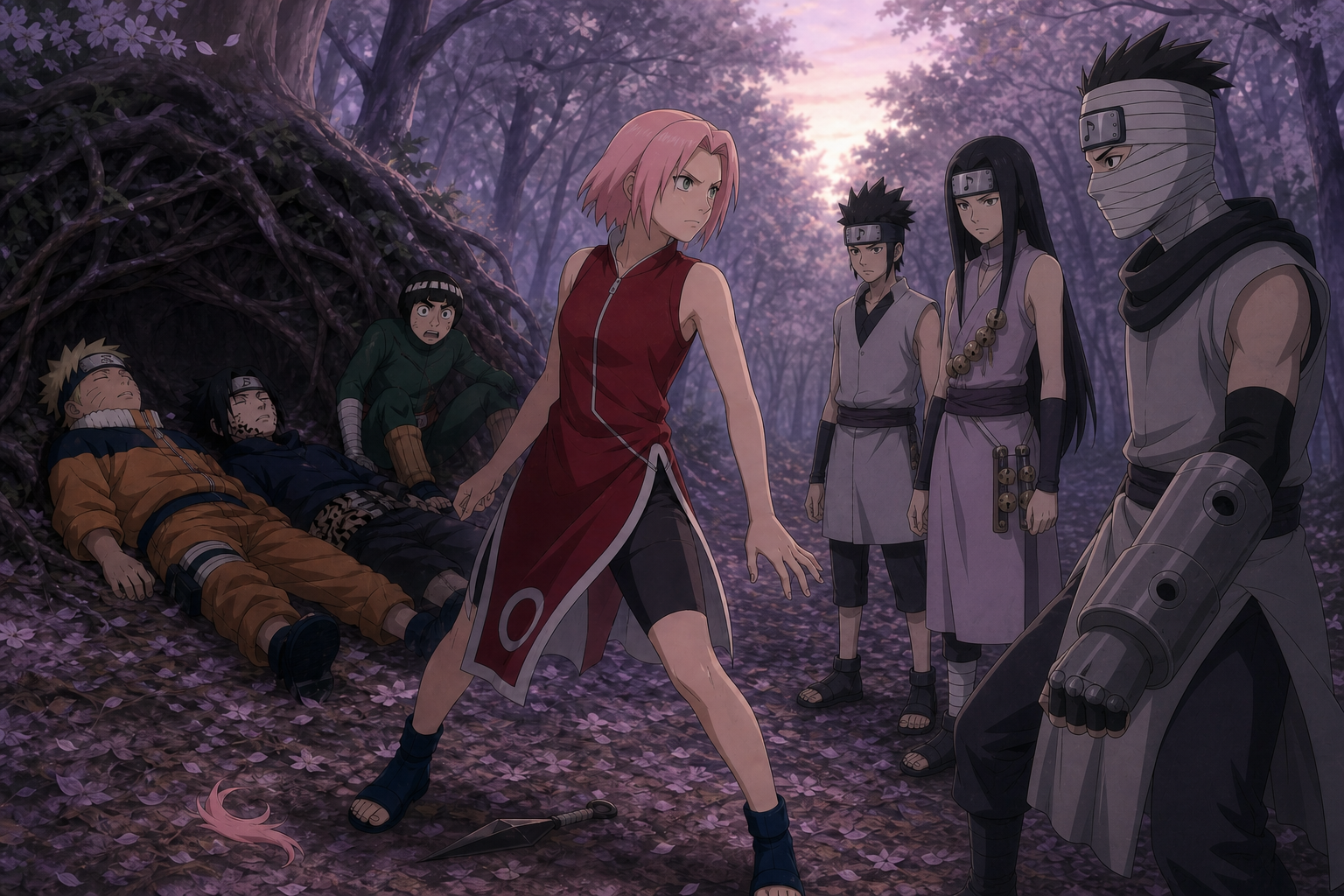
Sakura Blossoms!
Lee falls, the Sound trio keeps coming, and Sakura finally stops measuring her worth by how well she can stand behind the boys she loves.
Episode 32 does not turn Sakura into the strongest person in the Forest of Death. It makes her stop waiting for strength to arrive in somebody else’s body. Lee is down. Naruto and Sasuke are unconscious. Dosu, Zaku and Kin want the marked boy behind her. Sakura has no secret bloodline, monster reserve or miracle teacher. She has preparation, anger, a kunai and the decision to get back up.
The haircut is memorable because it is an escape, not a makeover. Kin grabs the long hair Sakura once grew because she thought Sasuke might like it. Sakura cuts away the grip and the fantasy attached to it. Hair is not courage, babes. The choice is.
Rock Lee loses, and that is why his promise matters
Rock Lee attacks Dosu with the Primary Lotus after arriving to protect Sakura. The technique is dangerous to Lee’s own body and depends on controlling the target through the drop. Zaku cushions Dosu’s fall with air, turning Lee’s dramatic finisher into a failed gamble.
Dosu’s sound-based attack then overwhelms Lee. That outcome does not cancel his courage. It shows the cost of arriving alone against three coordinated opponents with techniques he has never studied. Lee keeps his promise without receiving a victory montage as payment.
This matters because protection is often written as male competence replacing female helplessness. Episode 32 refuses the clean version. Lee helps, gets hurt and becomes another person Sakura must defend. Solidarity does not guarantee domination. Sometimes it enlarges the group of people who need care.
The Sound trio came for Sasuke, not an exam scroll
Dosu, Zaku and Kin are not behaving like ordinary examinees. Their orders point toward Sasuke, whom Orochimaru has already marked. The official test gives them a forest, plausible violence and limited adult supervision. Orochimaru turns that public institution into cover for private recruitment.
Dosu reads the field and directs the pressure. Zaku weaponizes air through openings in his palms. Kin uses wire, bells and needles while exploiting Sakura’s hair as a handle. Their techniques are specialized enough to feel unfair because the point is not a balanced tournament bout. They are a work crew sent to stress Orochimaru’s preferred specimen.
The trio are also children inside his hierarchy. That fact explains their position without excusing their choices. Orochimaru offers affiliation and power, then spends young followers as tests for another young person. Downward exploitation is still exploitation when the workers enjoy having somebody beneath them.
Sakura’s memory is not filler between punches
The episode looks backward at the version of Sakura who worried about her forehead, her hair and whether Sasuke noticed her. Those concerns were real because childhood social life is real. The problem was never that a girl cared about appearance. The problem was that Sakura let imagined approval become the ruler she used against herself.
Ino Yamanaka once defended Sakura and helped her feel visible. Their friendship became a rivalry around Sasuke, but the older bond does not disappear just because the girls learned to perform competition. Sakura’s memory carries both gratitude and embarrassment. She knows other people have repeatedly stepped forward for her.
That realization does not produce a speech about becoming independent from every relationship. It produces reciprocity. Naruto protects her. Sasuke protects her. Lee protects her. Ino protected her before Team 7 existed. Sakura decides that receiving care creates a reason to act, not a debt that makes her small.
Cutting her hair is an escape, not a personality transplant
Kin seizes Sakura by the hair and mocks the effort she put into growing it. Sakura uses a kunai to cut herself free. The scene works because the hair has a documented emotional history. It was tied to beauty, femininity, Sasuke and the younger Sakura’s hope that being desirable could make her secure.
She does not reject femininity, beauty or romance forever. She rejects an enemy’s grip right now. That distinction matters. Too many action stories treat a woman’s short hair as proof that she has graduated out of being a girl. Sakura remains Sakura. She simply refuses to let an old wish become a leash.
The visual language is blunt because this is a weekly shōnen anime. Long hair falls. Short hair remains. The symbolism still earns itself through action. The episode does not ask the audience to admire scissors as mystical character development. It shows a tactical decision that exposes a deeper change already happening.
She cannot overpower them, so she makes resistance expensive
Sakura attacks Zaku and absorbs punishment while refusing to release her grip. Her strategy is ugly, close and limited. She does not suddenly reveal speed greater than Lee’s or a technique stronger than Sasuke’s fire. She uses commitment to deny Zaku an easy victory.
That is an important power-system boundary. Determination can change how long a person acts and what pain they accept. It does not erase chakra reserves, training gaps or damage. Sakura’s courage becomes visible precisely because the physical mismatch remains.
She also bites Zaku when her arms cannot solve the position. Dignified? Not particularly. Effective enough to force another moment? Yes. The Forest of Death does not award style points for looking cute while three assassins approach your unconscious teammates.
Her resistance buys time and changes the social field. Help can arrive because she has not surrendered the space. The episode makes courage communal without stealing Sakura’s authorship. Other people witnessing her stand does not mean they created it.
Ino has to see the cost of standing still
Team 10 observes the attack while Shikamaru weighs the danger and Chōji fears the obvious consequences. Their caution is not irrational. Joining the fight risks their own exam and their bodies. The question is whether self-preservation can remain neutral when somebody they know is being brutalized in front of them.
Ino’s history with Sakura makes the decision personal. She once gave Sakura a ribbon and helped her emerge from isolation. Now Sakura is standing without that ribbon, without Ino and without the safety of childhood. The episode leaves Ino with an uncomfortable receipt: the girl she used to protect has learned to protect others while Ino watches.
This is not a simple shame ritual. Ino is also a child in a lethal state exam. Her hesitation shows the institution’s moral damage. The rules encourage teams to treat compassion as a competitive disadvantage. Helping Sakura should not require deciding whether friendship is worth sacrificing one’s assigned objective.
The hidden village calls this education
The Chūnin Exams are supposed to identify judgment, leadership and combat readiness. In practice, children are abandoned in a death-permitted forest while hostile agents use the event to pursue a private target. Sakura’s awakening happens inside institutional failure, not because the institution wisely designed a lesson for her.
Konoha will benefit from the strength she develops here. That does not make the method ethical. A village can praise resilience while refusing to count what caused the wound. The episode’s emotional triumph and its political horror exist at the same time.
The forest also exposes unequal preparation. Sakura’s academic intelligence has value, but Team 7 entered without a balanced distribution of combat tools. Naruto has abnormal stamina and shadow clones. Sasuke has clan inheritance and copied technique. Sakura has control and knowledge without an equivalent offensive curriculum. Asking her to bloom under attack is not the same as having watered the plant.
The adults cannot call the danger an unexpected edge case either. The rules permit killing, teams carry contested scrolls, and the forest contains giant predators before Orochimaru adds his own agents. Yet the monitoring system still leaves injured children outside timely rescue. Anko discovers the larger breach, but Sakura experiences the practical result: adult knowledge does not become adult protection quickly enough. The exam measures whether children can survive institutional gaps that the institution helped create.
Reciprocity gives the episode its moral spine
A Confucian reading centers obligation created through relationship. Sakura is not an isolated individual proving that she needs nobody. She remembers who stood for her and decides what kind of teammate she wants to be. Virtue appears through conduct within relationships, not through a slogan about self-reliance.
Reciprocity does not require equal power or identical repayment. Sakura cannot return Naruto’s rescue in the same form, and she cannot reproduce Lee’s taijutsu. She protects their unconscious bodies with the means available to her. The ethical match is commitment, not technique.
A Buddhist lens makes the haircut more complicated than rejecting vanity. Attachment becomes dangerous when Sakura lets Sasuke’s imagined preference determine her value. Cutting the hair loosens that attachment in a moment of crisis. It does not erase affection. It stops affection from owning the next decision.
Chie Nakamura lets determination sound difficult
Chie Nakamura performs Sakura in the original Japanese anime. The episode needs fear, memory, exhaustion and anger to occupy the same voice. Sakura’s decision would feel cheap if confidence arrived spotless. Nakamura keeps strain inside the resolve.
Yōichi Masukawa’s Lee carries the collapse from heroic declaration into bodily consequence. Daisuke Egawa’s Dosu, Keijin Okuda’s Zaku and Akiko Koike’s Kin give the Sound trio distinct pressure rather than one shared villain voice. The scene works as a group attack because each threat has a different rhythm and function.
Music and editing pull Sakura’s memories into the fight without pretending the past pauses the attackers. The flashbacks explain what the hair means, then the physical action answers that meaning. The creative choice is not subtle. It is clear, earned and useful.
Sakura blossoms, but she is not finished growing
The title risks making this sound like a final transformation. It is not. Sakura still lacks the medical training, strength and combat authority she will build under Tsunade. Episode 32 is the moment she stops accepting passivity as her assigned personality.
Growth also does not retroactively erase her mistakes. She has mocked Naruto, centered Sasuke and treated Ino’s friendship as competition. Maturity begins when a person changes conduct, not when fandom rewrites the earlier person as secretly perfect.
The consequence reaches forward. Sakura’s stand pushes Ino toward a choice and tells the audience that the girls’ relationship contains more history than a crush rivalry. It also establishes the emotional problem her later training must answer: courage without adequate power keeps sending her body into bills she cannot afford.
RaeRae’s verdict
Sakura’s haircut gets the screenshots, but the real event is a transfer of authority. She stops asking whether Naruto, Sasuke, Lee or Ino will define her place and decides what she will do with the place she already occupies.
She does not win cleanly. Good. A sudden flawless victory would turn growth into fan service. Sakura makes three trained attackers work for access to two unconscious boys. For this version of her, on this morning, that is a rebellion.
Fandom misreadings I am rejecting
“Sakura becomes useful because she cuts her hair.” The haircut is a tactical escape and a symbol. Her preparation, endurance and decision to defend people are the substance.
“Lee failed, so his promise meant nothing.” He faced three specialized opponents alone and bought Sakura time. Courage is not valid only when the scoreboard cooperates.
“The Sound trio being exploited means they are innocent.” Orochimaru uses them, and they still choose to brutalize Sakura. Context is not absolution.
“Ino hesitates because she never cared.” She is weighing friendship against survival inside an exam designed to punish compassion.
“This fixes every problem with Sakura’s writing.” No. It gives her a necessary beginning. The series still has to invest in her skills, ambitions and consequences afterward.
Receipts and official routes
Episode number, title and official synopsis: Naruto Official Site. Japanese broadcast archive and synopsis: TV Tokyo. Streaming availability varies by region; use the official options linked from the episode directory.