
Everybody wants the same future.
“Genin Takedown! All Nine Rookies Face Off!” turns a registration room into Naruto’s first encounter with the international shinobi system. The episode barely needs a formal test. The room makes ambition itself feel dangerous.
The room turns children into intelligence
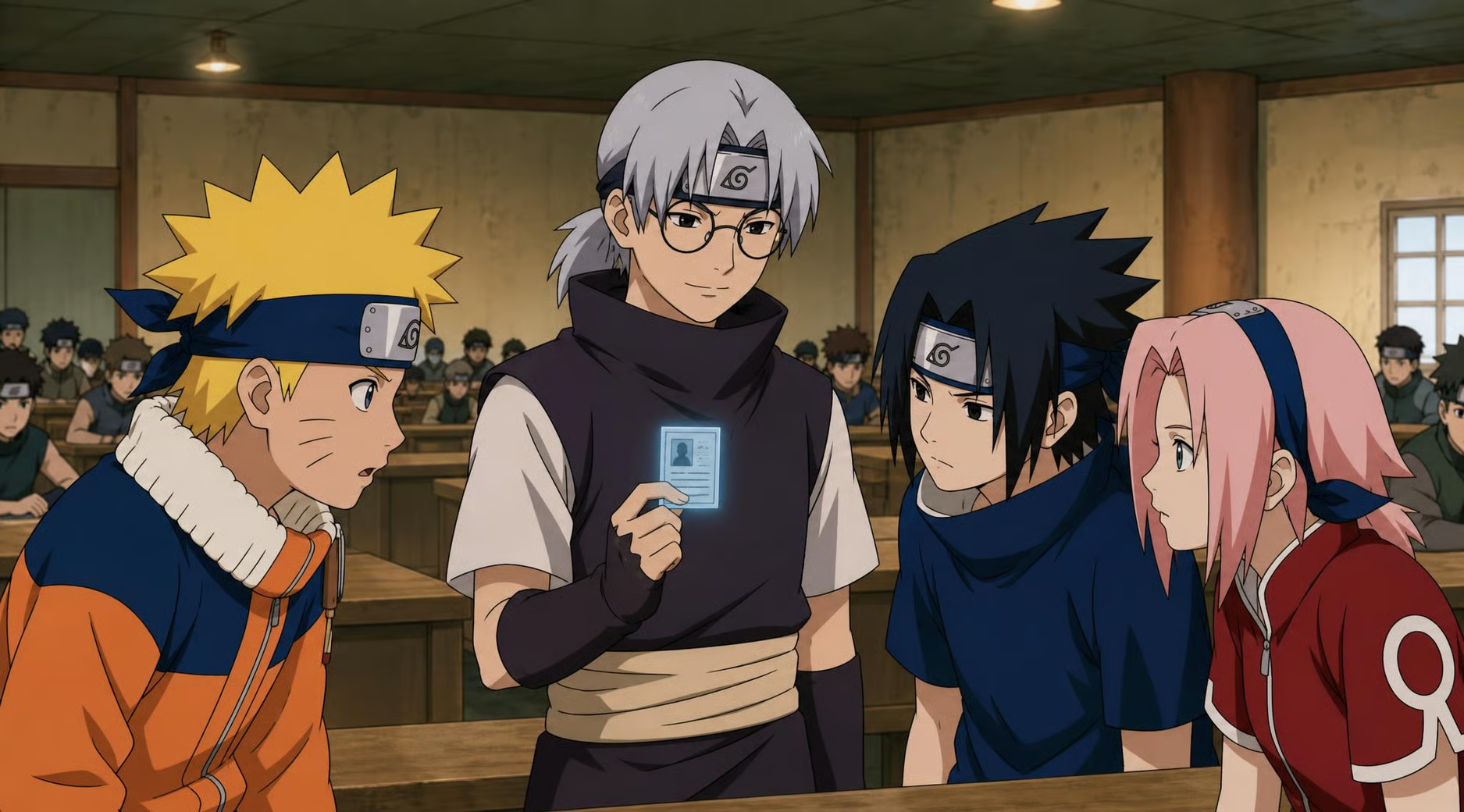
Kabuto’s cards look helpful because information reduces uncertainty. They also demonstrate how quickly a person can become a collection of measurable traits. Mission history, village, rank, and known techniques fit onto a card more easily than grief, coercion, or the reason someone entered the exam.
That compression is useful to shinobi institutions. A village needs to estimate threats and deploy labor. The danger begins when the file is mistaken for the person. Kabuto appears generous while teaching everyone to think like an intelligence service.
Kabuto performs safety with professional precision
He presents himself as the experienced candidate who can help younger genin survive the room. His tone is calm, his information is specific, and his repeated exam attempts make him seem familiar rather than threatening. Credibility is part of the technique.
The audience does not need later knowledge to feel the imbalance. Kabuto knows more than a candidate should casually possess, controls what he reveals, and decides which people become examples. Team 7 receives information while also revealing what information attracts them.
Sasuke asks about Gaara and Lee because his hierarchy has changed
Lee’s speed has already damaged Sasuke’s confidence, and Gaara’s presence offers another unfamiliar measure of danger. Sasuke wants the cards because he is rebuilding the ranking he assumed he understood. Curiosity is healthier than denial, but it remains tied to his need to locate himself among potential threats.
He does not ask who seems kind, reliable, or capable of leadership. He asks about power. The exam claims to identify future chūnin, yet the candidates have already learned to treat combat danger as the most legible qualification.
Naruto’s declaration is fear translated into a public promise
The crowded room overwhelms Naruto because every headband represents a village, every stare feels like judgment, and every unknown technique could expose how little he understands. He responds by announcing that he will defeat everyone.
The speech is not calm confidence. It is the courage available to him. Naruto has always used noise to keep fear from becoming the only voice in the room. The promise steadies him, but it also paints a target on Team 7 and asks Sakura and Sasuke to share the consequences.
The Rookie Nine arrive with shared history and unequal burdens
Konoha’s rookies know one another from the Academy, but familiarity does not mean equal preparation. Clan children carry techniques and expectations developed before graduation. Naruto carries a sealed power and almost no family instruction. Sakura brings control and academic strength without a clan system behind her.
The room makes them look like one generation while preserving every difference in access, support, and social standing. The exam will call the results individual merit even when the starting lines were never equal.
Sound attacks the person controlling the narrative
The Sound genin strike Kabuto after he displays his cards and confidence. The attack announces that information itself can provoke violence. Kabuto has positioned himself as the person who knows the room, and Team Dosu refuses to let that position remain unchallenged.
The technique also widens the meaning of danger. A visible punch is not the only threat. Sound, vibration, deception, and hidden purpose can bypass what the eyes expect. The candidates are entering an exam where the obvious contest is rarely the complete one.
Every village sends children carrying adult policy
The headbands make the room internationally legible. The candidates did not create the alliances, wars, grudges, or strategic interests attached to those symbols. They still become representatives of them. Their bodies are asked to display what each hidden village can produce.
Promotion may change an individual career, but the gathering is also a military exhibition. Adults observe performance, rivals collect intelligence, and villages measure one another through adolescents who are encouraged to experience the process as personal ambition.
Sakura reads the room while managing her teammates
Sakura recognizes Naruto’s anxiety before he names it and understands how his declaration changes the room’s attention. She is entering the same dangerous process while also tracking the emotional weather of Team 7.
That labor is easy to miss because it does not arrive as a special technique. She translates context, notices social risk, and anticipates consequences. The series benefits from her awareness even when it does not reward her equally for providing it.
The hidden test is whether identity survives comparison
Before Ibiki explains a rule, candidates begin comparing themselves to reputations, card statistics, unusual bodies, and village stereotypes. Some inflate. Some withdraw. Some perform indifference. The room tests whether private purpose can survive public measurement.
Naruto’s answer is to become louder. Sasuke becomes more analytical. Hinata becomes more careful. Kabuto becomes more useful. Each response reveals a survival strategy before any score exists.
RaeRae’s final take
Episode 23 works because introductions are action. Kabuto converts people into files. Sasuke searches for the new ceiling above his talent. Naruto refuses to let fear silence him. The Sound team proves that the apparent helper can become the first target.
The room is the monster because it teaches children to inspect one another as threats before asking who they are. Clan history, village policy, teacher ambition, and private grief all enter under the label of a promotion exam.
Naruto’s declaration is messy and tactically questionable. It is also honest. He cannot promise that he is unafraid, so he promises that fear will not decide his future. The rest of the exam will determine what that promise costs him and everyone standing nearby.
Team 7 enters as one unit carrying three private exams
Naruto wants the room to witness his certainty. Sasuke wants to locate every person who might exceed him. Sakura wants to prove she belongs beside both boys without disappearing into their ambitions. The official test will give them shared rules, but each teammate has already decided that a different verdict is at stake.
That difference can make them stronger if they learn to recognize it. It can also make teamwork feel like three solo stories occupying the same frame. The Chūnin Exam will keep asking whether their bond can hold when success does not mean the same thing to all of them.
That private meaning will shape every answer they give once the written test finally begins.
Episode file
Episode
Naruto Episode 23
Official English title
“Genin Takedown! All Nine Rookies Face Off!”
Arc
Chūnin Exams · registration and candidate introduction
Core question
What happens when a child’s private dream enters a room full of other children carrying their villages’ expectations?
Spoilers: this recap discusses the complete original Naruto story when an Easter egg or later consequence makes Episode 23 richer.
The feeling you remember
The room is frightening because Naruto discovers he is not the only protagonist in it.
For twenty-two episodes, the series has trained us to experience the world from Team 7’s emotional center. Their missions mattered because we stood beside them. Their injuries felt enormous because the frame stayed close.
Then the Chūnin Exam room opens and the camera finds dozens of other headbands, teams and ambitions. Every stranger has survived an academy. Every forehead protector claims a home. Every candidate has someone who believes, or needs to believe, that this child can carry a village’s honor.
Naruto does not merely meet competition. He meets evidence that the world continues beyond him. That is one of adolescence’s quiet existential shocks: discovering that everyone else possesses an interior life as urgent as your own.
Registration is already a test
Naruto Uzumaki, Sasuke Uchiha and Sakura Haruno officially register together. The rule is plain: three shinobi enter as one unit, and one member’s failure can end the team’s attempt.
That condition changes promotion from a measurement of isolated talent into a problem of mutual consequence. Sasuke cannot simply be excellent beside Naruto. Sakura cannot privately answer every question while the others collapse. Their records are temporarily braided.
This matters after the previous episode’s confrontation with Rock Lee. Lee exposed how badly Sasuke can be outmatched despite his name. Episode 23 enlarges that discomfort: Lee is not a singular interruption but one competitor inside a crowded ecology of specialists.
Team 7 walks into the building carrying personal motives such as recognition, revenge and proof, then immediately enters a structure that demands collective survival.
The Rookie Nine reunite
The exam gathers all nine recent Konoha graduates: Team 7, Team 8 and Team 10. The reunion contains familiar comedy, rivalry and affection, but it also reveals how rapidly childhood classmates have become deployable teams.
Shikamaru Nara still sounds inconvenienced by effort. Chōji Akimichi remains physically and socially close to him. Kiba Inuzuka and Akamaru bring their loud confidence. The others arrive with the rhythms of teams we have barely seen operate.
They are peers, but not interchangeable units. Their clans, teachers and specialties have already distributed advantages unevenly. Naruto sees classmates; the exam sees assets with different reconnaissance, capture, combat and command value.
The title promises that all nine rookies will “face off,” but the deeper confrontation is with the category that contains them. They are the children Konoha is willing to put forward.
One room, many villages
The atmosphere changes because the exam is international. Candidates from allied and rival villages are physically compressed into one room before anyone explains the first formal task.
Gaara does not need a speech to feel dangerous. The Sand siblings’ composure suggests experience beyond ordinary classroom rivalry. The Hidden Rain candidates carry another history. The newly established Hidden Sound team arrives with unfamiliar equipment and an aggressive need to be acknowledged.
A Chūnin promotion appears individual, yet villages gain prestige from who passes. The candidates therefore operate simultaneously as people and symbols. A child can lose a match; a forehead protector can be made to look weak.
This is why the room feels political before anyone discusses politics. Bodies have been arranged into flags.
Kabuto makes people into cards
Kabuto Yakushi approaches with the useful calm of an experienced candidate. He says he has taken the exam repeatedly and collected information on the people entering it.
His Ninja Info Cards require chakra to reveal their contents. The prop is delightful early-series worldbuilding: shinobi intelligence made tactile, portable and faintly theatrical. The prop also tells us exactly what kind of person Kabuto performs.
He does not dominate the room through volume. He becomes valuable by knowing what everyone else does not. He offers Team 7 relief from uncertainty, and that relief encourages trust.
The cards transform people into attributes: village, rank, mission history, known skills. Information becomes protection, status and leverage. The card does not contain a person. The card contains whatever a surveillance system has successfully converted into usable data.
Later knowledge makes the scene deliciously sinister. Kabuto is not merely a friendly repeat examinee. He is an intelligence operative whose identity has been built through records, covers and borrowed affiliations. A boy unsure who he is becomes the person who catalogs everyone else.
Sasuke asks the dangerous question
Sasuke requests information about specific competitors, including Lee and Gaara. His attention is revealing. He does not ask who is kind or trustworthy. He asks where the threat is.
Lee has already wounded Sasuke’s confidence by defeating him in direct combat. Gaara radiates another order of danger. Sasuke’s selection turns Kabuto’s deck into a map of possible obstacles between himself and advancement.
This is how trauma can make intelligence feel like control. Sasuke cannot undo the massacre that taught him powerlessness. He can scan the room, identify rivals and reduce uncertainty before it surprises him again.
Yet the cards also demonstrate the limit of foreknowledge. Statistics cannot fully explain why Lee fights, what Gaara’s sand means to him or what Kabuto is concealing. Data predicts capability more easily than choice.
Naruto shouts because he is afraid
Naruto’s public declaration to the room is often remembered as comic bravado. The declaration is also emotional regulation performed at maximum volume.
The gathered talent almost overwhelms Team 7. Naruto responds by announcing himself to everyone. He converts private fear into a social fact: now the room can watch him refuse intimidation.
That is not the absence of anxiety. That response is Naruto’s oldest survival method. When invisibility hurts, become impossible to ignore. When the future feels uncertain, say the future aloud until retreat becomes more embarrassing than fear.
His declaration irritates Sakura because it draws attention. Strategically, she has a point. Existentially, Naruto is doing something essential to himself: placing his name in a room designed to classify him as one candidate among many.
He cannot control who is stronger. He can control whether terror gets the final sentence.
Sound attacks the information broker
Dosu Kinuta, Zaku Abumi and Kin Tsuchi react to Kabuto’s presentation of Sound as known information.
For a new village, unfamiliarity is part of the weapon. Kabuto punctures that mystique by implying that Sound candidates can already be recorded, compared and anticipated.
Dosu’s attack appears to miss, yet Kabuto’s glasses crack and he becomes sick. The moment introduces sound as a medium that can bypass the obvious geometry of impact. A fist does not have to land in the expected way when vibration carries the injury.
Zaku and Kin support the group’s intimidation, establishing the trio before later episodes separate their methods. Their hostility is real, but dramatic irony complicates it: these supposed representatives of Sound are serving Orochimaru’s agenda while attacking another person entangled in the same agenda.
They perform village pride inside an organization that will ultimately treat them as disposable material.
The hidden exam before the exam
No written question has appeared, yet Episode 23 has already tested everyone through atmosphere.
Can you enter?
Team 7 must cross the threshold without letting stronger reputations decide the result in advance.
Can you read?
Sasuke studies threats, Kabuto studies the room and Sound studies what Kabuto’s knowledge does to their image.
Can you remain a team?
The rules ensure that private excellence cannot be cleanly separated from a teammate’s weakness.
Can you control your performance?
Every candidate chooses what confidence, fear or aggression to display under observation.
The proctors do not need to announce these pressures. Institutions begin evaluating people before the official rubric arrives.
Easter eggs and future echoes
Kabuto’s repetitions
Repeated failure makes him seem harmless. In retrospect, recurrence is cover: each exam supplies access, observation and plausible presence.
The cards
Kabuto’s future is obsessed with bodies, abilities and identities that can be collected. The deck is an early miniature of that appetite.
The nine rookies
The grouping becomes a generational identity. Future crises will repeatedly ask whether these classmates can act beyond team and clan boundaries.
Gaara’s silence
Naruto loudly demands acknowledgment; Gaara initially compels attention through danger. Their parallel loneliness is already staged before it is explained.
Sound’s honor
The trio defends the reputation of a village that offers them no durable belonging, which warns against confusing institutional branding with care.
Teamwide failure
The rule anticipates Naruto’s larger ethic: advancement that abandons comrades is not the kind of victory the story ultimately respects.
What the hidden village is telling us
A Hidden Village is both home and military bureaucracy. Episode 23 lets those meanings occupy the same room.
The candidates love teammates, teachers, families and places. Those attachments are genuine. The system converts the same attachments into motivation, prestige and obedience. “Carry your village’s honor” sounds noble partly because it makes institutional demand feel personal.
The episode does not flatten every village into identical evil. The episode asks us to notice the arrangement: children from multiple territories are gathered, observed and ranked according to how effectively they can survive pressure and perform force.
Kabuto’s cards clarify the worldview. The system wants a legible shinobi measured through missions completed, abilities known and affiliations recorded. Naruto’s humanity exceeds those fields. So does Gaara’s suffering. So does Kin’s erased life. A record can be accurate and still fail to tell the truth.
The existential challenge is therefore not merely “Who am I?” The sharper question becomes, “Who am I when institutions, rivals and allies have already made files about me?” Naruto’s answer is crude but powerful: he names himself before the card can finish the definition.
RaeRae reaction: the room is the monster
Episode 23 is mostly introductions, and it absolutely should not feel small. This room contains enough abandoned children, inherited techniques, clan obligations, state secrets and dangerous teachers to power the rest of the series.
I love that Naruto is visibly rattled and then chooses noise. Naruto’s choice is not polished courage. The noisy promise is the courage available to him. He cannot become calm on command, so he turns panic into a promise.
Kabuto remains the episode’s sharpest pleasure. On a first watch, he is comforting exposition with cool cards. On a rewatch, every helpful gesture has a second edge. He understands that the easiest way to enter a group is to solve the uncertainty making it anxious.
And the Sound trio already hurts in retrospect. They arrive desperate to make a new village look formidable. We know the adult behind that village does not intend to build a future for them.
Episode verdict: 9/10. Not because it delivers a major fight, but because it changes the scale of Naruto’s world without losing the frightened child at its center.
Where Episode 23 leaves us
The candidates have been measured by one another before the proctor measures them. Kabuto has offered a map, Sound has demonstrated that maps contain blind spots, and Naruto has declared war on his own intimidation.
The next episode begins the formal written examination. The essential question will not simply be whether Team 7 knows the answers. The deciding issue will be whether they understand what the test is actually designed to observe.