
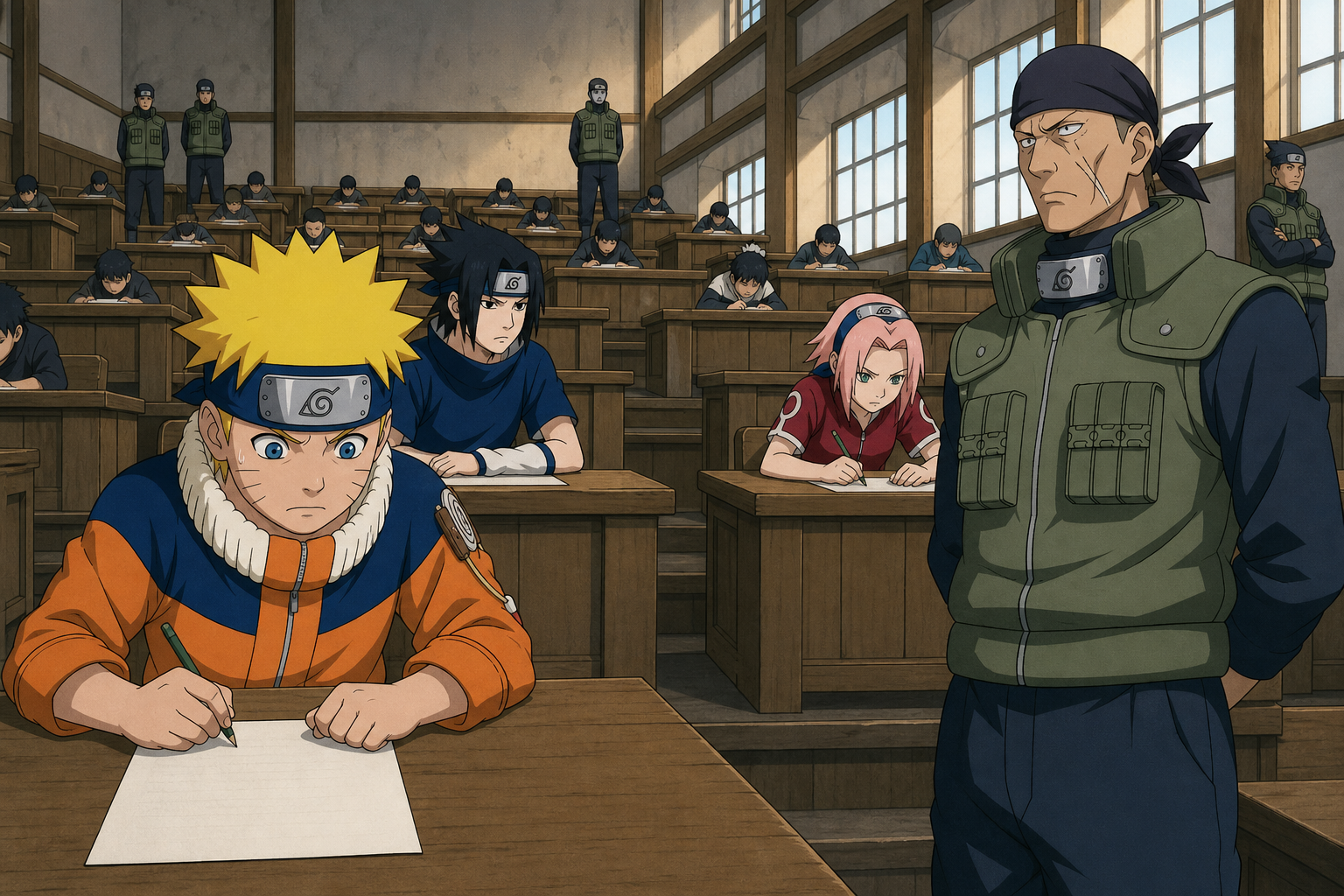
The question is not the test.
“Start Your Engines: The Chunin Exam Begins!” puts shinobi behind school desks and immediately exposes the disguise. This is not an academic contest. The classroom is surveillance training with three careers tied to every pencil.
Ibiki tests whether candidates can identify the real assignment
The written questions are intentionally beyond what most genin should know. That mismatch is the first clue. The exam is not primarily measuring recall or calculation. It is measuring whether candidates can gather protected information without exposing themselves or damaging their teams.
A shinobi who accepts the stated problem without examining the conditions has already misunderstood the work. Ibiki turns a classroom into an intelligence field and lets anxiety keep the true objective hidden.
The scoring rules make every teammate a hostage
Individual mistakes threaten the whole team, which means the exam transforms private panic into collective consequence. A candidate cannot decide that getting caught is worth the risk without spending teammates’ futures too. Cooperation exists even when nobody can speak openly.
That structure rewards people who understand one another’s abilities before entering the room. Teams with clan techniques, established signals, and experienced teachers carry advantages the scoring system never names. The test appears equal because everyone receives the same paper. Their access to ways around it is anything but equal.
Sakura solving the questions honestly is not a joke
Sakura looks at a test designed to force cheating and can answer through knowledge. The moment confirms that her academic strength is operational, not decorative. She recognizes the complexity, manages the pressure, and does not need another person’s paper to remain in the room.
The irony is delicious because the institution expected competence to mean covert information gathering, while Sakura’s competence exceeds the stated requirement. She solves the wrong problem perfectly and then has to realize perfection was never the point.
Hinata offers help because kindness survives the rules
Hinata’s offer to Naruto risks her own team’s position. It grows from affection, but it also shows her refusal to let competition erase care. The exam encourages every candidate to treat nearby people as sources, obstacles, or surveillance threats. Hinata still sees a person struggling.
Naruto’s response contains pride and concern. Accepting could expose her, damage both teams, or make his own survival feel borrowed. Their exchange is quiet, but it asks whether kindness can remain ethical when the system turns assistance into misconduct.
Clan techniques become educational privilege
The Byakugan, Sharingan, insects, shadows, and other specialized skills create routes to information unavailable to candidates without inherited or family-taught tools. The exam quietly rewards bloodline access while presenting success as proof of general shinobi readiness.
Naruto enters with enormous chakra and almost no precise information-gathering method. Sakura enters with knowledge. Sasuke enters with visual ability and analysis. They share a desk row, not a starting line.
Cheating becomes acceptable when the institution wants the result
Ibiki’s proctors punish clumsy collection, not collection itself. The rule and the objective point in opposite directions. Candidates are expected to violate the visible instruction professionally enough that authority can pretend not to see it.
That is an accurate lesson for espionage and a dangerous lesson for children. Success depends on learning that institutions may announce one moral standard while rewarding another behavior underneath it. The exam calls this judgment. It also trains plausible deniability.
Naruto’s blank page reveals the limit of determination
Naruto can endure pain, repeat training, and make enormous promises. None of those strengths produces an answer he does not know. The written test places him in a form of helplessness that cannot be punched or outlasted in the usual way.
His refusal to cheat badly is partly pride and partly lack of method. The episode lets him be brave without pretending bravery has already become competence. He remains in the seat because leaving would settle the result before he understands the final question.
Kabuto’s calm becomes more suspicious in this room
Kabuto presents experience and information as reassurance, then enters an examination built around concealed collection. His apparent familiarity with failure gives him cover. Repeating the exam can look like weakness while providing continued access to candidates, teachers, and village intelligence.
Even without later revelations, his composure deserves attention. Most candidates are reacting to the room. Kabuto behaves like somebody studying how the room reacts to them.
The proctors are measuring exposure, not morality
Candidates removed from the room are those who reveal their methods or accumulate enough suspicion. The exam does not ask whether gathering another person’s answer is honest. It asks whether the candidate can do it without compromising the operation.
That distinction prepares them for shinobi work, where the village may praise conduct during a mission that would be punished in ordinary civic life. Promotion requires learning which rule governs the surface and which objective governs survival.
RaeRae’s final take
Episode 24 turns pencils into weapons because the real fight is over information. Sakura demonstrates that her brain is terrifying. Hinata preserves kindness inside competition. Sasuke reads the structure. Naruto discovers that refusal to quit cannot fill a blank page by itself.
I hate the test lovingly because it is clever and morally slippery. It rewards observation, teamwork, and covert skill while teaching children that authority may lie about what it wants. Passing requires more than finding answers. It requires recognizing when the question on the page is camouflage.
The exam has begun, and the first opponent is not another genin. It is the candidate’s willingness to mistake instructions for truth.
The cleverness of the exercise should not hide its unequal design. Candidates with inherited surveillance techniques can collect answers while barely moving. Others must risk obvious signals, unfamiliar tools, or dependence on teammates. Ibiki measures adaptation, but the institution still calls unequal access an individual result.
The score will record performance, not the privilege that made each method possible.
Episode file
Episode
Naruto Episode 24
Official English title
“Start Your Engines: The Chunin Exam Begins!”
Arc
Chūnin Exams · first examination
Core question
Can a shinobi recognize the real assignment when an institution deliberately presents the wrong one?
Spoilers: complete-series connections appear when they clarify the episode’s mechanics or political meaning.
The feeling you remember
Nothing makes Naruto look younger than a blank answer sheet he cannot defeat with his fists.
The previous episode made the candidate room feel dangerous through bodies and reputations. Episode 24 drains that noise into the scratch of pencils.
Naruto sits still, which is already unnatural for him. The page offers no opponent to charge, no insult to answer and no visible rule he can break creatively. Around him, other candidates begin moving with purpose.
The terror is intimate. He is not afraid of pain. He is afraid of becoming the reason Sasuke and Sakura fail.
That distinction matters. Recognition once seemed like Naruto’s private hunger. Team membership has given failure other people’s faces.
Ibiki enters before he speaks
Ibiki Morino arrives with a force of proctors and changes the emotional temperature. His reputation as an interrogation specialist reaches the candidates before the details of the test do.
Ibiki does not need uncontrolled cruelty to establish authority. He uses posture, silence, numbers and the knowledge that every person in the room is already afraid of losing something.
The difference between a teacher and an interrogator is not simply kindness. The difference rests in each authority figure’s relationship to uncertainty. A teacher generally wants the student to understand. An interrogator wants to observe what a person does when understanding is incomplete and consequence feels urgent.
Ibiki’s classroom is built for the second purpose.
The scoring system weaponizes friendship
Each candidate begins with ten points. Incorrect answers reduce that score, and a team’s three results are combined. If one member collapses completely, all three can be eliminated.
Sasuke and Sakura immediately understand the threat named Naruto. Their concern is not baseless contempt. Sakura knows the academic gap between them, and Sasuke knows effort cannot create information Naruto never learned.
The rules convert affection into pressure. Naruto’s teammates cannot answer for him openly, yet his paper can erase their work. Every individual sits alone while carrying two other futures.
This resembles real shinobi missions, where one person’s capture, panic or bad intelligence can compromise a unit. The system also reveals the institution’s preferred psychology: responsibility is taught through the fear of harming comrades.
Teamwork here does not feel warm. The arrangement feels like three throats inside one collar.
Sakura actually knows the answers
Sakura reads the questions and realizes they are far beyond ordinary genin material. Then she begins solving them.
This is one of the early series’ clearest demonstrations that her intelligence is not decorative. She does not need to copy because her academic preparation, precision and recall are genuinely exceptional.
The moment can be overlooked because the episode’s hidden objective rewards information gathering. But Sakura’s direct competence remains real. A test designed to force espionage accidentally contains a candidate capable of meeting its stated demand.
That distinction protects her from two lazy readings. She is not merely “the smart girl” because someone announces it, and she is not strategically foolish because she answers honestly. Her method works.
Her anxiety about Naruto also contains an emerging form of care. She understands exactly how difficult the page is and therefore understands how alone he must feel.
Sasuke reads the institution
Sasuke recognizes that the questions are intentionally unreasonable. A legitimate promotion exam would not simply demand knowledge the target population was never taught and then eliminate entire teams for lacking it.
Once he stops treating the stated task as the real task, the room becomes legible. Skilled candidates are present as planted information sources. Proctors are monitoring behavior. Deductions punish being caught rather than the existence of copying itself.
The assignment is covert intelligence gathering.
Sasuke’s strength here is not memorization. His real advantage is institutional suspicion. He asks why the test has been designed this way and what competence the design could reveal.
That habit will serve and endanger him throughout the story. Sasuke often sees beneath comforting surfaces. Trauma has trained him to assume that declared motives conceal another agenda. In Episode 24, the suspicion is exactly correct.
Cheating becomes shinobi craft
Once the hidden objective is understood, bloodline techniques and team specialties change function.
Dōjutsu
Enhanced vision can observe pencil movement and translate another candidate’s work into usable information.
Insects
Small living partners can cross space without drawing the attention a human body would.
Possession
Mind techniques can bypass the distance between one person’s knowledge and another person’s paper.
Mirrors and sightlines
Ordinary surfaces become collection tools when positioned and read with discipline.
Combat abilities are not separate from intelligence work. The same technique can strike, track, observe, infiltrate or communicate depending on the mission.
The episode expands what a “power” means. Strength is not merely output. Power here means acquiring the missing piece without letting the target know what was taken.
The proctors are part of the battlefield
Every cheating technique must account for the watchers. Candidates who act too obviously receive deductions; repeated detection eliminates the team.
This turns surveillance into terrain. Walls and desks matter, but so do attention, suspicion and the proctor’s angle of view.
A successful candidate must model two minds at once: the source whose information is needed and the observer deciding whether the collection was visible.
The exercise rewards subtlety, yet it also teaches normalization. These children learn that being watched is ordinary and that excellence means performing concealment inside surveillance rather than questioning the surveillance itself.
Konoha calls this readiness. The episode lets us feel the claustrophobia inside the word.
Naruto has no elegant method
Naruto Uzumaki cannot solve the questions and cannot identify a reliable way to copy. The skills that usually rescue him, including stamina, clones and audacity, do not fit cleanly into a monitored desk.
His predicament exposes the limits of raw determination. Wanting the answer does not create the answer. Declaring a dream does not fill a blank.
That does not make his will meaningless. The exam relocates the value of his will. Naruto’s decisive contribution to this stage will not be intellectual theft but the ability to withstand the fear attached to the final choice.
Episode 24 has not reached that release yet. The episode keeps him inside helplessness long enough for us to remember what the academy felt like: everyone else moving through a code that seems to have been explained on the day he was absent.
Hinata’s offer
Hinata quietly offers Naruto access to her answers. The gesture is tender, but Naruto hesitates because accepting could get her caught and damage her team.
This is meaningful development. Early Naruto might have received help as proof that someone finally noticed him. Here he considers what the helper could lose.
His refusal is not efficient. His refusal may not even be strategically correct. The choice is ethically revealing.
Hinata’s courage also deserves precision. For someone trained under the Hyūga clan’s severe gaze, reaching across the exam boundary is not socially easy. She risks detection and emotional exposure at once.
The scene makes their bond visible through asymmetry: Hinata is ready to endanger herself for Naruto; Naruto, who barely understands why, does not want her punished for saving him.
Why the impossible questions matter
The exam could have openly instructed candidates to collect information. That would test technique. The deception tests recognition.
Real missions rarely arrive with a neutral narrator announcing the true objective. A client can lie, as Tazuna did. An enemy can stage evidence. An ally can be compromised. A written order can omit the political reality that makes the assignment dangerous.
The candidate must determine what problem is actually being solved.
Episode 24 therefore belongs beside the Land of Waves, not apart from it. Team 7 survived because Kakashi and his students repeatedly revised their model of the mission. The bridge assignment was never merely escort work. The written exam is never merely a paper.
Intelligence is a relationship, not an object
The answers seem like objects that can be possessed, but every answer exists inside a relationship: a source knows it, a candidate needs it and a proctor watches the transfer.
Good intelligence work therefore requires more than acquisition. The collector must judge reliability, protect the method and understand what the source may have misunderstood. Episode 24 simplifies that chain for an exam, yet its social structure remains visible beneath the paper.
Naruto’s isolation comes partly from having no relationship to the information. He cannot derive it, cannot safely reach a source and cannot trust the institution to explain why the gap exists. The blank page is not merely empty knowledge. The blank page represents a broken route between people.
Easter eggs and future echoes
Sakura’s precision
Her ability to process complex material anticipates the control and study demanded by medical ninjutsu.
Sasuke’s suspicion
He habitually searches for the hidden rule. Later, that same instinct makes official village narratives difficult for him to accept at face value.
Shino’s insects
The exam quietly demonstrates why reconnaissance teams need abilities that operate below ordinary human attention.
Hinata watching Naruto
Her attention is not passive admiration. She recognizes his struggle and attempts practical intervention.
Collective scoring
The system makes individual advancement inseparable from comrades, prefiguring Naruto’s rejection of success purchased through abandonment.
Ibiki’s unseen final weapon
The numerical rules condition the candidates to fear measurable failure before he introduces a consequence that cannot be calculated.
What the hidden village is telling us
A Hidden Village survives through information asymmetry. The village wants to know what enemies conceal while preventing those enemies from learning the same information about Konoha.
Episode 24 translates that geopolitical need into a childhood classroom. Every candidate becomes both spy and surveillance target.
The elegant reading celebrates ingenuity: these students turn inherited and learned abilities toward nonviolent intelligence work. The darker reading notices what has been normalized. Children are evaluated on how successfully they can violate another person’s informational boundary without detection.
Both readings are true. Naruto’s world does not separate useful skill from the system that decides how usefulness will be deployed.
The existential question is sharper than “Can you cheat?” The real question asks, “Can you recognize reality when authority has mislabeled reality?” Sasuke passes that conceptual threshold quickly. Sakura exceeds the false label through knowledge. Naruto remains trapped by the literal page because nobody has taught him to distrust the question.
Education is supposed to make the world more legible. This exam measures whether children have already learned that institutions may deliberately make it less so.
RaeRae reaction: I hate this test, lovingly
This is such a good Naruto setup because the written exam initially looks like the cheapest possible way to stop the action. Then the pencils become weapons, eyeballs become surveillance equipment and every desk becomes a tiny intelligence operation.
Sakura solving the questions honestly is deeply satisfying. Let my girl have her frightening brain. She is sitting in a room built to prove nobody can do the stated task and quietly doing it anyway.
Sasuke gets the cooler analytical beat: he understands that a ridiculous rule is evidence of a hidden rule. Naruto gets the emotional punishment. He has to sit with being the weak link without punching the feeling into submission.
And Hinata offering her paper? That is not merely cute. Hinata is a frightened child choosing generosity inside a system designed to make everyone protect their own score.
Episode verdict: 8.8/10. The formal test has barely begun, but the episode makes examination feel like espionage, shame and friendship pressed into one silent room.
Where Episode 24 leaves us
Candidates are being caught. Others are adapting. Sakura has answers, Sasuke has decoded the assignment, and Naruto still has an empty page.
The test’s final mechanism has not yet been revealed. Ibiki has first taught the room to fear points, deductions and collective failure. Once that fear is stable, he can ask the question that actually matters.