
Naruto · Complete Character Profile
Ibiki Morino
Ibiki looks like the threat in the room because his body carries what real threats already did to him. His greatest examination uses no blade at all. He makes children face uncertainty, shared consequence and the possibility that courage has to act before certainty arrives.
Ibiki Morino at a glance
| Full name | Ibiki Morino |
|---|---|
| Japanese name | 森乃イビキ |
| Birthday | March 20 |
| Age | 27 in Part I; 31 to 32 in Part II |
| Height | 193.5 cm |
| Weight | 88 kg |
| Blood type | A |
| Village | Konohagakure |
| Rank | Tokubetsu jōnin, or special jōnin |
| Registration | 010913 |
| Academy graduation | Age 10 |
| Chūnin promotion | Age 15 |
| Occupation | Head of Konoha’s Torture and Interrogation Force; intelligence leader; exam proctor |
| Manga debut | Chapter 40 |
| Anime debut | Episode 21; his full proctor role begins with the written exam |
| Japanese performer | Taiten Kusunoki |
| Status | Alive through the New Era record |
The bottom line
Ibiki teaches the difference between knowing and committing. The first Chūnin Exam stage pretends to be a written test, then reveals itself as an intelligence operation and finally becomes a pressure chamber for collective responsibility. He understands the lesson because uncertainty, captivity and pain are written across his own scalp. That history gives him authority. It does not automatically make every method he uses humane.
Appearance: the body as classified history
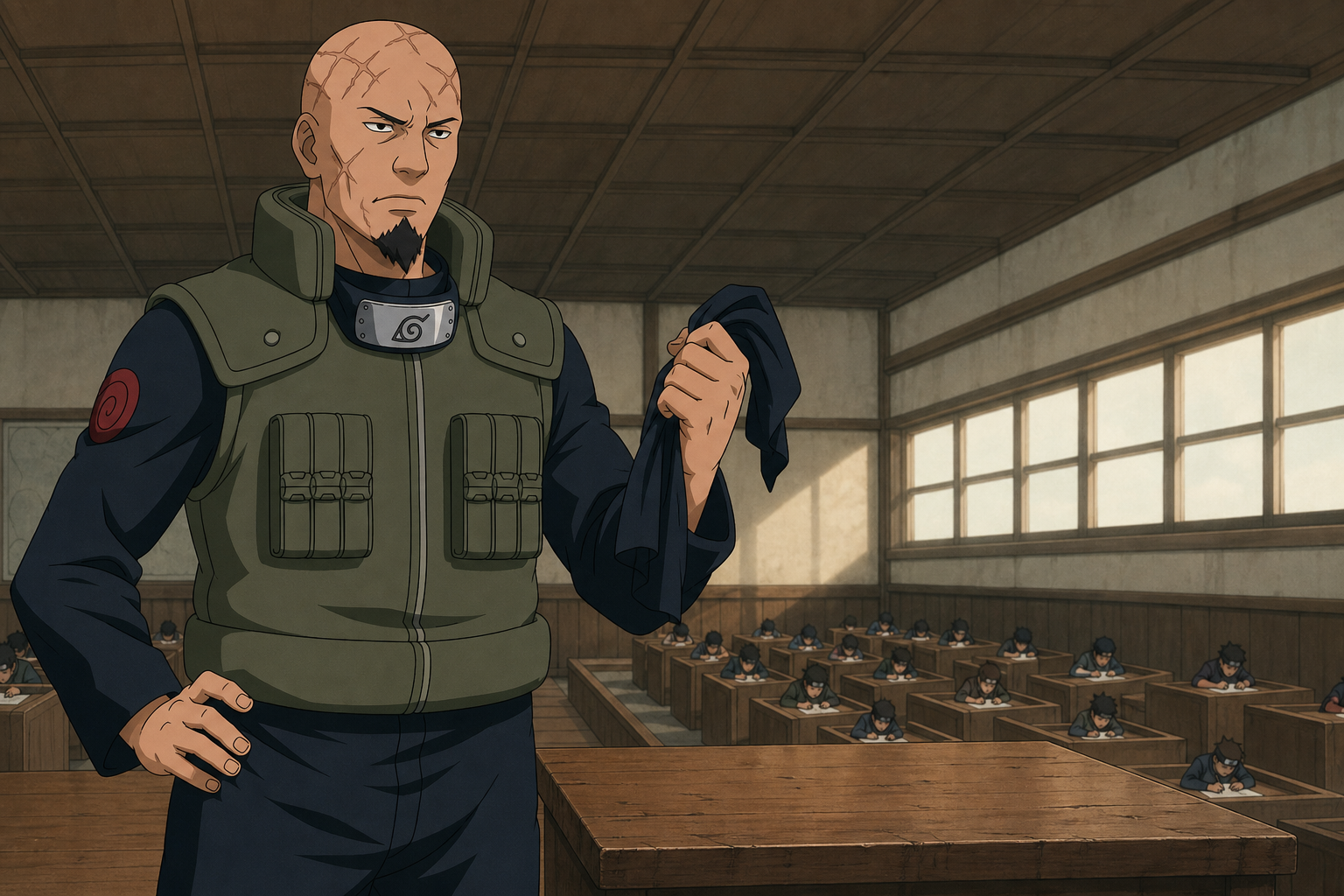
Ibiki is tall, broad and physically imposing. He usually wears the standard Leaf flak jacket over a dark uniform with a bandanna covering his head.
When the covering is removed, extensive scars cross his scalp. They are not decorative proof that he is “tough.” They are records of captivity, resistance and professional danger carried on a body that continues to serve the same village.
The Chūnin Exam candidates react because the scars make interrogation visible. The adult at the front of the room has encountered consequences far beyond a classroom score.
Ibiki’s design therefore performs an authority different from inherited clan prestige. His legitimacy is written through survival, experience and the knowledge of what hostile systems attempt to take from a shinobi.
What a special jōnin is
Ibiki is a special jōnin rather than a general-purpose jōnin. The classification recognizes elite ability concentrated in a particular professional domain.
His domain is intelligence. Konoha relies on him to question prisoners, assess credibility and protect information whose loss could endanger missions or lives.
This is a useful correction to the idea that shinobi hierarchy measures only combat strength. A village needs scouts, medics, analysts, barrier teams, sensory specialists and interrogators. Institutional survival depends on expertise that cannot be reduced to who wins a tournament bracket.
Ibiki can fight, but his defining weapon is an understanding of how people behave when knowledge, fear and loyalty collide.
The first Chūnin Exam stage
Ibiki enters Episode 24 with a team of proctors and establishes strict scoring rules. Candidates begin with points and lose them for incorrect answers. Team scores are combined, making each person responsible for two other futures.
The questions are deliberately beyond what many genin can solve directly. The real task is covert information acquisition. Candidates must recognize that skilled targets may possess information they do not and then obtain it without being caught.
Proctors monitor cheating rather than expecting pure academic isolation. Poorly executed cheating brings deductions and elimination. The examination recreates espionage inside a classroom.
This makes Sakura’s genuine academic competence useful but not the sole standard. Sasuke must infer the hidden rule. Hinata’s Byakugan, Shino’s insects and other specialized techniques become intelligence tools rather than battle effects.
Naruto, lacking both answers and a subtle collection method, reaches the exam’s final pressure point through another route.
The tenth question
Ibiki delays the final question and offers candidates a choice. Refuse it and fail the current attempt with the possibility of returning. Accept it and answer incorrectly, he warns, and the candidate will lose the right to take the exam again, while a teammate’s decision can eliminate the entire unit.
The threatened permanent consequence is the instrument. Ibiki makes uncertainty feel career-ending and collective.
Naruto raises his hand, terrifying Sasuke and Sakura, but he does not withdraw. He declares that even if he remains a genin forever, he will still become Hokage.
That decision passes the test. The “question” measures whether a shinobi can commit to a dangerous mission when perfect information is unavailable and retreat would preserve personal safety.
Ibiki then reveals his scars and explains the logic. In real operations, information may be incomplete and surrender can endanger comrades or villages. The exam rewards resolve, but it also raises difficult ethical questions about which kinds of resolve institutions encourage in children.
Why Naruto changes the room
Naruto does more than rescue himself. His declaration interrupts the fear circulating among the candidates.
Ibiki has individualized the threat: each person imagines becoming the one whose mistake destroys a team’s future. Naruto makes courage public and therefore socially available. The room hears someone choose uncertainty without pretending it is safe.
This resembles Naruto’s broader gift. He often cannot solve another person’s trauma for them. He can embody a refusal that makes their own refusal imaginable.
Ibiki recognizes the response because the test is not seeking calm perfection. It is seeking commitment under pressure. Naruto’s loudness, usually treated as immaturity, becomes the exact form of courage the room needs.
Interrogation and the ethics of fear
Ibiki’s work lives in a morally difficult part of the shinobi system. Intelligence can prevent attacks and save lives. Coercive institutions can also normalize cruelty, secrecy and the reduction of prisoners to information sources.
Naruto does not present a detailed legal code governing Konoha’s interrogation force. A complete profile should not invent one. What canon demonstrates is Ibiki’s expertise, endurance and willingness to employ severe psychological pressure.
His exam is defensible as a simulation of mission conditions and disturbing as pedagogy. Children are taught that collective responsibility and permanent consequence are ordinary features of professional advancement.
Ibiki’s own scars complicate judgment without resolving it. A survivor can understand cruelty intimately and still reproduce structures shaped by it. Experience can generate empathy, severity or both.
Relationship atlas
| Person | Relationship | What it reveals |
|---|---|---|
| Naruto Uzumaki | Candidate | Naruto supplies the public commitment Ibiki’s final test is designed to uncover. |
| Idate Morino | Younger brother | Duty, manipulation and unspoken care fracture a family before reconciliation becomes possible. |
| Anko Mitarashi | Fellow Chūnin Exam proctor | Her theatrical arrival contrasts Ibiki’s controlled dread while both test survival under uncertainty. |
| Hiruzen Sarutobi | Hokage and institutional superior | Ibiki’s authority operates within the village system Hiruzen leads. |
| Konoha Intelligence Division | Professional institution | His specialized identity is inseparable from the village’s need to control dangerous information. |
Abilities and professional tools
Psychological analysis
Ibiki reads fear, hesitation, loyalty and perceived consequence, then builds pressure around the target’s own expectations.
Interrogation resistance
His scars and reputation demonstrate survival through attempts to extract protected information.
Operational assessment
The first exam converts intelligence principles into a controlled evaluation of observation and resolve.
Summoning technique
His Torture Chamber summon manifests an iron-maiden-like restraint, externalizing the severity associated with his profession.
Leadership
He coordinates proctors and later intelligence work without needing theatrical volatility to establish command.
Combat competence
As a special jōnin, he possesses advanced shinobi fundamentals even though specialization defines his narrative identity.
Personality
Controlled
Ibiki uses stillness, rules and timing. He does not need to shout continuously because the room supplies its own anxiety.
Perceptive
He understands that imagined consequence can be stronger than an immediate threat.
Severe
His standards reflect a profession in which information failure can kill, but severity damages relationships when care remains unreadable.
Loyal
He protects Konoha’s intelligence even after enduring torture.
Respectful of courage
He does not dismiss Naruto’s noisy defiance. He recognizes the decision beneath the performance.
Institutional
Ibiki’s virtues and blind spots are shaped by the system he serves; duty gives him purpose and limits his emotional language.
Original Japanese performance
Taiten Kusunoki performs Ibiki in the original Japanese anime across the Chūnin Exam, later intelligence work and New Era appearances. The credit is verified. Those scenes require the performer to carry procedural authority, intimidation, professional explanation and brief recognition when Naruto changes the room.
I am not inventing pitch, breath or timing analysis without the heard Japanese scenes. A cast list is better than fake criticism. Ibiki’s written behavior supplies plenty to analyze honestly: he controls information, lets silence work, escalates imagined consequence and respects the candidate who answers fear with commitment.
After the exam: a career beyond one iconic room
Ibiki remains part of Konoha’s intelligence infrastructure after the Chūnin Exams. Later appearances return him to interrogation, security and crisis response rather than reinventing him as a conventional front-line hero.
That continuity is important. Naruto contains spectacular specialists whose techniques dominate battles, but villages also persist through professionals who evaluate prisoners, guard knowledge and coordinate responses after an enemy has been captured.
His later summon literalizes the imagery already attached to his name: restraint, confinement and controlled terror. The visual is extreme, yet it remains consistent with his central concern, preventing an opponent from controlling what happens next.
Ibiki’s endurance through multiple eras also distinguishes survival from fame. He rarely becomes the emotional center of a major arc, but Konoha repeatedly relies on the expertise his scars represent.
What Ibiki is really telling us
Ibiki embodies the difference between certainty and commitment.
Certainty says the danger has been fully measured and the answer is known. Shinobi work rarely offers that comfort. Commitment means choosing while acknowledging that the map is incomplete.
The first exam turns this principle into theater. Desks, papers and points imitate school, but the candidates are actually being asked whether they can identify hidden objectives, gather intelligence, protect teammates and resist a threat whose truth they cannot verify.
Existentially, Ibiki asks whether identity survives uncertainty. Naruto says he will remain the person reaching for Hokage even if the institution threatens to freeze him at genin forever. His chosen self is not conditional on the examiner’s guarantee.
Yet Ibiki also shows the cost of making endurance a civic virtue. A village that needs people who never break may neglect what happens after they survive. His scars are honored as strength, but they remain scars. His relationship with Idate demonstrates how the language of duty can crowd out the language of care.
The most honest reading holds both sides. Ibiki teaches a necessary lesson about incomplete information. He also stands inside a military society that teaches it through terror to children. Naruto passes by becoming more fully himself; the institution congratulates itself for creating the pressure that required the declaration.
Name meaning and translation limits
Ibiki can be written as a word meaning snoring, while Morino reads like “of the forest.” Put together, the name invites the joke “snoring in the forest.” Naruto loves names that can carry puns, profession signals or personality texture, and Ibiki’s otherwise severe presentation makes the sleepy wordplay extra funny.
That joke is not a secret technique, clan origin or medical diagnosis. It does not prove the Morino family has a forest-based bloodline. The canon gives Ibiki a registered Leaf identity and an anime-only younger brother, not a developed Morino clan history. Translation should reveal the play without inflating it into lore.
The contrast is useful anyway. His name sounds harmless. His reputation does not. Ibiki’s work depends on the distance between surface information and hidden reality, so even the comedy in his name fits a character who makes first impressions unreliable.
Scars, captivity and the body as evidence
Ibiki’s scalp is covered in severe scars usually concealed beneath his bandanna. The exam candidates see them when he removes the covering to explain why information discipline matters. His body becomes a receipt: hostile interrogators tried to force knowledge out of him, and he endured without surrendering what he was protecting.
The story does not provide a complete incident report for every mark. Fans should resist turning the scar pattern into invented dates, captors and techniques. What is confirmed is the professional meaning Ibiki gives them. He knows that torture seeks more than pain. It attacks identity, loyalty, time perception and the belief that resistance will change anything.
Naruto often turns a wounded body into instant character shorthand. Ibiki complicates that device because his scars are both private trauma and institutional credential. Konoha respects the endurance that lets him keep serving, yet the series spends little time asking what care a survivor receives after becoming useful again. A village can honor resilience while quietly depending on people never needing recovery.
That is why “the scars make him cool” is too shallow. They make him credible, frightening and sad. They also show the price of an intelligence system whose workers may be captured precisely because the village entrusted them with knowledge worth stealing.
Tokubetsu jōnin is not discount jōnin
Ibiki is a tokubetsu jōnin, commonly rendered as special jōnin. The rank recognizes jōnin-level mastery in a specialized professional field rather than presenting him as a weaker copy of a broad front-line commander. His field is interrogation and intelligence.
A functioning Hidden Village cannot measure value only through tournament wins. It needs medics who can keep teams alive, sensors who can find threats, analysts who can connect fragments, barrier specialists who can contain danger and interrogators who can recover information after capture. Ibiki’s authority belongs to that infrastructure.
He still possesses advanced shinobi fundamentals. He can command personnel, respond during invasion conditions and survive dangerous assignments. The honest limit is that canon does not build him an encyclopedic duel record. His defining competence is the ability to understand people under pressure and protect the village’s information system.
Calling him “just an examiner” misses the joke. The classroom is one public-facing application of a career built around extracting and defending knowledge. The exam is memorable because Ibiki translates his specialty into a test hundreds of viewers can understand without watching an actual interrogation session.
The written exam, rule by rule
| Layer | What candidates hear | What Ibiki is actually testing |
|---|---|---|
| Starting score | Each candidate begins with points and loses them for wrong answers. | Pressure begins before anyone understands the real objective. |
| Team total | One person’s deductions affect all three teammates. | Information work carries collective consequence; private failure is operational failure. |
| Difficult questions | The paper appears to reward advanced academic knowledge. | Candidates must recognize when direct knowledge is insufficient and acquire intelligence covertly. |
| Proctor surveillance | Cheating appears forbidden. | Clumsy collection is punished. Skilled collection that avoids detection demonstrates shinobi competence. |
| Tenth question | Attempting an unknown question may permanently end future eligibility. | Ibiki tests commitment when facts are incomplete, stakes feel irreversible and teammates share the cost. |
| Naruto’s declaration | A loud candidate refuses to withdraw. | His public resolve breaks the room’s fear loop and proves that identity can survive an uncertain outcome. |
The design is clever because each layer revises the last. The written test is not really about memorized answers. The cheating rule is not really a demand for pure isolation. The final question is not really a question on paper. Ibiki keeps candidates inside a changing information environment and watches who updates their model.
The tenth question is effective and ethically messy
Ibiki threatens candidates with a permanent career consequence if they attempt the tenth question and answer incorrectly. He also makes one teammate’s withdrawal end the attempt for all three. The threat concentrates fear around uncertainty and shared responsibility.
Naruto refuses to protect himself by retreating. He says that even if he remains a genin forever, he will still become Hokage. The declaration matters because it is not private confidence. Everyone hears it. Courage becomes socially available, and candidates who were about to fold can imagine staying because somebody else made staying visible.
Ibiki passes the remaining candidates because the decision is the answer. Real missions may force shinobi to act without complete information. Quitting can protect one operative while abandoning teammates or a village. The test asks whether candidates can choose under that pressure.
Now the side-eye: these are children in a military institution being taught to accept uncertain, potentially permanent consequences. The lesson has operational logic. The teaching method also normalizes the idea that good shinobi prove themselves by refusing exit when authority describes the stakes as absolute. Naruto succeeds because his chosen identity is stronger than the threat, not because every institutional threat is automatically wise.
That tension is the meat. Fans do not have to choose between “Ibiki is brilliant” and “this system is disturbing.” He is brilliant at constructing the test. The test is disturbing because it accurately reflects the world that made such conditioning useful.
Complete abilities, tools and limits
| Ability | Confirmed function | Boundary |
|---|---|---|
| Psychological analysis | Ibiki reads fear, hesitation, loyalty and the pressure created by imagined consequences. | Reading behavior is not supernatural omniscience. Targets can resist, lie or withhold. |
| Interrogation | He leads Konoha’s torture and interrogation force and questions prisoners for operational intelligence. | The manga does not publish a complete legal code or success ledger for every case. |
| Resistance under torture | His scars and explanation establish that he protected information through severe captivity. | Endurance does not make him invulnerable or erase trauma. |
| Command and assessment | He coordinates proctors, structures examinations and works within the intelligence division during crises. | His specialty is institutional intelligence, not every form of village leadership. |
| Summoning Technique | The anime gives him confinement and torture-themed summons, including Iron Maiden and Torture Chamber presentations during combat. | These named manifestations are anime material and should not be backfilled into the manga record. |
| Anime tools | Adaptation records associate him with concealed weapons such as a blowpipe, mouth ember and katar. | These tools need anime continuity labels; they are not his core manga identity. |
| Shinobi fundamentals | His rank and operational assignments support advanced general competence. | Canon does not establish him as a top-tier destructive combatant or give him a broad elemental catalog. |
The cleanest description is “specialist with combat capability,” not “secret powerhouse” and not “paperwork guy.” His value is knowing what information means, how people protect it and what fear does to decision-making.
Career chronology after the famous classroom
Ibiki’s first major role is the written Chūnin Exam stage, but his career does not stop after Anko crashes through a window and steals the room’s attention. He remains tied to Konoha’s intelligence and security infrastructure through later crises.
During the Pain assault material, the intelligence apparatus works to extract what Konoha can learn about the enemy. Ibiki’s presence belongs to the village’s less glamorous defense layer: prisoners, fragments, questioning, coordination and information that must travel fast enough to matter. Anime combat additions can make his interrogation imagery literal, but the institutional role is the important throughline.
The Fourth Shinobi World War expands the value of intelligence coordination. Front lines receive the fireworks; headquarters, analysis and communication determine whether separated units understand the battlefield. Ibiki is not rewritten into the war’s central duelist, and the profile should not pretend otherwise. His profession remains part of the machinery that makes large-scale response possible.
By the New Era, he is still alive and associated with intelligence leadership. The Boruto anime also assigns him Team 40, including Dōshu Goetsu, Enko Onikuma and Tsuru Itoi. That teacher role is anime continuity. It extends his pressure-reading specialty into mentorship, especially when a young shinobi’s dangerous ability needs disciplined care instead of public spectacle.
Idate Morino and the anime’s family argument
Idate Morino is Ibiki’s younger brother in the anime continuity, specifically the Land of Tea storyline. He is not a manga foundation that should be quietly blended into every version of Ibiki’s biography.
Idate wants advancement and recognition badly enough to trust Aoi Rokushō, who manipulates him into stealing forbidden material. Ibiki cannot erase the professional betrayal simply because the accused is family. Idate experiences the resulting severity as proof that his brother chose the institution over him and flees with shame hardened into resentment.
The story exposes a problem Ibiki’s exam also contains. He understands pressure, deception and the consequences of bad intelligence. He is much less fluent at making care legible before judgment arrives. Duty may require accountability. Love that remains entirely unspoken can still feel like abandonment to the person receiving only the punishment.
The later reunion offers repair without pretending the lost years were harmless. Ibiki can recognize that Idate no longer carries the same cowardice and confusion. Idate can see that his brother’s severity was not indifference. Neither realization makes Aoi’s manipulation or the family fracture disappear.
Media and continuity shelf
Ibiki’s manga debut is chapter 40, and the original anime places him in the early Chūnin Exam sequence beginning with episode 21 before his full written-exam function takes center stage. His game debut is Naruto: Ultimate Ninja. His OVA shelf includes Hidden Leaf Village Grand Sports Festival!, a bonus production rather than an extra manga chapter.
Naruto the Movie: Blood Prison places him in the film shelf. Film participation should be labeled as film continuity instead of used to rewrite the central manga timeline. The novel record includes Sakura Hiden: Thoughts of Love, Riding Upon a Spring Breeze, which belongs to the licensed prose shelf and needs its own continuity context.
The Land of Tea brother story, the torture-themed combat summons and Team 40 leadership are anime additions. They can enrich the complete adaptation profile when labeled. They cannot be cited as though Kishimoto’s manga showed the same scenes.
Boruto material keeps Ibiki alive in the New Era and tied to Konoha’s intelligence world. That is a career extension, not permission to invent a retirement date, hidden family branch or promotion beyond the titles actually recorded.
Eight fandom shortcuts that miss the point
“The first test is just schoolwork.”
The impossible paper creates an intelligence-gathering problem inside a classroom disguise.
“Any cheating means failure.”
Badly executed collection is punished. Covert acquisition is the hidden professional task.
“Naruto answers a secret question.”
His refusal to withdraw is the answer. The exam measures commitment before certainty.
“Tokubetsu jōnin means inferior jōnin.”
It marks specialized jōnin-level expertise. Ibiki’s field is intelligence and interrogation.
“Scars prove he feels nothing.”
They prove endured violence. Survival is not emotional absence.
“Idate is manga canon.”
The brother storyline belongs to anime continuity and must stay labeled.
“Anime summons prove a manga arsenal.”
Iron Maiden and Torture Chamber imagery comes from adaptation material.
“He is only important in one room.”
The room is iconic because it translates a continuing intelligence career into visible drama.
Hierarchy, reciprocity and the cost of useful pain
A Confucian reading asks what legitimate hierarchy owes in return for obedience. Ibiki’s exam demands that teammates accept shared consequence and that candidates commit to dangerous service. The village gains operatives capable of protecting collective interests. Its reciprocal duty is to train, protect and care for the people carrying those risks.
Ibiki’s scars reveal how easily that balance can tilt. His endurance benefits Konoha. The narrative honors him by giving the scars authority, but it says far less about recovery. When institutions praise survivors mainly for returning to work, pain can become another productive resource.
A Buddhist lens adds the problem of attachment to certainty and status. Candidates panic because they imagine one unknown answer permanently severing the future title they want. Naruto loosens that grip. He refuses the examiner’s power to define his entire identity through one outcome. He will pursue Hokage even if the route becomes absurdly difficult.
Ibiki recognizes that freedom because his test is looking for it. The institutional irony remains delicious: Naruto passes the system’s test by declaring that the system cannot decide who he is. Ibiki, professional keeper of controlled information, rewards the loudest refusal to let official information close the future.
Where to continue
Sources and canon boundary
Manga chronology controls this profile. Anime staging, databook material, novels, films, games, and later franchise appearances are labeled instead of being blended into one false continuity.
Primary franchise references: Naruto Official and VIZ Media Naruto. CVM Sekai’s conclusions about interrogation ethics, the Chūnin Exam written test, trauma, Idate, institutional power, and Ibiki’s New Era career are editorial analysis, not invented creator quotations.