
Naruto · Complete Character Profile
Dosu Kinuta
He enters the Chūnin Exams as Orochimaru’s instrument, recognizes the hand holding him, and dies trying to prove that awareness has already made him free.
The bottom line
Dosu is clever enough to discover that he is disposable, but still believes defeating the target will let him negotiate with the person who made him disposable.
That contradiction defines him. He is not a loyal zealot who never notices Orochimaru’s contempt. He notices. He reassesses. He develops anger and independent intent. Yet the only language of autonomy available to him is greater usefulness through violence.
He tries to escape being a tool by proving he is the better tool.
Appearance and immediate identity
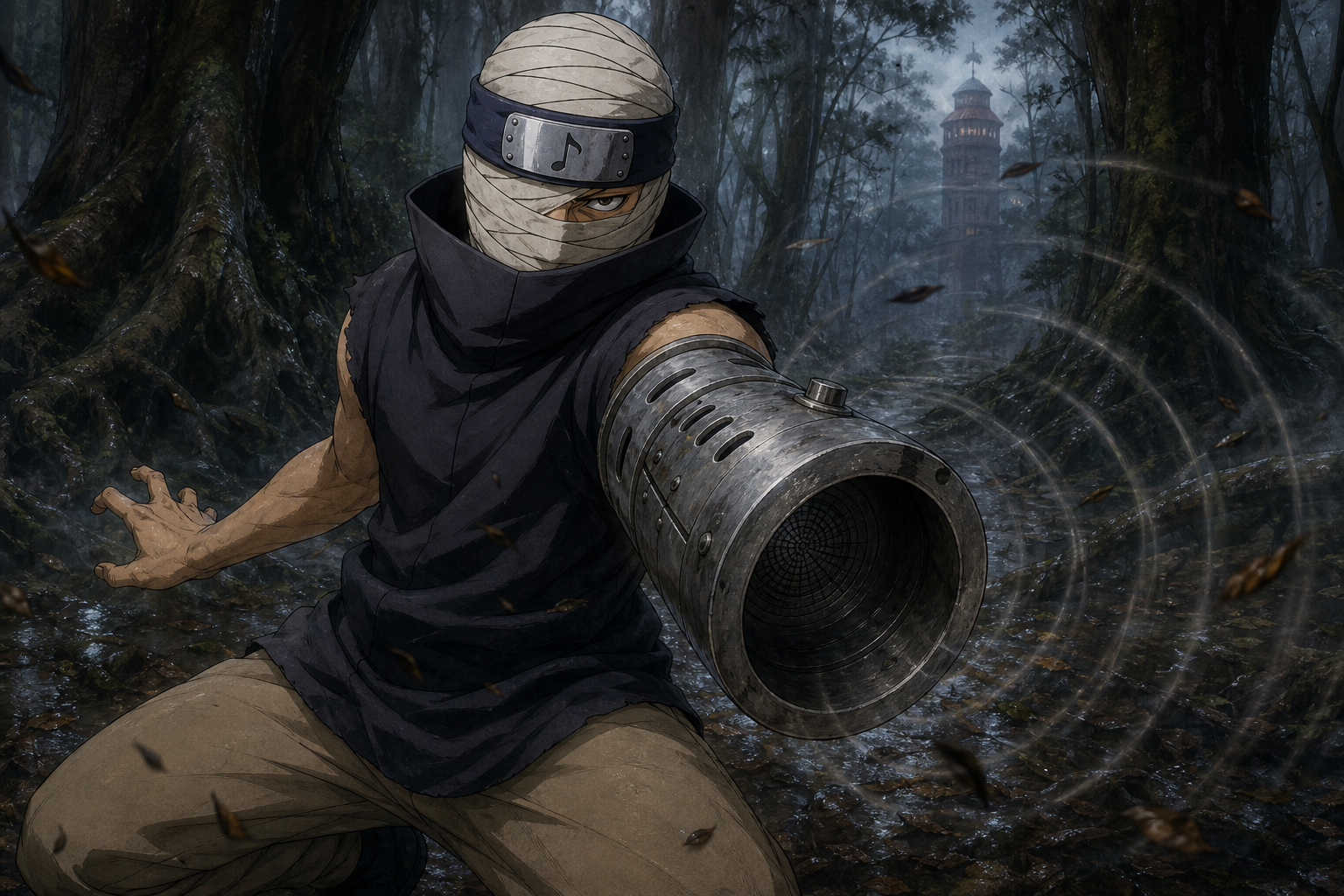
Dosu’s visual design makes concealment and machinery inseparable. Bandages cover most of his head and face, leaving one watchful eye exposed. His Sound forehead protector identifies an official village whose political reality is largely Orochimaru’s manufactured front.
The Melody Arm dominates one forearm. It is not a subtle weapon: metal, chambers and sound-producing machinery convert small motion into attacks that bypass conventional toughness.
Where Zaku’s palms reveal bodily modification openly and Kin’s bells resemble ordinary ninja tools, Dosu carries a visible apparatus that looks half instrument, half restraint.
His design communicates the team’s truth before the plot says it aloud. Hidden Sound does not simply train bodies. It treats them as experimental platforms.
What is the Hidden Sound Village?
Otogakure is presented to the Chūnin Exam bureaucracy as a shinobi village new enough to be unfamiliar. In practice, it serves Orochimaru’s research, recruitment, military experiments and ambitions.
The village name makes “sound” appear to be a shared cultural identity. For Dosu’s team, sound is closer to a weapons program. Dosu’s arm amplifies sound; Zaku’s implanted air tubes manipulate pressure; Kin combines senbon and bells with misdirection.
Their headbands grant institutional appearance to children selected and modified for another person’s plans. Certification becomes camouflage for ownership.
Episode 23: the helpful stranger becomes a target
In the packed exam room, Kabuto Yakushi demonstrates information cards containing profiles of participating genin. He presents himself as an experienced repeat candidate helping nervous rookies understand the field.
For the Sound team, the display is an insult and a threat. Kabuto publicly possesses intelligence on foreign candidates and Hidden Sound’s entrants while treating their young village as data already captured.
Dosu leads Zaku and Kin in attacking him. The Melody Arm produces an effect even when Kabuto appears to evade. Kabuto’s glasses break; he becomes nauseated and vomits.
The moment establishes Dosu’s method: attack the inner ear and equilibrium rather than requiring a clean external hit. It also participates in Kabuto’s performance. The spy benefits from looking vulnerable just before the examination begins.
The Melody Arm: sound attacks the body from inside
Dosu’s gauntlet amplifies sound generated through his movement. The resulting vibrations travel through air and solid material, allowing him to affect an opponent even when armor, muscle or a near miss would defeat an ordinary strike.
The inner ear regulates balance. Disrupting it can create dizziness, nausea, pain and disorientation. Dosu’s power is frightening because the body becomes the attack surface.
Why defense fails
Blocking the gauntlet does not necessarily block vibration. Contact can provide another transmission route.
Why proximity matters
Dosu fights at close range so his amplified sound reaches the target with force and precision.
Why analysis matters
He watches opponents for structural weaknesses and understands that technique choice must match anatomy.
Why it fits the series
The technique expands chakra combat beyond visible elements and shows that ordinary physiology remains relevant inside supernatural battles.
Forest of Death mission
The Sound trio’s apparent task is to attack Sasuke. The deeper purpose is entangled with Orochimaru’s attempt to test the cursed seal and observe how Sasuke responds to power.
By the time Dosu’s team reaches Team 7, Sasuke is incapacitated after Orochimaru’s attack and Naruto is unconscious. Sakura has remained awake to protect them.
Rock Lee intervenes. He uses the Front Lotus on Dosu, but Zaku cushions the impact through air pressure, converting a finishing move into a team-survival demonstration.
Dosu then lands his sound attack on Lee. The victory matters: Lee’s physical durability and speed do not protect the inner ear from vibration. Dosu defeats a stronger-looking close-combat specialist by attacking the body’s hidden dependency.
Team 10 and Sakura’s stand
The conflict expands as Sakura fights to protect her teammates, Team 10 intervenes, and other young shinobi reveal what friendship means under examination conditions.
Dosu remains the Sound team’s clearest strategist. Zaku is more openly cruel and impulsive; Kin uses humiliation and deception. Dosu watches how reinforcements change the field.
The trio expects vulnerable prey. Instead, they encounter a network: Lee’s promise, Ino’s unresolved bond with Sakura, and the Rookie Nine’s social history become tactical facts.
This is one of the arc’s recurring ideas. The exam claims to assess three-person teams, but relationships beyond official squads keep entering the battlefield.
Sasuke awakens under the cursed seal
Sasuke rises altered by Orochimaru’s cursed seal and attacks the Sound trio with terrifying aggression. He breaks Zaku’s arms and demands to know who harmed Sakura.
Dosu recognizes that the power inside Sasuke exceeds the mission briefing. He also recognizes something worse: Orochimaru has used the Sound team to provoke and measure Sasuke.
Dosu gives Team 7 the scroll necessary to continue and retreats. This is not compassion in a clean moral sense. It is tactical surrender, shock and the beginning of rebellion against the hierarchy that sent his team into a test they were not meant to understand.
The team’s mission was never really “kill Sasuke.” If Orochimaru wanted Sasuke dead, the cursed seal would make no sense. Dosu realizes that their violence has been arranged as stimulus.
The relationship atlas
| Person | Relationship | What it reveals |
|---|---|---|
| Orochimaru | Commander, village founder and exploiter | Dosu sees manipulation but imagines usefulness can renegotiate ownership. |
| Zaku Abumi | Teammate and modified weapon | Dosu frequently provides tactical direction while Zaku embodies anger and reckless force. |
| Kin Tsuchi | Teammate and ranged specialist | The trio coordinates distinct sound-related methods, though canon gives their personal bond limited interior space. |
| Kabuto Yakushi | Apparent rival, hidden fellow operative | Dosu attacks a performance without knowing both groups serve the same architect. |
| Sasuke Uchiha | Assigned target and later proof of Dosu’s disposability | Sasuke receives Orochimaru’s investment; Dosu’s team receives risk. |
| Rock Lee | Forest opponent | Specialist intelligence can counter a physically superior close-combat style. |
| Chōji Akimichi | Preliminary opponent | Dosu exploits vibration transmission through an enlarged rotating body. |
| Gaara | Final intended target and killer | Dosu mistakes political awareness for sufficient power against a jinchūriki losing control. |
Preliminary match: Dosu versus Chōji
Dosu fights Chōji in the final preliminary bout. Chōji uses the Human Boulder Technique, turning his enlarged rotating body into both offense and defense.
Dosu observes that sound can travel through the body’s mass. He places the Melody Arm against Chōji’s surface and sends vibration inward, defeating him quickly.
The win confirms that Dosu is more than a single surprise trick. He identifies transmission paths under pressure and adapts the technique to a target whose visible defense would discourage ordinary contact.
It also earns him a place in the finals, the achievement that creates his fatal illusion: formal advancement seems to prove he has become important enough to act independently.
Rebellion without liberation
Dosu concludes that Orochimaru cares about Sasuke rather than the Sound genin. He plans to defeat Sasuke and demonstrate that he cannot be dismissed.
When the final brackets change, Dosu approaches Gaara at night, intending to remove an obstacle and improve his path toward Sasuke.
He has correctly identified the political structure and catastrophically misread the immediate person. Gaara’s instability and Shukaku’s power make the ambush suicidal. Dosu is killed almost instantly.
The death is abrupt because expendability is abrupt. A character can develop insight, ambition and anger; the system exploiting him does not become obligated to honor that development with a fair confrontation.
Dosu’s personality
Analytical
He studies physiology, techniques and battlefield changes rather than relying only on force.
Proud
He resents condescension toward Hidden Sound and wants recognition beyond assigned utility.
Controlled
Compared with Zaku, Dosu is more likely to assess before escalating.
Cruel
Intelligence does not make him gentle; he participates willingly in attacks on exhausted and vulnerable opponents.
Suspicious
He notices contradictions in Orochimaru’s mission and Sasuke’s treatment.
Tragically overconfident
Recognizing manipulation convinces him that he has already escaped it.
His name, sound vocabulary, and translation limits
Kinuta can refer to a traditional fulling block or mallet, and the word also sits near the anatomy of the ear through the incus, the anvil-shaped middle-ear bone. The wordplay suits a fighter who turns vibration into internal damage. It is support for the design, not proof that every combat rule can be reverse-engineered from a surname.
Dosu is written in katakana, which limits neat kanji explanations. English fan discussion sometimes turns the name into a complete etymology with more confidence than the page earns. The honest receipt is simpler: his name, team, village, and weapon sit inside a cluster of percussion, vibration, and ear imagery.
Hidden Sound uses that cluster as shared identity. Orochimaru controls the institution beneath it. A village aesthetic can make exploitation look communal without giving the children any actual protection.
The first databook shows a specialist, not a secret jōnin
Dosu’s first-databook ratings total 16: ninjutsu 2.5, taijutsu 2, genjutsu 1.5, intelligence 2.5, strength 1.5, speed 3, stamina 2, and hand seals 1. The shape fits the story. He is quick, observant, technically focused, and not built to win through raw force or an enormous technique shelf.
Those numbers do not make him a hidden elite adult. He is fourteen and carries one core weapon system. Naruto fandom loves turning “underrated” into “secretly Kage level” because apparently respect needs a power-scale parade float. Dosu does not need the promotion.
His competence is better at the level shown. He can hear pencil strokes, identify traps, read anatomy, coordinate teammates, and change tactics. He can also make one arrogant matchup decision and die before the bracket begins. Intelligence reduces risk. It does not repeal consequence.
The written exam proves sound is intelligence before it is a weapon
Ibiki’s written test is built around covert information gathering. Candidates use insects, sight lines, mirrors, puppets, and other methods to steal answers without being caught. Dosu listens to pencil movement. The sensory attention guiding his weapon can separate strokes and writing rhythm from a crowded room.
That matters because his specialization is not “loud arm go boom.” Sound provides surveillance, diagnosis, and attack. The exam rewards the first function before the preliminaries reward the second.
It also creates a nasty institutional mirror. Konoha turns covert theft into a controlled professional exercise. Root and Otogakure take similar skills outside the classroom and attach them to adults who consider children replaceable.
Resonating Echo Drill: mechanics, range, and limits
The Resonating Echo Speaker on Dosu’s right forearm amplifies sound from movement and directs vibration into a target. The attack disrupts the inner ear, producing pain, nausea, vertigo, and loss of balance. A clean external wound is not required because equilibrium is the target.
Against Kabuto, the apparent near miss still produces symptoms. Against Lee, the technique punishes close-range contact after Front Lotus fails to finish the team. Against Chōji, Dosu reasons that covering the ears and rolling inside an enlarged body will not stop vibration traveling through the body’s water and tissue.
The technique still has limits. Dosu works at close range, depends heavily on the arm device, and shows no broad long-range bombardment. A prepared opponent who controls distance, disables the gauntlet, or overwhelms him before transmission can reduce the advantage. Gaara’s defense and jinchūriki power sit far outside the matchup Dosu has proved he can solve.
Sound itself is not genjutsu here. The effect is physical disruption through vibration. Naruto has sound-based illusion techniques elsewhere, but shared sensory language does not make every ability the same category.
Team Dosu coordinates, but Orochimaru never gives it a future
Dosu acts as the trio’s unofficial leader because he observes first and usually speaks for the team. Zaku supplies violent confidence and implanted air-pressure weapons. Kin uses senbon, bells, thread, and expectation. Their methods overlap around sound without becoming copies.
Zaku cushions Dosu during Lee’s Front Lotus, a concrete act of team survival. Dosu later promises retaliation after Shino destroys Zaku’s arms. Those moments show more than three strangers sharing a bracket, but canon gives little private interiority about their bond. The profile does not need to manufacture found-family tenderness to make their deaths hurt.
Orochimaru does not need them to mature as a squad. He needs stress applied to Sasuke. The team’s coordination is real; the mission structure using it is fraudulent. That distinction is the tragedy in miniature.
Attacking Gaara is coherent planning built on terrible threat assessment
The finals bracket places Dosu against Shikamaru, with Temari waiting on that side of the draw. Dosu wants to reach Sasuke and damage Orochimaru’s preferred investment. Removing Gaara early appears to reduce one of the tournament’s largest threats.
The strategic goal is coherent. The information beneath it is incomplete. Dosu knows Gaara is dangerous from the preliminaries, but he does not understand the scale of Shukaku, Gaara’s instability, or how little inner-ear disruption matters against a partial transformation backed by automatic sand defense.
He also chooses a night ambush without the team structure that saved him against Lee. Recognition has become pride. He has correctly diagnosed exploitation and then treated the diagnosis as a power-up.
Gaara kills him with brutal speed. The tournament rearranges around the empty slot. Orochimaru’s larger plan continues. Dosu’s death proves the thing he was trying to disprove: the institution can consume him and proceed without administrative delay.
Child-soldier labor and a disposable village
Otogakure presents itself as a new hidden village able to send candidates into an international exam. That recognition gives Orochimaru access to Konoha’s security theater, young targets, and political stage. The headband is a credential for the founder before it is protection for the child wearing it.
Dosu, Zaku, and Kin perform hazardous labor with incomplete information. Their bodies carry the equipment, modifications, and consequences. Orochimaru keeps the research value and strategic options. This is downward exploitation with a village logo slapped on top.
Confucian ideas about hierarchy and reciprocal duty help explain why the arrangement fails. A superior can demand loyalty only inside obligations of care, instruction, and moral responsibility. Orochimaru demands obedience while withholding the mission’s real purpose and treating death as acceptable data. That is hierarchy without reciprocity.
From an attachment lens, Dosu’s rebellion also makes sense. No alternative institution, caregiver, or community offers a life beyond usefulness. He challenges the evaluator’s verdict because he still needs the evaluator to recognize him. Awareness opens the cage door in his head. It does not build anywhere to go.
Sound, bodies, and the series’ early power rules
Dosu matters to Naruto’s combat grammar because he proves that supernatural fighting still depends on ordinary anatomy. A character can have chakra, muscle, armor, and speed while remaining vulnerable to the organs controlling balance. Power does not erase the body; it creates new ways to reach it.
The Melody Arm also separates a technique from spectacle. There is no dragon, giant summon, or arena-sized crater. A small movement, short distance, and correct physiological target can end the fight. That scale makes the preliminary win feel clinical rather than weak.
Creatively, Kishimoto uses the weapon to prepare readers for later specialized tools and modified bodies. The Sound trio makes the ninja world feel less like a clean elemental system and more like an arms market where laboratories, implants, and personal techniques overlap.
The bandages and single visible eye sharpen that effect. Dosu looks like an injury that learned to watch back. The design never tells us exactly what is under every wrap, and it does not need to. Concealment keeps his face secondary to the equipment Orochimaru wants the audience to notice.
Consequences for Zaku, Kin, and the bracket Dosu leaves behind
Dosu’s death is not an isolated dramatic beat. Zaku and Kin have already been defeated, exposed as disposable, and later selected as sacrifices for Orochimaru’s Impure World Reincarnation during the Konoha Crush. Team Dosu is dismantled body by body before any member receives the future a village team is supposed to prepare.
The finals bracket changes because Dosu is gone. Shikamaru faces Temari directly. That match becomes the performance earning him promotion, which means Dosu’s absence quietly shapes another child’s career. Naruto often lets consequence travel through administrative changes rather than speeches.
Orochimaru loses nothing he cannot replace. The invasion proceeds, the sacrifices are consumed, and Sasuke remains the preferred target. That imbalance tells us who owns the mission’s value and who merely carries its risk.
Dosu’s awareness therefore arrives too late to save himself or his teammates. It still matters because the reader can see the shift. A child operative recognizes the contract is fraudulent. The story refuses to confuse recognition with rescue.
Eight fandom shortcuts that flatten Dosu
“He only has one gimmick”
He has one main weapon system, plus hearing-based information gathering, tactical reading, team coordination, close-range movement, and the judgment to adapt transmission to different bodies. A narrow kit is not an empty one.
“He beat Lee only because Zaku helped”
Zaku saves Dosu from the full Front Lotus impact. Dosu then uses his own technique to incapacitate Lee. Teamwork changes the fight; it does not erase either participant’s contribution.
“Chōji was simply too weak”
Dosu wins by understanding that the Human Boulder Technique does not remove the body’s vulnerability to vibration. The matchup rewards analysis, not a universal ranking.
“He became a good guy after distrusting Orochimaru”
He remains cruel, proud, and willing to kill. Disillusionment changes his allegiance, not every value he learned under exploitation.
“Orochimaru ordered him to kill Sasuke for real”
The team receives the apparent mission while Orochimaru has already marked Sasuke and wants to observe the cursed seal. Dosu realizes they were stimulus inside somebody else’s experiment.
“Gaara defeated him in the finals”
Dosu attacks Gaara before the tournament resumes and dies outside the scheduled match. The bracket never gives him the fair stage he imagined.
“He was secretly strong enough to beat Gaara”
No shown receipt supports that claim. Dosu’s attack works on ordinary anatomy at close range. Gaara’s sand, transformation, and lethal response create a different scale entirely.
“His abrupt death means he was pointless”
The abruptness is part of the point. Expendable operatives do not receive narrative retirement packages from the institution using them.
Dosu, Kabuto, and Haku show three responses to being used
Kabuto learns to survive by changing identity until the assignment fits. Dosu keeps a stronger visible personality, but he still measures freedom through usefulness. Both can identify manipulation without immediately escaping the system that taught them how value works.
Haku understands his bond with Zabuza through usefulness and chosen devotion. Haku’s care, agency, and power imbalance must remain together. Dosu receives less tenderness and far less interior space, but his attempt to become indispensable belongs to the same world where adults recruit wounded children by offering purpose.
Sasuke is the preferred investment connecting the cases. Orochimaru gives him the cursed seal, tests his response, and sacrifices Sound labor around the experiment. Dosu’s anger is not jealousy floating in empty air. He has watched the hierarchy price one child as a future body and three others as disposable equipment.
The difference is what each character can imagine beyond the assigned role. Kabuto eventually returns to care after catastrophe. Haku chooses protection inside a coercive bond. Dosu sees the cage and still imagines freedom as winning a better position inside it. That is why the Gaara ambush feels psychologically consistent even when it is tactically disastrous.
Media record and continuity boundaries
Kishimoto’s manga supplies Dosu’s core Chūnin Exam biography, fights, disillusionment, and death. The television anime follows that spine while adding staging and small connective moments. Anime details stay inside anime continuity when the manga does not show the same beat.
Dosu appears in the licensed OVA Finally a Clash! Jōnin vs. Genin!! Indiscriminate Grand Melee Tournament Meeting!! and in games including Naruto: Path of the Ninja. Those appearances belong on the franchise shelf. A playable move, tournament cameo, or alternate scenario does not reverse his manga death or create a secret post-exam career.
The limited shelf is part of the record. Dosu is a consequential minor character, not a recurring cast member whose every blank year needs fanfiction disguised as biography.
Original Japanese performance
Daisuke Egawa performs Dosu in the original Japanese anime. His verified credit covers the exam-room attack, Forest of Death conflict, preliminary victory, disillusionment, and final encounter with Gaara.
Those scenes give the role several contexts: controlled threat, tactical command, wounded pride, and reckless independence. A cast list can establish the performer and the scenes. It cannot prove pitch, breath, timing, or delivery, so this profile does not invent scene-level criticism from credits alone.
No English-dub material belongs in this profile.
Common misconceptions
“Dosu’s attack is ordinary loud noise.”
No. The Melody Arm amplifies and directs sound vibration to disrupt balance and internal function.
“He stays blindly loyal to Orochimaru.”
No. He realizes the team was used and develops an independent plan, though that plan remains shaped by Orochimaru’s value system.
“Dosu was meant to kill Sasuke.”
The apparent order masks Orochimaru’s interest in provoking and evaluating Sasuke after applying the cursed seal.
“Gaara defeats him in a proper exam match.”
No. Dosu ambushes Gaara before the finals and is killed outside the tournament arena.
What Dosu is really telling us
Dosu’s story asks whether recognizing exploitation is the same as becoming free from it.
He discovers the truth: Orochimaru treats his team as disposable stimulus for Sasuke. But Dosu’s answer is to become stronger, defeat Sasuke and prove greater value. He does not reject the hierarchy. He appeals its verdict through performance.
Existentially, he attempts self-authorship using the only vocabulary his environment supplied: combat utility. “I am not your tool” becomes “I will show you I am the tool you should have chosen.”
That is why his death feels both foolish and tragic. Awareness without an alternative community can reproduce the logic one has exposed.
Dosu does not need a more impressive final battle to matter. His unfinishedness is the point. Systems that consume children do not wait for their character arcs to become satisfying.
Legacy
Dosu expands Naruto’s early combat grammar. Sound can bypass surface defense, physiology matters, and intelligence can make an apparently minor antagonist dangerous.
He also humanizes Hidden Sound before the village’s larger machinery is fully understood. The forehead protector does not represent a stable homeland in the way Konoha’s does. It represents a constructed affiliation owned by one man.
Later victims and operatives deepen Orochimaru’s pattern, but Dosu’s team establishes it cleanly: recruit the vulnerable, modify the body, provide a name, then call disposability loyalty.
His single visible eye sees much of the trap. It does not see a road out.
Sources and canon boundary
Manga chronology controls this profile. Anime staging, databook material, novels, games, and later appearances are labeled instead of being blended into one false continuity.
Primary franchise references: Naruto Official and VIZ Media Naruto. CVM Sekai’s conclusions about sound-based combat, Team Dosu, Orochimaru’s exploitation, ambition, tactical intelligence, and Dosu’s death are editorial analysis, not invented creator quotations.