
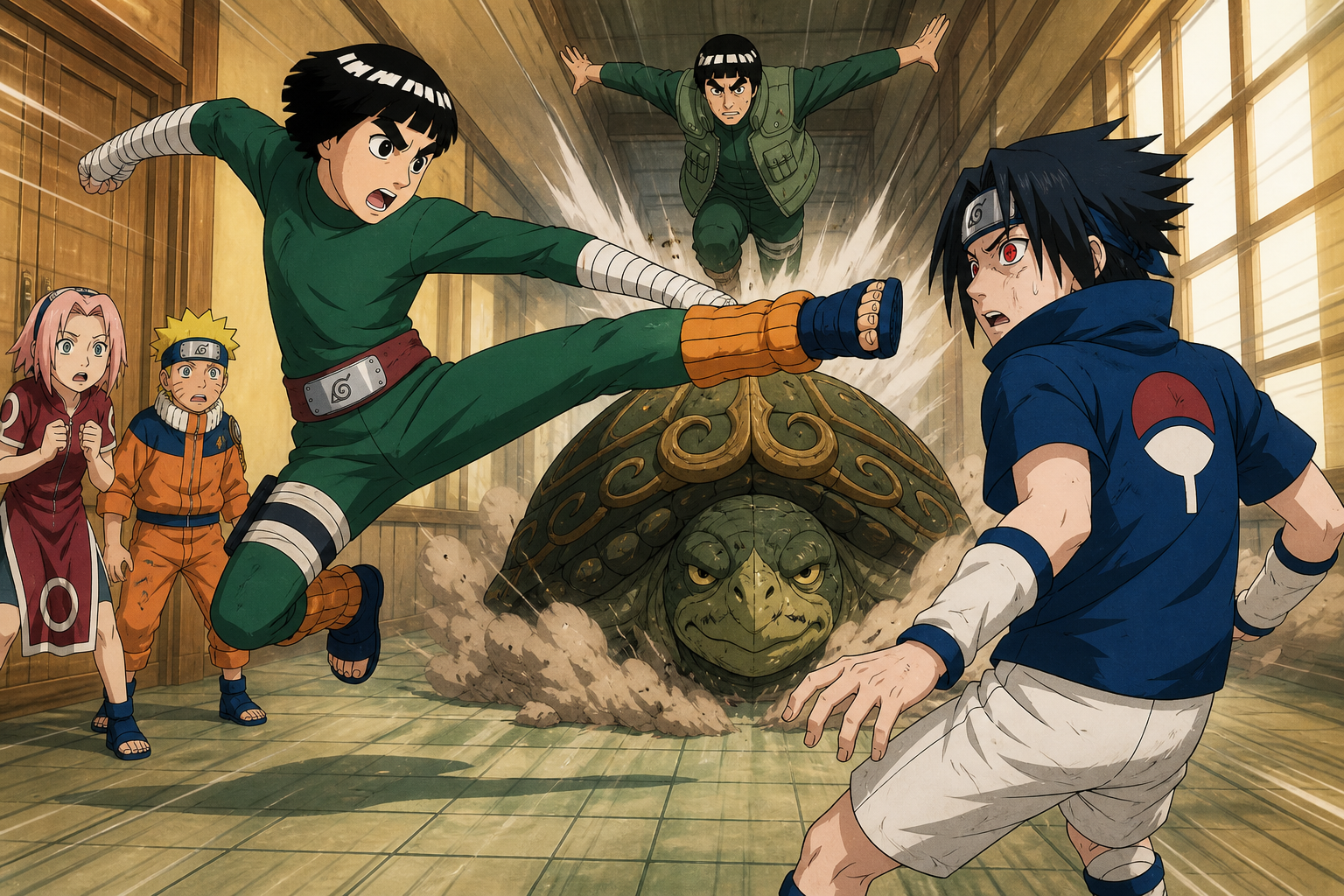
Chūnin Challenge: Rock Lee vs. Sasuke!
Sasuke can see Lee. That is exactly why losing frightens him. Episode 22 demolishes the fantasy that possessing the right eyes is the same as having built the right body, then asks why a boy like Lee is willing to spend his body simply to make his existence undeniable.
Lee wins before Sasuke understands the contest
Sasuke accepts the challenge as if the Uchiha name and Sharingan have already defined the terms. Lee changes those terms through speed, repetition, and a body trained beyond what Sasuke expects. The humiliation is not that Sasuke lacks talent. It is that talent cannot substitute for preparation in a contest built around somebody else’s discipline.
The Sharingan lets Sasuke follow more than most opponents could, but perception and execution remain different skills. Lee’s body can complete movements that Sasuke’s eyes recognize but his muscles cannot yet answer. That gap is the episode’s cleanest lesson.
Hard work is not automatically a gentle story
Lee is inspiring because he built extraordinary taijutsu while lacking the abilities his culture treats as basic shinobi currency. His effort deserves celebration. The conditions that made such extreme effort feel necessary deserve scrutiny.
A child should not have to push toward bodily destruction to prove that teachers and peers were wrong to dismiss him. Determination is Lee’s strength, but the village’s narrow definition of promise helped turn determination into desperation.
Guy sees both the dream and the danger
Might Guy is proud of Lee because he understands the labor behind every movement. He also intervenes when Lee prepares to reveal the Lotus before the exam. The interruption shows that mentorship requires boundaries, not only encouragement.
Guy’s theatrical affection gives Lee public acknowledgment in a culture that once made him feel defective. That relationship is precious. It becomes responsible when Guy is willing to say no, protect Lee from his own urgency, and reserve dangerous techniques for conditions that justify their cost.
Sasuke’s humiliation can become curiosity or cruelty
Being defeated does not automatically produce growth. Sasuke could dismiss Lee, chase a shortcut, or turn shame against his teammates. The useful possibility is curiosity: what did Lee build that inherited vision could not immediately overcome?
Sasuke has already learned in the Land of Waves that power can awaken through attachment. Lee teaches a different lesson. Some power comes from ordinary days repeated so consistently that the result looks impossible to anybody who did not witness the work.
Sakura and Naruto witness different threats to their self-stories
Naruto sees another loud underdog displaying strength and has to face the possibility that determination alone does not make their paths identical. Lee’s training is organized, technical, and guided. Naruto’s persistence is enormous, but it often scatters until somebody teaches him where to place it.
Sakura sees Lee’s sincerity, Sasuke’s vulnerability, and Guy’s protection of a student. She is not simply the person being courted while boys compete. Her reactions register how quickly social comedy becomes physical danger.
The corridor is already sorting children into spectacle
No proctor asked Lee and Sasuke to fight, yet the approaching exam makes every encounter feel like an audition. Candidates assess bloodlines, techniques, bodies, and reputations before registration. The institution benefits from that atmosphere because children begin testing and exposing one another without formal instruction.
Lee nearly reveals a forbidden technique because the room has taught everyone that being memorable matters. Sasuke accepts because refusing could look like weakness. Competition starts governing them before the exam rules are spoken.
RaeRae’s final take
Episode 22 gives Sasuke exactly the humbling he needs and gives Lee the entrance his labor earned. The victory is satisfying because it breaks a lazy hierarchy: famous bloodline does not mean automatic readiness, and unusual presentation does not mean comic irrelevance.
I still refuse to turn Lee’s pain into motivational wallpaper. He is brilliant, disciplined, funny, and frighteningly willing to damage himself for proof. Guy’s best contribution is not teaching him to work harder. It is recognizing when the child he believes in needs to be stopped.
The match ends before the exam begins, but the ranking in Sasuke’s head has already changed. That is the real result.
Episode file
The feeling of returning to this episode
If you remember Episode 22 only as “the one where Lee embarrasses Sasuke,” the rewatch is almost startling. The fight is short. Its consequences are not. Lee arrives looking like a punch line, Sasuke answers like a child accustomed to being the final measurement in the room, and within minutes both boys expose the dangerous bargains beneath their confidence.
Sasuke has spent his life carrying a prestigious name attached to a murdered family. Lee has spent his life trying to become legible to a profession whose standard curriculum tells him he should not qualify. One boy fears that his inheritance is all he has left. The other fears that nothing he does will ever count as inheritance.
They do not know each other well enough to understand any of this. Their bodies know first.
Recap: the challenge continues
Episode 21 ended with Lee challenging Sasuke before Team 7 reaches the Chūnin Exam registration room. Lee’s stated motive is partly competitive and partly romantic: he wants to test the celebrated Uchiha and demonstrate his strength in front of Sakura Haruno.
Sasuke accepts because refusing would contradict the identity he performs. He is an Uchiha. He has the Sharingan. He has already survived Zabuza, Haku and the Land of Waves. Naruto’s protests only sharpen the impulse; Sasuke cannot allow the loud class failure to imagine he is afraid of a stranger with ridiculous eyebrows.
The first exchange changes the temperature immediately. Lee moves with clean, direct taijutsu. Sasuke’s eyes track him, but the attacks arrive faster than Sasuke’s conditioned responses can defend. The Sharingan supplies information. The Sharingan cannot manufacture the muscles, timing and repetition needed to use what Sasuke sees.
Seeing is not doing
Sasuke’s eyes are not failing. They are reporting the truth faster than his pride can accept it.
This distinction is one of Naruto’s best early power-system lessons. The Sharingan can read movement and help copy technique, but copying is not magic theft detached from physical capacity. A body must still be trained to reproduce what the eye understands.
Lee explains the problem without cruelty. Sasuke can perceive his movements, yet cannot respond quickly enough. The loss is devastating because Lee has no trick for Sasuke to expose. Lee is not using genjutsu, a hidden weapon or a bloodline Sasuke can classify as unfair. He has simply trained at a level Sasuke has not.
The episode does not claim hereditary ability is worthless. The episode makes a more precise argument: inherited access can accelerate learning, but inherited access cannot abolish embodiment.
Sasuke’s confidence was never simple arrogance
Sasuke’s pride is real, but it is not empty vanity. “Uchiha” is the name of his dead. His talent is one of the few surviving proofs that his family existed and that he belongs to it. When strangers recognize his clan ability, the praise also confirms continuity.
That makes defeat unusually intimate. Lee is not merely stronger in this hallway; he threatens the equation Sasuke has built between bloodline, worth and the future revenge that organizes his life.
Notice how quickly Sasuke escalates emotionally. He is not responding only to pain. He is encountering a version of the world in which someone with no prestigious clan name has constructed an advantage the Sharingan cannot instantly close.
For a child who believes he must kill Itachi, “not yet fast enough” does not sound temporary. Lee hears proof that his entire reason for surviving may be impossible.
Lee’s victory is also a warning
Lee deserves the exhilaration of this moment. He has trained relentlessly, found a discipline suited to him and made the famous prodigy confront him seriously. But Episode 22 quietly reveals that he is willing to use the Front Lotus against a boy he has just met.
The technique is forbidden outside specific circumstances because opening the first internal gate and driving an opponent headfirst into the ground endangers both bodies. Lee starts unwrapping his bandages and prepares it anyway.
This is where inspiration turns complicated. Lee does not merely want to test himself. He needs recognition so intensely that an ordinary victory may not feel sufficient. He is prepared to convert a hallway rivalry into bodily catastrophe because spectacle has become the language through which he expects the world to believe him.
Hard work is not automatically healthy because it is hard.
Ningame appears, and comedy restores the boundary
Before Lee completes the Front Lotus, a giant tortoise appears. Naruto and Sakura are baffled. Even Sasuke cannot immediately place what is happening. Lee, however, recognizes Ningame as an authority connected to his teacher.
The entrance is funny in the precise Naruto way: a fight charged with pride and bodily danger is interrupted by an enormous talking animal who scolds the most earnest person in the room.
Ningame’s function is more than comic relief. The summoning makes supervision material. Lee’s training did not emerge through private willpower alone; it exists inside a relationship, a method and rules. The same mentorship that enabled his power also establishes limits on when he may use it.
Might Guy arrives as teacher, mirror and spectacle
Might Guy descends with such overwhelming theatricality that Team 7 struggles to process him. He resembles an adult Rock Lee because Lee has patterned clothing, hair, speech and emotional style after the teacher who first recognized him.
Guy strikes Lee for breaking the rule. Lee accepts the correction, and then teacher and student embrace through streaming tears against a ridiculous imagined sunset. Naruto, Sakura and Sasuke stare.
The joke works because their sincerity is socially enormous. Yet the bond beneath it is real. Guy does not shame Lee’s dream; he disciplines the way Lee pursues it. He is one of the first adults in the series to understand that belief without boundaries can become another form of abandonment.
Still, Guy is not uncomplicated. He teaches Lee techniques that can destroy Lee’s body and romanticizes endurance. He is both protective structure and the person who gives self-sacrifice a heroic vocabulary.
Kakashi’s rival?
Guy identifies himself as Kakashi’s eternal rival and boasts that his record against Kakashi favors him. Team 7 has difficulty accepting that their cool, elite teacher could have this exuberant green-clad man as a serious peer.
The gag expands the series’ definition of strength. Kakashi’s style is economical, masked and intellectually prestigious. Guy is loud, emotionally naked and physically specialized. The village contains multiple languages of competence even when children recognize only the one carrying social glamour.
Guy also knows the Sharingan well enough to explain its limits. His rivalry with Kakashi has required him to develop methods that do not depend on matching eye techniques directly. Lee inherits not only exercises but a strategic tradition born from Guy’s own proximity to genius.
The reveal Lee did not intend to give
After the interruption, Lee tells Sasuke that another genin participating in the exam is stronger than Lee: his teammate Neji Hyūga. Lee’s goal is to defeat Neji.
The admission rearranges the hierarchy again. Sasuke has just been overwhelmed by someone who does not consider himself the strongest member of his own three-person team.
For viewers, the line turns Neji from an aloof boy in the corridor into a looming measurement. For Lee, it explains the personal force inside his training. Neji is not only a rival. He represents the doctrine that talent and fate arrive already assigned.
Lee wants victory to prove that his life is not the administrative consequence of what he could not do at the Academy.
They still have to register
The Chūnin Exam itself has not technically begun, yet every hallway has functioned as an assessment. The false room number tested perception. The older genin tested social intimidation. Lee tested bodily preparation. Guy tested obedience and restraint.
Team 7 finally proceeds toward the registration room carrying altered self-images. Naruto has seen that Sasuke can be dominated. Sakura has seen unfamiliar kinds of danger and discipline. Sasuke has been forced to locate a gap he cannot close through reputation.
This is why the episode matters beyond the fight. The exam is already stripping away the identities formed inside one Academy classroom. In a wider field, “top rookie,” “dead last” and “girl with good grades” are provincial labels. The world contains other teams, other teachers and other definitions of readiness.
Sakura and Naruto are watching different disasters
Sakura begins the encounter as the person Lee wants to impress, but the episode does not leave her as a trophy between two boys. She reads the social awkwardness, recognizes the danger when the fight escalates and witnesses Sasuke’s confidence collapse from close range.
Her reaction matters because she has built part of her own identity around Sasuke’s effortless superiority. Seeing him lose does not make him lesser to her; it makes her imagined version of him less complete. The genius she adores has limits, fear and a body that can fail to keep pace.
Naruto experiences the encounter differently. He initially resents Lee and wants to insert himself into the contest. Once Sasuke is overwhelmed, Naruto receives proof that the hierarchy of their Academy class was never universal. The boy who always stood above him can stand below someone else.
That realization could become cruelty, but it also creates possibility. Rankings are local. Identity is unfinished. Naruto does not yet have the discipline to articulate the lesson, but his whole life depends on it being true.
The episode’s quiet argument about teachers
Kakashi is absent from the hallway, and that absence sharpens the comparison with Guy. Kakashi nominated Team 7 because he believes in them, but he often teaches through distance, delay and tests whose emotional meaning the children must decode.
Guy is almost painfully explicit. He praises Lee, corrects him, names rules and places himself visibly inside Lee’s dream. The style can be embarrassing, yet Lee never has to wonder whether his teacher sees him.
Neither method is presented as wholly sufficient. Guy’s closeness can feed imitation and self-sacrificial intensity. Kakashi’s reserve can force independence while leaving traumatized children alone with meanings they cannot safely interpret.
Placed side by side, the rival teachers ask an adult question beneath the children’s exam: is mentorship primarily the transfer of technique, or is it the responsibility to help a young person survive the identity that technique creates?
Easter eggs and details worth catching
The Uchiha fan
Sasuke’s crest remains visible during the humiliation. The episode keeps the clan identity in frame while separating inherited symbol from present capability.
Lee’s bandages
They are functional tools for the Lotus, not decorative fighter styling. Unwrapping them signals escalation before Team 7 understands the technique.
Guy and the Sharingan
Guy’s later fighting method emphasizes watching an opponent’s feet rather than meeting Kakashi’s eye, evidence that rivalry produced adaptation rather than imitation.
The sunset parody
The melodramatic background visualizes the emotional world Guy and Lee occupy together. Other characters see absurdity; they experience chosen family.
Lee’s forehead protector
He wears it at his waist, visually placing institutional certification beneath the body he has made into his primary credential.
The fight is unofficial
No proctor validates the outcome. Its importance comes from what each participant learns, not from a tournament record.
What the hidden village is really telling us
Konoha calls itself a village, a word associated with belonging, familiarity and mutual care. The academy is also a military institution that sorts children by usable capacity. Lee’s story exposes the contradiction.
The Academy’s broad curriculum is rational for producing versatile shinobi. The institution is also capable of confusing standardization with human possibility. A child who cannot meet two major categories of technique is treated as if the remainder of him cannot become professionally meaningful.
Guy’s intervention creates an alternative institution inside the institution: one adult, one specialist curriculum, one relationship durable enough to turn private refusal into public competence.
Existentially, Lee is not born with a complete essence called “splendid ninja.” He makes the identity through repeated acts. But the episode refuses the shallow version of self-creation. Lee does not create himself alone. He needs a teacher, rules, time, opponents and a body that can survive the project.
Sasuke’s lesson runs in the opposite direction. He has an identity given before action: Uchiha, avenger, genius. Lee forces him to discover that inherited meaning must still pass through present practice.
One boy must prove he is more than what he lacks. The other must prove he is more than what he inherited.
RaeRae reaction
This episode is delicious because Sasuke needs the humbling. I love him, but the boy walked into that corridor wearing “last surviving Uchiha” like the universe had already printed his ranking. Then Lee arrived dressed like an aggressively earnest houseplant and rearranged his understanding of physics.
But the older I get, the less I can watch Lee prepare the Lotus without feeling the ache beneath the hype. He is thirteen. He has learned that being impressive is not enough unless the impression is unforgettable. That is not only ambition. That is a child trying to make rejection impossible by becoming spectacular enough to overwhelm it.
Guy’s ridiculous entrance makes me laugh, and his correction makes me relieved. Someone is watching. Someone will stop Lee before determination turns all the way into self-erasure.
Verdict
Episode 22 is compact Naruto at its best: kinetic action, character comedy, coherent power mechanics and a philosophical argument embedded inside bruised pride.
Lee wins the encounter, but nobody leaves with a simple victory. Sasuke gains a necessary wound to his certainty. Lee reveals how dangerously much proof he demands from his own body. Guy demonstrates the life-saving difference between admiration and accountable mentorship.
The Chūnin Exams have barely opened their doors, and already the village is asking the question that will follow the series for years: when children turn themselves into weapons, who is responsible for teaching them when not to fire?