
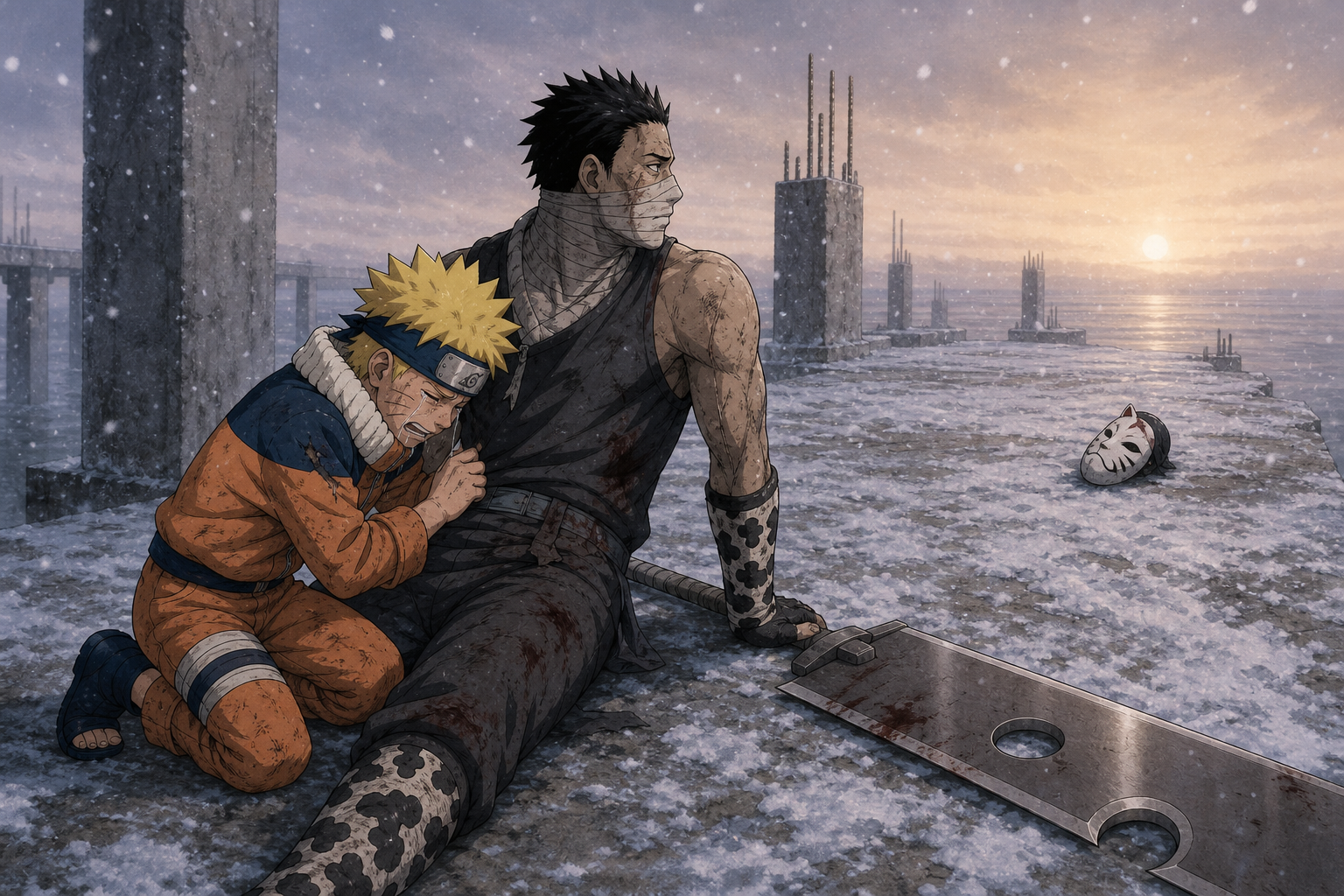
Land of Waves: the mission that taught Naruto what a shinobi costs
A bridge, a lie about a mission rank, two boys trained to become weapons, and the first time Naruto looks directly at the system that made him,and says no.
This is where Naruto stops being merely charming
The first five episodes make a promise: the loud orphan might force his village to see him. Land of Waves asks the harder question. What if being seen by the village only means being assigned a rank, given an order, and spent efficiently?
The mission begins with a joke about chores. Team 7 has chased cats, weeded gardens, and endured Naruto’s complaints about work unworthy of a future Hokage. Then Tazuna walks into the assignment room, insults the children protecting him, and accepts a C-rank escort he knows is a lie. The comedy conceals an institutional failure. A poor country cannot afford the mission it actually needs, so a civilian places children in mortal danger and hopes desperation will be accepted as payment.
Naruto initially treats the trip as proof that adulthood has finally begun. The Demon Brothers correct him within minutes. When their chains tear through Kakashi’s apparent body, Naruto freezes. Sasuke moves. Sakura protects Tazuna. Naruto,the boy whose identity depends upon becoming a ninja,discovers that wanting the title and inhabiting the danger are different things.
His response is the blood oath: a kunai through his own hand, a promise that he will never freeze or run again. It is reckless, theatrical, and psychologically exact. Naruto does not yet know how to forgive fear. He knows only how to punish the body that betrayed his self-image. The arc will slowly teach him a better definition of courage: not never being afraid, but acting with and for other people.
Fourteen episodes, one widening moral circle
The mission is built on a lie
Tazuna hides the danger because Gatō’s economic occupation has made honest protection unaffordable. Kakashi could turn back once the deception is exposed. Instead, Team 7 chooses to continue. That distinction matters: an order becomes an ethical commitment only after the people carrying it understand the risk and consent to it.
The Land of Waves has no shinobi village of its own. Its vulnerability is geopolitical before it becomes personal. Gatō controls shipping, crushes local labor, and makes collective action feel suicidal. The bridge threatens him because infrastructure changes who can move, trade, and imagine a future without his permission.
Zabuza turns combat into atmosphere
Zabuza Momochi does not arrive like the early show’s comic antagonists. Mist enters first. His sword follows. Kakashi’s response,the reveal of the Sharingan,expands the power system while keeping the fight intelligible: deception, observation, copied movement, water clones, and the terror of losing sight of the real body.
When Kakashi is trapped inside the Water Prison, Naruto and Sasuke produce the arc’s first true Team 7 victory. Their shuriken transformation plan works because Naruto’s unpredictability and Sasuke’s precision stop competing. The boys do not become friends in dialogue. They become partners in timing.
Tree climbing makes chakra personal
Kakashi turns recovery into instruction. The tree-climbing exercise explains chakra control without burying us in a lecture: too little energy and the foot slips; too much and the bark breaks. Sakura succeeds first, exposing a strength the earlier episodes have not respected. Naruto and Sasuke transform rivalry into an engine, training past exhaustion because neither will concede the next mark on the trunk.
This quiet stretch also places Naruto beside Haku before he knows Haku is an enemy. Their conversation establishes the arc’s emotional trap. Haku believes strength appears when someone has a precious person to protect. Naruto hears wisdom. Neither understands yet that Haku has converted devotion into permission to erase himself.
Inari’s despair is political, not childish
Inari mocks Naruto’s promises because he has already watched courage get murdered in public. His stepfather Kaiza became the country’s symbol of resistance; Gatō destroyed him precisely because symbols allow isolated people to recognize one another.
Naruto is furious with Inari because he recognizes the same wound wearing the opposite mask. Naruto performs invulnerability to demand attention. Inari performs hopelessness to avoid another loss. Their argument is not optimism versus pessimism. It is two traumatized children debating whether hope is evidence of strength or an invitation to punishment.
The ice mirrors make sacrifice visible
On the bridge, Haku’s Demonic Mirroring Ice Crystals turn speed into imprisonment. Sasuke’s Sharingan begins to awaken under pressure, but his most important action is not ocular. He moves in front of the needles meant for Naruto. The series lets the body confess before the boy can: attachment already exists.
Naruto believes Sasuke has died and the Nine-Tails’ chakra erupts. The power is thrilling, but the scene is not a clean heroic awakening. Grief opens the seal. Violence becomes the language of a child who cannot bear another person disappearing for him. Even after overpowering Haku, Naruto hesitates when Haku calmly requests death. The so-called weapon must ask an enemy to complete his programming.
Haku’s death exposes the lie of the tool
Haku intercepts Kakashi’s Lightning Blade to save Zabuza. Gatō then arrives and discards Zabuza as casually as Zabuza claimed he could discard Haku. The parallel is deliberate: systems that call people tools always reserve the right to throw those tools away.
Naruto’s speech to Zabuza works because it attacks the identity Zabuza has built for survival. If Haku was only equipment, why does his death hurt? Why did his loyalty matter? Why does Zabuza’s voice break? Naruto does not defeat him with superior strength. He makes emotional denial impossible.
Zabuza’s final charge is not redemption in the tidy sense. It cannot undo the lives he took or the childhood he consumed. It is a last refusal to remain Gatō’s object. He asks to be placed beside Haku, and snow falls over a bridge built by people who have finally remembered their collective strength.
The people who make the arc hurt
Naruto Uzumaki
Begins desperate to prove he is a real ninja; leaves determined to define what a ninja should be. His empathy is not softness added after victory. It is the force that changes the meaning of victory.
Sasuke Uchiha
His tactical brilliance matters, but the arc’s revelation is involuntary love. He protects Naruto before pride can invent an excuse.
Sakura Haruno
Her chakra control and steadfast protection of Tazuna establish real field value. The arc also reveals how often the story keeps her at the edge of decisions it allows the boys to make.
Kakashi Hatake
Teacher, strategist, and survivor. He models competence without pretending orders erase moral responsibility.
Haku
A gentle child who mistakes usefulness for belonging. Haku’s tragedy is not that love is false; it is that love has been narrowed until self-erasure feels like its purest proof.
Zabuza Momochi
A killer formed by the Bloody Mist, hiding attachment behind the vocabulary of ownership. Naruto forces his grief into daylight.
Tazuna, Tsunami and Inari
Three generations living inside occupation: compromised resistance, protective endurance, and inherited despair.
Gatō and Kaiza
One rules by making examples; the other becomes an example that survives his death. The bridge carries Kaiza’s unfinished work into public memory.
What Kishimoto is really asking
Can a hidden village call itself community while manufacturing tools?
Naruto’s world gives children citizenship through militarization. The forehead protector offers identity, status, and belonging, but it also marks the body as deployable. Land of Waves makes that bargain visible before the larger series normalizes it. Haku and Zabuza come from the extreme version,the Bloody Mist,but Konoha also sends twelve-year-olds into a situation where one bad mission classification can kill them.
The existential question is not whether Naruto can avoid being used. Every institution uses human effort. The question is whether he can remain an author of meaning inside roles inherited from other people. Haku locates meaning entirely in Zabuza’s need. Zabuza locates meaning in survival and power. Gatō locates value in profit. Naruto’s emerging nindō insists that relationship does not require surrendering personhood.
The bridge is a technology of solidarity
Gatō’s power depends upon controlled movement and private fear. Tazuna’s bridge solves both. It opens trade, but it also gives the country a shared object around which courage can gather. That is why the climax requires the villagers to arrive together. Team 7 can defeat elite fighters; it cannot liberate a population on that population’s behalf.
Naming the completed structure the Great Naruto Bridge is sentimental, but earned. The name does not commemorate the strongest combatant. It commemorates the child whose refusal to accept despair helped other people become visible to one another.
Haku is Naruto’s first dark mirror
Both boys are isolated, feared for an internal power, and rescued from purposelessness by someone who recognizes their usefulness. Iruka gives Naruto recognition without demanding self-annihilation. Zabuza gives Haku purpose inside a hierarchy where being needed and being loved can never be safely distinguished. The difference between their futures is not talent. It is the ethics of the person who finds them.
Easter eggs and structural echoes
The puddle on a dry road announces the Demon Brothers before the attack and rewards viewers who learn to inspect the environment like shinobi. Naruto and Sasuke’s transformed shuriken plan foreshadows the series’ love of victory through misdirection rather than raw power. The tree-climbing exercise establishes the control principle behind later chakra techniques. Sasuke shielding Naruto prefigures the central bond long before either boy can discuss it honestly. Haku’s body intercepting Kakashi repeats that protective movement in a darker relationship, making sacrifice rhyme across enemy lines.
Gatō’s real weapon is control of movement
Gatō does not conquer the Land of Waves with superior chakra. His shipping company dominates the routes people need for trade, work, and contact. He hires force to protect that monopoly and makes public punishment teach civilians that resistance is expensive.
The bridge threatens him before it exists because infrastructure changes bargaining power. Tazuna is not simply building a road over water. He is creating an alternative to private control. That makes carpentry political and explains why Gatō spends on assassination rather than competing with better service. Monopoly does not want a fair race. It wants ownership of the track.
Kaiza’s execution is labor discipline performed as spectacle. Gatō damages the body associated with building and collective courage, then displays the punishment so every worker imagines the same consequence. The target is one man; the audience is the country.
Tazuna’s lie moves the cost down another hierarchy. Gatō impoverishes Waves. Waves cannot afford a B-rank or higher protection request. Tazuna files a C-rank. Konoha assigns genin. The village economy and monopoly economy never meet in a boardroom, so children’s bodies become the negotiation.
Kakashi’s choice to continue is humane, but it is a charitable exception, not reform. One jōnin absorbs the mission gap because the people in front of him need help. The price system that made truthful safety unaffordable remains intact. Naruto’s later influence helps a community act; it does not magically create a regional public-works fund.
This is why the villagers’ arrival matters more than Gatō’s death alone. A monopolist can be removed by another armed group and leave dependency behind. Collective movement toward the bridge proves fear has stopped isolating each household. Liberation needs people recognizing one another as participants, not waiting for foreign ninja to become permanent government.
How the anime turns mist, mirrors, and silence into moral pressure
Under Hayato Date’s series direction, the adaptation uses Land of Waves to prove Naruto can carry sustained danger without abandoning comedy or tenderness. The arc expands the visual world beyond Konoha’s warmth into wet roads, forest shade, water surfaces, coastal fog, and an unfinished bridge exposed to weather.
Zabuza’s first appearance understands suspense as missing information. The suspicious puddle rewards environmental attention. Mist removes distance and turns hearing into survival. Kubikiribōchō announces mass before the man fully explains himself. The fight becomes frightening because viewers understand what Kakashi cannot currently see.
Haku’s mirrors reverse the visual logic. Zabuza hides the attacker inside atmosphere; Haku makes the enclosure visible and the body impossible to track. Reflections produce too many locations, senbon make injury incremental, and the bright ice field becomes more claustrophobic than the fog.
The verified original Japanese cast keeps the central franchise voices while adding Unshō Ishizuka as Zabuza and Mayumi Asano as Haku. Their credits matter because the arc asks adult mercenary denial and adolescent devotion to coexist without making either relationship simple. This file names the performers and the scenes they carry without inventing pitch or timing analysis from a cast list.
Toshio Masuda’s score and the anime’s willingness to hold aftermath give the final material room to change genre. The bridge is no longer only a combat platform. Haku’s body, Zabuza’s injuries, Gatō’s contempt, Naruto’s accusation, and the villagers’ arrival turn it into a public moral stage.
The adaptation also risks romanticizing death through beauty, especially the final snow. The image can honor grief while making two violent, preventable deaths feel fated and pure. The better reading keeps the beauty and the accountability: Haku was fifteen, Zabuza controlled the terms of belonging, and a late admission is not retroactive freedom.
The arc ends, but nobody returns to the earlier definition of ninja
Naruto leaves with a nindō shaped by Haku. He wants strength to protect precious people, but he also rejects a system that defines protection as becoming disposable. That distinction follows every later attempt to save an enemy, a friend, or a tailed beast.
Sasuke’s body has already chosen Naruto before his conscious identity catches up. Stepping into Haku’s senbon becomes the relationship receipt later arcs cannot erase. The boys’ rivalry now contains sacrifice, not just classroom resentment.
Sakura proves chakra control and mission steadiness while being positioned mainly beside Tazuna during the decisive fight. That is both a character strength and a writing limit. The arc establishes her technical promise without giving her equal access to the moral confrontation that defines her team.
Kakashi sees his teamwork lesson operate under lethal pressure. Naruto and Sasuke coordinate, Sakura protects the client, and the team refuses to abandon one another. He also watches children encounter violence far beyond their filed mission, a reminder that good mentorship cannot repair every institutional failure after deployment.
Inari’s shift matters because Naruto does not defeat fear for him. Naruto’s example makes action imaginable; Inari gathers people and acts. Kaiza’s courage stops being only a traumatic memory and becomes a lineage the child can revise rather than worship.
For Zabuza, the final charge is consequence, not absolution. He acknowledges Haku too late to offer him a different life. Killing Gatō answers immediate exploitation while leaving the years of control intact. His tears matter because denial ends. They do not issue a refund for Haku’s childhood.
The bridge becomes public memory. Naming it after Naruto honors catalytic hope, but its concrete also contains Tazuna’s labor, Tsunami’s household care, Inari’s organizing, Kaiza’s example, and villagers who finally arrive. Naruto is the name on the structure. Waves built it.
Land of Waves episode route
Episodes 6-9 · the mission breaks open
The lie, the Demon Brothers, Zabuza, Kakashi’s Sharingan, and Naruto and Sasuke’s first coordinated rescue.
Episodes 10-12 · training and inheritance
Chakra control, Haku’s philosophy, Inari and Kaiza, then the return to the bridge.
Episodes 13-16 · inside the mirrors
Haku’s kekkei genkai, Sasuke’s awakening, sacrifice, and the Nine-Tails’ rage.
Episodes 17-19 · people, not weapons
Haku’s past, the meaning of the shinobi tool, Zabuza’s tears, and a bridge given a name.
Browse the complete 220-episode directory · Watch Naruto officially on Crunchyroll
Why this arc still carries the franchise
Land of Waves does not need a tournament bracket, a legendary bloodline, or a village-sized explosion to prove Naruto can hit hard. It needs one exploited country, two boys trained to call themselves tools, and a newly formed team discovering that mission language can hide a human emergency. The scale is smaller than what comes later. The moral pressure is not.
This is also where Naruto earns the right to keep arguing with the shinobi world. He does not defeat Zabuza’s ideology through superior theory. He breaks down because Haku mattered, says the quiet part out loud, and forces an adult killer to admit that the “tool” was a person he loved. The speech works because the arc has already shown Naruto learning the same lesson through Sasuke. Bonds create vulnerability, but pretending not to care creates monsters.
That is why this guide treats the bridge as more than scenery and Haku as more than an early tragic villain. The completed bridge carries Kaiza’s interrupted resistance, Tazuna’s shame, Inari’s recovered courage, and the name of the child who refused to let the country stay numb. Naruto leaves stronger, yes. More importantly, he leaves with a definition of strength that the village did not teach him.
Source shelf and adaptation boundary
Arc range and event checks use the official Naruto 20th Anniversary retrospective, the official Naruto birthday column, the official Volume 4 synopsis, and official episode pages across the Land of Waves run. Staff and original Japanese cast credits use the official Naruto anime page. Episode availability is linked through Crunchyroll. Analysis and judgment are original to CVM Sekai.
The manga and anime differ in pacing, staging, and some violence. This file labels the anime episode route and does not treat beauty in the adaptation as proof of moral redemption. Character links point only to live canonical profiles.
Land of Waves ends. Naruto’s argument does not.
The Chūnin Exams take the question of children inside military systems and scale it across villages, clans, bloodlines, and spectators.
Continue with Episode 20 → · Return to the Naruto arc directory →