
Zabuza Momochi
The demon did not lack a heart. He trained himself to treat one like a liability.
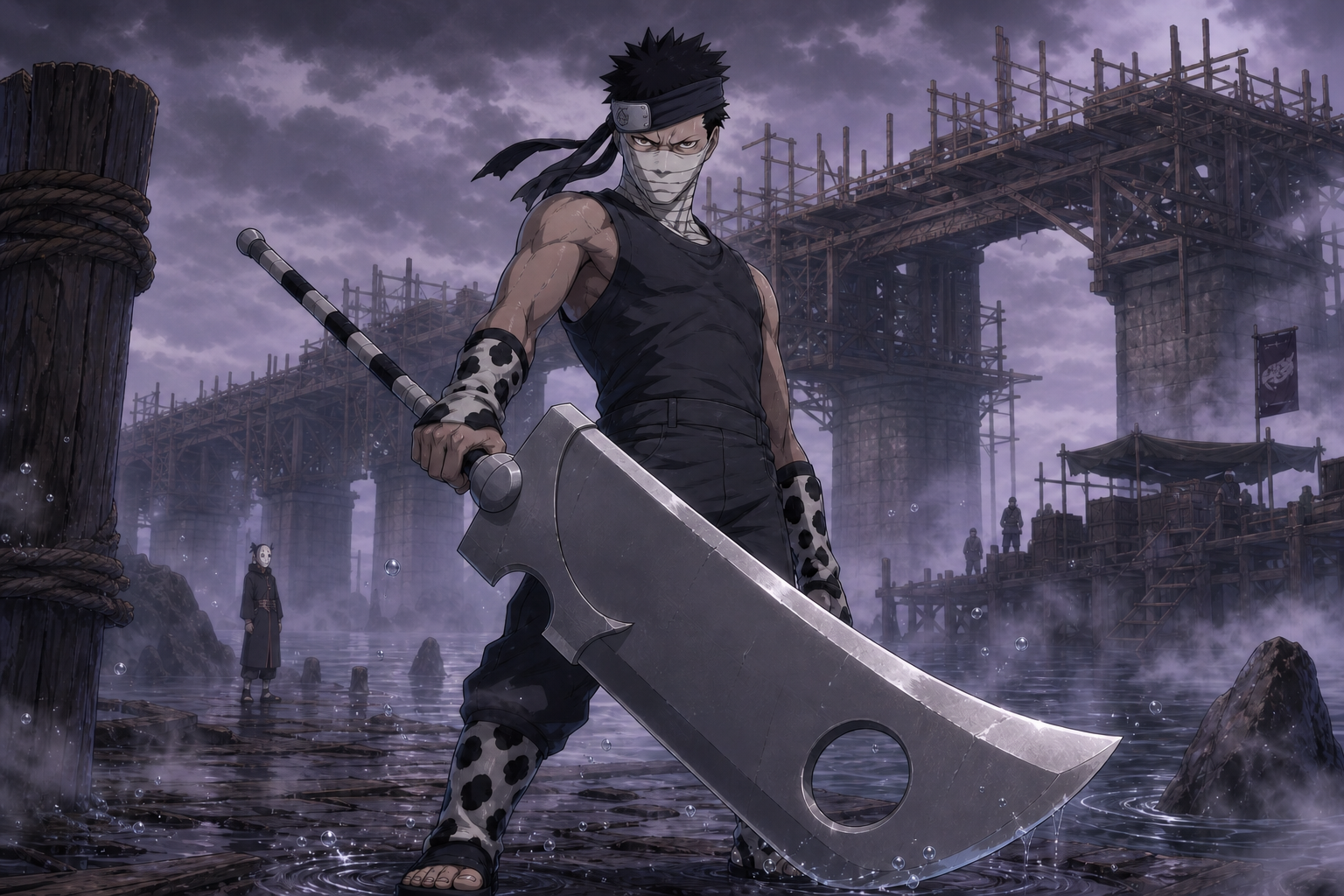
Zabuza Momochi enters Naruto looking like every warning adults give children about the real world. His face is wrapped. His sword is bigger than a responsible housing decision. Mist swallows the battlefield before his voice reaches Team 7. Kakashi, who has spent the whole mission managing three new genin and one lying bridge builder, suddenly stops playing teacher. That change tells us everything. Zabuza is not a classroom problem. He is what happens when a shinobi village turns childhood violence into job training, then sells the finished product to whoever can afford him.
That bottom line matters because Zabuza’s final tears are often treated like a surprise redemption coupon. Nada, babes. Naruto does not uncover a secretly harmless foster father hiding beneath the bandages. Zabuza trained Haku, protected Haku, depended on Haku, controlled Haku, used Haku, and loved Haku in the damaged language he allowed himself to speak. Every part of that sentence has to stay. Remove the exploitation and the profile romanticizes a brutal power imbalance. Remove the attachment and the bridge scene loses the contradiction Naruto forces Zabuza to admit.
Zabuza is the first major villain who teaches Naruto that the shinobi world can make decent human feeling look professionally embarrassing. He also teaches the audience something nastier: a person can recognize that a system is rotten, rebel against that system, and still carry its rules into every relationship afterward. The Blood Mist did not need Zabuza to remain inside Kirigakure. He carried the village with him.
Databook record, with the contradictions left visible
The first character-databook record credits Zabuza with 191 official missions: 4 D-rank, 67 C-rank, 79 B-rank, 29 A-rank, and 12 S-rank. The distribution matters more than the giant total. Most of his listed career sits in C- and B-rank work, but forty-one A- and S-rank missions establish repeated high-risk service before exile. His professional history did not begin with Gatō.
The same databook tradition gives his eight-category stat line as ninjutsu 4.5, taijutsu 4.5, genjutsu 2.5, intelligence 3, strength 4, speed 4, stamina 4, and hand seals 4, for 30.5 points out of a possible 40. Those values describe a broad physical and ninjutsu specialist rather than a one-trick swordsman. Genjutsu sits lowest, while assassination craft lets him create fear through terrain and killing intent without relying on illusion techniques.
Databook trivia lists sharpening edged tools as his hobby, fresh vegetables as his least favorite food, “control” or “domination” (支配, shihai) as his favorite word, and the Five Kage as opponents he wanted to fight. Those details fit the page, almost suspiciously well. Still, they belong in a labeled databook box rather than being treated like dialogue he spoke in the manga.
The age record contains a real continuity wrinkle. Zabuza is listed as twenty-six, and the Academy massacre is associated with age nine. Kakashi describes the massacre as occurring ten years before Team 7’s mission. All three claims cannot produce one neat calendar. Record the conflict honestly. Do not “fix” Kishimoto with fan arithmetic.
Name and epithet, without fake Japanese certainty
Zabuza is written 再不斬. The individual characters can be read through ideas such as “again,” negation, and “cut” or “behead,” and official/fan reference traditions commonly gloss the name as “never cut twice.” That phrase suits an executioner who expects one decisive stroke. A kanji breakdown is not the same as a normal dictionary phrase, so “never cut twice” works as name wordplay rather than the only possible translation.
Momochi is written 桃地, combining “peach” and “earth” or “ground.” The produce reference matches the naming pattern associated with several Mist swordsmen. The surname may also echo the historical ninja name Momochi Sandayū, written with different characters. “May” matters. Kishimoto’s confirmed naming process outweighs a clever fan etymology.
The epithet Kirigakure no Kijin (霧隠れの鬼人) is usually rendered “Demon of the Hidden Mist.” Kijin can carry demon, fierce spirit, or superhuman-monster force depending on context. The story uses the name as reputation, intimidation, and institutional branding. Zabuza performs the demon because enemies who fear a monster become easier to control.
What the Blood Mist confirmed, and what fandom sometimes invents
Kirigakure once used a graduation system that forced Academy candidates to fight one another to the death. The practice tried to destroy emotional hesitation before young shinobi entered official service. Zabuza became infamous after killing more than one hundred candidates while not yet an Academy student himself. The massacre ended the exam and gave him the name Demon of the Hidden Mist.
That record needs careful language. “Zabuza killed his classmates” is catchy, common, and too loose. Available character references describe him as not yet enrolled when he entered the test and killed the candidates. He did not simply win the assignment given to his own graduating class. He invaded an already murderous system and pushed its logic so far that Kirigakure finally changed the rule.
The institution still owns part of the blame. A village cannot build a child death match, reward extreme violence, and then pretend one violent child arrived from another moral universe. Zabuza made choices. The Academy created the stage, the incentives, and the definition of success. He became the nightmare version of the graduate that system claimed to want.
Later canon complicates the phrase “Blood Mist” through the Fourth Mizukage, Yagura, Obito’s control, older village practices, and incomplete political records. The safe conclusion is institutional, not conspiratorial. Kirigakure had violent traditions before every later manipulation was revealed. Yagura’s reign deepened the village’s terror. Zabuza opposed that rule and attempted a coup against the Mizukage. The manga and checked official anime summaries do not give us a complete meeting transcript, participant list, reform platform, or proof that Zabuza understood every hidden hand behind Yagura.
That uncertainty does not weaken the analysis. Zabuza knew enough to oppose the Mizukage and organize an overthrow attempt. The coup failed, and he fled. Some databook-derived summaries add betrayal by one follower. The Shikamaru Hiden continuity later uses Gengo, a former follower, to describe Zabuza as charismatic and committed to a society ruled by shinobi. Those additions illuminate his ambition within their named sources. The original Land of Waves manga does not hand readers Zabuza’s constitution, participant list, or full political platform.
ANBU, Seven Swordsmen, missing-nin
Databook-derived character summaries place Zabuza in Kirigakure’s ANBU and then among the Seven Ninja Swordsmen of the Mist. The checked manga chapters establish his Swordsman identity but do not date every promotion. The ANBU sequence therefore remains a databook-derived record rather than a fully dated manga timeline. Silent killing, anatomical knowledge, patience inside obscured terrain, and a willingness to strike before an opponent understands the battlefield fit assassination work, but skill fit is not independent proof of personnel history.
Membership among the Seven Swordsmen gave him Kubikiribōchō and linked him to one of Kirigakure’s most feared martial institutions. That title carries prestige, but prestige in the Mist is rarely clean. The group turns unusual blades and unusual people into national weapons. Zabuza’s fame grows because he performs that role extremely well.
After the coup fails, he becomes a missing-nin. Exile changes the customer, not the profession. The village once pointed him at enemies for state reasons. Gatō points him at Tazuna for private profit. Zabuza still kills through contracts, subordinate labor, intelligence, and fear. The difference is that no village seal launders the transaction into public duty.
This is where Naruto gets brutally adult before its protagonist is old enough to shave. Public violence and private violence share workers. When the institution discards trained killers, men with money purchase the leftover expertise. Gatō does not need ninjutsu. He needs enough capital to rent someone else’s.
Personality and ideology: control is the point
Zabuza presents as aggressive, proud, pragmatic, cynical, and emotionally withholding. He enjoys control because control promises safety in a career built around betrayal. He studies an opponent, chooses terrain, delegates risk, and treats hesitation as a defect. His databook favorite word, shihai, meaning control or domination, does not reveal a hidden personality so much as underline the one already visible.
Ambition complicates the hired-killer label. He does not leave Kirigakure because he wants a peaceful civilian life. He challenges the Mizukage, survives the failed coup, and seeks money for future power. The Land of Waves manga shows a mercenary willing to use Gatō while expecting betrayal. Later novel continuity gives former follower Gengo a more explicit ideology of shinobi rule. That material supports the idea that Zabuza wanted power for warriors, but the source must stay attached. Opposition to Yagura does not automatically make his alternative humane.
His coldness is partly genuine behavior and partly discipline. He threatens children, attacks through Haku’s body, and plans murder. Those are choices, not misunderstood facial expressions. He also trusts Haku, adjusts plans around him, reacts to insults against him, and finally admits grief. The contradiction makes Zabuza a character. A secret-softie rewrite would make him a greeting card with a sword.
Design: Zabuza performs the monster before he speaks
Zabuza’s design gives the audience a silhouette before a biography. He is tall and muscular, with short spiky black hair, narrow eyes, small eyebrows, and bandages covering the lower half of his face. His Kirigakure forehead protector sits at an angle rather than politely centered. Baggy striped trousers, patterned guards, open sandals, and a mostly bare or sleeveless upper body make him look built for movement rather than ceremony.
The bandages do several jobs. They hide expression. They make his voice feel detached from an ordinary human mouth. They also stage the eventual reveal of sharp teeth and grief. Zabuza spends most of his story visually controlling access to his humanity. Kishimoto does not suddenly give him a heart on the bridge. The design lets the audience see how hard he worked to cover one.
Kubikiribōchō completes the argument. The blade is absurdly large, but the shape remains practical enough to feel nasty rather than royal. A circular opening near the tip and a notch near the base reinforce the decapitation theme. Zabuza carries no elegant heirloom associated with moral nobility. He carries a cleaver built to make bodies into proof of use.
Design variants carry different source labels. Childhood material shows a smaller sleeveless outfit and the oni character on his back. Service-era flashbacks add Kirigakure protective gear and ANBU-associated clothing in adaptation/reference material. His first Land of Waves look leaves much of the upper body exposed beneath the harness that supports the sword. The second bridge confrontation uses a sleeveless black shirt and waist protection closer to the shared clothing of his Swordsman generation. Reanimation changes his eyes and skin to the cracked, dulled Edo Tensei appearance while restoring the blade and much of the familiar combat silhouette. Studio Pierrot model-sheet scale can differ from the databook’s 183 centimeters and does not replace the published in-world vital.
Kubikiribōchō: the sword repairs itself because other bodies do not
Kubikiribōchō is one of the Seven Swordsmen’s legendary weapons. Later manga material explains that the blade repairs damage by drawing iron from the blood of people cut down in battle. The reveal comes during the war-era return. Part I never pauses to explain that metallurgy.
The weapon passes through multiple hands, with each handoff tied to a source. The fourth databook identifies Jūzō Biwa as an earlier wielder. The manga establishes Zabuza as the owner during Land of Waves and shows his burial with Haku. Suigetsu later retrieves the blade from Zabuza’s grave. Killer B damages the weapon during the Taka battle, and the remaining section is lost during the Five Kage Summit conflict. During the war, Kabuto’s side provides the broken blade to the reanimated Zabuza. Volume 55 then reveals the blood-iron repair property as the weapon reforms through battlefield use. Anime-only custody involving another thief stays in the adaptation record rather than blending into the manga chain.
The symbolism almost writes itself, which means we still need to behave. The sword survives by consuming what bodies lose. The shinobi system works the same way. Villages, employers, and commanders remain standing because replaceable people absorb the damage. Zabuza thinks carrying the blade makes him the wielder. His biography suggests that he also became another material the system used to keep itself whole.
Haku: child, tool, companion, and moral mirror
Haku begins in a small Land of Water village after war has made bloodline abilities objects of fear. His mother hides her Ice Release heritage. When young Haku reveals the same power, his father kills Haku’s mother and leads an attack against the child. Haku’s power erupts in lethal self-defense, killing his father and the attacking group. The child survives, but survival leaves him orphaned, homeless, traumatized, and convinced that nobody needs him.
Zabuza finds Haku on the street and recognizes both the Ice Release bloodline and the child’s desperation for purpose. He offers Haku a place beside him on explicitly instrumental terms. The age and power imbalance could not be clearer: an adult missing-nin recruits a bereaved child who has no stable home, no protection, and no competing model of belonging. Zabuza trains him into an unusually capable hunter, medic-like caretaker, tracker, strategist, and combat partner. Haku then builds his identity around serving Zabuza.
Calling that relationship “chosen family” without qualification is fandom comfort food. Calling the bond fake is also wrong. Haku has agency, makes tactical decisions, limits killing when possible, and chooses to protect Zabuza. Those choices grow inside trauma, dependence, recruitment by an adult, and a severe power imbalance. He is a child taught that personal worth comes from functioning as another person’s weapon. His devotion is sincere. The conditions that shape that devotion remain exploitative.
Zabuza repeatedly calls Haku a tool. He also trusts Haku with recovery, strategy, protection, and survival. Haku understands his moods, hides his injuries, arranges the false death, and risks everything to keep him alive. Their partnership contains discipline, intimacy, fear, care, and control. Those elements do not cancel each other like clean numbers in a spreadsheet.
The bridge exposes the ugliest version of the relationship. Haku uses his body to intercept Kakashi’s Lightning Blade. Zabuza continues his attack through Haku’s corpse because the mission and the tool doctrine still command his movements. That moment should block every attempt to rewrite him as secretly gentle. Attachment exists, and he still behaves terribly.
Naruto’s speech works because Naruto refuses Zabuza’s language. Haku cried for him. Haku lived for him. Haku died for him. Zabuza can say “tool” until the bandages unravel, but his own reaction proves the word has become a lie. Naruto does not insert love into Zabuza. He names the love Zabuza has treated like professional weakness.
Demon Brothers, Gatō, and the subcontracting chain
Gōzu and Meizu attack first. The Demon Brothers operate as subordinate killers in the Tazuna contract and fail against Team 7. Zabuza then enters as the higher-grade solution. That structure shows a labor chain: Gatō finances the violence, Zabuza manages the mission, the Demon Brothers take the early field risk, and Haku becomes Zabuza’s most valuable human asset.
Gatō believes payment gives him authority without obligation. Once Zabuza and Haku are weakened, he arrives with hired men, cancels the arrangement through betrayal, and expects the contractors to absorb the loss. He has no loyalty because the contract was never reciprocal. Everybody beneath him is a cost line.
Zabuza recognizes the insult immediately, but the parallel should make readers uncomfortable. Gatō calls Zabuza disposable. Zabuza calls Haku a tool. Zabuza despises the employer who treats him the way he has trained himself to treat the child beside him.
That does not make the two men morally identical. Zabuza forms a real bond and finally acts on grief. Gatō sees only control and profit. The echo still matters because exploitation rarely travels in one direction. People harmed by a hierarchy can repeat its logic downward while correctly condemning the cruelty above them.
Team 7’s first encounter with adult shinobi violence
Zabuza changes the scale of Naruto. Mizuki threatens Naruto personally. Gōzu and Meizu prove that missions can hide lethal information. Zabuza shows what an experienced professional can do to an entire field.
Hiding in Mist removes sight and turns fear into terrain. Silent Killing makes every direction feel unsafe. Kakashi explains the vulnerable points Zabuza can target while Sakura guards Tazuna and the boys realize that Academy confidence means very little outside a controlled exercise.
Zabuza traps Kakashi in Water Prison, maintains a water clone, and shifts attention toward the genin. The technique has a limit because his real body must remain close and keep one hand committed. Naruto and Sasuke exploit that limit with the transformed shuriken plan. Their victory is not greater raw power. They create one opening through coordination.
Kakashi then copies and answers Zabuza’s Water Release, including the Water Dragon and Great Waterfall exchange. Haku intervenes in the role of a hunter-nin, strikes Zabuza with senbon, and removes the apparently dead body. Kakashi later identifies the trick: a real hunter-nin would normally dispose of a missing-nin corpse and its secrets rather than carry the body away intact.
That whole sequence establishes Zabuza’s intelligence and his limits. He can pressure Kakashi, control inexperienced genin, and build layered deception. Kakashi can still read him, copy him, and exploit his emotional and tactical openings. Zabuza is elite without becoming invincible. Later power scaling does not retroactively make the encounter small.
Kakashi is the professional mirror
Kakashi and Zabuza both enter the bridge with younger people whose bodies can support the mission. The difference lies in responsibility. Kakashi initially misreads the danger because Tazuna hides the truth, but he repeatedly tries to protect his students and gives them roles within their capacity. Zabuza develops Haku into a terrifying fighter while encouraging the belief that death for him would prove Haku’s value.
Neither relationship is free of shinobi violence. Kakashi brings children onto a mission that becomes lethal. The series knows that contradiction and keeps returning to the age of its soldiers. Still, Kakashi treats Team 7 as people he must train and preserve. Zabuza treats Haku’s personhood as something both of them should suppress.
During the war, Kakashi’s judgment becomes explicit. He remembers their tears and their manner of death. He tells the reanimated pair that Naruto’s first adversaries showed the bond between them. That statement does not declare Zabuza innocent. Kakashi recognizes that their tragedy taught Naruto what the shinobi system costs.
The final charge: grief arrives after repair is impossible
Naruto’s accusation breaks Zabuza’s performance of indifference. The tears matter because Zabuza has spent the arc treating emotion as evidence against his own identity. Once Gatō mocks Haku’s body, Zabuza rejects the contract and attacks.
His arms are disabled. He takes a kunai in his mouth and moves through Gatō’s hired men anyway. The sequence makes grief physical. Zabuza cannot heal Haku, apologize in time, or build a healthier relationship. He can only direct his remaining body toward the man degrading Haku’s death.
The manga and anime stage Gatō’s death differently. In the manga, Zabuza decapitates him. The television anime replaces that image with repeated stabbing and a fall from the bridge. Both versions preserve the decision and result: Zabuza reaches Gatō, kills him, receives fatal wounds, and asks to be placed beside Haku. The adaptation softens one graphic method without softening the bodily cost of the charge.
That request is an admission, not absolution. He recognizes the relationship when recognition can no longer protect the child. The tragedy earns emotion because consequence remains. Nobody hands Haku his childhood back. Nobody lets Zabuza practice honesty on a safer day.
Masculinity: crying does not make him weak, silence made him late
Fandom sometimes talks about Zabuza’s tears as the moment a hard man becomes soft. The better reading is that hard masculinity has failed him. He performs command, emotional distance, physical dominance, and professional control. Those habits help him survive. They also prevent him from naming obligation before Haku dies.
His final violence does not prove that rage is the purest form of love. The charge proves that grief can overpower the identity built to contain grief. Zabuza becomes most physically determined when his emotional denial collapses. Tears and strength are not opposites. The story makes the refusal of feeling look weak because refusal leaves him unable to act honestly until no good option remains.
Confucian reciprocity and Buddhist attachment
A Confucian lens helps explain why Gatō’s authority feels illegitimate. Hierarchy creates duties in both directions. A leader who demands service while offering no loyalty, care, or moral example has rank without worth. Gatō pays for bodies and believes payment ends responsibility. Zabuza commands Haku and accepts devotion, but he withholds open recognition of the reciprocal bond. Both hierarchies rot where obligation only travels downward.
A Buddhist lens helps with Zabuza’s denial. He acts as though refusing to name attachment can free him from suffering. The bridge proves the opposite. Attachment continues whether he confesses or not. Clinging to the Demon identity does not eliminate grief. The identity delays honest response until suffering has become irreversible.
Neither lens should become decorative incense floating above the plot. The evidence sits in specific actions: Haku shields him, Zabuza attacks through Haku, Naruto names the bond, Gatō violates the body, Zabuza cries, and the dying man asks for closeness. Philosophy earns space because the story already stages duty, attachment, denial, and consequence.
Death still does not free his body
Kabuto reanimates Zabuza and Haku during the Fourth Shinobi World War. The return is not a cute reunion tour. Their bodies become military equipment again, controlled by someone who values their techniques.
Zabuza warns the Allied Shinobi Forces before control tightens. Haku fights beside him. Other reanimated Seven Swordsmen join the battle, and Kubikiribōchō returns to Zabuza’s hands. Mist covers the field. Haku again shields Zabuza from Kakashi, repeating the Land of Waves composition under even less personal freedom.
Kakashi’s division counters the formation through teamwork, shadow techniques, mind transfer, and sealing. Zabuza and Haku are defeated and sealed. The echo matters because resurrection does not offer them repair. War reuses their most painful pattern. The body shield happens again because a new controller conscripts the bond.
That is one of the series’ ugliest institutional consequences. Kirigakure used Zabuza while he lived. Gatō rented him after exile. Kabuto uses his corpse. The shinobi world keeps finding paperwork for ownership.
Abilities, without later-series nonsense
Zabuza specializes in assassination and Water Release. Hiding in Mist blocks conventional sight and supports Silent Killing. Water Clone creates field pressure. Water Prison can immobilize a strong opponent but commits the user’s hand and position. Water Dragon and Great Waterfall demonstrate large-scale elemental control. His sword skill, physical strength, speed, endurance, and anatomical knowledge make close range dangerous.
Hiding in Mist Technique: Zabuza produces dense mist that reduces ordinary visibility across a wide area and turns the battlefield into hunting space. The Land of Waves encounters occur beside abundant water, so those scenes do not prove that he can create the same field under every dry condition. The mist does not make him intangible or automatically hide sound, scent, chakra, or every possible sensory signal. Sensor types, coordinated counters, dispersed terrain effects, and attacks that force movement can reduce the advantage.
Silent Killing: This is a practiced assassination method rather than a magic instant-death button. Zabuza moves and listens inside obscured terrain, tracks breathing and sound, and targets vital areas before the victim can orient. Kakashi’s knowledge, Sharingan, clones, and team communication keep the technique from becoming absolute.
Water Clone Technique: A clone formed from water can move and attack away from the original, but carries only a fraction of the user’s power and collapses when sufficiently struck. Zabuza uses one while maintaining Water Prison, which lets him threaten Team 7 without releasing Kakashi. The split attention also creates the exact coordination problem Naruto and Sasuke exploit.
Water Prison Technique: A sphere of water immobilizes Kakashi while Zabuza maintains physical contact with the prison. The restraint is powerful, yet the technique anchors the original user and commits a hand. Zabuza solves that drawback with a water clone. Team 7 solves his solution by forcing the original body to move.
Water Release: Water Dragon Bullet Technique: Zabuza forms a large dragon-shaped mass of water and sends the attack toward a target. The early manga uses a famously long seal sequence, while anime timing and later franchise portrayals can compress the process. The dragon shape belongs to the technique, but the approved profile art wisely uses restrained water atmosphere rather than turning his character portrait into a fantasy-creature poster.
Water Release: Great Waterfall Technique: A large rotating surge of water strikes and carries the opponent with destructive force. Kakashi copies and answers the technique in their first battle. Scale depends on available water, chakra, staging, and medium; one impressive shoreline attack does not mean Zabuza can flood every battlefield without cost.
Swordsmanship and physical combat: Kubikiribōchō extends his reach and converts strength into sweeping pressure. The size creates visual terror but also demands space and commitment. Zabuza can throw, recover, and wield the blade in close quarters. After Kakashi disables his arms, he changes methods and carries a kunai in his mouth, showing adaptation and endurance rather than a secret new power.
Adaptation and game boundary: The anime visualizes his killing intent with oni-like imagery and expands the timing and motion of techniques already present in the manga. Licensed fighting games build longer sword combinations and special attacks for playable balance. Those commands belong to the specific game move set, not the manga ability list.
He also thinks tactically. He tests Kakashi, recognizes the Sharingan, uses deception with Haku, and adjusts after the first defeat. His presence forces Naruto and Sasuke to cooperate beyond Academy patterns.
Limits belong in the profile. Kakashi defeats and outreads him. Maintaining techniques creates openings. Emotional denial distorts his decisions around Haku. He has no answer for every bloodline or later divine-scale ability. None of those limits make him a fraud. Zabuza is a high-level human shinobi whose threat comes from training, terrain, killing experience, and willingness.
Original Japanese performance credit
Unshō Ishizuka performs Zabuza in the original Japanese anime across the Land of Waves and the war return. His credit is verified. I am not inventing pitch, breath, or timing analysis without the heard Japanese scenes; a cast list is better than fake criticism. The performance carries Zabuza through the first mist confrontation, his exchanges with Haku after the staged death, Naruto’s accusation on the bridge, the charge at Gatō, the dying request, and his reanimation. Those scenes explain where the voice belongs without pretending memory is audio evidence.
Manga, anime, novel, OVA, and game boundaries
Zabuza’s central canon story appears in the manga’s Land of Waves arc and his war reanimation. The original anime adapts the early mission with direction, timing, music, mist, and some staging differences that require episode-level labeling. Naruto: Shippūden adapts the war return and expands motion, sound, and performance around the repeated Haku shield.
Naruto: Innocent Heart, Demonic Blood retells early material in novel form. The profile should not sell that adaptation as a separate lost Zabuza campaign. Shikamaru Hiden later uses Gengo’s memory of Zabuza, which expands the political reputation without making Zabuza an active participant in that novel’s present-day plot.
The OVA Hidden Leaf Village Grand Sports Festival! includes Zabuza in a comic side-media context. Naruto: Shippūden also uses brief visual cameos, including a lantern image and a later crowd shot identified in episode records. These belong in a cameo line, not the central chronology.
The verified game record is broad. Zabuza is playable in the original Naruto: Clash of Ninja and Clash of Ninja 2, the first three Naruto: Ultimate Ninja games, Naruto: Rise of a Ninja, Naruto: The Broken Bond, Naruto Shippūden: Ultimate Ninja 4 and 5, and multiple later Storm titles. Ultimate Ninja Storm Generations gives Zabuza and Haku a two-cutscene tale narrated by Kakashi. Zabuza remains playable in Ultimate Ninja Storm 3, Revolution, Storm 4, and Ultimate Ninja Storm Connections. Mobile and online rosters also include him, but a representative profile does not need to dump every discontinued service name onto readers.
Games adapt battles, create playable move sets, and sometimes arrange original matchups. Those additions prove licensed franchise presence, not manga canon. The checked character record lists anime, manga, game, novel adaptation, and OVA presence but no substantive feature-film role. Therefore, the film boundary is simple: no verified movie storyline belongs in this biography.
Fandom arguments that miss the actual story
“Zabuza was secretly a good dad.”
No. He was a damaged adult who formed a real attachment to a child he also trained to erase himself. The care matters. The exploitation matters. Haku deserves a reading large enough to hold both.
“Naruto redeemed Zabuza with one speech.”
Naruto exposed a lie. Zabuza then made one final choice under irreversible conditions. That choice reveals humanity and carries consequence. Redemption language becomes cheap when the person harmed cannot benefit.
“Haku chose everything, so the relationship was not exploitative.”
Agency does not erase context. A traumatized orphan can choose devotion while lacking safe alternatives and while believing usefulness is the price of belonging.
“Zabuza became weak when he cried.”
His grief fuels the final charge after his arms fail. Emotional admission does not reduce his strength. Denial delayed his moral action.
“Later villains make him fodder.”
Power scaling is not literary analysis. Zabuza controls terrain, threatens Kakashi, forces Team 7’s first true field coordination, and establishes the moral question that follows Naruto across the franchise.
“The Blood Mist made him, so none of his choices are his fault.”
Institutional responsibility and personal responsibility can coexist. Kirigakure trained brutality. Adult Zabuza still chose control, tool language, mercenary violence, and delayed honesty.
Why Zabuza still matters
Zabuza dies early, but Naruto never outgrows him. Later arcs add clans, conspiracies, tailed beasts, gods, reincarnation, and enough eye upgrades to make an optometrist file for workers’ compensation. The first major moral wound stays simple. What happens when a system teaches people that bonds are weaknesses and bodies are tools?
Zabuza answers badly for most of his life. He rebels against one violent institution, enters another market, and reproduces the same logic with Haku. At the bridge, Naruto makes him hear his own contradiction. Zabuza finally acts like Haku was a person, but action comes too late to protect the person who needed that truth.
That is why the tears, the loosened bandages, the ruined bridge battlefield, and the request to lie beside Haku still hit. The scene does not prove every monster hides a saint. The scene proves dehumanization requires work. Zabuza had to keep calling Haku a tool because admitting love would expose every duty he had failed.
He was the Demon of the Hidden Mist. He was also a twenty-six-year-old product of a village that taught children to murder for graduation, an exile who sold the only labor he had been trained to perform, and a man who discovered that emotional armor cannot stop grief from entering through the seams.
Naruto remembers him because Zabuza’s last honest moment becomes the boy’s first serious lesson about the shinobi world. Readers remember him because the lesson never becomes comfortable: love can be real inside a harmful relationship, rebellion can carry the habits of the system being opposed, and a human admission does not erase the cost of waiting.
Sources and canon boundary
Manga chronology controls this profile. Anime staging, databook material, games, and later franchise appearances are labeled instead of being blended into one false continuity.
Primary franchise references: Naruto Official and VIZ Media Naruto. CVM Sekai’s conclusions about the Blood Mist, mercenary labor, Haku, and institutional violence are editorial analysis, not invented creator quotations.