
Memory, Sorrow, and Thorn · Canonical Character Profile
Tiamak
The smallest man in almost every room becomes one of the saga’s largest intellectual anchors. Tiamak is a Wrannaman healer, field naturalist, reluctant diplomat, crocodile survivor, ghant translator, Scrollbearer, and the person who keeps noticing that the visible war may be somebody else’s distraction.
At a Glance
The scholar drylanders kept treating like a footnote
- People
- Wrannaman; youngest and smallest of Tugumak’s six children
- Calling
- Healer, naturalist, scribe, translator, diplomat, and Scrollbearer
- Major work
- Sovran Remedies of the Wranna Healers, completed after the war
- Core expertise
- Wran ecology, medicinal knowledge, animal behavior, languages, Nisses’s text, and Three Swords evidence
- Defining companions
- Isgrimnur, Miriamele, Camaris, Cadrach, Strangyeard, and the dead mentors whose work he inherits
- End-of-series status
- Alive; returned to the rebuilt Hayholt after completing his book
The Visual Receipt
Small, thin, brown, and more durable than anybody’s hierarchy
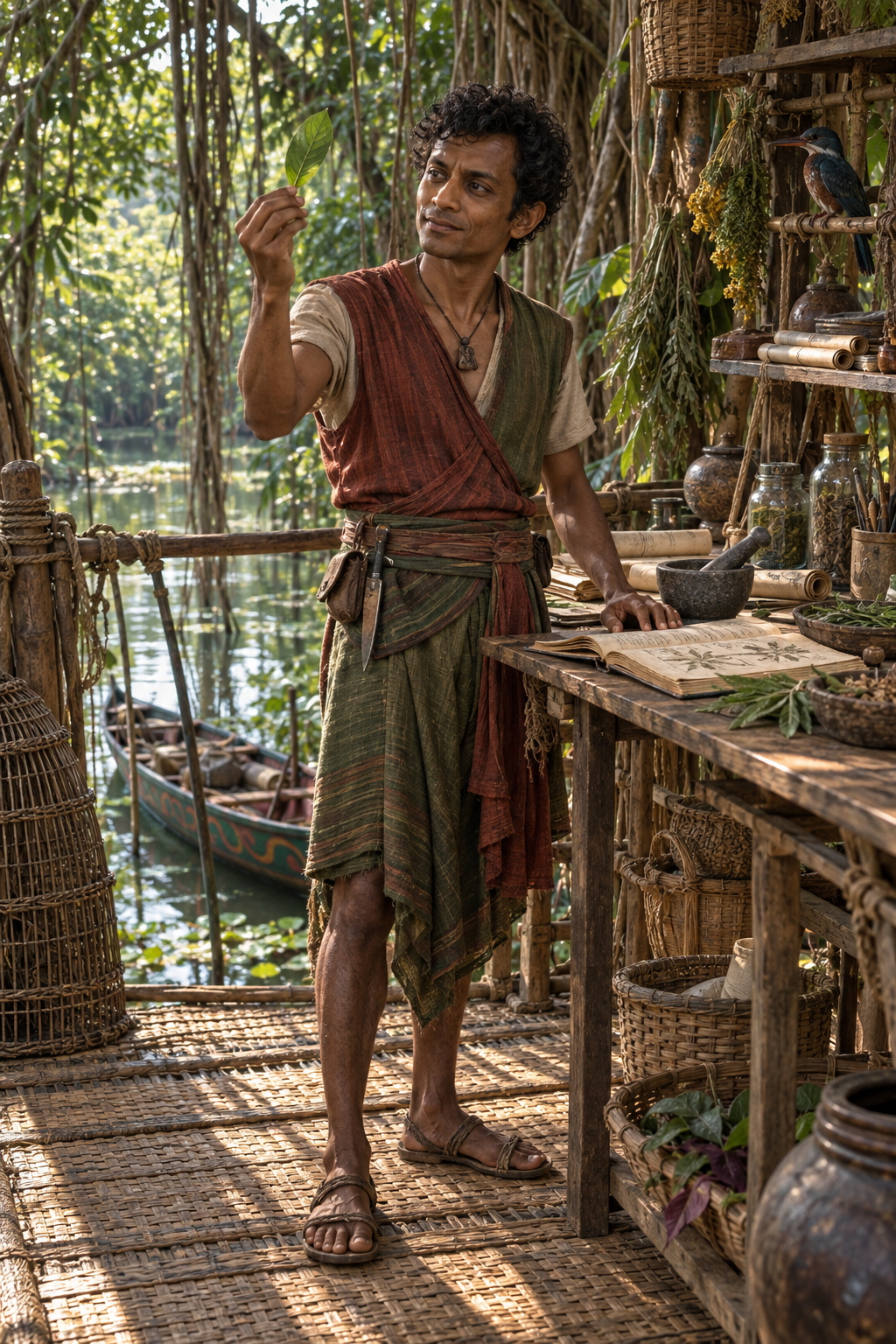
Tiamak is a small, thin, brown-skinned Wranaman, physically unassuming beside drylander knights and particularly tiny beside Isgrimnur or Camaris. He should look adult, attractive, alert, and wiry—not childlike, comic, or racially caricatured. His intelligence lives in attention: the eyes of somebody cataloguing plants, currents, motives, and the thing everyone else dismissed five minutes too early.
His approved healthy Book 1 identity is a handsome man of about thirty-eight with a very small thin-wiry frame, warm deep-brown skin, narrow high-cheeked face, alert dark-brown eyes, short dense black curls, and the wry almost-smile of somebody who has already noticed the flaw in your premise. His banyan workspace surrounds practical scholarship with medicinal leaves, handwritten pages, mortar, herb stores, traps, roots, water, a painted flatboat, and a messenger bird.
The books establish his adult smallness, thin build, brown skin, scholarship, healing, fishing, manuscript work, banyan home, painted flatboat, broken tools, traps, and bird network. Exact age, face, skin shade, eyes, hair, proportions, clothing, pendant, tools, plant species, bird, boat ornament, house layout, and lighting are editorial reconstruction. His visual milestones carry real bodily change: a crocodile tears his leg from knee to heel; fever, the road, ghant captivity, white gelatin, fire, snow, and Sorrow’s cold leave further marks. The finished-book scholar at the Great Table must remain the same man who poled this flatboat through the roots, not a generic robed-wizard makeover.
The Complete Journey
He leaves home to make Wran knowledge portable—and discovers home may be gone
Book 1 · The Dragonbone Chair
A message reaches the scholar everyone remembers only when disaster needs him
Tiamak lives alone above the Wran waterways, revising Sovran Remedies of the Wranna Healers while surviving root soup, rice biscuits, broken equipment, bad traps, and the comedy of a mind with more questions than money. He practices old prayers through affection and habit even when certainty about the gods has thinned.
He was the first person from his village to leave the swamps and study with Aedonite brothers. Drylander students treated him as an amusing savage; people at home treated scholarship as impractical. Morgenes fed and befriended the isolated student, beginning a loyalty that later makes every League summons feel personal. A trained sparrow finally arrives from Erkynland with the Conqueror Star warning and a request tied to Nisses’s lost book. Tiamak looks north because the quietest Book 1 introduction is already carrying part of the answer.
Duty immediately splits. Wran elders give him a Summoning Stick and order him to Nabban to protest rising tribute and the seizure of young Wran sons for service. The League calls him to Kwanitupul. Tiamak chooses his people first, then nearly dies diving after a hooked fish when a crocodile takes his leg. He escapes by knifing its eye, recovers the fish anyway, and wakes into a storm with his grand obligations reduced to blood, hunger, and a flatboat.
Book 2 · Stone of Farewell
Recognition arrives after the people whose approval mattered are dead
Wounded and feverish, Tiamak reaches Pelippa’s Bowl carrying the Summoning Stick, his manuscript, and a mysterious page of Du Svardenvyrd. Isgrimnur brings Dinivan’s golden pendant and the news that makes membership cruelly bittersweet. The League used Tiamak’s herbs, animal studies, and river knowledge for years while offering warm promises instead of equality. He becomes a Scrollbearer only after Morgenes and Dinivan can no longer welcome him.
The inn’s childlike doorkeeper Ceallio is Camaris. When Fire Dancers attack, the old man’s oath survives missing memory and moves his body to save Tiamak. Tiamak recognizes that identity can remain in practice before it returns in language. Geloë later reaches him through the Dream Road; his fragments about the old knight and Nisses’s page help draw separate journeys toward Sesuad’ra.
His route home through the Wran becomes a reckoning with knowledge outsiders call folklore. Tiamak explains Old Sekob, gift-based governance, medicinal plants, ghants, and the difference between marsh-edge settlements and the Wran itself. Village Grove stands abandoned. Ghants capture him, place an ancient Witness shard in his cut hands, and use his mind to translate a patient nonhuman hatred into clicks and visions of endless conquest. Rescue saves his body just before he believes his ka would have been destroyed.
Younger Mogahib dies afterward. Tiamak gives a funeral to a man he did not like, pausing until he finds one honest kindness: Mogahib respected his elders and never stinted when his feast was due. The moment contains Tiamak’s ethic in miniature. Truth need not be flattering to be merciful.
Book 3 · To Green Angel Tower, Part I
The small and quiet man keeps interrupting heroic certainty
At Sesuad’ra, Binabik administers reciprocal oaths to Tiamak and Strangyeard, creating a new League generation. Their mandate is immediate: understand the Great Swords with incomplete manuscripts, dead teachers, contradictory histories, and an enemy who may be shaping the contradictions.
Tiamak never begins imagining himself as the saga’s central hero. He longs for his banyan tree, a Wran wife, children, and a noisy home. That self-description does not make his actions small. During a Norn attack, the injured scholar finds Thorn unexpectedly light, swings it long enough to buy Camaris a heartbeat, and overturns a brazier to raise the camp. Later he sees the political wars as possible mirrors hiding Ineluki’s deeper objective.
When Camaris refuses to reveal Jao é-Tinukai’i’s secret, Tiamak invents the humane compromise: confession to Strangyeard under religious seal, with disclosure limited to relevance for the current threat. The solution protects dignity while answering necessity. It is the opposite of treating vulnerable people as containers that authority may empty at will.
Book 4 · To Green Angel Tower, Part II
He walks into the legend because somebody has to notice the missing stair
Tiamak and Strangyeard recognize that failure to solve the sword pattern is itself evidence. They widen the investigation beyond heroic battles toward ignored people, places, and incidents. When Aditu nearly vanishes on the Dream Road during their inquiry, the cost prevents Sithi knowledge from becoming a convenient answer machine.
Tiamak volunteers to enter Asu’a with the sword party because scholarship must be present where the evidence becomes physical. Inside shifting architecture, he finds the hidden continuation after Camaris disappears upward. In Green Angel Tower he tries to interrupt the brothers’ confrontation; Elias seizes him, burns him with Sorrow’s unnatural cold, and throws him aside.
He survives the collapse, crosses Cadrach’s invisible stair with Miriamele, Binabik, and Simon, and later gives Isgrimnur the account of Josua’s apparent death and the tower escape. After the war, Tiamak completes Sovran Remedies and returns to the rebuilt Hayholt. The book is not a quaint artifact from the marsh. It is the durable form of knowledge his family, drylander scholars, and even the League repeatedly underestimated.
The People Around Him
Recognition matters; reciprocity matters more
Morgenes
Morgenes feeds the isolated student, respects his work, and becomes Tiamak’s emotional route into the League. The kindness matters without excusing the institution’s years of delayed equality.
Father Strangyeard
They become oath-brothers, investigators, drinking companions, and frightened friends. Their partnership refuses the fantasy that one scholar should carry every dangerous answer alone.
Miriamele
She asks sincere questions, respects his privacy, helps rescue him, and names the Wrannamen as political allies. He gives her a Wran seen from inside rather than a swamp arranged for drylander adventure.
Isgrimnur
The duke initially patronizes what he does not understand; Tiamak answers with dry humor and demonstrable competence. Their affection grows through correction instead of requiring either man to become culturally blank.
Camaris
Tiamak sees the oath inside the forgotten knight and later protects the person inside the public symbol. Each man’s vocation survives a crisis of recognition.
The Wran
Home gives him ecology, gods, wounds, ridicule, duty, and the book he spends the series completing. Belonging remains complicated enough to be real.
Why He Works
The intellectual center refuses to dress like one
Tiamak works because expertise is practical, cultural, and embodied. It is knowing how a plant heals, why a crocodile is political, what a funeral owes the disliked dead, how a text traveled, when a confession needs limits, and where a stair should continue even when the architecture says it does not.
His story also refuses inclusion-as-finale. Receiving the pendant does not repair years of extraction. Tiamak becomes important before the League names him and remains Wrannaman after drylanders need him. Completing his book is the stronger institutional victory: Wran knowledge survives in a form that does not depend on elite men remembering to invite its author.
On the Record
Scope, spoilers, and the registry correction
This is Tiamak’s one canonical profile across all four owned Kindle volumes and their completed reading receipts. It is intentionally full-spoiler. His absence from the original 153-record registry was a coverage defect; the corrected canonical count is 154. Franchise and volume directories must filter this one post rather than create duplicate biographies.
Visual state: approved and identity-locked. The same local attachment supplies this post’s featured image, visible hero, social image, and every referring directory card. Future wounded-traveler, ghant-captive, Scrollbearer, Asu’a explorer, tower survivor, and finished-author imagery must preserve this exact adult face, small wiry body, deep-brown complexion, dark eyes, and black curls. Scars, illness, clothing, climate, and status may accumulate; his body may not be enlarged, infantilized, racialized into caricature, or recast.